
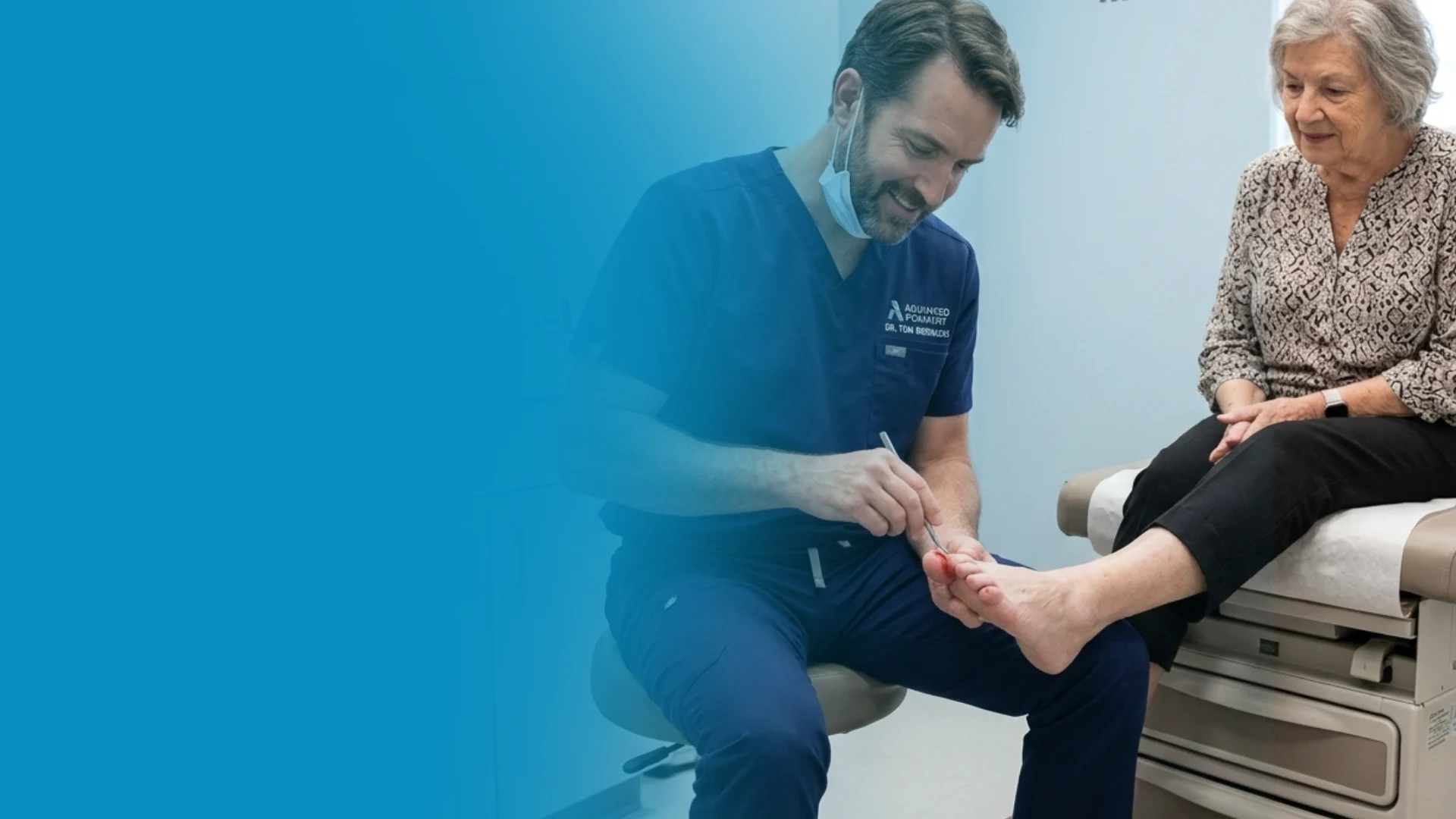
Medically Reviewed by Dr. Tom Biernacki, DPM — Board-Certified Podiatrist, Balance Foot & Ankle Specialists, Michigan. Last updated April 2026.
▶ Watch

What Is an Ingrown Toenail?
Onychocryptosis — the medical term for ingrown toenail — occurs when the lateral or medial edge of a toenail penetrates the surrounding soft tissue (the nail fold), triggering an inflammatory and potentially infectious response. The hallux (great toe) is affected in over 90% of cases, though any digit can be involved. Despite its seemingly minor nature, ingrown toenails are among the most common foot complaints seen in podiatric practice and can cause significant pain, disability, and — particularly in patients with diabetes or peripheral vascular disease — serious wound complications.
Root Causes of Ingrown Toenails
Improper Nail Trimming
The single most common cause is cutting toenails too short, especially when the corners are rounded down rather than cut straight across. This encourages the nail plate to grow into the adjacent sulcus tissue as it elongates.
Nail Plate Shape and Width
Congenital or acquired nail plate curvature — pincer nail deformity — creates a downward-curving nail edge that chronically presses into the nail fold. Wide nail plates relative to the toe width are similarly predisposing. These anatomical factors explain why some patients develop recurrent ingrown toenails despite perfect trimming technique.
Tight or Narrow Footwear
Shoes with a narrow toe box compress the digits, forcing the nail edge laterally into the soft tissue with every step. High heels exacerbate this by driving the foot forward into the toe box. Athletic cleats — particularly soccer cleats with minimal forefoot room — are a frequent culprit in adolescent athletes.
Repetitive Trauma
Running, kicking sports, and activities requiring repeated toe flexion create microtrauma to the nail fold. Stubbing the toe against the shoe during downhill running is a classic mechanism in distance runners.
Subungual Pathology
Subungual exostosis — a bony spur under the nail — pushes the nail plate upward and outward into the sulcus. Fungal nail infection (onychomycosis) thickens and distorts the nail plate, altering its growth direction. Both conditions predispose to ingrown nail development.
Clinical Staging
Podiatrists classify ingrown toenail severity using the Heifetz classification system, which guides treatment selection:
Stage I — Mild
Erythema (redness), edema (swelling), and tenderness along the nail fold. No infection, no drainage. The nail edge is irritating but has not fully penetrated the skin. Conservative treatment is appropriate: proper nail trimming, cotton wisp placement under the nail edge, warm soaks, and wider footwear.
Stage II — Moderate
Infection has developed: purulent drainage, increased swelling, and skin breakdown around the nail edge. The nail has now embedded into the nail fold. In-office partial nail avulsion — removing the offending nail border under local anesthesia — provides rapid relief. Oral antibiotics are typically prescribed.
Stage III — Severe / Chronic
Granulation tissue (hypergranulation, sometimes called proud flesh) has formed alongside the nail edge. The toe is chronically inflamed with recurrent infection cycles. Conservative treatment reliably fails at this stage. Partial nail avulsion combined with permanent nail matrix ablation — chemical matrixectomy using phenol — is the definitive procedure.
In-Office Procedure: Partial Nail Avulsion with Phenol Matrixectomy
This is performed under local digital block anesthesia, typically taking 15–20 minutes. A tourniquet controls bleeding. The offending nail border — approximately 3–5mm — is separated from the underlying nail bed and removed. Phenol (89% concentration) is applied to the exposed nail matrix for 30 seconds, repeated three times with alcohol flush between applications. Phenol chemically destroys the germinative cells in the nail matrix, permanently preventing regrowth of that nail border.
Patients leave walking in a surgical shoe. Healing typically occurs in 3–6 weeks with daily wound care using antiseptic solution. Recurrence rates are approximately 2–4% with proper phenol application technique — dramatically lower than nail avulsion alone.
Alternative: Nail Wedge Resection (Surgical)
For patients with phenol contraindications, or in cases with extensive hypertrophic nail fold tissue, a formal surgical wedge resection removes the nail border, matrix, and excess nail fold tissue as an elliptical excision closed with sutures. This is performed under sterile conditions, often in an ambulatory surgery setting for complex cases.
When Conservative Care Is Appropriate
Stage I ingrown toenails in otherwise healthy patients may resolve with meticulous home care: daily warm soaks, gentle retraction of the nail fold with a cotton wisp, and strict adherence to correct trimming. Gutter splinting — threading a small plastic tube along the nail edge to redirect growth — is effective in early cases, particularly in children who cannot tolerate in-office procedures.
High-Risk Patients Require Early Intervention
Patients with diabetes, peripheral arterial disease, venous insufficiency, or immunosuppression should not attempt home management of ingrown toenails. What presents as a Stage I problem can rapidly progress to cellulitis, osteomyelitis, or limb-threatening infection in these populations. Early podiatric evaluation and definitive treatment is strongly recommended.
Prevention After Treatment
Trim toenails straight across, level with the tip of the toe — never shorter. File sharp corners rather than cutting them. Choose footwear with adequate toe box width and depth. Address fungal nail infections promptly to prevent nail plate distortion. Patients with recurrent ingrown toenails should see a podiatrist annually for professional nail care and monitoring.
Ready to Relieve Your Foot or Ankle Pain?
Board-certified podiatrists serving Southeast Michigan — same-week appointments available.
Insurance Accepted
BCBS · Medicare · Aetna · Cigna · United Healthcare · HAP · Priority Health · Humana · View All →
Howell Office
3980 E Grand River Ave, Suite 140
Howell, MI 48843
Get Directions →
Bloomfield Hills Office
43700 Woodward Ave, Suite 207
Bloomfield Hills, MI 48302
Get Directions →
Your Board-Certified Podiatrists



Ready to Get Back on Your Feet?
Same-week appointments available at both locations.
Book Your AppointmentMore Podiatrist-Recommended Ingrown Essentials
Roomy Walking Shoe
New Balance 990v6 — wide toe box prevents toe jamming that causes ingrowns.
Extra-Depth Diabetic Shoe
Orthofeet Sprint — no pressure on nail edges, seamless lining.
Moisture-Wicking Compression Sock

OS1st FS4 — dry environment reduces ingrown infection risk.
As an Amazon Associate, Balance Foot & Ankle earns from qualifying purchases. Product recommendations are based on clinical experience; prices and availability shown above update live from Amazon.

When to See a Podiatrist
Home care works for early ingrowns — but if redness, drainage, or granulation tissue has developed, the nail edge needs professional removal. At Balance Foot & Ankle, matrixectomy (permanent corner removal) is a 15-minute in-office procedure that prevents recurrence. Most patients walk out the same day and return to normal shoes within 48 hours.
Call Balance Foot & Ankle: (810) 206-1402 · Book online · Offices in Howell & Bloomfield Hills
In Our Clinic
Ingrown toenails are one of the most common same-day visits at our clinic. The patient has usually been soaking in Epsom salts and trying to “dig out” the edge themselves for several days before pain drives them in. If the nail corner is simply curling but the skin isn’t infected, a conservative trim and change in nail-cutting technique resolves it. If the surrounding tissue is red, swollen, or draining, we perform a partial nail avulsion under local anesthetic — this takes about 15 minutes in the office, patients walk out, and the recurrence rate with phenol ablation is very low.
In-Office Treatment at Balance Foot & Ankle
When conservative care isn’t enough, Dr. Tom Biernacki and the team at Balance Foot & Ankle offer advanced, same-day options — including Ingrown Toenail Treatment Michigan at our Howell and Bloomfield Hills clinics.
Same-day appointments available. Call (810) 206-1402 or book online.

Dr. Tom Biernacki, DPM is a double board-certified podiatrist and foot & ankle surgeon at Balance Foot & Ankle Specialists in Southeast Michigan. With over a decade of clinical experience, he specializes in heel pain, bunions, diabetic foot care, sports injuries, and minimally invasive surgery. Dr. Biernacki is a member of the APMA and ACFAS, and his patient education content on MichiganFootDoctors.com and YouTube has reached over one million views.
- Plantar Fasciitis: Diagnosis and Conservative Management (PubMed)
- Plantar Fasciitis (APMA)
- Diagnosis and Treatment of Plantar Fasciitis (PubMed / AAFP)
- Heel Pain (APMA)
Recommended Products from Dr. Tom