
Quick answer: An ingrown toenail happens when the nail edge grows into the surrounding skin, causing pain, redness, and often infection — most commonly on the big toe. Mild cases may settle with proper soaking and footwear, but a nail that is infected, recurring, or very painful needs in-office care. At Balance Foot & Ankle in Howell and Bloomfield Township, we offer same-day relief: a quick, numbed procedure to remove the offending nail border, and a permanent fix (matrixectomy) for nails that keep coming back. Book online or call (810) 206-1402.
Ready to be seen? Book a real appointment time online, 24/7 — Howell or Bloomfield Township. Takes about a minute, 24/7.
★ 4.9-star rated by Michigan patients on Google · Same-week (often same-day) appointments · Most insurance accepted
Ingrown Toenail Treatment in Howell & Bloomfield Township, MI
Ingrown toenails are one of the most common — and most quickly fixable — problems we see. The relief from a simple in-office procedure is dramatic; most patients tell us afterward they wish they’d come in sooner. Here’s how to tell when home care is enough, and when it’s time for a podiatrist.
Symptoms of an ingrown toenail
- Pain and tenderness along one or both sides of the nail
- Redness and swelling around the nail edge
- Warmth, drainage, or pus (signs of infection)
- Overgrown skin (granulation tissue) at the nail border
What causes ingrown toenails?
The most common causes are cutting nails too short or curved (rather than straight across), tight or narrow shoes, trauma to the toe, naturally curved nail shape, and excessive sweating. Genetics play a real role — if your nail shape is prone to it, recurrence is likely without a permanent correction.
Heifetz Classification — Staging Ingrown Toenails

The Heifetz classification (1937, still widely used) divides ingrown toenails into three stages based on clinical severity. Stage assignment determines treatment:
Stage I — Inflammation Without Infection
The nail fold is red, swollen, and tender along the affected nail border. There is no drainage, no purulence, and no granulation tissue. The nail edge has penetrated or is pressing on the lateral fold tissue but has not created a true wound. The skin remains intact.
Treatment: Conservative measures are appropriate and effective at Stage I when applied correctly. See Treatment section below.
Stage II — Infection With Drainage
The nail edge has pierced the skin of the nail fold. There is active purulent or seropurulent drainage from the sulcus. The periungual tissue is more swollen, erythematous, and tender. Stage II represents an early soft tissue infection — the nail fold has become an infected wound with a retained foreign body (the nail edge).
Treatment: Conservative measures are unlikely to succeed because the infecting nail edge cannot be adequately accessed at home. In-office partial nail avulsion under local anesthesia is the standard of care. Antibiotics alone without nail removal do not resolve Stage II ingrown toenails.
Stage III — Granulation Tissue and Chronic Infection
The nail fold is now hypertrophied with exuberant granulation tissue that partially or fully overrides the nail plate. There may be continued drainage, chronic pain, and recurrent infection. The nail may grow into or under the granulation tissue. Stage III typically represents a chronic, longstanding ingrown nail with permanent structural change to the periungual tissue.
Treatment: Partial or total nail avulsion plus definitive matrixectomy (phenolization or Winograd procedure) to prevent recurrence. Granulation tissue debridement is performed concurrently.
Ingrown Toenail vs. Similar Conditions
- Paronychia (non-ingrown-nail type): Infection of the nail fold from a different cause — bacteria entering through a hangnail, nail biting, or cuticle manipulation. Presents similarly to Stage II ingrown nail but without a palpable nail edge penetrating the fold. Treatment: incision and drainage of the paronychia pocket ± antibiotics, without nail avulsion.
- Periungual wart (verruca): HPV infection around the nail fold — presents as a rough, keratotic growth adjacent to or under the nail. May mimic granulation tissue of Stage III ingrown nail. Clinical distinction: warts have a roughened, hyperkeratotic surface; thrombosed capillaries visible as black dots; disrupt skin ridges. Periungual warts need wart-specific treatment (such as cryotherapy), not nail procedures.
- Subungual exostosis: Bony outgrowth from the distal phalanx that pushes up through the nail plate or pushes the nail edge into the fold. Mimics recurrent ingrown nail. Diagnosed on X-ray. Treatment is surgical excision of the exostosis — phenolization alone will not resolve this cause.
- Periungual melanoma: Any dark discoloration or irregular pigmented lesion around the nail fold in an adult warrants biopsy to exclude melanoma before any nail procedure.
Treatment options
1. Conservative care (mild cases)
For an early, non-infected ingrown nail: warm soaks, gentle lifting of the nail edge, roomy footwear, and avoiding “bathroom surgery.” If it doesn’t improve in a few days — or shows any sign of infection — stop and see us.
2. Partial nail avulsion (removing the offending edge)
An in-office, numbed procedure that removes just the ingrown border of the nail. It’s quick, brings immediate relief, and most patients walk out comfortable. This is the typical same-day fix.
3. Permanent correction (matrixectomy)
For nails that keep coming back, we remove the problem border and treat the nail-root cells so that portion of the nail doesn’t regrow. It’s still a quick in-office procedure and is the definitive solution for chronic ingrown toenails.
A caution for diabetic patients
If you have diabetes or poor circulation, do not treat an ingrown or infected toenail at home — even a minor toe infection can escalate quickly. Call us promptly; this is exactly the kind of problem early podiatric care prevents from becoming serious. (See diabetic foot care.)
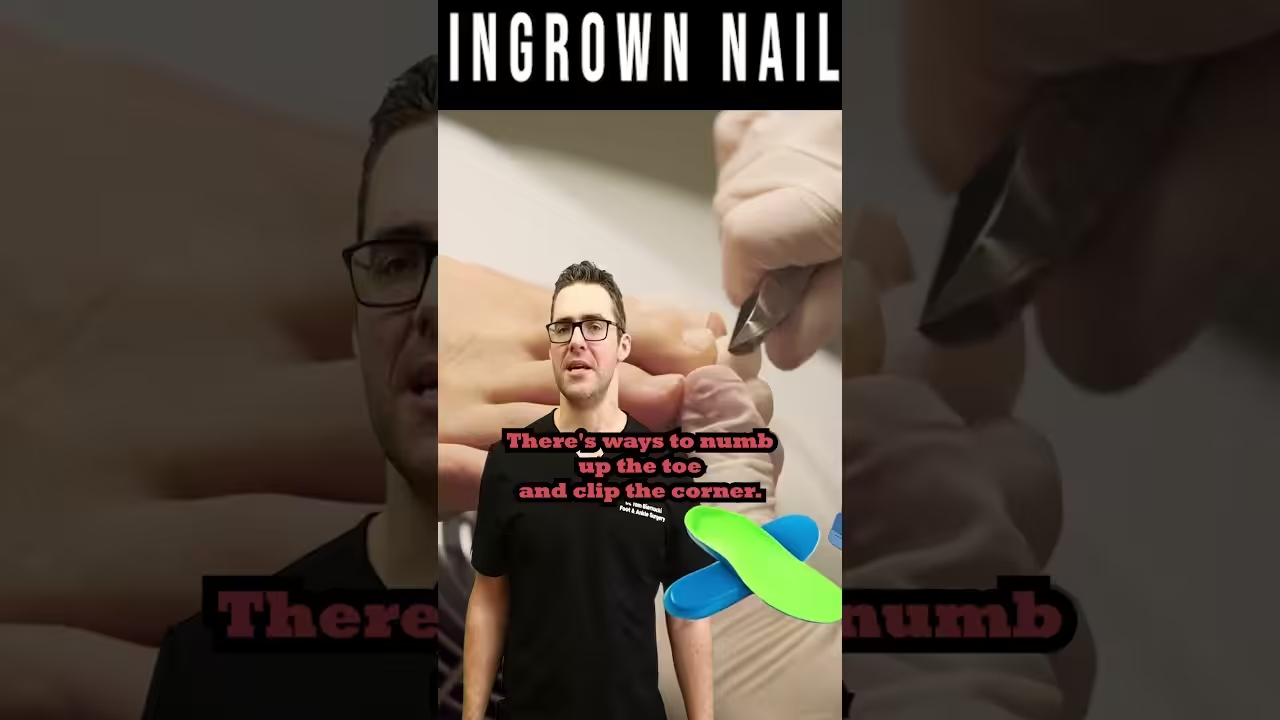
Watch: ingrown toenail removal, explained
Dr. Tom Biernacki on infected ingrown toenail removal, and why the in-office procedure is pain-free (10 min).
Most Common Mistakes Patients Make
- Cutting a “notch” in the center of the nail (the “V-trick”): A widely circulated internet remedy claims that cutting a V-shape in the center of the toenail relieves tension on the nail edges. This has no anatomical or biomechanical basis — nail growth direction is determined by the matrix, not by cuts in the distal nail plate. It does not work and delays appropriate care while the infection advances.
- Expecting antibiotics alone to resolve an ingrown nail infection: Stage II–III ingrown toenail is fundamentally a retained foreign body problem. Antibiotics treat the secondary infection but cannot remove the nail edge — so the infection recurs the moment antibiotics are stopped. The nail must be removed. Repeated antibiotic courses without nail avulsion is the most common reason Stage II ingrown nails become Stage III.
When to see a podiatrist now
Come in promptly if you have signs of infection (pus, spreading redness, warmth), the toe is very painful, the problem keeps recurring, or you have diabetes/circulation issues. Same-week — often same-day — appointments are available.
Throbbing at midnight? You don’t have to wait for the phones to open: online booking is open 24/7, and an ingrown toenail is one of the problems we most often treat same-day once you’re on the schedule.
Go to urgent or emergency care the same day if you notice:
- Redness or red streaks spreading up the foot, or the whole toe becoming hot and swollen — a sign the infection is spreading.
- Fever or chills along with a painful, draining toe.
- Diabetes, neuropathy, or poor circulation together with any infected or ingrown nail — even a minor toe infection can become limb-threatening, so don’t wait.
- A pocket of pus or an abscess, a toe turning dark or blue, or foul-smelling drainage that won’t stop.
Why patients choose Balance Foot & Ankle
Dr. Tom Biernacki, Dr. Carl Jay, and Dr. Daria Gutkin are board-certified and rated 4.9 stars by Michigan patients on Google. We do these procedures every day, with a focus on comfort and getting you out of pain fast — and we offer the permanent fix so you’re not back in three months.
Visit us — two Michigan offices
Balance Foot & Ankle — Howell
4330 E Grand River Ave, Howell, MI 48843
Livingston County · (810) 206-1402
Mon–Fri 9:00 AM–4:30 PM · Free on-site parking
Balance Foot & Ankle — Bloomfield
43494 Woodward Ave #208, Bloomfield Township, MI 48302
Oakland County · (810) 206-1402
Mon–Fri 9:00 AM–4:30 PM · Serving Bloomfield Township, Birmingham, Troy & West Bloomfield
Get same-day ingrown toenail relief →
Recovery after ingrown toenail removal
Recovery is usually quick and comfortable. After a partial nail avulsion or a permanent matrixectomy, we bandage the toe and you can walk out and drive yourself home the same day. Expect only mild soreness for a day or two — most patients manage with over-the-counter pain relief and return to normal activities within a few days. We’ll have you soak and re-dress the toe as directed, keep it clean and dry, and wear roomy shoes for about two weeks while it heals; hold off on swimming and hard exercise until we clear you. When a matrixectomy is done, the treated nail edge will not grow back, so the ingrown problem is solved for good rather than returning months later.
What to expect at your appointment
Your visit is straightforward and, in most cases, same-day, at either our Howell or Bloomfield Township office. We fully numb the toe with a local anesthetic, so the procedure itself is painless — patients are usually surprised how quick and easy it is. Your podiatrist removes the offending nail edge and, for recurring cases, treats the nail root so it cannot come back, then bandages the toe and gives you clear aftercare instructions. The whole appointment typically takes well under an hour and you leave on your own two feet. If you are diabetic or have circulation concerns, please don’t try to dig out an ingrown nail at home — that is exactly how a minor problem becomes a serious infection, and it is a quick fix in our office.
Cost and insurance for ingrown toenail treatment
Ingrown toenail procedures are covered by most insurance plans when medically necessary, and we quote your copay before you come in. Paying without insurance? We post our prices — see ingrown toenail procedure costs and self-pay pricing, or check whether we take your plan.
Frequently asked questions
Where can I get an ingrown toenail removed near me?
Balance Foot & Ankle removes ingrown toenails at two Michigan offices — Bloomfield Township (serving Oakland County) and Howell (serving Livingston County) — often the same week. Our podiatrists numb the toe and remove the ingrown edge in a quick in-office procedure, with a permanent option to stop it coming back. Call (810) 206-1402 to book at the location nearest you.
How do I know if my ingrown toenail is infected?
Signs of infection include pus or drainage, spreading redness, warmth, increasing pain, and overgrown tissue at the nail edge. If you see these — or you have diabetes — see a podiatrist promptly rather than treating it at home.
Can I treat an ingrown toenail myself at home?
An early, non-infected ingrown nail may improve with warm soaks and roomy shoes. Avoid digging at the nail. If there’s any infection, it’s recurring, or you have diabetes/poor circulation, skip home care and come in.
Does ingrown toenail removal hurt?
The toe is numbed first, so the procedure itself is essentially painless. Most patients feel immediate relief afterward, with only mild soreness as the numbing wears off.
Will my ingrown toenail come back after treatment?
Removing just the edge can relieve the current problem, but recurrence is common for curved nails. A matrixectomy (permanent nail-border correction) prevents that section from regrowing and is the definitive fix.
Does Medicare or insurance cover ingrown toenail removal?
Yes — ingrown toenail procedures are typically covered by Medicare and major insurance plans we accept. We verify your benefits and tell you your expected cost up front.
Do I need a referral to have an ingrown toenail treated?
Usually not. Podiatrists are direct-access providers in Michigan, so you can book with us directly. Some HMO plans, such as Blue Care Network, still require a referral for the visit to be covered, so tell us your plan when you book and we will check it.
How much does ingrown toenail removal cost?
Most insurance plans, including Medicare, cover ingrown toenail removal when it is medically necessary, and we check your benefits and tell you your expected cost before the visit. Paying without insurance? A self-pay first visit is one bundled price of $200 total, and it includes the exam, any X-rays and the ingrown toenail procedure. Follow-up visits are $100. See self-pay pricing.
How long does it take to recover from ingrown toenail removal?
Most people walk out, drive home and are back to normal activities within a few days, with mild soreness for a day or two. Keep the toe clean and dressed and wear roomy shoes for about two weeks. Full healing of the nail fold takes about 2 to 6 weeks, and if the nail root was treated, that nail grows back slightly narrower.
When should I see a podiatrist for an ingrown toenail?
Come in if the toe is red, swollen, draining or painful, if you have diabetes or poor circulation, or if the same nail keeps becoming ingrown. Early treatment prevents infection, and a matrixectomy permanently fixes a nail that keeps coming back. Same-day visits are usually available at both offices.
Prefer we call you?
Leave your info and our team calls back within 2 hours, the same business day — to get you scheduled with a board-certified podiatrist at our Howell or Bloomfield Township office. Same-week appointments; most insurance accepted, and we verify your benefits up front.
Clinical sources
- Evaluation of the Recurrence Rate of Ingrown Toenail After a 45-Second Matrix Cauterization With Phenol. Dermatologic Surgery, 2024. PubMed 38954750
- Comparison of Chemical Matricectomy with Trichloroacetic Acid, Phenol, or Sodium Hydroxide for Ingrown Toenails: A Systematic Review and Network Meta-Analysis. PMC9128932
- Long-Term Outcomes of Surgical and Chemical Matricectomy for Ingrown Toenail Management: A Retrospective Study. PMC12090955
Need ingrown toenail removal near me? Our podiatrists perform same-day ingrown toenail removal at our Howell and Bloomfield Township offices, serving Livingston and Oakland County. Most patients are seen quickly — request an appointment here.
Ingrown toenail removal across Metro Detroit & Livingston County: we care for patients from Howell, Brighton, Novi, Bloomfield Township, Birmingham, Troy, Rochester Hills, and Auburn Hills.
Related care: if the goal is thick, discoloured or painful nails trimmed and treated properly rather than cosmetically covered, see our medical pedicure — performed by a podiatrist in Howell and Bloomfield Township, with sterilised instruments and a nail assessment included.
Ingrown toenail questions, answered in detail
- What ingrown toenail surgery costs in Michigan — with and without insurance
- Ingrown toenail urgent care — when the toe is infected and you need to be seen today
- Infected ingrown toenail — what home treatment can and cannot do
- Treating an ingrown toenail without surgery — when conservative care is enough
- Recovery after ingrown toenail removal — shoes, showering, back to work
- Partial toenail removal and matrixectomy — the permanent option when it keeps coming back
- Ingrown toenails in children
- Toenail growing into the skin and curved toenails
- Ingrown nail vs. paronychia — how to tell them apart
- Shoes that reduce pressure on an ingrown nail
- Other toenail problems — a guide to causes and treatments
Book ingrown toenail removal in Howell or Bloomfield Township
Most ingrown toenails are treated and resolved in a single visit. Same-week appointments are usually available at both offices, and no referral is needed.
- Howell — 4330 E Grand River Ave, Howell, MI 48843 · book online · office details and directions
- Bloomfield Township — 43494 Woodward Ave #208, Bloomfield Township, MI 48302 · book online · office details and directions
Prefer to call? (810) 206-1402. If the toe is draining pus, you have a fever, or you have diabetes or poor circulation, tell us when you call and we will get you in sooner.
If the toe is already infected — pus, spreading redness, fever, or red streaking up the foot — that is an urgent problem, not a routine one. Our guide to seeing an emergency podiatrist explains what we can treat the same day and which signs mean the emergency room instead.