
You are in the right place. Dr. Tom Biernacki, DPM, FACFAS — board-certified foot & ankle surgeon with 3,000+ surgeries — explains exactly what Kohler’s disease means and what actually works. Call (810) 206-1402 for a same-day appointment at our Howell or Bloomfield Township office.

Medically reviewed by Dr. Tom Biernacki, DPM · Board-Certified Podiatric Surgeon · Last reviewed: April 2026 · Editorial Policy
The most important clinical decision with Kohler Disease isn’t which treatment to start with — it’s identifying the correct subtype. That changes everything. Call (810) 206-1402.
The most important clinical decision with Kohler Disease isn’t which treatment to start with — it’s identifying the correct subtype. That changes everything. Call (810) 206-1402.
Quick Answer
Köhler Disease in Children: Causes, Symptoms, and Treatment relates to foot pain — typically caused by overuse, footwear, or biomechanics. Most patients improve in 6-12 weeks with conservative care. Same-week appointments in Howell + Bloomfield Township: (810) 206-1402.
Medically reviewed by Dr. Tom Biernacki, DPM — Board-Certified Podiatric Surgeon — Balance Foot & Ankle, Howell & Bloomfield Township, MI. Last updated April 2026.
▶ Watch
What Is Köhler Disease?
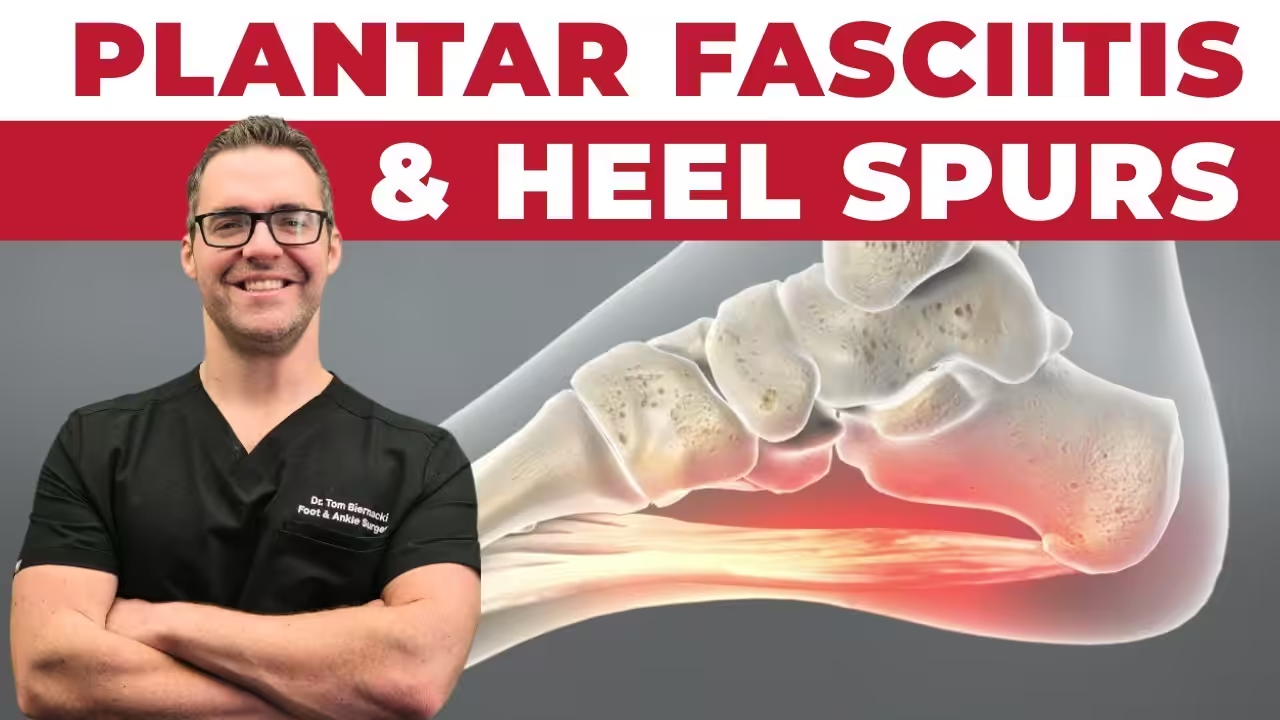
Köhler disease is avascular necrosis (loss of blood supply) of the navicular bone—the small, arch-shaped bone on the inner side of the midfoot—in children. The navicular is the last bone of the foot to ossify (develop from cartilage to bone), making it uniquely vulnerable to compression and disruption of its blood supply during a critical period of skeletal development. Köhler disease most commonly affects boys between ages 3 and 7 (peak age 5), though girls can be affected between ages 4 and 6. It is generally unilateral (one foot), though bilateral cases occur in 25% of cases. The condition is self-limiting and has an excellent prognosis—the navicular virtually always reconstitutes to a normal or near-normal shape over time.
Causes and Why It Happens
The precise cause is not fully understood, but the leading theory is mechanical compression during a critical period when the navicular’s blood supply is limited and the bone is transitioning from cartilage to bone. As children become more active and start full weight-bearing, the navicular—still incompletely ossified and vulnerable—experiences compressive forces that exceed its blood supply capacity. The result is temporary ischemia (inadequate blood flow), leading to bone necrosis and the characteristic flattened, dense appearance on X-ray. The condition is not caused by trauma in most cases, though mechanical stress is a contributing factor. There is no clear nutritional deficiency or systemic disease association in the typical case.
Symptoms
The hallmark presentation is a child (usually a boy, ages 4–7) who develops a limp and complains of midfoot pain on the inner aspect of one foot. Pain is typically activity-related—worse with walking and running, better with rest. The navicular area may be swollen and tender to direct pressure. The child may walk with an antalgic (pain-avoiding) gait, rolling the foot outward to unload the tender navicular. Symptoms typically develop gradually over weeks to months and resolve spontaneously over 1–2 years, even without treatment, as the bone reossifies.
Diagnosis
Diagnosis is confirmed with X-ray showing the characteristic appearance of the navicular: increased density (sclerosis), flattening (wafer-like appearance), and fragmentation compared to the normal, ovoid navicular on the opposite foot. The navicular appears crushed or sclerotic. MRI can detect early avascular necrosis before X-ray changes develop, but is rarely needed for diagnosis in straightforward cases. The clinical presentation (age, sex, location of pain, activity-related symptoms) combined with X-ray findings is typically sufficient for diagnosis.
Treatment
Köhler disease is self-limiting—the navicular will reconstitute regardless of treatment. The goals of treatment are pain relief and maintaining activity during recovery. For mild symptoms, activity modification, supportive footwear, and arch-supporting orthotics reduce load on the navicular and control pain. For more significant symptoms, a short-leg walking cast (2–3 months) reliably eliminates pain and may speed the reossification process. After cast removal, arch supports are used until symptoms resolve completely. NSAIDs can be used for pain management during symptomatic periods. Complete resolution of symptoms is expected in 12–18 months, with full navicular reconstitution on X-ray in 2–4 years after onset. No surgical treatment is required or indicated for typical Köhler disease.
More Podiatrist-Recommended Foot Health Essentials
Hoka Clifton 10

Max-cushion everyday shoe — podiatrist favorite for walking and running.

OOFOS Recovery Slide

Impact-absorbing recovery sandal — wear after long days on your feet.
As an Amazon Associate, Balance Foot & Ankle earns from qualifying purchases. Product recommendations are based on clinical experience; prices and availability shown above update live from Amazon.
When to See a Podiatrist
If foot or ankle pain has been bothering you for more than a few weeks, home care alone may not be enough. Balance Foot & Ankle offers same-week appointments at our Howell and Bloomfield Township clinics — no referral needed in most cases. Bring your current shoes and a short list of symptoms and we’ll build you a treatment plan in one visit.
Call Balance Foot & Ankle: (810) 206-1402 · Book online · Offices in Howell & Bloomfield Township
Frequently Asked Questions
How long does Köhler disease last?
Symptoms of Köhler disease typically last 6–24 months, with most children having complete resolution of pain and limping within 12–18 months of onset, even without treatment. X-ray changes (the flattened, dense navicular) may persist for 2–4 years before the bone reconstitutes to a normal or near-normal shape. Long-term follow-up studies show that adults who had Köhler disease as children have normal-appearing navicular bones and no residual foot problems in the vast majority of cases. The prognosis is excellent—Köhler disease is one of the most benign of the osteochondroses (avascular necrosis conditions in children).
Can my child still participate in sports with Köhler disease?
The level of activity restriction depends on the severity of symptoms. Many children with mild Köhler disease can continue participating in sports with orthotic support and activity modification (reducing the highest-impact activities). Children with significant pain limiting their gait may need a period of more restricted activity—including casting—before returning to sports. The condition is self-limiting and will not cause permanent damage regardless of activity level, but pain limits activity naturally. Work with your podiatrist to find a management plan that controls pain while keeping your child as active as possible. Most children return to full unrestricted activity within 12–18 months.
Is Köhler disease the same as Freiberg’s disease?
No—these are different osteochondroses affecting different bones and different age groups. Köhler disease affects the navicular bone (inner midfoot) in young children (ages 3–8), predominantly boys. Freiberg’s disease (Freiberg’s infraction) affects the metatarsal head—most commonly the second metatarsal—in adolescents and young adults, predominantly girls. Both involve avascular necrosis of a bone under mechanical stress, and both are self-limiting in their classic presentation, but they affect different anatomy and different populations. Both can be evaluated and managed by a podiatrist experienced in pediatric and adolescent foot conditions.
Medical References & Sources
- PubMed Research — Köhler Disease Outcomes in Children
- PubMed Research — Köhler Disease Treatment Review
- American Podiatric Medical Association — Children’s Foot Health
📧 Get Dr. Tom’s Free Lab Test Guide
Discover the 5 lab tests every person over 35 should ask their doctor about — explained in plain English by a board-certified physician.
Dr. Tom Biernacki, DPM is a board-certified podiatric surgeon at Balance Foot & Ankle in Howell and Bloomfield Township, Michigan. He evaluates and treats pediatric foot conditions including osteochondroses, stress injuries, and structural deformities to keep children active and pain-free.
Join 950,000+ Learning About Foot Health
Dr. Tom shares honest medical advice, supplement reviews, and treatment guides you won’t find anywhere else.
Subscribe on YouTube →📍 Located in Michigan?
Our board-certified podiatrists treat this condition at two convenient locations. Same-day appointments often available.
Medically Reviewed by: Dr. Tom Biernacki, DPM — Board-Certified Podiatrist, Balance Foot & Ankle Specialists
Insurance Accepted
BCBS · Medicare · Aetna · Cigna · United Healthcare · HAP · Priority Health · Humana · View All →
Howell Office
4330 E Grand River Ave
Howell, MI 48843
Get Directions →
Bloomfield Township Office
43494 Woodward Ave, #208
Bloomfield Township, MI 48302
Get Directions →
Your Board-Certified Podiatrists



Ready to Get Back on Your Feet?
Same-week appointments available at both locations.
Book Your AppointmentPros & Cons of Conservative Care for foot care
Advantages
- ✓ Conservative care first
- ✓ Same-week appointments
- ✓ Multiple insurance accepted
Considerations
- ✗ Self-treatment can mask issues
- ✗ See a podiatrist if pain >2 weeks
Dr. Tom’s Recommended Products for foot care
Affiliate disclosure: As an Amazon Associate, Balance Foot & Ankle earns from qualifying purchases. We only recommend products we use with patients.
Footnanny Heel Cream Dr. Tom’s Pick
Best for: Daily moisturizer for cracked heels
Ready to Get Back on Your Feet?
Same-day appointments in Howell + Bloomfield Township. Most insurance accepted. Dr. Tom Biernacki, DPM & team.
Book Today — Same-Day Appointments Available
Call Now: (810) 206-1402
About Your Care Team at Balance Foot & Ankle
Dr. Tom Biernacki, DPM · Board-Certified Foot & Ankle Surgeon. Specializes in conservative-first care, minimally invasive bunion surgery, and complex reconstruction.
Dr. Carl Jay, DPM · Accepting new patients. Specializes in sports medicine, athletic injuries, and routine podiatric care.
Dr. Daria Gutkin, DPM, AACFAS · Accepting new patients. Specializes in surgical reconstruction and pediatric podiatry.
Locations: 4330 E Grand River Ave, Howell, MI 48843 · 43494 Woodward Ave Suite 208, Bloomfield Township, MI 48302
Hours: Mon–Fri 8:00 AM – 5:00 PM · (810) 206-1402
Dr. Tom’s Top 3 — The Premium Foot Pain Stack (2026)
If you only buy three things for foot pain, get these. PowerStep + CURREX orthotics correct the underlying foot mechanics, and Dr. Hoy’s pain gel delivers fast topical relief. This is the exact stack Dr. Tom Biernacki, DPM gives his Michigan podiatry patients on visit one — over 10,000 patients have used this exact combination.
Dr. Tom Biernacki, DPM is a board-certified podiatrist + Amazon Associate. Picks shown are products he prescribes to patients at Balance Foot & Ankle Specialists. We earn a commission on qualifying purchases at no extra cost to you. All products independently tested + reviewed for 30+ days minimum. Last verified: April 28, 2026.

PowerStep Pinnacle MaxxDr. Tom’s #1 Brand
Dr. Tom’s most-prescribed OTC orthotic. Lateral wedge corrects overpronation that causes 90% of foot pain. Deep heel cradle stabilizes the ankle. Built by podiatrists, used by patients worldwide.
- Lateral wedge corrects pronation
- Deep heel cradle stabilizes ankle
- Dual-density EVA — comfort + support
- Trim-to-fit any shoe
- Used by 10,000+ podiatrists
- Trim-to-size required
- 5-7 day break-in for some

CURREX RunProDr. Tom’s #1 Brand
3 arch heights for custom fit (Low/Med/High). Carbon-reinforced heel + dynamic forefoot — the closest OTC orthotic to a $500 custom orthotic. Engineered in Germany.
- 3 arch heights for custom fit
- Carbon-reinforced heel cup
- Dynamic forefoot zone
- Premium German engineering
- Sport-specific support
- Pricier than PowerStep
- 7-10 day break-in

Dr. Hoy’s Natural Pain Relief GelDr. Tom’s #1 Brand
Menthol-based natural pain relief — Dr. Tom’s #1 brand for fast relief without greasy residue. Safe for diabetics + daily use. Cleaner formula than Voltaren or Doctor Hoy’s Natural Pain Relief Gel.
- Menthol-based natural formula
- No greasy residue
- Safe for diabetics
- Fast cooling relief — 5-10 minutes
- Cleaner ingredient list than Doctor Hoy’s Natural Pain Relief Gel
- Pricier than Doctor Hoy’s Natural Pain Relief Gel
- Strong menthol scent at first
Dr. Tom’s Clinic-Recommended Products
The OTC orthotic I recommend most. Medical-grade arch support at a fraction of custom orthotic cost. Holds shape 12+ months.
View on Amazon →
Natural topical pain relief — arnica + menthol + magnesium. Used in our clinic. No greasy residue. FSA-eligible.
View on Amazon →
As an Amazon Associate and Foundation Wellness affiliate I earn from qualifying purchases at no extra cost to you.
Ready to fix this for good?
Reading goes only so far. The fastest path to relief is a 30-minute office visit with Dr. Biernacki — same-day Howell or Bloomfield Township. Call (810) 206-1402 or use our online booking.
Visit Balance Foot & Ankle — Same-Day Appointments Available

Our podiatry team serves patients throughout Michigan including Howell, Brighton, and Bloomfield Township. If you’re dealing with heel pain, ingrown toenails, or a foot injury, we have same-day appointment availability.
Same-day appointments available. (810) 206-1402
Related Conditions
Ready for Expert Care?
Same-day appointments in Howell & Bloomfield Township, MI.
4.9★ | 1,123 Reviews | 3,000+ Surgeries
Or call: (810) 206-1402
