
Medically reviewed by Dr. Tom Biernacki, DPM · Board-Certified Podiatric Surgeon · Last reviewed: April 2026 · Editorial Policy
Quick Answer
Lisfranc Injury — Midfoot Fracture-Dislocation Michiga relates to foot/ankle injury — typically caused by trauma or twist. Most patients improve in 4-8 weeks with conservative care. Same-week appointments in Howell + Bloomfield Twp: (810) 206-1402.

Medically reviewed by Dr. Tom Biernacki, DPM — Board-Certified Podiatric Surgeon — Balance Foot & Ankle, Howell & Bloomfield Hills, MI. Last updated April 2026.
Treatment at Balance Foot & Ankle: Foot Emergency Guide →
▶ Watch

👟 Dr. Tom Also Recommends
Podiatrist Recommended Shoes 2026: Dr. Tom’s Top Picks for Every Condition
The right footwear can make or break your recovery. Dr. Tom’s complete guide to the best shoes for plantar fasciitis, flat feet, neuropathy, bunions & more — with clinical picks for every foot type.
See Dr. Tom’s Top Shoe Picks →Medically Reviewed by Dr. Tom Biernacki, DPM — Board-Certified Podiatrist, Balance Foot & Ankle Specialists, Michigan. Last updated April 2026.
What Is a Lisfranc Injury?
A Lisfranc injury is a fracture, dislocation, or ligamentous disruption of the tarsometatarsal (TMT) joint complex — the junction between the midfoot bones (cuneiforms and cuboid) and the metatarsal bases. These injuries range from subtle ligament sprains to complex fracture-dislocations with significant displacement. They are one of the most frequently missed serious foot injuries in emergency medicine — approximately 20–40% of Lisfranc injuries are initially misdiagnosed as “foot sprains,” leading to delayed treatment and permanent midfoot instability. At Balance Foot & Ankle in Howell and Bloomfield Hills, Michigan, Dr. Tom Biernacki, DPM accurately diagnoses and manages Lisfranc injuries. Call (810) 206-1402.
How Lisfranc Injuries Happen
Lisfranc injuries occur through two mechanisms: high-energy trauma (motor vehicle accidents, industrial crush injuries — produces complex fracture-dislocations requiring surgery) and low-energy indirect mechanisms (stepping in a hole while running, a football cleat catching the turf, a horse-riding fall with foot in stirrup — produces subtle ligamentous injuries that are easily missed). In our clinic, the most diagnostically challenging cases are the low-energy indirect injuries — a runner who “twisted” their foot, X-rays show no obvious fracture, and they’re sent home with “foot sprain.” The key is recognizing the mechanism and ordering weight-bearing X-rays or MRI.
The Diagnostic Keys — Why Routine X-Rays Miss Lisfranc Injuries
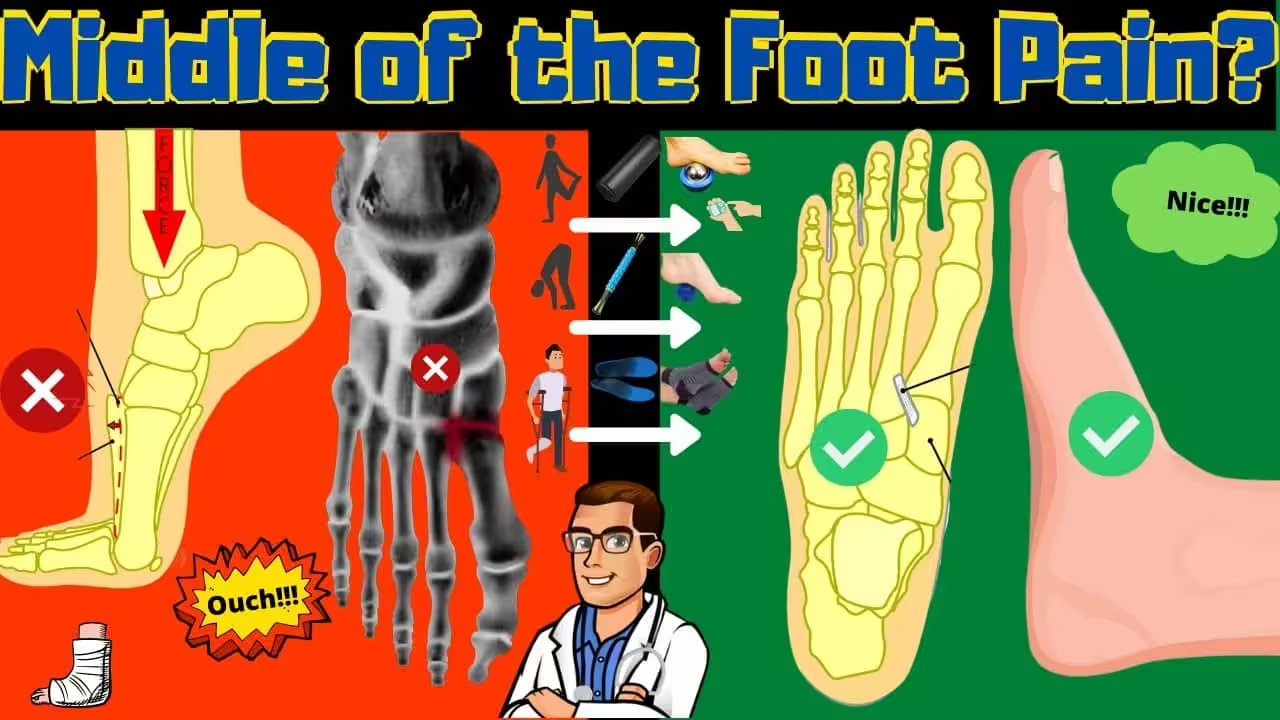
Non-weight-bearing ankle and foot X-rays taken in the ER frequently appear normal in subtle Lisfranc injuries. The critical diagnostic view is a weight-bearing AP X-ray of the foot — the compressive force of weight-bearing opens the midfoot instability that’s invisible at rest. The classic radiographic sign: >2mm widening between the first and second metatarsal bases, or loss of alignment between the medial border of the second metatarsal and the medial border of the intermediate cuneiform. When X-ray is equivocal, MRI is the gold standard for identifying the degree of ligamentous disruption. CT scan is used for surgical planning in confirmed injuries.
Classification and Treatment Decision
Lisfranc injuries are classified as stable (intact Lisfranc ligament, no displacement — rare) or unstable (disrupted ligament ± fracture, with displacement on stress views). Stable injuries without displacement can be treated conservatively with strict non-weight-bearing for 6–8 weeks in a cast or CAM boot, followed by gradual weight-bearing at 8–10 weeks. Unstable injuries with any displacement (>2mm on weight-bearing X-ray) require surgical stabilization — either open reduction and internal fixation (ORIF) with screws/plates, or primary arthrodesis (fusion) for injuries with significant articular damage. Attempting to treat an unstable Lisfranc injury conservatively leads to progressive midfoot collapse, early arthritis, and a poor functional outcome.
Recovery Timeline
Conservative treatment: 6–8 weeks non-weight-bearing, 8–10 weeks partial weight-bearing in a boot, return to light activity at 4–6 months. Surgical treatment (ORIF): non-weight-bearing 8–10 weeks, gradual return to weight-bearing 10–14 weeks, return to sport 6–9 months. Hardware removal is typically performed at 3–4 months post-operatively (screws crossing the mobile TMT joints need removal to prevent breakage during return to activity). Primary arthrodesis cases: longer fusion healing time, 4–6 months before full activity.
Long-Term Outcomes and Post-Traumatic Arthritis
Even with optimal treatment, post-traumatic midfoot arthritis develops in a significant proportion of Lisfranc injuries — particularly those that were displaced, involved significant articular comminution, or were treated with delay. Symptoms include: midfoot aching with prolonged activity; loss of arch height over time; and pain specifically at the TMT joints. Management options include custom orthotics with a rigid arch extension, rocker-bottom shoe modifications, cortisone injections, and ultimately TMT arthrodesis for refractory cases. Early accurate diagnosis and treatment produces the best long-term outcomes.
Red Flags — Don’t Miss a Lisfranc
Seek urgent evaluation for: midfoot pain and swelling after any significant foot twisting mechanism, even if “X-rays were negative”; inability to bear weight after a midfoot injury; bruising specifically on the plantar (bottom) surface of the midfoot — plantar ecchymosis is pathognomonic for Lisfranc injury; or pain specifically at the TMT joints (between the midfoot and metatarsals). A “negative X-ray” does not rule out a Lisfranc injury — request weight-bearing views or MRI.
Lisfranc Injury Evaluation in Howell & Bloomfield Hills Michigan
Dr. Tom Biernacki, DPM provides accurate midfoot injury evaluation at Balance Foot & Ankle — including weight-bearing X-ray, diagnostic ultrasound, and MRI coordination. Serving Howell, Brighton, Bloomfield Hills, Troy, Auburn Hills, and all Southeast Michigan. Book urgent evaluation online or call (810) 206-1402.
👟 Dr. Tom’s Pick: CURREX RunPro Insoles for Runners
📍 Located in Michigan?
Our board-certified podiatrists treat this condition at two convenient locations. Same-day appointments often available.
CURREX RunPro are biomechanically tuned running insoles with 3 arch profiles (low, medium, high) to match your foot type. Unlike generic insoles, they’re engineered specifically for the high-impact demands of running — reducing pronation stress and metatarsal loading.
View CURREX RunPro on Amazon →📧 Get Dr. Tom’s Free Lab Test Guide
Discover the 5 lab tests every person over 35 should ask their doctor about — explained in plain English by a board-certified physician.
Affiliate disclosure: As an Amazon Associate, Balance Foot & Ankle earns from qualifying purchases.
Join 950,000+ Learning About Foot Health
Dr. Tom shares honest medical advice, supplement reviews, and treatment guides you won’t find anywhere else.
Subscribe on YouTube →
Insurance Accepted
BCBS · Medicare · Aetna · Cigna · United Healthcare · HAP · Priority Health · Humana · View All →
Howell Office
3980 E Grand River Ave, Suite 140
Howell, MI 48843
Get Directions →
Bloomfield Hills Office
43700 Woodward Ave, Suite 207
Bloomfield Hills, MI 48302
Get Directions →
Your Board-Certified Podiatrists



Ready to Get Back on Your Feet?
Same-week appointments available at both locations.
Book Your AppointmentMore Podiatrist-Recommended Foot Health Essentials
Hoka Clifton 10

Max-cushion everyday shoe — podiatrist favorite for walking and running.
PowerStep Pinnacle Insole

- The Pinnacle Full length insoles for men & women provide maximum cushioning, from high activity to moderate support. The PowerStep arch support shape provides stability to the foot and ankle, helping to relieve foot pain.
- When you spend all day on your feet, every step counts. PowerStep insoles are a podiatrist-recommended orthotic to help relieve & prevent foot pain related to athletes, runners, Plantar Fasciitis, heel spurs & other common foot, ankle & knee injuries
- The Pinnacle plantar fasciitis insoles offer superior heel cushioning and arch support. The dual-layer cushioning is designed to reduce stress and fatigue, while PowerStep premium arch support is designed for plantar fasciitis relief.
- The PowerStep Pinnacle arch support inserts for men & women can be worn in a variety of shoe types such as; athletic, walking, running, work & some casual shoes. Orthotic Inserts are ordered by shoe size, no trimming required.
- Made in the USA & backed by a 30-day money-back guarantee. PowerStep orthotic inserts for men & women are designed for shoes where the factory insole can be removed. HSA & FSA Eligible
The podiatrist-recommended over-the-counter orthotic.
OOFOS Recovery Slide

- The Original Recovery Footwear.
- Finding Your Size - For your perfect fit, consult the “size chart” link above. Wear a half size? In general, we recommend that women who wear a ½ size size UP, and men who wear a ½ size size DOWN
- OOahh - An evolution of the OOriginal, the OOahh slide features our proven foundation of OOfoam technology + patented footbed design with a slide-style strap that has become a best-seller in the OOFOS line
- OOfoam Technology - Our revolutionary OOfoam technology absorbs 37% more impact than traditional footwear foams to reduce the stress on your feet, joints & back. Plus, the closed-cell foam is machine washable and designed to minimize odor
- Patented Footbed - Our patented footbed cradles and supports arches to reduce energy exertion in the ankles by up to 47% compared to competitors’ footwear. So walking is easier. Recovery is faster. And yOO feel better
Impact-absorbing recovery sandal — wear after long days on your feet.
As an Amazon Associate, Balance Foot & Ankle earns from qualifying purchases. Product recommendations are based on clinical experience; prices and availability shown above update live from Amazon.
When to See a Podiatrist
If foot or ankle pain has been bothering you for more than a few weeks, home care alone may not be enough. Balance Foot & Ankle offers same-week appointments at our Howell and Bloomfield Hills clinics — no referral needed in most cases. Bring your current shoes and a short list of symptoms and we’ll build you a treatment plan in one visit.
Call Balance Foot & Ankle: (810) 206-1402 · Book online · Offices in Howell & Bloomfield Hills
Differential Diagnosis: What Else Could It Be?
Not every case of lisfranc (midfoot) injury is straightforward. In our clinic we routinely rule out three look-alike conditions before confirming the diagnosis. If your symptoms don’t match the classic presentation, one of these may explain the pain — which is why physical exam matters more than self-diagnosis.
| Condition | How It Differs |
|---|---|
| Midfoot sprain | No diastasis on X-ray; able to bear weight after initial pain. |
| Navicular stress fracture | Dorsal midfoot pain with impact loading; stress fx confirmed on MRI. |
| Cuboid syndrome | Lateral midfoot pain, often following ankle inversion; relieved by cuboid whip. |
Red Flags — When to See a Podiatrist Now
Seek same-day evaluation at Balance Foot & Ankle if you notice any of the following:
- Pain out of proportion to injury severity
- Plantar bruising across the arch (classic Lisfranc sign)
- Inability to bear weight for >24 hours
- Widening of tarsometatarsal joints on weight-bearing X-ray
Call (810) 206-1402 or request an appointment. Our Howell and Bloomfield Hills offices reserve same-day slots for urgent foot and ankle issues.
In Our Clinic: What We See
Clinical perspective from Dr. Tom Biernacki, DPM — Balance Foot & Ankle, Howell & Bloomfield Hills, MI:
Lisfranc injury is the most-missed foot injury in primary care and emergency rooms. Patients walk in weeks after a misstep complaining of midfoot pain that never resolves. In our clinic the first clue is often the bruising pattern — plantar bruising across the arch is pathognomonic. Weight-bearing X-rays comparing both feet reveal the widening that non-weight-bearing films miss. Non-displaced Lisfranc sprains can heal in a boot; any displacement requires surgery. Dr. Biernacki has handled dozens of missed Lisfranc injuries and always comments: if a midfoot sprain isn’t significantly better at 3 weeks, get weight-bearing films — don’t wait.
In-Office Treatment at Balance Foot & Ankle
When conservative care isn’t enough, Dr. Tom Biernacki and the team at Balance Foot & Ankle offer advanced, same-day options — including Foot & Ankle Fracture Repair Michigan at our Howell and Bloomfield Hills clinics.
Same-day appointments available. Call (810) 206-1402 or book online.
Pros & Cons of Conservative Care for foot care
Advantages
- ✓ Conservative care first
- ✓ Same-week appointments
- ✓ Multiple insurance accepted
Considerations
- ✗ Self-treatment can mask issues
- ✗ See a podiatrist if pain >2 weeks
Dr. Tom’s Recommended Products for foot care
Affiliate disclosure: As an Amazon Associate, Balance Foot & Ankle earns from qualifying purchases. We only recommend products we use with patients.


Footnanny Heel Cream Dr. Tom’s Pick
Best for: Daily moisturizer for cracked heels
Ready to Get Back on Your Feet?
Same-day appointments in Howell + Bloomfield Twp. Most insurance accepted. Dr. Tom Biernacki, DPM & team.
Book Today — Same-Day Appointments Available
Call Now: (810) 206-1402
About Your Care Team at Balance Foot & Ankle
Dr. Tom Biernacki, DPM · Board-Certified Foot & Ankle Surgeon. Specializes in conservative-first care, minimally invasive bunion surgery, and complex reconstruction.
Dr. Carl Jay, DPM · Accepting new patients. Specializes in sports medicine, athletic injuries, and routine podiatric care.
Dr. Daria Gutkin, DPM, AACFAS · Accepting new patients. Specializes in surgical reconstruction and pediatric podiatry.
Locations: 4330 E Grand River Ave, Howell, MI 48843 · 43494 Woodward Ave Suite 208, Bloomfield Twp, MI 48302
Hours: Mon–Fri 8:00 AM – 5:00 PM · (810) 206-1402

Dr. Tom Biernacki, DPM is a double board-certified podiatrist and foot & ankle surgeon at Balance Foot & Ankle Specialists in Southeast Michigan. With over a decade of clinical experience, he specializes in heel pain, bunions, diabetic foot care, sports injuries, and minimally invasive surgery. Dr. Biernacki is a member of the APMA and ACFAS, and his patient education content on MichiganFootDoctors.com and YouTube has reached over one million views.
- Plantar Fasciitis: Diagnosis and Conservative Management (PubMed)
- Plantar Fasciitis (APMA)
- Diagnosis and Treatment of Plantar Fasciitis (PubMed / AAFP)
- Heel Pain (APMA)