
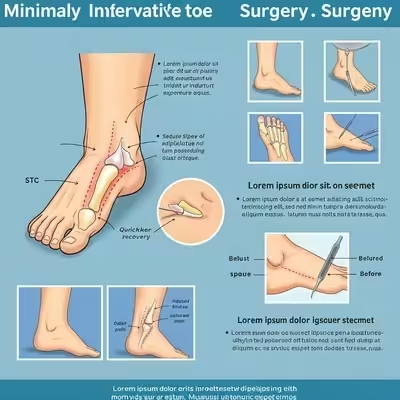
Quick answer: Minimally Invasive Foot Surgery Percutaneous Techniques Overview is a common foot/ankle topic that affects many patients. Effective treatment starts with a targeted diagnosis, conservative-first treatment, and escalation only when needed. We treat this regularly at our Howell and Bloomfield Hills practices. Call (810) 206-1402.
Medically reviewed by Dr. Tom Biernacki, DPM · Board-Certified Podiatric Surgeon · Last reviewed: April 2026 · Editorial Policy
The most important clinical decision with Minimally Invasive Foot Surgery Percutaneous Techniques Overview isn’t which treatment to start with — it’s identifying the correct subtype. That changes everything. Call (810) 206-1402.
Quick Answer
Minimally Invasive Foot Surgery: Percutaneous Techniques and relates to foot pain — typically caused by overuse, footwear, or biomechanics. Most patients improve in 6-12 weeks with conservative care. Same-week appointments in Howell + Bloomfield Hills: (810) 206-1402.

Medically reviewed by Dr. Tom Biernacki, DPM — Board-Certified Podiatric Surgeon — Balance Foot & Ankle, Howell & Bloomfield Hills, MI. Last updated April 2026.
▶ Watch
Medically Reviewed by Dr. Tom Biernacki, DPM — Board-Certified Podiatrist, Balance Foot & Ankle Specialists, Michigan. Last updated April 2026.
Minimally invasive foot surgery (MIS) — also termed percutaneous foot surgery — has undergone a significant renaissance over the past decade, driven by improved instrumentation, surgeon training programs, and a growing evidence base demonstrating outcomes comparable to traditional open techniques with meaningful advantages in incision size, soft tissue disruption, and recovery. For properly selected patients, MIS bunion and hammertoe correction represents a paradigm shift in foot surgical care — transitioning procedures that previously required weeks of non-weight-bearing to surgeries that allow immediate protected weight-bearing in a surgical sandal.
Principles of Minimally Invasive Bone Surgery
MIS foot surgery uses 2–3mm stab incisions through which burrs, chisels, and rasps are introduced under continuous fluoroscopic (X-ray) guidance to perform osteotomies (bone cuts), resections, and corrections without open dissection or large incisions. The key instrumentation is a motorized Shannon burr, which oscillates (rather than rotates) to cut bone with precision while minimizing heat generation and soft tissue injury. Fluoroscopic guidance is mandatory — the surgeon operates by feel and real-time X-ray imaging rather than direct visualization, requiring dedicated training for competency. The advantages of MIS are substantial in appropriate cases: minimal scarring, reduced post-operative swelling, lower infection risk (the primary portal of bacterial entry is the incision), faster return to regular footwear, and the ability to address multiple procedures through several small incisions simultaneously.
MIS Bunion Correction: MICA and MIBO Techniques
The Minimally Invasive Chevron Akin (MICA) procedure has become the most widely studied MIS bunion technique. Through two 2–3mm incisions, a distal metatarsal chevron osteotomy is performed with fluoroscopic guidance, the metatarsal head is translated laterally to correct the intermetatarsal angle, and fixation is achieved with 1–2 headless compression screws placed percutaneously. A concurrent Akin osteotomy (proximal phalangeal closing wedge) corrects residual hallux valgus interphalangeus. Multiple prospective studies, including comparative trials against open chevron osteotomy, demonstrate MICA produces equivalent radiographic correction and patient-reported outcomes with lower wound complication rates, less post-operative swelling, and earlier return to regular shoes. Immediate partial weight-bearing in a surgical sandal is the standard post-operative protocol for most MIS bunion procedures. MIS bunion correction is not equivalent to all open procedures — patients with severe bunion deformity, hypermobile first tarsometatarsal joint (requiring Lapidus/Lapiplasty fusion), or prior failed bunion surgery are generally better served by established open techniques.
MIS Hammertoe Correction and Plantar Fascia Release
Percutaneous flexor tenotomy for flexible hammertoes and claw toes is perhaps the simplest MIS foot procedure — a 2mm stab incision and blind tenotomy blade release of the flexor tendon under the toe, performed in the office under local anesthetic with immediate return to activity. More complex MIS hammertoe correction through percutaneous diaphyseal osteotomy (DMMO — distal metatarsal metaphyseal osteotomy) addresses metatarsalgia by shortening the relevant metatarsal through a single 3mm dorsal incision. Endoscopic plantar fasciotomy (EPF) and percutaneous plantar fascia release are also well-established MIS techniques for refractory plantar fasciitis, releasing the medial band of the plantar fascia through minimal incisions with direct or fluoroscopic visualization. Dr. Biernacki at Balance Foot & Ankle offers minimally invasive foot surgery for appropriate candidates alongside the full range of open reconstructive procedures, selecting the optimal technique for each patient’s specific deformity and goals. Call (810) 206-1402 for a surgical consultation.
📧 Get Dr. Tom’s Free Lab Test Guide
Discover the 5 lab tests every person over 35 should ask their doctor about — explained in plain English by a board-certified physician.
📍 Located in Michigan?
Our board-certified podiatrists treat this condition at two convenient locations. Same-day appointments often available.
Insurance Accepted
BCBS · Medicare · Aetna · Cigna · United Healthcare · HAP · Priority Health · Humana · View All →
Howell Office
4330 E Grand River Ave
Howell, MI 48843
Get Directions →
Bloomfield Hills Office
43494 Woodward Ave, #208
Bloomfield Hills, MI 48302
Get Directions →
Your Board-Certified Podiatrists



Ready to Get Back on Your Feet?
Same-week appointments available at both locations.
Book Your AppointmentMore Podiatrist-Recommended Surgery Essentials
OOFOS Recovery Slide


Post-op approved — impact-absorbing slide for early recovery.
HOKA Ora 3 Recovery Slide
Max-cushion recovery sandal — comfort for post-surgical swelling.
Hoka Bondi 9
Max-cushion walking shoe — ease into return-to-walking post-surgery.
As an Amazon Associate, Balance Foot & Ankle earns from qualifying purchases. Product recommendations are based on clinical experience; prices and availability shown above update live from Amazon.

When to See a Podiatrist
Foot and ankle surgery in 2026 is dramatically different than a decade ago — most procedures are now minimally-invasive, outpatient, and allow weight-bearing within days. Balance Foot & Ankle surgeons have performed 3,000+ foot/ankle surgeries with modern techniques. If another surgeon has recommended a traditional open procedure, a second opinion may reveal a faster, less-invasive option.
Call Balance Foot & Ankle: (810) 206-1402 · Book online · Offices in Howell & Bloomfield Hills
Pros & Cons of Conservative Care for foot care
Advantages
- ✓ Conservative care first
- ✓ Same-week appointments
- ✓ Multiple insurance accepted
Considerations
- ✗ Self-treatment can mask issues
- ✗ See a podiatrist if pain >2 weeks
Dr. Tom’s Recommended Products for foot care
Affiliate disclosure: As an Amazon Associate, Balance Foot & Ankle earns from qualifying purchases. We only recommend products we use with patients.
Footnanny Heel Cream Dr. Tom’s Pick
Best for: Daily moisturizer for cracked heels
Ready to Get Back on Your Feet?
Same-day appointments in Howell + Bloomfield Hills. Most insurance accepted. Dr. Tom Biernacki, DPM & team.
Book Today — Same-Day Appointments Available
Call Now: (810) 206-1402
About Your Care Team at Balance Foot & Ankle
Dr. Tom Biernacki, DPM · Board-Certified Foot & Ankle Surgeon. Specializes in conservative-first care, minimally invasive bunion surgery, and complex reconstruction.
Dr. Carl Jay, DPM · Accepting new patients. Specializes in sports medicine, athletic injuries, and routine podiatric care.
Dr. Daria Gutkin, DPM, AACFAS · Accepting new patients. Specializes in surgical reconstruction and pediatric podiatry.
Locations: 4330 E Grand River Ave, Howell, MI 48843 · 43494 Woodward Ave Suite 208, Bloomfield Hills, MI 48302
Hours: Mon–Fri 8:00 AM – 5:00 PM · (810) 206-1402
In-Office Treatment at Balance Foot & Ankle
If home treatment isn’t providing relief for your foot and ankle conditions, our podiatry team at Balance Foot & Ankle can help with same-day evaluations and advanced in-office care.
Same-day appointments available. (810) 206-1402
Doctor Hoy’s Natural Pain Relief Gel
Natural topical pain relief I use in our clinic. Arnica + camphor formula — apply directly to the area 3–4x daily. ($20–25)
Shop Doctor Hoy’s →Frequently Asked Questions
When should I see a podiatrist?
If symptoms persist past 2 weeks, affect your normal activity, or are accompanied by red-flag symptoms (warmth, redness, swelling, inability to bear weight).
What does treatment cost?
Most diagnostic visits and conservative treatments are covered by Medicare and major insurers. Out-of-pocket costs vary by your specific plan.
How quickly can I get an appointment?
Most non-urgent cases see us within 5 business days. Urgent cases (sudden pain, possible fracture) typically same or next business day.
Ready for Expert Care?
Same-day appointments in Howell & Bloomfield Hills, MI.
4.9★ | 1,123 Reviews | 3,000+ Surgeries
Or call: (810) 206-1402

Dr. Tom Biernacki, DPM is a board-certified foot & ankle surgeon (ABFAS & ABPM) at Balance Foot & Ankle Specialists in Southeast Michigan. With over a decade of clinical experience, he specializes in heel pain, bunions, diabetic foot care, sports injuries, and minimally invasive surgery. Dr. Biernacki is a member of the APMA and ACFAS, and his patient education content on MichiganFootDoctors.com and YouTube has made him one of the most-followed foot & ankle educators on YouTube.