
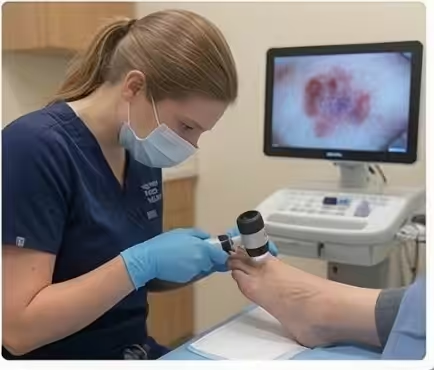
Quick answer: Osteochondral Lesion Talus Ankle Cartilage Damage 2 is a common foot/ankle topic that affects many patients. The 2026 evidence-based approach combines proper diagnosis, conservative-first treatment, and escalation only when needed. We treat this regularly at our Howell and Bloomfield Township practices. Call (810) 206-1402.
What Is an Osteochondral Lesion of the Talus?
Medically Reviewed by Dr. Tom Biernacki, DPM — Board-Certified Podiatrist, Balance Foot & Ankle Specialists, Michigan. Last updated April 2026.
An osteochondral lesion of the talus (OLT) — also called a talar dome lesion, osteochondritis dissecans, or transchondral fracture — is an injury involving both the articular cartilage surface of the talus (ankle bone) and the underlying subchondral bone. When this cartilage-bone unit is damaged, the affected area can become unstable, fragment, or develop into a defect that causes persistent ankle pain, swelling, and mechanical symptoms such as clicking and locking.
OLTs are a significant clinical problem because they often develop after ankle sprains that appear to have healed — patients experience persistent ankle pain and swelling months after the initial injury and are told the sprain should be better by now. The OLT, undiagnosed on initial X-rays, explains the persistent symptoms. At Balance Foot & Ankle, our foot and ankle specialists have extensive experience identifying and treating OLTs that have been missed or undertreated elsewhere.
Causes and Mechanism of OLT
The vast majority of OLTs — approximately 70 to 80 percent — follow traumatic events, most commonly ankle sprains and ankle fractures. During an inversion sprain, the talus impacts and rotates against the fibula and tibia, compressing and shearing the articular cartilage on the talar dome. The medial talar dome is compressed in a plantarflexion mechanism; the lateral dome is impacted in a dorsiflexion-inversion mechanism. This explains why medial and lateral OLTs have slightly different shapes and behaviors.
The remaining 20 to 30 percent of OLTs are idiopathic — developing without identifiable trauma. These may represent avascular necrosis of a portion of the talar dome from impaired blood supply, genetic predisposition, or repetitive microtrauma below the threshold of recognized acute injury. Bilateral OLTs are more common in the idiopathic group.
Symptoms
OLT presents as persistent deep ankle pain localized to the talar dome region — pain that is worse with activity, particularly walking on uneven surfaces, climbing stairs, and cutting movements. Swelling that persists or recurs after activity is characteristic. Catching, clicking, or locking sensations occur when unstable cartilage fragments become pinched in the joint during movement. Giving way (a sensation of the ankle suddenly losing support) may occur.
The critical distinguishing feature from simple ankle sprain is chronicity and disproportionality — pain and swelling that persist well beyond the expected 4 to 8 week recovery period for an ankle sprain without adequate improvement suggest intra-articular pathology including OLT.
Diagnosis
OLTs are frequently missed on plain X-rays — studies estimate that 40 to 50 percent of OLTs are not visible on initial plain radiographs. When X-ray findings are present, they appear as a lucent (dark) defect on the talar dome with or without a bone fragment. Suspicion based on clinical findings should prompt advanced imaging even with normal X-rays.
MRI is the imaging study of choice for OLT evaluation. It reveals the cartilage integrity, the size and depth of the lesion, the presence of subchondral edema (bone bruising) suggesting instability, and whether the overlying cartilage surface is intact or displaced. MRI classification of OLT directly guides treatment decisions — stable lesions with intact cartilage may be managed conservatively; displaced or unstable lesions typically require surgery.
CT scan provides detailed assessment of the bony architecture of the lesion — particularly valuable for surgical planning when the lesion location, depth, and cyst formation need precise characterization. Weight-bearing CT offers three-dimensional assessment of the lesion in a functional position.
Conservative Treatment
Small, stable OLTs with intact overlying cartilage — particularly those in younger patients with good healing potential — may be managed non-operatively with immobilization, activity restriction, and protected weight bearing. The goal is allowing spontaneous healing of the subchondral bone while protecting the cartilage surface from further damage.
Non-operative treatment involves 6 to 12 weeks of protected weight bearing in a cast or boot, followed by gradual return to activity. Success rates for conservative management in carefully selected stable lesions range from 45 to 60 percent — meaning a meaningful proportion of conservatively managed OLTs ultimately require surgery when symptoms persist.
Surgical Treatment Options
Surgical treatment is indicated for unstable OLTs, displaced or cystic lesions, and stable lesions that fail conservative management. Multiple techniques exist, chosen based on lesion size, location, depth, and patient age and activity demands.
Bone marrow stimulation — including microfracture and drilling — is the most commonly performed technique for primary OLT treatment and is generally performed arthroscopically. The unstable cartilage is debrided, the underlying bone is perforated with a microfracture awl or drill to create channels through the subchondral plate, and blood from the bone marrow fills the defect with a fibrin clot that matures into fibrocartilage. Outcomes are generally good for lesions smaller than 1.5 cm in diameter. For larger lesions, fibrocartilage provides inferior biomechanical properties compared to hyaline cartilage and outcomes deteriorate with lesion size.
Osteochondral autograft transfer (OATS) harvests small cylindrical plugs of bone and cartilage from a non-weight-bearing area of the knee and transplants them into the talar defect. The transplanted hyaline cartilage provides superior tissue quality compared to fibrocartilage from microfracture, achieving better outcomes for medium-sized lesions (1.5 to 2.5 cm). Donor site morbidity at the knee harvest site is a consideration, though typically minor.
Autologous chondrocyte implantation (ACI) and matrix-induced ACI (MACI) are two-stage procedures in which cartilage cells are harvested, grown in culture, and reimplanted into the defect. These procedures are indicated for large lesions or failed prior treatment. They achieve excellent cartilage quality but require two surgical procedures and lengthy rehabilitation.
BioCartilage augmentation uses a dehydrated cartilage matrix mixed with platelet-rich plasma and packed into the microfracture defect, providing a scaffold to enhance the quality of tissue filling the defect beyond simple fibrocartilage. It is used adjunctively with microfracture for medium-sized lesions as a single-stage procedure.
If you have persistent ankle pain after a sprain that has not improved as expected, contact Balance Foot & Ankle for evaluation. We provide comprehensive ankle assessment and individualized treatment planning for OLTs throughout Southeast Michigan, with same-week appointments available.
Ready to Relieve Your Foot Pain?
Board-certified podiatrists serving Southeast Michigan. Same-week appointments available.
Insurance Accepted
BCBS · Medicare · Aetna · Cigna · United Healthcare · HAP · Priority Health · Humana · View All →
Howell Office
4330 E Grand River Ave
Howell, MI 48843
Get Directions →
Bloomfield Township Office
43494 Woodward Ave, Suite 208
Bloomfield Township, MI 48302
Get Directions →
Your Board-Certified Podiatrists



Ready to Get Back on Your Feet?
Same-week appointments available at both locations.
More Podiatrist-Recommended Arthritis Essentials
Cushioned Running Shoe


Hoka Clifton 10 — max cushioning reduces joint impact for arthritic feet.
Wide Walking Shoe
New Balance 990v6 — wide toe box accommodates arthritic first-MTP (hallux rigidus).

As an Amazon Associate, Balance Foot & Ankle earns from qualifying purchases. Product recommendations are based on clinical experience; prices and availability shown above update live from Amazon.
When to See a Podiatrist
Foot and ankle arthritis progresses silently — cartilage doesn’t regrow, but joint fusion, cheilectomy, and biologic injections can restore function at every stage. Balance Foot & Ankle offers the full arthritis spectrum: bracing, injections, and reconstructive surgery. Start with a consult so we can image the joint and give you a realistic 5-year outlook.
Call Balance Foot & Ankle: (810) 206-1402 · Book online · Offices in Howell & Bloomfield Township
In-Office Treatment at Balance Foot & Ankle
If home treatment isn’t providing relief for your foot and ankle injuries, our podiatry team at Balance Foot & Ankle can help with same-day evaluations and advanced in-office care.
Same-day appointments available. (810) 206-1402
Doctor Hoy’s Natural Pain Relief Gel
Natural topical pain relief I use in our clinic. Arnica + camphor formula — apply directly to the area 3–4x daily. ($20–25)

Dr. Tom Biernacki, DPM is a board-certified foot & ankle surgeon (ABFAS & ABPM) at Balance Foot & Ankle Specialists in Southeast Michigan. With over a decade of clinical experience, he specializes in heel pain, bunions, diabetic foot care, sports injuries, and minimally invasive surgery. Dr. Biernacki is a member of the APMA and ACFAS, and his patient education content on MichiganFootDoctors.com and YouTube has made him one of the most-followed foot & ankle educators on YouTube.