
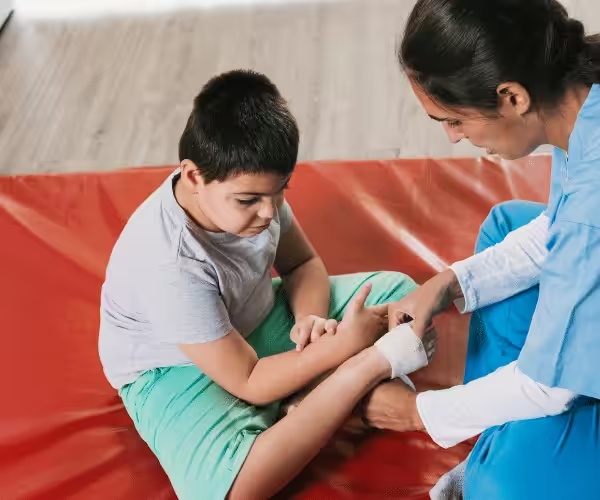

Most pediatric in-toeing and out-toeing resolves on its own as children grow — but persistent gait deviations or those causing tripping/pain warrant evaluation for tibial torsion, femoral anteversion, or skeletal dysplasia.
You’re in the right place. Dr. Tom Biernacki, DPM, FACFAS — board-certified foot & ankle surgeon with 3,000+ surgeries — explains exactly what pediatric in-toeing and out-toeing means and what works. Call (810) 206-1402 for same-day appointment at Howell or Bloomfield Township.
Quick answer: Pediatric Foot Conditions In Toeing Out Toeing is a clinical condition that responds to evidence-based treatment when caught early. Symptoms include pain, swelling, and altered function. Diagnosis requires clinical exam, often imaging. Treatment ladder: conservative care first (4-6 weeks), then targeted interventions if needed. Call (810) 206-1402.
Medically reviewed by Dr. Tom Biernacki, DPM · Board-Certified Podiatric Surgeon · Last reviewed: April 2026 · Editorial Policy
The most important clinical decision with Pediatric Foot Conditions In Toeing Out Toeing isn’t which treatment to start with — it’s identifying the correct subtype. That changes everything. Call (810) 206-1402.
Quick Answer
Pediatric Foot Conditions: In-Toeing, Out-Toeing, and When t relates to toe deformity — typically caused by imbalanced muscles + footwear. Most patients improve in depends on severity with conservative care. Same-week appointments in Howell + Bloomfield Township: (810) 206-1402.
Medically reviewed by Dr. Tom Biernacki, DPM — Board-Certified Podiatric Surgeon — Balance Foot & Ankle, Howell & Bloomfield Township, MI. Last updated April 2026.
▶ Watch
Medically Reviewed by Dr. Tom Biernacki, DPM — Board-Certified Podiatrist, Balance Foot & Ankle Specialists, Michigan. Last updated April 2026.
Parents regularly bring children to podiatry appointments concerned about the way their child walks — toes pointing inward (in-toeing) or outward (out-toeing), flat feet, toe walking, or limping. Most pediatric gait variants are physiological developmental patterns that resolve spontaneously without intervention. The podiatrist’s role is to distinguish normal developmental variation from pathological conditions requiring treatment, provide reassurance when appropriate, and identify the rare cases needing orthopedic referral, casting, or surgical intervention.
In-Toeing (Pigeon Toes)
In-toeing in children has three anatomic causes at different levels of the lower extremity. Metatarsus adductus (forefoot adduction with normal hindfoot — the “banana-shaped” foot) is present at birth from intrauterine positioning. Mild-to-moderate metatarsus adductus resolves spontaneously in 90% of cases by 18 months; severe rigid cases with inability to passively correct the forefoot to neutral require serial casting in the first 6 months of life. Internal tibial torsion — medial twisting of the tibial shaft — is the most common cause of in-toeing in toddlers (ages 1–3). It resolves spontaneously with normal walking development and requires no treatment. Femoral anteversion — excessive medial rotation of the femoral neck — causes in-toeing in school-age children (ages 4–8) and is diagnosed by the characteristic “W-sitting” preference. It self-corrects in 99% of cases by late childhood.
Out-Toeing
Out-toeing is more commonly pathological than in-toeing and warrants more careful evaluation. Physiological external tibial torsion normalizes by age 5–6. Persistent out-toeing beyond age 8, or out-toeing associated with pain, limping, or asymmetry, requires evaluation for slipped capital femoral epiphysis (SCFE — urgent hip X-ray), Legg-Calve-Perthes disease, hip dysplasia, or tarsal coalition. Calcaneovalgus foot (neonatal flexible dorsiflexed/everted foot from intrauterine positioning) resolves completely with gentle parental stretching in 2–3 months — no treatment needed.
Pediatric Flatfoot
Flexible flatfoot in children — low arch during weight-bearing that reconstitutes during non-weight-bearing — is physiological until age 6–8 when the arch typically develops. Pre-school children uniformly have flat feet due to ligamentous laxity and fat pad filling the arch. Arch development is complete by age 8–10 in most children. Flatfoot requiring evaluation includes: rigid flatfoot (fixed deformity without arch formation even non-weight-bearing — evaluate for tarsal coalition or vertical talus), unilateral flatfoot, symptomatic flatfoot with pain or limitation, and flatfoot associated with neurological symptoms or muscle weakness.
Toe Walking
Habitual toe walking (idiopathic toe walking) affects approximately 5% of children and is a diagnosis of exclusion after ruling out autism spectrum disorder, cerebral palsy, Duchenne muscular dystrophy, limb length discrepancy, and Achilles contracture. Idiopathic toe walking is managed with serial casting, Botulinum toxin injection (Botox) to the gastrocnemius, physical therapy gastrocnemius stretching, and AFO night splinting. Surgical gastrocnemius recession or Achilles tendon lengthening is reserved for cases with fixed ankle equinus that fails conservative management.
Pediatric Foot Care at Balance Foot & Ankle
Dr. Biernacki at Balance Foot & Ankle evaluates pediatric foot conditions with a developmental context-appropriate examination, weight-bearing gait observation, and radiographic assessment when indicated. Most pediatric gait variants are benign and self-resolving — the goal of evaluation is accurate reassurance when appropriate and early intervention when pathology is identified. Call (810) 206-1402 for a pediatric foot evaluation.
Concerned About Your Child’s Feet or Gait?
Serving Southeast Michigan from Bloomfield Township and Howell.
📞 (810) 206-1402 |
📧 Get Dr. Tom’s Free Lab Test Guide
Discover the 5 lab tests every person over 35 should ask their doctor about — explained in plain English by a board-certified physician.
📍 Located in Michigan?
Our board-certified podiatrists treat this condition at two convenient locations. Same-day appointments often available.
Insurance Accepted
BCBS · Medicare · Aetna · Cigna · United Healthcare · HAP · Priority Health · Humana · View All →
Howell Office
4330 E Grand River Ave
Howell, MI 48843
Get Directions →
Bloomfield Township Office
43494 Woodward Ave, #208
Bloomfield Township, MI 48302
Get Directions →
Your Board-Certified Podiatrists



Ready to Get Back on Your Feet?
Same-week appointments available at both locations.
Book Your AppointmentWatch: Dr. Tom explains
Podiatrist-recommended products
As an Amazon Associate, Dr. Tom earns from qualifying purchases.
Gentle support during development.
View on Amazon →Selected cases of persistent in-toeing.
View on Amazon →Topical if older child has pain.
View on Amazon →Post-activity symptom control.
View on Amazon →Related resources
Ready to solve this? Book today.
Same-week appointments · Howell & Bloomfield Township · 4.9★ (1,123+ reviews)
☎ (810) 206-1402Book Online →More Podiatrist-Recommended Pediatric Essentials
Hoka Clifton 10

Watch: Pediatric Heel Pain in Children **The Cause Will Shock You!** — MichiganFootDoctors YouTube
Max-cushion everyday shoe — podiatrist favorite for walking and running.

OOFOS Recovery Slide

Impact-absorbing recovery sandal — wear after long days on your feet.
As an Amazon Associate, Balance Foot & Ankle earns from qualifying purchases. Product recommendations are based on clinical experience; prices and availability shown above update live from Amazon.
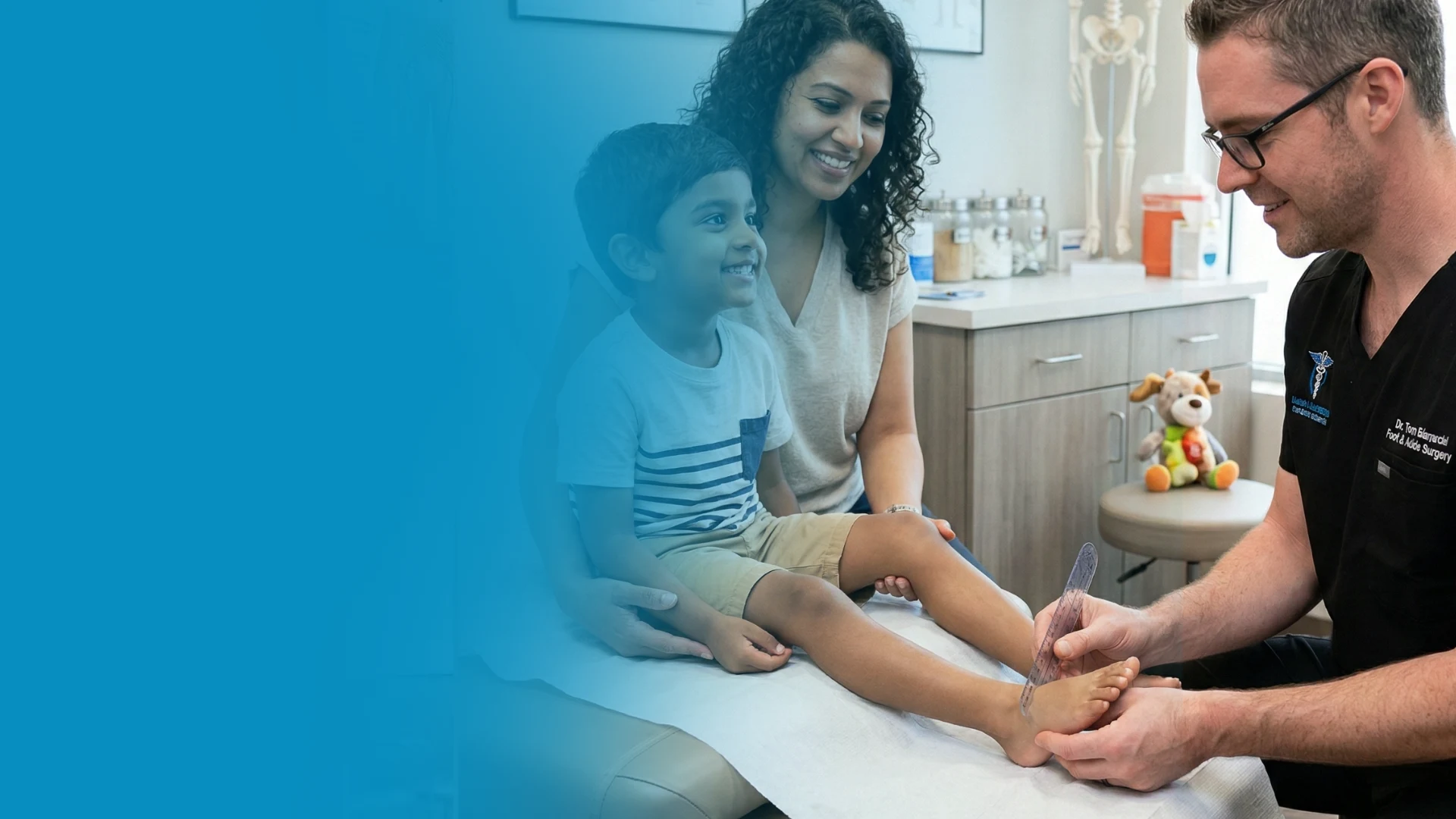
When to See a Podiatrist
Children’s foot pain is never normal — flat feet, in-toeing, heel pain (Sever’s disease), and curly toes all have effective non-surgical treatments when caught early. Balance Foot & Ankle evaluates pediatric patients with gentle, age-appropriate exams and parent-friendly treatment plans. Most pediatric issues resolve with the right inserts and guided activity modification.
Call Balance Foot & Ankle: (810) 206-1402 · Book online · Offices in Howell & Bloomfield Township
In-Office Treatment at Balance Foot & Ankle
When conservative care isn’t enough, Dr. Tom Biernacki and the team at Balance Foot & Ankle offer advanced, same-day options — including Pediatric Foot Care in Michigan at our Howell and Bloomfield Township clinics.
Same-day appointments available. Call (810) 206-1402 or book online.
Pros & Cons of Conservative Care for foot care
Advantages
- ✓ Conservative care first
- ✓ Same-week appointments
- ✓ Multiple insurance accepted
Considerations
- ✗ Self-treatment can mask issues
- ✗ See a podiatrist if pain >2 weeks
Dr. Tom’s Recommended Products for foot care
Affiliate disclosure: As an Amazon Associate, Balance Foot & Ankle earns from qualifying purchases. We only recommend products we use with patients.
Footnanny Heel Cream Dr. Tom’s Pick
Best for: Daily moisturizer for cracked heels
Ready to Get Back on Your Feet?
Same-day appointments in Howell + Bloomfield Township. Most insurance accepted. Dr. Tom Biernacki, DPM & team.
Book Today — Same-Day Appointments Available
Call Now: (810) 206-1402
About Your Care Team at Balance Foot & Ankle
Dr. Tom Biernacki, DPM · Board-Certified Foot & Ankle Surgeon. Specializes in conservative-first care, minimally invasive bunion surgery, and complex reconstruction.
Dr. Carl Jay, DPM · Accepting new patients. Specializes in sports medicine, athletic injuries, and routine podiatric care.
Dr. Daria Gutkin, DPM, AACFAS · Accepting new patients. Specializes in surgical reconstruction and pediatric podiatry.
Locations: 4330 E Grand River Ave, Howell, MI 48843 · 43494 Woodward Ave Suite 208, Bloomfield Township, MI 48302
Hours: Mon–Fri 8:00 AM – 5:00 PM · (810) 206-1402
Frequently Asked Questions
What causes this condition?
Causes include mechanical stress, biomechanical imbalance, age-related changes, and sometimes systemic disease. Our clinical exam plus imaging identifies the specific driver.
Can it go away on its own?
Mild cases sometimes resolve with rest and supportive footwear. Persistent symptoms past 4-6 weeks rarely resolve without active treatment.
Is surgery required?
Most patients resolve with non-surgical care. Surgery is reserved for refractory cases or structural deformity.
In-Office Treatment at Balance Foot & Ankle
If home treatment isn’t providing relief for your foot and ankle conditions, our podiatry team at Balance Foot & Ankle can help with same-day evaluations and advanced in-office care.
Same-day appointments available. (810) 206-1402
Get Expert Care at Balance Foot & Ankle
Same-week appointments at our Howell and Bloomfield Township offices. Board-certified podiatric surgeons. Most insurance accepted.
Ready for Expert Care?
Same-day appointments in Howell & Bloomfield Township, MI.
4.9★ | 1,123 Reviews | 3,000+ Surgeries
Or call: (810) 206-1402

Dr. Tom Biernacki, DPM is a board-certified foot & ankle surgeon (ABFAS & ABPM) at Balance Foot & Ankle Specialists in Southeast Michigan. With over a decade of clinical experience, he specializes in heel pain, bunions, diabetic foot care, sports injuries, and minimally invasive surgery. Dr. Biernacki is a member of the APMA and ACFAS, and his patient education content on MichiganFootDoctors.com and YouTube has made him one of the most-followed foot & ankle educators on YouTube.