


Second toe pain with crossover deformity is most often a plantar plate tear — and catching it early with taping and stiff-soled shoes prevents the chronic toe drift that requires surgery later.
You’ve come to the right podiatry team. Dr. Tom Biernacki, DPM, FACFAS — board-certified foot & ankle surgeon with 3,000+ surgeries — explains exactly what second toe pain and crossover deformity means and what works. Call (810) 206-1402 for same-day appointment at Howell or Bloomfield Hills.
Quick answer: Second Toe Pain Crossover Deformity Plantar Plate Tear Guide has multiple potential causes including mechanical, neurological, vascular, and inflammatory. The patterns we see most often are overuse, poorly-fitted shoes, and biomechanical imbalance. Red flags requiring urgent evaluation: warmth/redness (infection), inability to bear weight (fracture), and unilateral swelling without injury (DVT). Call (810) 206-1402.
Medically reviewed by Dr. Tom Biernacki, DPM · Board-Certified Podiatric Surgeon · Last reviewed: April 2026 · Editorial Policy
The most important clinical decision with Second Toe Pain Crossover Deformity Plantar Plate Tear Guide isn’t which treatment to start with — it’s identifying the correct subtype. That changes everything. Call (810) 206-1402.
Quick Answer
Second Toe Pain and Crossover Deformity: The Plantar Plate relates to plantar fasciitis — typically caused by tight calves and arch overload. Most patients improve in 6-12 weeks with conservative care. Same-week appointments in Howell + Bloomfield Twp: (810) 206-1402.
Medically reviewed by Dr. Tom Biernacki, DPM — Board-Certified Podiatric Surgeon — Balance Foot & Ankle, Howell & Bloomfield Hills, MI. Last updated April 2026.
▶ Watch
Medically Reviewed by Dr. Tom Biernacki, DPM — Board-Certified Podiatrist, Balance Foot & Ankle Specialists, Michigan. Last updated April 2026.
Second toe pain at the ball of the foot — particularly with a toe that drifts toward the great toe or gradually crosses over it — is one of the most frequently misdiagnosed forefoot conditions in clinical practice. It is commonly attributed to Morton’s neuroma, metatarsalgia, or simple overuse, when in fact the underlying pathology is a plantar plate tear: a structural disruption of the fibrocartilaginous ligament that maintains second toe alignment at the second metatarsophalangeal joint (MTPJ). Misdiagnosis leads to months of ineffective treatment, while correct diagnosis leads to rapid, targeted intervention — often avoiding surgery entirely if caught early.
What Is the Plantar Plate?
The plantar plate is a thick fibrocartilaginous structure at the base of each lesser toe, spanning the plantar surface of the MTPJ. It functions as the primary restraint against dorsal subluxation of the toe at the MTPJ and provides the fibrous attachment for the collateral ligaments and flexor tendon sheath. The second MTPJ plantar plate is the most commonly injured, due to the second metatarsal’s length and the forces concentrated there during propulsion.
How Plantar Plate Tears Develop
Plantar plate tears typically develop through cumulative micro-trauma rather than a single acute event — the plantar plate degenerates from repetitive hyperextension stress at the second MTPJ. Contributing factors include a long second metatarsal (relative to the first), hallux valgus (bunion) that destabilizes the second MTPJ by displacing the second toe medially, high-heeled footwear (which concentrates forefoot plantar pressure), and ground-reaction forces in running and impact sports. A “drawer test” — gently pushing the proximal phalanx upward (dorsal) while stabilizing the metatarsal — reproduces pain and subluxation in positive cases.
Symptoms and Progression
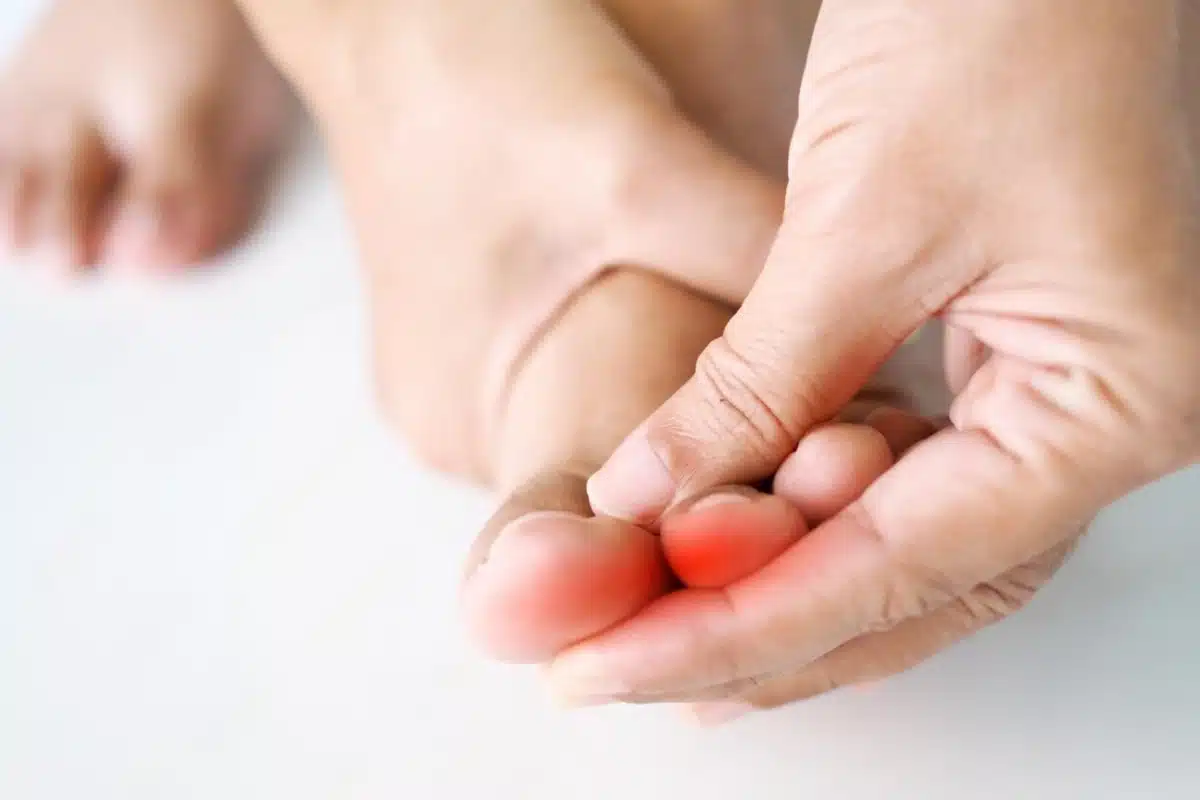
Early plantar plate pathology presents as plantar pain at the second MTPJ — often described as “stepping on a stone” or “a marble in the shoe” — indistinguishable clinically from Morton’s neuroma without careful examination. As the plantar plate tears progress, the MTP joint loses its stabilizing restraint: the toe begins to deviate medially (toward the hallux) and dorsally (upward). This produces the classic “crossover toe” deformity — the second toe crossing over the great toe. At this stage, shoe fitting becomes difficult and skin breakdown can occur from the toe pressing against the great toenail or the shoe box.
Diagnosis
The drawer test (vertical stress test) is the key clinical diagnostic maneuver. Ultrasound imaging — available at Balance Foot & Ankle at the first visit — directly visualizes plantar plate tears with high sensitivity and specificity. MRI provides excellent characterization of tear grade and extent when surgical planning is needed.
Treatment
Conservative Management (Early Tears)
For partial plantar plate tears without fixed deformity, conservative management is highly effective if initiated promptly. A metatarsal pad placed proximal to the second metatarsal head offloads plantar pressure. Buddy taping or a specialized toe splint maintains dorsal reduction, preventing progressive dorsal subluxation during healing. Stiff-soled footwear reduces MTPJ dorsiflexion stress during pushoff. This protocol produces symptom resolution in 60–70% of patients with early-stage tears over 6–12 weeks.
Surgical Repair
For complete plantar plate tears, fixed deformity, or conservative management failure, direct plantar plate repair — often combined with Weil metatarsal osteotomy (shortening the second metatarsal to decompress the joint) — restores alignment and plantar plate function. Early surgical repair before fixed deformity develops has substantially better outcomes than delayed repair once the toe has permanently crossed over.
Second Toe Drifting or Ball-of-Foot Pain? Get Evaluated Early.
Dr. Biernacki at Balance Foot & Ankle diagnoses plantar plate tears with on-site ultrasound imaging and provides both conservative and surgical management. Bloomfield Hills and Howell, MI.
📞 (810) 206-1402 |
📧 Get Dr. Tom’s Free Lab Test Guide
Discover the 5 lab tests every person over 35 should ask their doctor about — explained in plain English by a board-certified physician.
📍 Located in Michigan?
Our board-certified podiatrists treat this condition at two convenient locations. Same-day appointments often available.
Insurance Accepted
BCBS · Medicare · Aetna · Cigna · United Healthcare · HAP · Priority Health · Humana · View All →
Howell Office
3980 E Grand River Ave, Suite 140
Howell, MI 48843
Get Directions →
Bloomfield Hills Office
43700 Woodward Ave, Suite 207
Bloomfield Hills, MI 48302
Get Directions →
Your Board-Certified Podiatrists



Ready to Get Back on Your Feet?
Same-week appointments available at both locations.
Book Your AppointmentMore Podiatrist-Recommended Sports Essentials
Hoka Clifton 10

Watch: Is Bunion Surgery Worth It? [Big Toe Joint Arthritis] — MichiganFootDoctors YouTube
Max-cushion everyday shoe — podiatrist favorite for walking and running.

OOFOS Recovery Slide

Impact-absorbing recovery sandal — wear after long days on your feet.
As an Amazon Associate, Balance Foot & Ankle earns from qualifying purchases. Product recommendations are based on clinical experience; prices and availability shown above update live from Amazon.
When to See a Podiatrist
Athletic injuries heal faster with sport-specific rehab protocols — not generic rest and ice. Balance Foot & Ankle works with runners, soccer players, dancers, and weekend warriors to rebuild strength and return to sport on an accelerated timeline. Don’t let a foot injury keep you sidelined longer than necessary.
Call Balance Foot & Ankle: (810) 206-1402 · Book online · Offices in Howell & Bloomfield Hills
Differential Diagnosis: What Else Could It Be?
Not every case of plantar plate tear is straightforward. In our clinic we routinely rule out three look-alike conditions before confirming the diagnosis. If your symptoms don’t match the classic presentation, one of these may explain the pain — which is why physical exam matters more than self-diagnosis.
| Condition | How It Differs |
|---|---|
| Metatarsalgia | Pain at metatarsal head without instability; negative drawer test at MTP. |
| Morton’s neuroma | Burning into 3rd-4th toes with positive Mulder’s click; not between 2nd-3rd. |
| Stress fracture (metatarsal) | Point tenderness on shaft, not joint; callus on follow-up imaging. |
Red Flags — When to See a Podiatrist Now
Seek same-day evaluation at Balance Foot & Ankle if you notice any of the following:
- 2nd toe visibly drifting sideways or floating above the ground
- Pain failing to improve after 6 weeks of metatarsal padding
- Progressive deformity at the 2nd MTP
- Patient diabetic with forefoot pain and deformity
Call (810) 206-1402 or request an appointment. Our Howell and Bloomfield Hills offices reserve same-day slots for urgent foot and ankle issues.
In Our Clinic: What We See
Clinical perspective from Dr. Tom Biernacki, DPM — Balance Foot & Ankle, Howell & Bloomfield Hills, MI:
Plantar plate tear is one of the most missed diagnoses in forefoot pain. Patients come in saying ‘metatarsalgia’ but in our clinic we check the drawer test at the 2nd MTP — if the toe lifts easily, the plantar plate is compromised. Early stage responds beautifully to a metatarsal pad placed BEHIND (not under) the metatarsal head, a stiff-soled shoe, and taping the toe down. Ignored plantar plate tears progress to a ‘floating toe’ and eventual crossover toe deformity. Dr. Biernacki emphasizes early intervention — a tear caught in month 2 rarely needs surgery; caught in year 2, it almost always does.
Watch: Dr. Tom explains
Podiatrist-recommended products
As an Amazon Associate, Dr. Tom earns from qualifying purchases.
Offloads the 2nd MTP joint with plantar plate injury.
View on Amazon →Forefoot support with metatarsal dome for plantar plate healing.
View on Amazon →Immobilization for acute plantar plate tears.
View on Amazon →Inflammation relief for 2nd MTP joint capsulitis.
View on Amazon →Related resources
Ready to solve this? Book today.
Same-week appointments · Howell & Bloomfield Hills · 4.9★ (1,123+ reviews)
☎ (810) 206-1402Book Online →Pros & Cons of Conservative Care for plantar fasciitis
Advantages
- ✓ Conservative care resolves 90%+ of cases
- ✓ Multiple home treatment options
- ✓ Strong evidence base
- ✓ Imaging often not required
Considerations
- ✗ Recovery takes 6-12 weeks
- ✗ Mistakes prolong recovery
- ✗ Untreated can become chronic
- ✗ Can mimic other conditions
Dr. Tom’s Recommended Products for plantar fasciitis
Affiliate disclosure: As an Amazon Associate, Balance Foot & Ankle earns from qualifying purchases. We only recommend products we use with patients.
PowerStep Pinnacle Maxx Dr. Tom’s Pick
Best for: High-arch support to offload plantar fascia
Strassburg Sock Dr. Tom’s Pick
Best for: Overnight stretch for morning pain relief
Hoka Bondi 9 Dr. Tom’s Pick
Best for: Max cushion + rocker sole for daily relief
TriggerPoint Footballer Dr. Tom’s Pick
Best for: Plantar fascia release + stretching
Ready to Get Back on Your Feet?
Same-day appointments in Howell + Bloomfield Twp. Most insurance accepted. Dr. Tom Biernacki, DPM & team.
Book Today — Same-Day Appointments Available
Call Now: (810) 206-1402
About Your Care Team at Balance Foot & Ankle
Dr. Tom Biernacki, DPM · Board-Certified Foot & Ankle Surgeon. Specializes in conservative-first care, minimally invasive bunion surgery, and complex reconstruction.
Dr. Carl Jay, DPM · Accepting new patients. Specializes in sports medicine, athletic injuries, and routine podiatric care.
Dr. Daria Gutkin, DPM, AACFAS · Accepting new patients. Specializes in surgical reconstruction and pediatric podiatry.
Locations: 4330 E Grand River Ave, Howell, MI 48843 · 43494 Woodward Ave Suite 208, Bloomfield Twp, MI 48302
Hours: Mon–Fri 8:00 AM – 5:00 PM · (810) 206-1402
Frequently Asked Questions
When should I see a doctor?
See a podiatrist if pain persists past 2 weeks, prevents normal activity, or is accompanied by red-flag symptoms (warmth, swelling, numbness, inability to bear weight).
Can I treat this at home?
Mild cases respond to RICE protocol (rest, ice, compression, elevation), supportive shoes, and OTC anti-inflammatories. Persistent symptoms need professional evaluation.
How long does it take to heal?
Most soft tissue injuries resolve in 2-6 weeks with appropriate care. Bone injuries take 6-12 weeks. Chronic conditions need longer-term management.
In-Office Treatment at Balance Foot & Ankle
If home treatment isn’t providing relief for your foot and ankle conditions, our podiatry team at Balance Foot & Ankle can help with same-day evaluations and advanced in-office care.
Same-day appointments available. (810) 206-1402
Doctor Hoy’s Natural Pain Relief Gel
Natural topical pain relief I use in our clinic. Arnica + camphor formula — apply directly to the area 3–4x daily. ($20–25)
Shop Doctor Hoy’s →Ready for Expert Care?
Same-day appointments in Howell & Bloomfield Hills, MI.
4.9★ | 1,123 Reviews | 3,000+ Surgeries
Or call: (810) 206-1402

Dr. Tom Biernacki, DPM is a double board-certified podiatrist and foot & ankle surgeon at Balance Foot & Ankle Specialists in Southeast Michigan. With over a decade of clinical experience, he specializes in heel pain, bunions, diabetic foot care, sports injuries, and minimally invasive surgery. Dr. Biernacki is a member of the APMA and ACFAS, and his patient education content on MichiganFootDoctors.com and YouTube has reached over one million views.