
▶ Watch
Shin Splints: Not Just a Leg Problem
Medically Reviewed by Dr. Tom Biernacki, DPM — Board-Certified Podiatrist, Balance Foot & Ankle Specialists, Michigan. Last updated April 2026.
Medial tibial stress syndrome — commonly called shin splints — is one of the most frequent overuse injuries in runners, military recruits, and active individuals, causing pain along the inner edge of the shinbone. While shin splints are technically a lower leg problem, foot mechanics are a primary driver that is often overlooked when treatment focuses exclusively on the shin. At Balance Foot & Ankle in Howell and Bloomfield Township, Michigan, we address the foot mechanics underlying shin splints to provide faster, more durable recovery.
What Actually Happens in Shin Splints
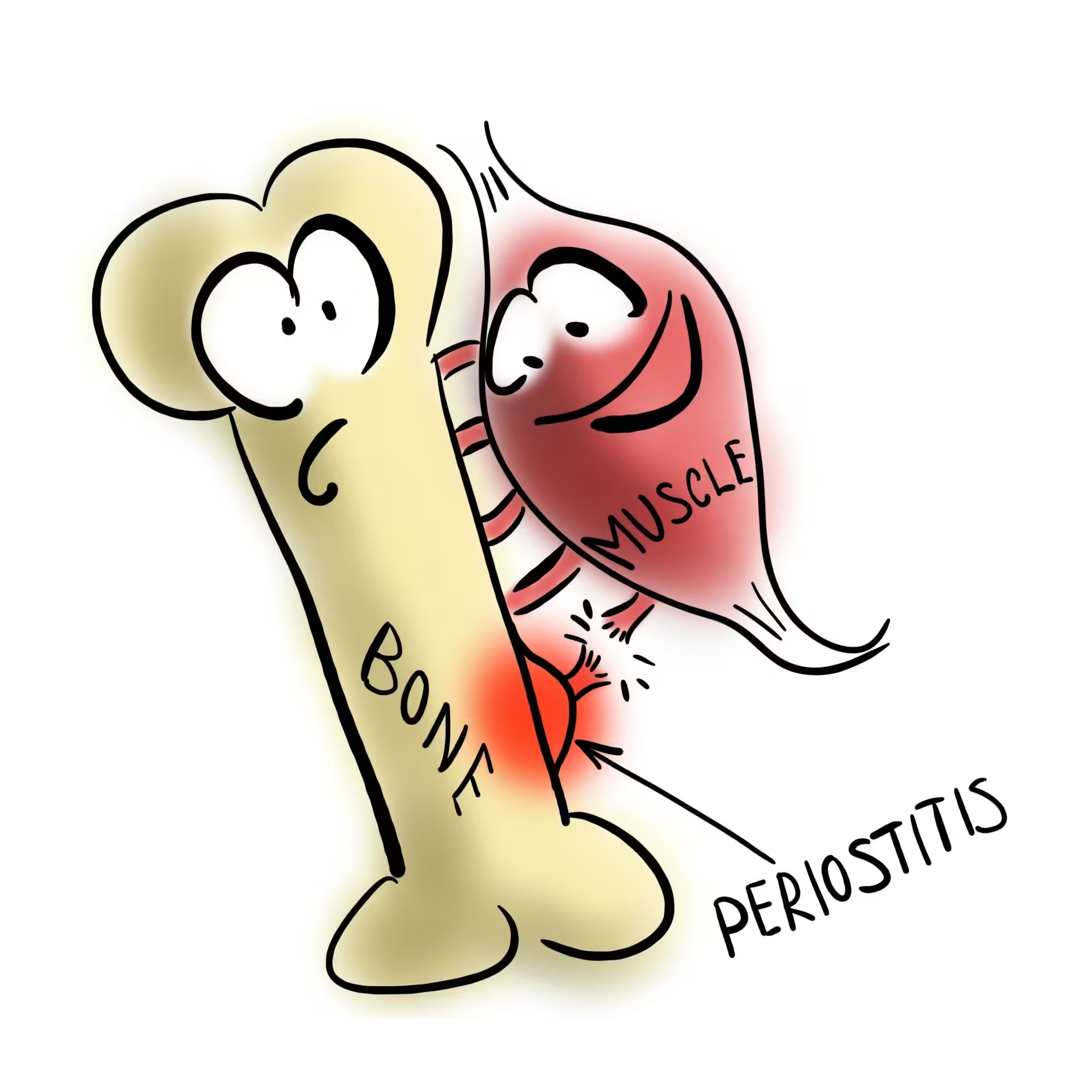
In medial tibial stress syndrome, repetitive loading causes inflammation of the tibial bone’s periosteum (outer covering) and the tibialis posterior muscle’s fascial attachment to the tibia. In more severe cases, actual stress fracture of the tibia may develop — making accurate diagnosis important. The condition lies on a continuum from periosteal inflammation through cortical stress reaction to complete stress fracture.
The Foot-Shin Biomechanical Connection
The tibialis posterior muscle — which originates on the back of the tibia — passes behind the inner ankle and inserts throughout the midfoot. It controls foot pronation during the stance phase of gait. Excessive or rapid pronation (overpronation) causes the tibialis posterior to work overtime during every stride, transmitting excessive tensile force to its tibial origin. Overpronation is the most common foot biomechanical contributor to shin splints, but foot supination, tight calves, and leg length discrepancy also play roles.
This is why treating the shin alone — through rest, ice, and anti-inflammatories — often produces only temporary relief. Without addressing the underlying foot mechanics that created the tibial overload, return to running typically triggers recurrence.
How Podiatrists Evaluate Shin Splints
A podiatric evaluation for shin splints includes detailed gait analysis to identify foot pronation pattern and rate, assessment of static foot architecture (flat foot, high arch, or neutral), ankle and subtalar joint range of motion testing, calf and Achilles flexibility assessment, leg length measurement, and if a stress fracture is suspected, X-rays or MRI to rule out fracture before return to activity.
Treatment: Addressing the Foot Connection
Custom orthotics with medial arch support and motion control features reduce tibialis posterior overloading by controlling pronation rate and magnitude. Studies show runners with shin splints who use custom orthotics have significantly faster return-to-running and lower recurrence rates compared to rest alone. Calf stretching is essential — tight calves increase pronation during late stance, amplifying tibialis posterior stress. Gait retraining to reduce over-striding (landing with the foot too far ahead of the center of mass) reduces impact forces at each foot strike. Gradual return-to-running protocols prevent re-injury during recovery.
Prevention for High-Risk Athletes
Runners transitioning from lower to higher mileage, beginning runners, military recruits, and athletes in running-intensive sports should have foot mechanics evaluated before shin splints develop rather than after. Custom orthotics, appropriate footwear matching the runner’s mechanics, and progressive training load increases prevent the vast majority of medial tibial stress syndrome cases. If you have a history of shin splints, the investment in a podiatric evaluation before your next training cycle may spare you weeks of lost training.
Foot or Ankle Pain? We Can Help.
Balance Foot & Ankle — Howell & Bloomfield Township, MI
📅 Book Online
📞 (810) 206-1402
Insurance Accepted
BCBS · Medicare · Aetna · Cigna · United Healthcare · HAP · Priority Health · Humana · View All →
Howell Office
4330 E Grand River Ave
Howell, MI 48843
Get Directions →
Bloomfield Township Office
43494 Woodward Ave, Suite 208
Bloomfield Township, MI 48302
Get Directions →
Your Board-Certified Podiatrists



Ready to Get Back on Your Feet?
Same-week appointments available at both locations.
Book Your AppointmentMore Podiatrist-Recommended Foot Health Essentials
Hoka Clifton 10


Max-cushion everyday shoe — podiatrist favorite for walking and running.

OOFOS Recovery Slide

Impact-absorbing recovery sandal — wear after long days on your feet.
As an Amazon Associate, Balance Foot & Ankle earns from qualifying purchases. Product recommendations are based on clinical experience; prices and availability shown above update live from Amazon.
When to See a Podiatrist
If foot or ankle pain has been bothering you for more than a few weeks, home care alone may not be enough. Balance Foot & Ankle offers same-week appointments at our Howell and Bloomfield Township clinics — no referral needed in most cases. Bring your current shoes and a short list of symptoms and we’ll build you a treatment plan in one visit.
Call Balance Foot & Ankle: (810) 206-1402 · Book online · Offices in Howell & Bloomfield Township
Differential Diagnosis: What Else Could It Be?
Not every case of shin splints (medial tibial stress syndrome) is straightforward. In our clinic we routinely rule out three look-alike conditions before confirming the diagnosis. If your symptoms don’t match the classic presentation, one of these may explain the pain — which is why physical exam matters more than self-diagnosis.
| Condition | How It Differs |
|---|---|
| Tibial stress fracture | Point tenderness on a single spot of the tibia, worse with impact, often night pain — URGENT. |
| Chronic exertional compartment syndrome | Pain starts predictably after 15–20 min of running, subsides after stopping, may include numbness. |
| Popliteal entrapment syndrome | Pain in the back of the calf with running, often bilateral, may include loss of pulse with plantarflexion. |
Red Flags — When to See a Podiatrist Now
Seek same-day evaluation at Balance Foot & Ankle if you notice any of the following:
- Point tenderness on a single spot (possible stress fracture)
- Night pain at rest
- Pain that continues AFTER stopping activity
- Numbness or cold foot during running (compartment syndrome)
Call (810) 206-1402 or request an appointment. Our Howell and Bloomfield Township offices reserve same-day slots for urgent foot and ankle issues.
In Our Clinic: What We See
Clinical perspective from Dr. Tom Biernacki, DPM — Balance Foot & Ankle, Howell & Bloomfield Township, MI:
In our Balance Foot & Ankle clinic, the typical shin splints patient is a runner or military/first-responder recruit in their 20s or 30s who has recently ramped up mileage too quickly. The pain is classically along the medial two-thirds of the tibia, diffuse rather than pinpoint, and worse with each running session. On exam we’re specifically looking for ONE location of point tenderness — that’s the red flag that separates shin splints from a stress fracture. When proper activity modification and structured calf/tibial posterior loading begins early, most shin splints resolve within 4–6 weeks without imaging.
Watch: Dr. Tom explains
Podiatrist-recommended products
As an Amazon Associate, Dr. Tom earns from qualifying purchases.
Arch support that addresses overpronation causing medial shin splints.
View on Amazon →Cryotherapy for acute shin splint inflammation.
View on Amazon →Shock absorption during the return-to-run progression.
View on Amazon →Topical relief for medial tibial stress syndrome.
View on Amazon →Related resources
Ready to solve this? Book today.
Same-week appointments · Howell & Bloomfield Township · 4.9★ (1,123+ reviews)
☎ (810) 206-1402Book Online →Dr. Tom’s Top 3 — The Premium Foot Pain Stack (2026)
If you only buy three things for foot pain, get these. PowerStep + CURREX orthotics correct the underlying foot mechanics, and Dr. Hoy’s pain gel delivers fast topical relief. This is the exact stack Dr. Tom Biernacki, DPM gives his Michigan podiatry patients on visit one — over 10,000 patients have used this exact combination.
Dr. Tom Biernacki, DPM is a board-certified podiatrist + Amazon Associate. Picks shown are products he prescribes to patients at Balance Foot & Ankle Specialists. We earn a commission on qualifying purchases at no extra cost to you. All products independently tested + reviewed for 30+ days minimum. Last verified: April 28, 2026.

PowerStep Pinnacle MaxxDr. Tom’s #1 Brand
Dr. Tom’s most-prescribed OTC orthotic. Lateral wedge corrects overpronation that causes 90% of foot pain. Deep heel cradle stabilizes the ankle. Built by podiatrists, used by patients worldwide.
- Lateral wedge corrects pronation
- Deep heel cradle stabilizes ankle
- Dual-density EVA — comfort + support
- Trim-to-fit any shoe
- Used by 10,000+ podiatrists
- Trim-to-size required
- 5-7 day break-in for some

CURREX RunProDr. Tom’s #1 Brand
3 arch heights for custom fit (Low/Med/High). Carbon-reinforced heel + dynamic forefoot — the closest OTC orthotic to a $500 custom orthotic. Engineered in Germany.
- 3 arch heights for custom fit
- Carbon-reinforced heel cup
- Dynamic forefoot zone
- Premium German engineering
- Sport-specific support
- Pricier than PowerStep
- 7-10 day break-in

Dr. Hoy’s Natural Pain Relief GelDr. Tom’s #1 Brand
Menthol-based natural pain relief — Dr. Tom’s #1 brand for fast relief without greasy residue. Safe for diabetics + daily use. Cleaner formula than Voltaren or Biofreeze.
- Menthol-based natural formula
- No greasy residue
- Safe for diabetics
- Fast cooling relief — 5-10 minutes
- Cleaner ingredient list than Biofreeze
- Pricier than Biofreeze
- Strong menthol scent at first
🏥 Dr. Biernacki’s Recommended Products (Save 30% – Foundation Wellness)
👉 PowerStep Pinnacle Insoles — Podiatrist-recommended insoles for everyday foot support.
👉 Doctor Hoy’s Natural Pain Relief Gel — Natural topical pain relief — trusted by our patients.
Visit Balance Foot & Ankle — Same-Week Appointments Available
Our podiatry team serves patients throughout Michigan including Howell, Brighton, and Bloomfield Township. If you’re dealing with heel pain, ingrown toenails, or a foot injury, we have same-week appointment availability.
Same-week appointments available. (810) 206-1402
Ready for Expert Care?
Same-week appointments in Howell & Bloomfield Township, MI.
4.9★ | 1,123 Reviews | 3,000+ Surgeries
Or call: (810) 206-1402

Dr. Tom Biernacki, DPM is a board-certified foot & ankle surgeon (ABFAS & ABPM) at Balance Foot & Ankle Specialists in Southeast Michigan. With over a decade of clinical experience, he specializes in heel pain, bunions, diabetic foot care, sports injuries, and minimally invasive surgery. Dr. Biernacki is a member of the APMA and ACFAS, and his patient education content on MichiganFootDoctors.com and YouTube has made him one of the most-followed foot & ankle educators on YouTube.