


Quick answer: Stair Climbing Foot Ankle Pain Causes Solutions has multiple potential causes including mechanical, neurological, vascular, and inflammatory. The most common causes we identify are overuse, ill-fitting shoes, and biomechanical imbalance. Red flags requiring urgent evaluation: warmth/redness (infection), inability to bear weight (fracture), and unilateral swelling without injury (DVT). Call (810) 206-1402.
![Inside of the Ankle Pain [Posterior Tibial Tendonitis Treatment]](https://www.michiganfootdoctors.com/wp-content/cache/flying-press/283e21b8b9b909701c3ee6f622a2c989.jpg)
Watch: Inside of the Ankle Pain [Posterior Tibial Tendonitis Treatment] — MichiganFootDoctors YouTube

Medically Reviewed by Dr. Tom Biernacki, DPM, FACFAS — Board-certified podiatrist & foot surgeon | Balance Foot & Ankle | Last updated: May 2026
⚡ Quick Answer: Why Does My Foot or Ankle Hurt When Climbing Stairs?
Foot and ankle pain during stair climbing is most commonly caused by plantar fasciitis (heel pain), Achilles tendinopathy (back of heel/calf pain), anterior ankle impingement (front of ankle), or metatarsalgia (ball of foot). Stairs increase demand on these structures compared to flat walking because they require greater ankle dorsiflexion range, more calf activation, and greater push-off force. The location of your pain is the most important clue—pain going up stairs vs. going down stairs points to different diagnoses and different treatments.
Pain Location Diagnostic Guide for Stair Climbing
Where your foot or ankle hurts during stair climbing narrows the diagnosis significantly. Use this guide to identify your most likely condition before your podiatric evaluation:
| Pain Location | Worse Going Up or Down? | Most Likely Diagnosis |
|---|---|---|
| Bottom of heel | Both, worse going up (push-off) | Plantar fasciitis, heel spur |
| Back of heel / lower calf | Going up (calf loading) | Achilles tendinopathy, Haglund’s deformity |
| Front of ankle | Going up (dorsiflexion) | Anterior ankle impingement, ankle arthritis |
| Ball of foot | Going up (push-off through forefoot) | Metatarsalgia, Morton’s neuroma, sesamoiditis |
| Outside of ankle / foot | Going down (deceleration) | Peroneal tendinopathy, lateral ankle instability |
| Big toe joint | Going up (dorsiflexion of great toe) | Hallux rigidus (big toe arthritis), sesamoiditis |
The Most Common Causes — Detailed
Plantar Fasciitis and Stair Climbing
The plantar fascia must stretch significantly during the push-off phase of stair ascent—more so than during level walking because the foot must dorsiflex further to clear the stair riser. Patients with plantar fasciitis often report that stair climbing is more painful than walking and that descending stairs in the morning (the first steps of the day) triggers the characteristic sharp heel pain. Treatment follows standard plantar fasciitis protocol: calf stretching, arch support, and plantar fascia-specific stretching reduce stair pain in most patients within 4–8 weeks.
Achilles Tendinopathy and Stair Climbing
The Achilles tendon undergoes approximately 8–10 times body weight in force during single-leg push-off on stairs. Insertional Achilles tendinopathy (where the tendon meets the heel bone) is particularly aggravated by stair climbing because the posterior heel contacts the shoe at the most painful point during the push-off position. Non-insertional tendinopathy (the “watershed zone” 2–7cm above the insertion) is more sensitive to the eccentric calf loading that occurs during controlled stair descent.
Anterior Ankle Impingement
The front of the ankle is a common pain generator during stair climbing that is often misdiagnosed as shin pain or generic ankle stiffness. Anterior impingement occurs when bone spurs or soft tissue at the front of the ankle joint are compressed as the ankle dorsiflexes going upstairs. Diagnosis is confirmed clinically (pain with forced dorsiflexion, tenderness at the anterior joint line) and on X-ray (anterior tibial or talar spurs). Conservative treatment includes activity modification and heel lift orthotics; surgical arthroscopic debridement has very high success rates for refractory cases.
When Is Stair Pain a Medical Urgency?
| Symptom | What It May Indicate | Action |
|---|---|---|
| Sudden sharp pop + inability to weight-bear | Achilles rupture, fracture | ER or same-day podiatry urgent |
| Swelling, bruising, severe pain after stair fall | Fracture, ligament tear | X-ray same day |
| Pain at night or at rest (not just with activity) | Possible infection, tumor, nerve issue | Podiatric evaluation within 1 week |
| Gradual worsening over weeks despite rest | Stress fracture, arthritis progression | Schedule within 2 weeks |
⚠️ Most Common Mistake: Treating All Stair Pain as “Knee Pain” or Arthritis
One of the most frequent misdiagnoses we see: patients told they have “knee pain going up stairs” when the actual source is their foot or ankle. The referral pattern from plantar fasciitis, Achilles tendinopathy, and anterior ankle impingement can travel up the leg during stair climbing, mimicking knee complaints. If your orthopaedic surgeon has cleared your knee but stair pain persists, a podiatric evaluation of the foot and ankle is the logical next step. In our practice, approximately 1 in 5 patients referred for “stair-related knee pain” have a primary foot or ankle diagnosis once properly examined.
Watch: Back of Heel Pain — Causes and Home Treatment
Dr. Tom explains the most common sources of posterior heel pain that are aggravated by stair climbing, including Achilles tendinopathy and Haglund’s deformity:
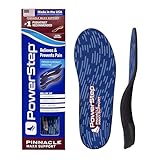
- Slightly Angled Heel Post: PowerStep Pinnacle Maxx insoles for men & women keep the feet from rolling inward, improve stability, and prevent problems caused by overpronation including flat feet and plantar fasciitis.
- Firm But Flexible Design: Our orthotics Pinnacle PowerStep insoles for overpronation are equipped with a deep heel insert cradle for increased comfort, stability, and motion control for standard arch support and immediate heel pain relief.
- Premium Dual Layer Cushioning: For enhanced comfort from heel to toe. As the thickest of our Pinnacle PowerStep orthotics, these need to be worn in shoes where the factory insole can be removed. HSA & FSA Eligible. Made in the USA
- The Perfect Balance of Comfort and Support: These PowerStep Pinnacle arch support inserts for men & women are unlike most other orthotics as they help to correct over-pronation which can cause ankle, knee, and hip pain in your daily routine
- No Trimming: Our arch support PowerStep insoles men & women can use can be worn in a variety of shoe styles & fit in any type with no trimming required! Unlike most insoles for flat feet and other heel pain relief products, these come ready to wear.
As an Amazon Associate, Balance Foot and Ankle earns from qualifying purchases. Product links are affiliate links and we may earn a commission at no extra cost to you. This does not influence our clinical recommendations. Last update on 2026-09-11 / Images from Amazon Product Advertising API

Book a stair pain evaluation → · (810) 206-1402
Frequently Asked Questions
Why is my foot pain worse going downstairs than upstairs?
Pain that is specifically worse going downstairs typically involves structures that are loaded eccentrically (lengthening under tension) rather than concentrically. The peroneal tendons, Achilles, and anterior tibialis all function eccentrically during controlled stair descent. Lateral ankle instability pain is also typically worse going down because the ankle must absorb the deceleration force through partially compromised ligaments. If descending stairs is significantly more painful than ascending, a peroneal tendon evaluation and lateral ankle stability assessment are warranted.
Can plantar fasciitis cause pain going up stairs specifically?
Yes—stair ascent is one of the most provocative activities for plantar fasciitis because it demands maximum ankle dorsiflexion (bending the foot up) which places peak tensile load on the plantar fascia at its calcaneal insertion. Patients with moderate-to-severe plantar fasciitis often find stair climbing more painful than walking. Descending stairs is typically less painful unless significant fat pad atrophy is present at the heel. If heel pain is specifically provoked by stairs and first morning steps, plantar fasciitis is the most likely diagnosis.
What stretches help with foot pain on stairs?
The most effective stretches address the calf complex, which is the primary driver of forefoot and heel load during stair climbing. Perform a standing gastrocnemius stretch (straight-leg calf stretch against a wall) and a soleus stretch (bent-knee version) for 30 seconds each, 3 times per side, twice daily. The plantar fascia-specific stretch—pulling the toes back toward the shin before taking the first step of the day—is particularly helpful for morning stair pain. These can reduce stair-related symptoms significantly within 2–4 weeks when done consistently.
Should I avoid stairs entirely if my foot hurts?
Complete stair avoidance is rarely necessary and often impractical. A better approach: temporarily reduce stair frequency if symptoms are acute (recent onset, severe), lead with your stronger leg when going up (step-over-step on good days, step-to-step on bad days), and use the handrail to offload some bodyweight. Once the underlying condition is identified and treated, you can progressively return to normal stair use. Complete avoidance without treatment doesn’t address the underlying pathology and may allow it to worsen.
At what point should stair pain prompt an X-ray?
X-rays are recommended when: stair pain began after a specific injury or fall (rule out fracture), there is visible deformity or swelling that appeared suddenly, pain has been present for more than 4–6 weeks without improvement, or there is bony tenderness at the heel, ankle, or midfoot. At Balance Foot & Ankle, we perform digital X-rays in-office at the time of evaluation—call (810) 206-1402 for a same-day appointment if stair pain is limiting your daily function.
Stop Dreading the Stairs — Get an Answer Today
Dr. Tom Biernacki diagnoses and treats all causes of foot and ankle pain with stair climbing. X-rays on-site. Same-day appointments available.
Howell: 4330 E Grand River Ave · Bloomfield Township: 43494 Woodward Ave #208
Related Articles
- Plantar Fasciitis Treatment Options
- Haglund’s Deformity (Pump Bump) Complete Guide
- Foot Pain After Walking Long Distances
- Custom Orthotics in Michigan
- Sharp Shooting Pain in the Little Toe
Podiatrist-Recommended Products for Stair-Related Foot Pain
- PowerStep Maxx — maximum arch support reduces the plantar fascia and Achilles stress during stair climbing
- Doctor Hoy’s Natural Pain Relief Gel — topical pain relief for foot and ankle soreness aggravated by ascending or descending stairs
- DASS Medical Compression Socks — graduated compression reduces the swelling that worsens stair-climbing foot and ankle pain
These are the same products Dr. Biernacki recommends in clinic. Available through our partner Foundation Wellness.
In-Office Treatment at Balance Foot & Ankle
If home treatment isn’t providing relief for your foot and ankle conditions, our podiatry team at Balance Foot & Ankle can help with same-day evaluations and advanced in-office care.
Same-day appointments available. (810) 206-1402
Frequently Asked Questions
When should I see a doctor?
See a podiatrist if pain persists past 2 weeks, prevents normal activity, or is accompanied by red-flag symptoms (warmth, swelling, numbness, inability to bear weight).
Can I treat this at home?
Mild cases respond to RICE protocol (rest, ice, compression, elevation), supportive shoes, and OTC anti-inflammatories. Persistent symptoms need professional evaluation.
How long does it take to heal?
Most soft tissue injuries resolve in 2-6 weeks with appropriate care. Bone injuries take 6-12 weeks. Chronic conditions need longer-term management.

Dr. Tom Biernacki, DPM is a board-certified foot & ankle surgeon (ABFAS & ABPM) at Balance Foot & Ankle Specialists in Southeast Michigan. With over a decade of clinical experience, he specializes in heel pain, bunions, diabetic foot care, sports injuries, and minimally invasive surgery. Dr. Biernacki is a member of the APMA and ACFAS, and his patient education content on MichiganFootDoctors.com and YouTube has made him one of the most-followed foot & ankle educators on YouTube.
More questions patients ask
Why do my feet hurt more on stairs than walking?
Stairs generate 3-5 times body weight in force compared to 1.5-2 times during level walking. Stairs also demand greater ankle range of motion and concentrate force on the forefoot going up or require high eccentric loads going down, exposing conditions tolerable during lower-demand walking.
Should I avoid stairs if I have foot pain?
Not necessarily. Modify technique instead: use handrails, full foot placement, one step at a time, and supportive footwear with orthotic insoles. Complete avoidance leads to deconditioning. Treat the underlying condition while maintaining tolerable stair use.
Is stair climbing good exercise for feet?
Yes, when feet are healthy and properly supported. Stair climbing strengthens calf muscles, Achilles tendon, intrinsic foot muscles, and ankle stabilizers more effectively than level walking. Start with manageable flights and increase gradually in supportive footwear.
Why does going down stairs hurt more than going up?
Descending requires eccentric muscle contractions and maximum ankle dorsiflexion, stressing different structures than ascent. Anterior ankle impingement, subtalar arthritis, and peroneal tendon pathology are commonly worse descending. Impact forces are also higher going down.
What shoes are best for climbing stairs?
Supportive athletic or walking shoes with cushioned midsoles, structured arch support, and non-slip outsoles. Avoid bare feet, socks, flip-flops, or flat shoes on stairs. Adding orthotic insoles further improves force distribution during both ascending and descending.
Still have a question about coverage or cost? Book online and we will check your benefits before your visit: Book in Howell · Book in Bloomfield Township. Prefer to talk it through first? Call (810) 206-1402.