
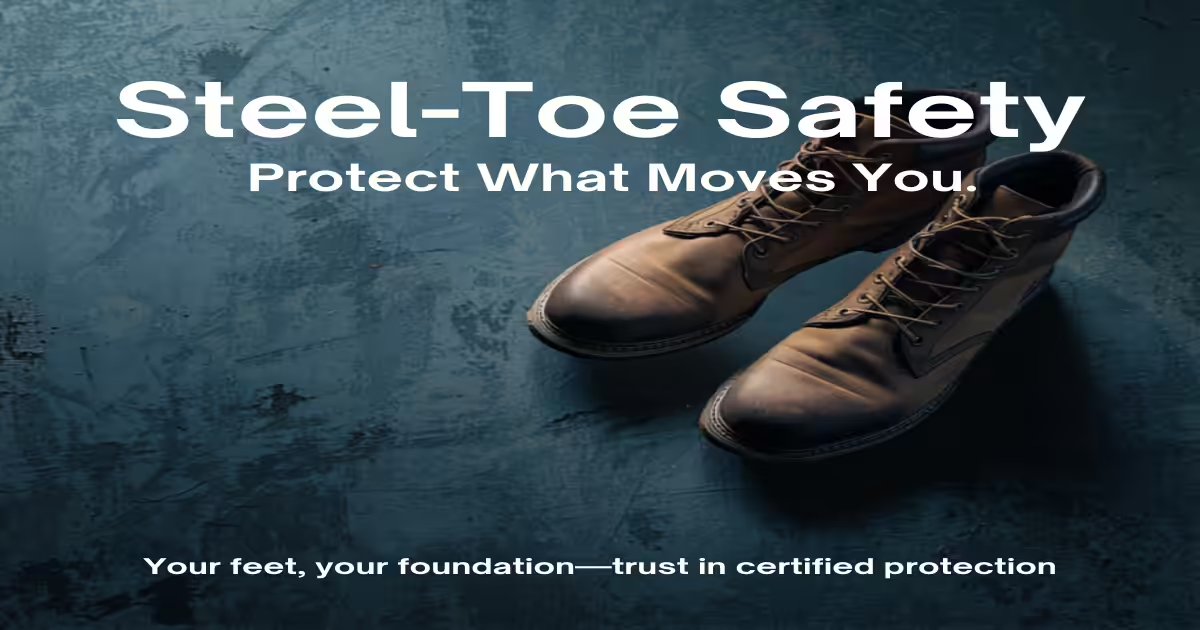

The most important clinical decision with Standing All Day Foot Pain Workers Prevention Tips isn't which treatment to start with — it's which subtype or underlying cause you actually have. Our podiatrists regularly see patients who've been treated for months for the wrong diagnosis. The correct identification changes the entire treatment path. Call (810) 206-1402 — Dr. Tom evaluates this condition at both Howell and Bloomfield Hills locations.
Medically reviewed by Dr. Tom Biernacki, DPM · Board-Certified Podiatric Surgeon · Last reviewed: April 2026 · Editorial Policy
The most important clinical decision with Standing All Day Foot Pain Workers Prevention Tips isn’t which treatment to start with — it’s identifying the correct subtype. That changes everything. Call (810) 206-1402.
The most important clinical decision with Standing All Day Foot Pain Workers Prevention Tips isn’t which treatment to start with — it’s identifying the correct subtype. That changes everything. Call (810) 206-1402.
Quick Answer
Standing All Day: Foot Pain in Workers, Prevention & Tr relates to foot pain — typically caused by overuse, footwear, or biomechanics. Most patients improve in 6-12 weeks with conservative care. Same-week appointments in Howell + Bloomfield Hills: (810) 206-1402.

Medically reviewed by Dr. Tom Biernacki, DPM — Board-Certified Podiatric Surgeon — Balance Foot & Ankle, Howell & Bloomfield Hills, MI. Last updated April 2026.
▶ Watch

Medically Reviewed by Dr. Tom Biernacki, DPM — Board-Certified Podiatrist, Balance Foot & Ankle Specialists, Michigan. Last updated April 2026.
Occupational foot pain from prolonged standing is one of the most prevalent and underaddressed workplace health issues in the United States. Nurses, teachers, factory workers, retail employees, chefs, and surgeons all share the common burden of standing on hard floors for 8–12 hour shifts — a pattern that generates cumulative load on the plantar fascia, metatarsal joints, Achilles tendon, and calf musculature far exceeding what recreational walkers experience. The foot and ankle problems that result are not simply “part of the job” — they are preventable and treatable with the right interventions.
Why Standing Is More Damaging Than Walking
Counterintuitively, prolonged static standing is more damaging to the feet and lower extremities than walking the same duration. Walking distributes load dynamically across the entire foot through alternating gait cycles; static standing maintains constant compressive load on the same structures without the muscular pumping action that assists venous return from the legs. The result is sustained plantar fascia tension, sustained metatarsal head pressure, pooling of venous blood in the lower legs, and progressive ankle and calf muscle fatigue.
Common Foot Problems in Standing Workers
Plantar Fasciitis
The most common foot condition in healthcare and service workers. The combination of hard floor surfaces, inadequate footwear, and sustained arch loading produces the characteristic insertional plantar fascia micro-tearing. Nurses in particular are at high risk because hospital floors provide virtually no cushioning and typical nursing shoes prioritize slip resistance over biomechanical support.
Metatarsalgia and Ball-of-Foot Pain
Sustained forefoot pressure against hard floors compresses the metatarsal fat pad and increases pressure at the metatarsal heads, producing ball-of-foot pain that worsens progressively through the shift. Workers who must stand on the balls of their feet (chefs, assembly line workers at waist-height equipment) are at particular risk.
Achilles Tendinopathy and Calf Pain
Sustained standing on hard floors requires continuous calf and Achilles engagement to maintain upright posture and balance. Workers with limited ankle dorsiflexion substitute by standing slightly on their toes, continuously loading the Achilles. Achilles pain that is worst at the beginning of a shift and partially improves as the tendon “warms up” is the classic pattern.
Venous Insufficiency and Ankle Swelling
Prolonged standing impairs venous return from the legs, producing progressive ankle and calf swelling (edema), varicose veins over time, and in severe cases chronic venous insufficiency with skin changes. This is particularly prevalent in workers over 50 and in those with a family history of varicose veins.
Tarsal Tunnel Syndrome
Compression of the posterior tibial nerve in the tarsal tunnel — the fibro-osseous canal behind the inner ankle — is exacerbated by prolonged standing, producing burning, tingling, and numbness into the plantar foot and toes. Standing workers with flat feet are at elevated risk.
Prevention Strategies
Anti-Fatigue Matting
Anti-fatigue matting at workstations — particularly in kitchens, assembly lines, and checkout counters — reduces ground reaction force and allows micro-movement of the calf muscles that assists venous return. Studies consistently show that anti-fatigue matting reduces lower extremity discomfort in standing workers by 30–50%.
Footwear Selection
For standing workers, footwear is the most impactful personal intervention:
- Maximum cushioning midsole — viscoelastic EVA or memory foam absorbs repeated low-level impact
- Rocker bottom or mild heel rocker — reduces plantar fascia strain and metatarsal pressure
- Adequate arch support — prevents excessive pronation and plantar fascia loading
- Wide toe box — prevents metatarsal compression during sustained forefoot weight-bearing
- Nursing and medical professional brands designed specifically for the demands of hospital floors: Dansko, Brooks Addiction Walker, New Balance 928, HOKA Transport
Compression Socks
Graduated compression socks (15–20 mmHg or 20–30 mmHg for symptomatic venous insufficiency) dramatically reduce end-of-shift ankle swelling, calf aching, and the long-term risk of venous disease in standing workers.
Scheduled Sitting and Positional Changes
Brief sitting breaks every 30–60 minutes, foot elevation during break periods, and alternating weight-bearing foot during prolonged static standing meaningfully reduce cumulative plantar fascia load.
When to See a Podiatrist
Occupational foot pain that persists beyond 2 weeks despite footwear changes, or that begins interfering with work performance or sleep, warrants podiatric evaluation. Custom orthotics specifically designed for work footwear — thinner than recreational orthotics and engineered for the specific footwear type — provide substantially better relief than over-the-counter insoles for standing worker biomechanics.
Occupational Foot Pain Evaluation
Dr. Biernacki at Balance Foot & Ankle evaluates standing worker foot pain and designs custom work orthotics. Medicare and most insurance accepted. Same-week appointments at Bloomfield Hills and Howell.
📞 (810) 206-1402 |
📧 Get Dr. Tom’s Free Lab Test Guide
Discover the 5 lab tests every person over 35 should ask their doctor about — explained in plain English by a board-certified physician.
📍 Located in Michigan?
Our board-certified podiatrists treat this condition at two convenient locations. Same-day appointments often available.

Insurance Accepted
BCBS · Medicare · Aetna · Cigna · United Healthcare · HAP · Priority Health · Humana · View All →
Howell Office
4330 E Grand River Ave
Howell, MI 48843
Get Directions →
Bloomfield Hills Office
43494 Woodward Ave, #208
Bloomfield Hills, MI 48302
Get Directions →
Your Board-Certified Podiatrists



Ready to Get Back on Your Feet?
Same-week appointments available at both locations.
More Podiatrist-Recommended Foot Health Essentials
Hoka Clifton 10


Watch: How to Cure Plantar Fasciitis in One Week? [FAST Heel Pain Relief!] — MichiganFootDoctors YouTube
Max-cushion everyday shoe — podiatrist favorite for walking and running.

OOFOS Recovery Slide

Impact-absorbing recovery sandal — wear after long days on your feet.
As an Amazon Associate, Balance Foot & Ankle earns from qualifying purchases. Product recommendations are based on clinical experience; prices and availability shown above update live from Amazon.
When to See a Podiatrist
If foot or ankle pain has been bothering you for more than a few weeks, home care alone may not be enough. Balance Foot & Ankle offers same-week appointments at our Howell and Bloomfield Hills clinics — no referral needed in most cases. Bring your current shoes and a short list of symptoms and we’ll build you a treatment plan in one visit.
Call Balance Foot & Ankle: (810) 206-1402 · Book online · Offices in Howell & Bloomfield Hills
Pros & Cons of Conservative Care for foot care
Advantages
- ✓ Conservative care first
- ✓ Same-week appointments
- ✓ Multiple insurance accepted
Considerations
- ✗ Self-treatment can mask issues
- ✗ See a podiatrist if pain >2 weeks
Dr. Tom’s Recommended Products for foot care
Affiliate disclosure: As an Amazon Associate, Balance Foot & Ankle earns from qualifying purchases. We only recommend products we use with patients.
Footnanny Heel Cream Dr. Tom’s Pick
Best for: Daily moisturizer for cracked heels
Ready to Get Back on Your Feet?
Same-day appointments in Howell + Bloomfield Hills. Most insurance accepted. Dr. Tom Biernacki, DPM & team.
Book Today — Same-Day Appointments Available
Call Now: (810) 206-1402
About Your Care Team at Balance Foot & Ankle
Dr. Tom Biernacki, DPM · Board-Certified Foot & Ankle Surgeon. Specializes in conservative-first care, minimally invasive bunion surgery, and complex reconstruction.
Dr. Carl Jay, DPM · Accepting new patients. Specializes in sports medicine, athletic injuries, and routine podiatric care.
Dr. Daria Gutkin, DPM, AACFAS · Accepting new patients. Specializes in surgical reconstruction and pediatric podiatry.
Locations: 4330 E Grand River Ave, Howell, MI 48843 · 43494 Woodward Ave Suite 208, Bloomfield Hills, MI 48302
Hours: Mon–Fri 8:00 AM – 5:00 PM · (810) 206-1402
Frequently Asked Questions
When should I see a doctor?
See a podiatrist if pain persists past 2 weeks, prevents normal activity, or is accompanied by red-flag symptoms (warmth, swelling, numbness, inability to bear weight).
Can I treat this at home?
Mild cases respond to RICE protocol (rest, ice, compression, elevation), supportive shoes, and OTC anti-inflammatories. Persistent symptoms need professional evaluation.
How long does it take to heal?
Most soft tissue injuries resolve in 2-6 weeks with appropriate care. Bone injuries take 6-12 weeks. Chronic conditions need longer-term management.
What is Foot pain?
Foot pain is a common foot/ankle condition that affects mobility and quality of life. Understanding the underlying cause is the first step in successful treatment. Our podiatrists at Balance Foot & Ankle perform a hands-on biomechanical exam, review your activity history, and use diagnostic imaging when appropriate to identify the root cause—not just treat the symptom. Many patients have been told to “rest and ice” without a deeper diagnostic workup; our approach is different.
Symptoms and warning signs
Common signs of foot pain include pain that worsens with activity, morning stiffness, swelling, tenderness when palpated, and difficulty bearing weight. If you experience sudden severe pain, inability to walk, visible deformity, numbness or color change, contact our office the same day or visit urgent care—these can signal a more serious injury such as a fracture, tendon rupture, or vascular compromise. Diabetics with any foot wound should seek same-day care.
Conservative treatment options
Most cases of foot pain respond to non-surgical care: structured rest, supportive footwear changes, custom orthotics, targeted stretching and strengthening protocols, anti-inflammatory medications when medically appropriate, and in-office procedures such as ultrasound-guided injections. We also offer advanced therapies including MLS laser therapy, EPAT/shockwave, regenerative injections, and image-guided procedures. Treatment is sequenced from least invasive to most invasive, and we explain the rationale at every step.
When is surgery considered?
Surgery is reserved for cases that fail 3-6 months of well-structured conservative care, when there is structural pathology (severe deformity, complete tear, advanced arthritis), or when imaging shows damage that will not heal without intervention. Our surgeons have performed 3,000+ foot and ankle procedures and prioritize minimally-invasive techniques whenever appropriate. We discuss recovery timelines, return-to-activity milestones, and realistic outcome expectations before any procedure is scheduled.
Recovery timeline and prevention
Recovery from foot pain varies based on severity and chosen treatment path. Conservative cases often improve within 4-8 weeks with consistent adherence to the protocol. Post-procedural recovery may range from a few days (in-office procedures) to several months (reconstructive surgery). Long-term prevention involves footwear assessment, activity modification, structured strengthening, and regular check-ins with your podiatrist if you have a history of recurrence. We provide written home-exercise plans and digital follow-up support.
Ready to feel better?
Same-week appointments available in Howell and Bloomfield Hills, Michigan.
In-Office Treatment at Balance Foot & Ankle
If home treatment isn’t providing relief for your foot pain, our podiatry team at Balance Foot & Ankle can help with same-day evaluations and advanced in-office care.
Same-day appointments available. (810) 206-1402
Doctor Hoy’s Natural Pain Relief Gel
Natural topical pain relief I use in our clinic. Arnica + camphor formula — apply directly to the area 3–4x daily. ($20–25)
Get Expert Care at Balance Foot & Ankle
Same-week appointments at our Howell and Bloomfield Hills offices. Board-certified podiatric surgeons. Most insurance accepted.
Ready for Expert Care?
Same-day appointments in Howell & Bloomfield Hills, MI.
4.9★ | 1,123 Reviews | 3,000+ Surgeries
Or call: (810) 206-1402

Dr. Tom Biernacki, DPM is a double board-certified podiatrist and foot & ankle surgeon at Balance Foot & Ankle Specialists in Southeast Michigan. With over a decade of clinical experience, he specializes in heel pain, bunions, diabetic foot care, sports injuries, and minimally invasive surgery. Dr. Biernacki is a member of the APMA and ACFAS, and his patient education content on MichiganFootDoctors.com and YouTube has reached over one million views.
- Plantar Fasciitis: Diagnosis and Conservative Management (PubMed)
- Plantar Fasciitis (APMA)
- Diagnosis and Treatment of Plantar Fasciitis (PubMed / AAFP)
- Heel Pain (APMA)
Recommended Products from Dr. Tom
Dr. Tom Biernacki, DPM is a board-certified foot & ankle surgeon (ABFAS & ABPM) at Balance Foot & Ankle Specialists in Southeast Michigan. With over a decade of clinical experience, he specializes in heel pain, bunions, diabetic foot care, sports injuries, and minimally invasive surgery. Dr. Biernacki is a member of the APMA and ACFAS, and his patient education content on MichiganFootDoctors.com and YouTube has made him one of the most-followed foot & ankle educators on YouTube.