
Podiatrist’s Answer
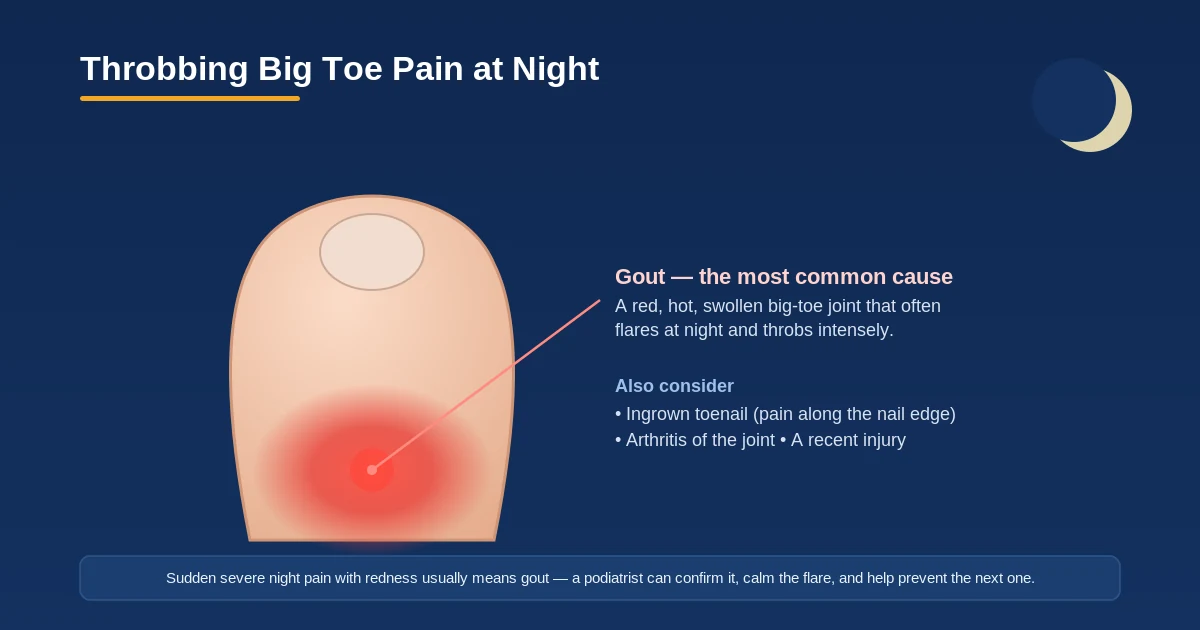
Nighttime throbbing in the big toe has three common causes: (1) Gout — uric acid crystals depositing in the first MTP joint, typically sudden and excruciating; (2) Hallux rigidus — arthritic stiffening that worsens with inactivity; (3) Peripheral neuropathy — burning/throbbing that’s worse at rest. Gout is most likely if pain woke you from sleep and the joint is hot and swollen. See a podiatrist for uric acid testing.
— Dr. Tom Biernacki, DPM, Board-Certified Podiatric Surgeon, Balance Foot & Ankle
Night pain in the big toe is worth testing for gout. Book a real appointment time online, 24/7 — Howell or Bloomfield Township.
Medically reviewed by Dr. Tom Biernacki, DPM
Board-certified podiatric surgeon | Balance Foot & Ankle
Last reviewed: May 2026
Being jolted awake by a throbbing, aching big toe is one of the more disorienting pain experiences our patients describe. The house is quiet, you haven’t done anything to your foot, and yet there it is — a pulsating, sometimes excruciating pain that won’t let you sleep. In our Howell and Bloomfield Township offices, we work through a specific diagnostic framework for nighttime big toe pain because the causes are distinct from daytime pain and some of them — gout in particular — require urgent treatment.
Why Big Toe Pain Is Worse at Night
Before going through individual causes, it’s worth understanding why pain in general — and foot pain specifically — often amplifies at night. During the day, your brain processes thousands of sensory signals simultaneously: the feel of the floor, background noise, visual input, task demands. This sensory competition effectively “gates” or dampens pain signals through a mechanism called descending inhibition.
At night in a quiet room, lying still with no competing sensory input, pain signals from an inflamed joint, a compressed nerve, or an infected tissue become the dominant signal in your nervous system. The pain hasn’t gotten worse — your brain is simply paying much more attention to it. This is why conditions like arthritis, gout, neuropathy, and infections characteristically feel more severe at night.
Additionally, in certain conditions — gout being the most striking example — physiological changes at night (lower body temperature, altered kidney function, dehydration from sleep) actually do make the condition physically worse, not just perceptually worse.
Key takeaway: Gout attacks in the big toe joint (first metatarsophalangeal joint) are classically nocturnal — they often begin between 2–4 AM, waking the patient from sleep with excruciating pain so severe that even bedsheet weight is intolerable. The joint is hot, red, and extremely swollen. This presentation is essentially diagnostic of gout and requires same-day or next-day evaluation for uric acid testing and treatment.
Cause 1: Gout — The Most Urgent Diagnosis
Gout is a form of inflammatory arthritis caused by deposition of monosodium urate crystals in joints when blood uric acid levels become chronically elevated (hyperuricemia). The first metatarsophalangeal (MTP) joint — the big toe joint — is the single most common site of acute gout attacks, accounting for approximately 60% of initial episodes. The medical term for big toe gout is podagra.
The classic gout attack begins suddenly, often between 2–4 AM, after a period of dehydration, alcohol consumption (especially beer and spirits), high-purine foods (shellfish, red meat, organ meats), or certain medications (diuretics, low-dose aspirin, cyclosporine). The urate crystals precipitate out of solution when the joint temperature drops during sleep, triggering an explosive inflammatory response.
What distinguishes gout from every other cause on this list: the joint is hot (noticeably warm to touch), brilliantly red, dramatically swollen, and the pain is so severe that even light touch — clothing, a bedsheet — is unbearable (allodynia). Patients often say it is “the worst pain of my life.” This presentation, especially in a middle-aged man with a history of heavy protein or alcohol intake, is essentially diagnostic before any testing is done.
Gout is confirmed with serum uric acid measurement, joint aspiration showing needle-shaped negatively birefringent crystals (the gold standard), and/or musculoskeletal ultrasound showing the “double contour sign” of urate deposition on cartilage. Treatment: NSAIDs (indomethacin, naproxen), colchicine, or corticosteroids for the acute attack; urate-lowering therapy (allopurinol, febuxostat) for prevention of future attacks.
Pain that wakes you up is worth a real look
Gout is the one cause on this list that shouldn’t wait — started early, treatment shortens the attack. The others here, arthritis, an ingrown nail, bunion bursitis and neuropathy, are not emergencies, but none of them resolve on their own either, and they are genuinely hard to tell apart at two in the morning. If the throbbing has woken you more than a night or two, have the toe looked at.
Howell — 4330 E Grand River Ave, Howell MI 48843 · Bloomfield Hills — 43494 Woodward Ave #208, Bloomfield Township MI 48302
Cause 2: Hallux Rigidus (Big Toe Arthritis)
Hallux rigidus — degenerative osteoarthritis of the first MTP joint — is the most common arthritic condition of the foot, affecting approximately 1 in 40 adults over age 50. The cartilage that cushions the joint surface wears away, bone rubs on bone, and bone spurs (osteophytes) form around the joint margins. The result is a stiff, painful big toe joint that resists both bending and pushing off during walking.
Unlike gout, hallux rigidus pain builds gradually over months to years. Nighttime throbbing represents the inflammatory component — the synovial lining of the arthritic joint produces inflammatory mediators throughout the day, and the resulting joint effusion and capsular distension produce the nocturnal aching. Morning stiffness that loosens with movement is another hallmark.
Key takeaway: Big toe arthritis (hallux rigidus) produces pain that worsens at night for a specific reason: during the day, your brain is flooded with sensory input from a thousand different sources, effectively dampening the pain signal. At rest in a quiet bedroom, the joint inflammation becomes the dominant signal and feels much worse. This nocturnal amplification is characteristic of inflammatory joint disease.
Hallux rigidus is graded 0–4 based on X-ray findings and clinical restriction. Grade 0–1 responds well to orthotics, shoe modification (stiff-soled shoes that reduce toe bending), and anti-inflammatory measures. Grade 2–3 often benefits from corticosteroid injection into the joint. Grade 4 (severe, bone-on-bone with near-total loss of motion) is the threshold for surgical consideration — either cheilectomy (bone spur removal) or joint fusion (arthrodesis).
Cause 3: Ingrown Toenail
An ingrown toenail produces throbbing pain that is typically at the nail fold (beside the nail), not deep within the joint — a distinction that helps clinically separate it from gout or arthritis. However, an infected Stage 2–3 ingrown toenail with a significant inflammatory response can create a pounding, pulsatile pain that wakes patients at night.
At night, elevated extremity position during sleep may temporarily reduce the blood pooling in the toe that occurs when standing — but the skin tension from the infected nail fold, combined with the absence of activity-related distraction, makes the pain feel worse. A quick visual inspection — is the toe red, swollen, and tender specifically at the nail corners? Is there drainage? — confirms this cause.
Cause 4: Sesamoiditis
The sesamoid bones are two small pea-sized bones embedded in the flexor hallucis brevis tendon under the first metatarsal head — directly under the big toe joint on the ball of the foot. They act as pulleys, improving the mechanical advantage of the big toe’s flexor mechanism. Sesamoiditis is inflammation of the sesamoid bone, its surrounding tissue, or a stress fracture within the bone itself.
Sesamoiditis pain is specifically located under the ball of the foot at the base of the big toe — not in the joint itself. It is worsened by pushing off (the toe extension motion at toe-off) and by any loading of the forefoot. Nighttime throbbing from sesamoiditis reflects the inflammatory response in the highly vascularized area under the first metatarsal head. Ballet dancers, runners, and people who walk barefoot on hard floors are disproportionately affected.
Cause 5: Bunion (Hallux Valgus) with Bursitis
A bunion is a lateral deviation of the great toe at the first MTP joint, with a prominent bony medial eminence forming on the inner side of the foot. The overlying tissue contains a bursa — a fluid-filled sac that can become acutely inflamed, especially after a day in tight shoes. Bursitis produces throbbing pain at the bunion site that is often worst at night after the inflammatory mediators have been accumulating all day.
Bunion-associated nighttime pain is distinguished by its location — the inner side of the foot at the big toe base — and by its direct relationship to shoe pressure earlier that day. Aggressive shoe compression during the day = worse bursitis-related night pain.
Cause 6: Peripheral Neuropathy
Peripheral neuropathy — most commonly from diabetes, B12 deficiency, or alcohol — causes damage to the small sensory nerve fibers of the feet. The resulting pain is classically described as burning, tingling, electric shocks, or “walking on glass” — typically bilateral and affecting multiple toes and the entire foot. Neuropathic pain is characteristically worse at night because of reduced sensory competition and because skin temperature drops with immobility, which triggers ectopic nerve firing in damaged fibers.
Key takeaway: Peripheral neuropathy typically produces burning, tingling, or electric-shock pain in multiple toes and the entire foot — not a single-joint throbbing localized to the big toe. If your nighttime toe pain is isolated precisely to the big toe joint and is throbbing rather than burning, gout or arthritis is far more likely than neuropathy.
Cause 7: Erythromelalgia
Erythromelalgia is a rare but distinctive condition — episodic burning pain, redness, and warmth in the feet (and sometimes hands) triggered by warmth and relieved by cold. The episodes can be severely painful and characteristically occur in warm environments or when in bed under covers. Erythromelalgia can be primary (idiopathic, often a sodium channel gene mutation) or secondary to polycythemia vera, essential thrombocythemia, or other conditions. Any patient with classic burning, red, warm feet relieved by hanging legs out of the covers needs evaluation for this condition and for underlying hematologic disease.
⚠️ When big toe night pain requires urgent evaluation
- Sudden onset severe throbbing with a hot, red, dramatically swollen big toe joint — gout attack, needs same-day evaluation and treatment
- Big toe pain with fever and chills — possible septic joint (infected joint), requires emergency evaluation
- Diabetic patient with any acute big toe pain — neuropathy masks serious infections; urgent podiatric evaluation regardless of pain severity
- Night pain following big toe trauma — check for fracture with X-ray
- Progressive worsening of night pain over weeks — not improving, needs diagnosis to guide treatment
The One That Has to Be Excluded First: Infection in the Joint
Gout and a joint infection can look identical. Both give a hot, red, swollen, exquisitely painful big toe that comes on over hours and is unbearable at night. The difference is that gout will settle on its own over a week or two, and septic arthritis destroys the joint if it is not treated within days.
This is why an acutely hot big toe is not something to wait out, particularly the first time it happens. The features that shift the balance toward infection:
- Fever, chills, or feeling systemically unwell. Gout is agonising but usually leaves you otherwise fine.
- Redness spreading beyond the joint, up the foot or toward the ankle, rather than confined to the toe.
- A break in the skin — a recent ingrown nail, a cut, a blister, a puncture, a nail procedure, or a chronic ulcer nearby.
- Diabetes, immune suppression, or peripheral neuropathy, where infection spreads faster and hurts less than it should.
- A first episode with no gout history, especially in someone who does not fit the usual pattern.
Two points worth being blunt about. First, a normal uric acid level does not rule out gout, and a raised one does not rule out infection — blood tests cannot separate these two reliably. Aspirating the joint and examining the fluid is the only definitive answer: crystals under polarised light confirm gout, and cell count and culture identify infection. Second, the two can coexist. A patient with known gout can still develop an infected joint, and “it is just my gout again” is how that gets missed. If the joint is hot and swollen and you feel unwell with it, that needs to be looked at urgently rather than waited out. Book an evaluation online.
If a big toe is hot and swollen alongside a fever, spreading redness, or any break in the skin, that is a same-day problem, not a next-week one.
Pseudogout: Gout’s Look-Alike With a Different Answer
There is a second crystal arthritis that presents almost exactly like gout, is far less well known, and is routinely diagnosed as gout for years.
Pseudogout — calcium pyrophosphate deposition, or CPPD — involves a different crystal depositing in and around the joint. The attack looks the same from the outside: sudden onset, hot, swollen, red, severe, often overnight.
What separates it:
- Uric acid is typically normal, and urate-lowering treatment does nothing. Someone whose “gout” has never responded to allopurinol is worth a second look.
- It favours larger joints — the knee above all, then the wrist and ankle. It can affect the big toe, but a first attack in the knee of an older patient points here rather than to gout.
- It is more common with age, and is associated with thyroid, parathyroid, and iron-storage disorders — which is why a diagnosis of pseudogout should prompt a look at those rather than stopping at the joint.
- X-rays can show chondrocalcinosis — a fine line of calcium within the cartilage — which gout does not produce.
- The crystals differ under polarised light: urate crystals are needle-shaped and negatively birefringent; CPPD crystals are shorter, rhomboid, and positively birefringent. This is the same joint aspiration described above, answering a second question at no extra cost.
Treatment of an acute attack overlaps — anti-inflammatories, colchicine, or a corticosteroid injection — but the long-term management diverges completely, because there is no equivalent of allopurinol for CPPD and the dietary advice that matters in gout is irrelevant here. Being told to give up red meat and beer for a condition that has nothing to do with purines is a common and entirely avoidable outcome.
If you have had recurring attacks in one joint that have never been confirmed by fluid analysis, that confirmation is worth getting. Balance Foot & Ankle sees patients in Howell (4330 E Grand River Ave, Howell, MI 48843) and Bloomfield Township (43494 Woodward Ave #208, Bloomfield Township, MI 48302). Call (810) 206-1402.
How We Diagnose Nighttime Big Toe Pain
In our diagnostic workup, three questions immediately focus the differential: (1) Is the pain in the joint itself, beside the nail, or under the ball of the foot? (2) Is the toe hot, red, and swollen — or just painful? (3) Was the onset sudden overnight versus gradually progressive over time?
Sudden onset + hot + red + swollen = gout until proven otherwise. X-ray (weight-bearing foot views), serum uric acid, and CBC are ordered. Weight-bearing X-ray also reveals hallux rigidus joint space narrowing, sesamoid stress fractures, and bunion deformity angle. If gout crystals are suspected and the diagnosis is uncertain, joint aspiration confirms it definitively. Neuropathy is assessed with 10-g monofilament testing and, when indicated, NCV/EMG studies.
Getting Nighttime Big Toe Pain Sorted Out
The reason this symptom is worth a visit rather than another night of guessing is that the causes above look similar at 2am and are treated in completely different directions. Gout needs medication and often urate testing. Hallux rigidus needs joint assessment and usually imaging. An ingrown nail needs a procedure that takes minutes. Neuropathy needs a workup for what is driving it. Taking an anti-inflammatory for all four gets one of them right.
Two things are worth mentioning when you call. First, whether the pain woke you from sleep or was simply there when you were lying still — a joint that wakes you from sleep with severe pain and looks red and swollen is treated as gout until proven otherwise, and it is worth being seen quickly. Second, whether the toe is hot to touch, since that changes the urgency considerably.
Balance Foot & Ankle sees patients at our Howell podiatry office and our Bloomfield Hills podiatry office. Call (810) 206-1402 or book as a new patient. If you have had episodes before, note roughly how often they come and how long they last — that history often settles the diagnosis on its own.
Frequently Asked Questions
How do I know if my big toe pain at night is gout? The combination of sudden onset (woke you up), excruciating pain at the big toe joint, and a joint that is hot, brilliantly red, and so sensitive that bedsheet touch is unbearable is virtually diagnostic of gout. A history of prior gout attacks, high-purine diet, alcohol use, or diuretic medications makes it nearly certain. Serum uric acid confirms it — though note that uric acid can be normal during an acute attack (it drops as crystals precipitate).
What relieves throbbing big toe pain at night? For suspected gout: ice, elevation, NSAIDs (naproxen 500mg or ibuprofen 600mg if no contraindications), and colchicine if prescribed. For arthritis: ice, elevation, anti-inflammatory medications. For ingrown toenail: warm soak, clean bandage, and same-day podiatric evaluation for Stage 2+. None of these are substitutes for diagnosis — a first episode of severe big toe pain warrants next-day evaluation regardless.
Can anxiety or stress cause throbbing toe pain at night? Anxiety and stress amplify pain perception and reduce pain tolerance, but they don’t cause joint inflammation or nerve damage. If you have structural or inflammatory pathology in the big toe, stress will make the nighttime pain feel worse. But recurring throbbing big toe pain always has a physical cause that needs to be identified — attributing it to stress alone is a diagnosis of exclusion only after physical causes have been ruled out.
The Bottom Line
Throbbing big toe pain at night has seven well-defined causes, and identifying which one is present determines everything about treatment. Gout — the most important to diagnose quickly — is also the most dramatic and the most distinctive. The others range from straightforward (ingrown toenail — one office visit) to requiring ongoing management (arthritis, neuropathy). None of them get better by being ignored.
Our Howell and Bloomfield Township teams see patients with nighttime big toe pain regularly and can typically identify the cause within a single comprehensive visit. Same-week appointments are often available. Stop losing sleep.
Stop the Night Pain — Get Diagnosed Today
Same-week appointments available in Howell & Bloomfield Township, MI
4.9★ | 1,123 Reviews | 3,000+ Surgeries Performed
Or call: (810) 206-1402
Sources
- Abhishek A, Roddy E, Doherty M. Gout — a guide for the general and acute physicians. Clin Med (Lond). 2017;17(1):54-59.
- Coughlin MJ, Shurnas PS. Hallux rigidus: demographics, etiology, and radiographic assessment. Foot Ankle Int. 2003;24(10):731-743.
- Dalbeth N, Merriman TR, Stamp LK. Gout. Lancet. 2016;388(10055):2039-2052.
- Richardson EG. Hallucal sesamoid pain: causes and surgical treatment. J Am Acad Orthop Surg. 1999;7(4):270-278.
- Tanaka S, Maeda S, Tanaka N, et al. The mechanism of nocturnal aggravation of pain associated with gout. Arthritis Res Ther. 2019;21(1):255.
What causes throbbing big toe pain at night?
The most common causes include gout (uric acid crystal buildup), hallux rigidus (big toe arthritis), bunion inflammation, ingrown toenail, and peripheral neuropathy. Gout classically causes sudden, severe nighttime pain that peaks between midnight and 3am.
How do you relieve throbbing toe pain at night?
Elevate the foot, apply ice for 15-20 minutes, and take NSAIDs like ibuprofen if tolerated. For gout attacks, colchicine is highly effective when taken early. Avoid tight footwear and trigger foods (alcohol, organ meats, shellfish).
When is throbbing big toe pain a medical emergency?
Seek urgent care if the toe is hot, red, and swollen with fever (possible infection), if you have diabetes (any foot wound or infection requires same-day evaluation), or if the pain began after a sudden injury that may indicate a fracture.
For a complete clinical overview: big toe fracture guide — Dr. Biernacki DPM explains hallux fractures — diagnosis, treatment and recovery timeline.
Footwear That Reduces Big-Toe Joint Pressure
If big-toe pain flares with certain shoes, stiff-soled or wide-toe options can ease pressure on the joint. See our podiatrist-recommended shoes and recommended orthotics. Night pain that recurs should be evaluated by a podiatrist.
Related big-toe pain guides
Other causes of big-toe pain to compare:

Dr. Tom Biernacki, DPM is a board-certified foot & ankle surgeon (ABFAS & ABPM) at Balance Foot & Ankle Specialists in Southeast Michigan. With over a decade of clinical experience, he specializes in heel pain, bunions, diabetic foot care, sports injuries, and minimally invasive surgery. Dr. Biernacki is a member of the APMA and ACFAS, and his patient education content on MichiganFootDoctors.com and YouTube has made him one of the most-followed foot & ankle educators on YouTube.
More questions patients ask
How do I relieve big toe pain at night?
For gout attacks: elevate the foot, apply ice, take NSAIDs like ibuprofen, and avoid pressure on the toe. Stay hydrated and avoid alcohol and purine-rich foods. If pain is severe or recurring, see a podiatrist for diagnosis and medication to manage uric acid levels.
When is throbbing big toe pain an emergency?
Seek urgent care if your big toe is red, hot, severely swollen, and you have a fever — this could indicate septic arthritis or an infected joint, which requires immediate treatment. Recurring nighttime gout attacks also need medical management to prevent joint damage.
How do you stop big toe pain at night?
Acute gout flare: ice 15 minutes 3-4 times nightly, NSAIDs (if no contraindications), elevation. Avoid pressure (sock-free or open-toed sleep). Long-term prevention: hydration, low-purine diet, allopurinol or febuxostat under medical supervision. See a podiatrist if pain persists or recurs to identify the underlying cause.
Could throbbing big toe pain be something serious?
Yes. Septic arthritis presents as severe throbbing pain with fever, redness, and warmth — this is a surgical emergency requiring joint drainage. Critical limb ischemia from PAD causes rest pain in toes — needs vascular evaluation. Subungual melanoma rarely presents with deep pain. Get evaluated promptly for severe or persistent toe pain.
Is gout in the big toe serious?
Gout attacks resolve in 3–10 days but recur and can damage joints. Treatment: colchicine or NSAIDs acutely, allopurinol for prevention, low-purine diet. Dr. Tom Biernacki DPM diagnoses and treats gout.
When should I see a podiatrist for big toe pain at night?
See Dr. Tom Biernacki DPM if big toe pain at night persists >4 weeks, worsens, or prevents normal walking. Same-day at Balance Foot & Ankle — Howell & Bloomfield Township. (810) 206-1402.
Does insurance cover podiatry in Michigan?
Most PPO plans and Medicare Part B cover medically necessary podiatry. We accept BCBS and most Michigan insurers. Call (810) 206-1402.
Why does my big toe throb at night?
Throbbing big toe pain at night is most commonly caused by gout (uric acid crystals depositing in the joint, which is 7x more likely in the big toe), hallux rigidus (arthritic stiffening of the big toe joint), or an ingrown toenail with secondary infection. Less common causes include peripheral neuropathy, Raynaud's phenomenon, and stress fractures. Gout attacks classically begin at night because uric acid crystalizes more readily in cooler temperatures and lower pH that occur during sleep.
Is throbbing toe pain at night a sign of gout?
Possibly, yes. Gout is the most common cause of sudden, severe, throbbing big toe pain at night — particularly if the joint is red, hot, swollen, and exquisitely tender to even light touch (like a bedsheet). Classic gout affects the big toe (metatarsophalangeal joint) in 50-70% of first attacks. A blood uric acid test and joint aspiration (looking for urate crystals) can confirm the diagnosis.
How do I relieve throbbing big toe pain at night?
For immediate relief: elevate the foot above heart level to reduce blood pressure in the area, apply ice wrapped in a cloth for 15-20 minutes (not directly to skin), and take an OTC anti-inflammatory (ibuprofen or naproxen) if not contraindicated. Keep bedding off the toe — even sheet contact can be excruciating with gout. See a doctor promptly for diagnosis, as gout requires prescription treatment and recurs if uric acid is not managed.
When should I be worried about big toe pain at night?
Seek urgent care if: pain is severe and the joint is red, hot, and swollen (possible gout or septic joint), you have fever alongside the toe pain (infection), the toe appears deformed or you had a recent injury, pain is accompanied by numbness or tingling spreading up the foot, or pain has been worsening over weeks without injury. Untreated gout, septic arthritis, or stress fractures worsen significantly without treatment.
Still have a question about coverage or cost? Book online and we will check your benefits before your visit: Book in Howell · Book in Bloomfield Township. Prefer to talk it through first? Call (810) 206-1402.