Best Foot Cream for Cracked Heels & Dry Feet 2026 | Podiatrist Picks
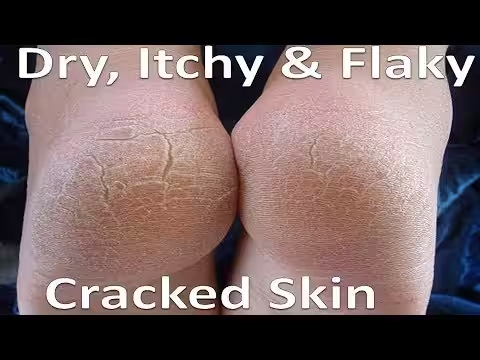
For cracked heels and dry feet, the right cream combines urea (10-25%) for keratolysis, lactic acid for hydration, and petrolatum for sealing — features the typical drugstore moisturizer lacks.
You’ve come to the right podiatry team. Dr. Tom Biernacki, DPM, FACFAS — board-certified foot & ankle surgeon with 3,000+ surgeries — explains exactly what the best foot cream for cracked heels means and what works. Call (810) 206-1402 for same-day appointment at Howell or Bloomfield Township.
Quick answer: Best Foot Cream Cracked Heels Dry Feet 2026 is a common foot/ankle topic that affects many patients. Effective treatment starts with a targeted diagnosis, conservative-first treatment, and escalation only when needed. We treat this regularly at our Howell and Bloomfield Township practices. Call (810) 206-1402.
The most important clinical decision with Best Foot Cream Cracked Heels Dry Feet 2026 isn’t which treatment to start with — it’s identifying the correct subtype. That changes everything. Call (810) 206-1402.
Quick Answer
Best Foot Cream for Cracked Heels & Dry Feet 2026 Podi relates to plantar fasciitis — typically caused by tight calves and arch overload. Most patients improve in 6-12 weeks with conservative care. Same-week appointments in Howell + Bloomfield Township: (810) 206-1402.
Medically Reviewed by Dr. Tom Biernacki, DPM — Board-Certified Podiatrist, Balance Foot & Ankle Specialists, Michigan. Last updated April 2026.
The active ingredient is what separates effective foot creams from expensive moisturizers — urea concentration is the key variable, with 20–40% urea providing the keratolytic (skin softening) action needed to actually reverse deep heel fissures, not just temporarily soothe them. Dr. Tom Biernacki, DPM, at Balance Foot & Ankle in Michigan, recommends the following foot creams based on formulation chemistry and clinical outcomes in patients with cracked heels, xerosis, and callus.
▶ Watch
Quick Answer: What Concentration of Urea Do You Need?
Urea cream concentration determines the clinical effect: 10% urea = moisturizing and mild softening (appropriate for maintenance); 20–30% urea = keratolytic (actively dissolves and softens thickened, calloused skin — the minimum effective concentration for cracked heels); 40% urea = strong keratolytic appropriate for thick callus and deep heel fissures (requires consistent use, not appropriate for skin between toes). Products marketed as “foot cream” without specifying urea concentration typically contain 0–5% urea and function as basic moisturizers — they will not heal established heel cracks. Always check the label for urea percentage before purchasing.
1. Flexitol Heel Balm (25% Urea) — Best Overall for Cracked Heels
Flexitol Heel Balm at 25% urea is the most prescribed foot cream in our clinic for heel fissures and callused heels. The 25% urea concentration is keratolytic enough to significantly soften deep heel cracks within 1–2 weeks while remaining safe for sensitive skin and diabetic patients. The glycerol-based emollient formula reduces transepidermal water loss, maintaining the softening effect between applications. Apply to clean, dry heels twice daily — after showering is ideal because the urea penetrates more effectively into slightly softened skin. For deep cracks: apply, cover with a thin cotton sock overnight. Available in 56g and 112g. APMA Seal of Acceptance recipient.
Eucerin’s 10% urea foot cream is appropriate for daily maintenance use once initial cracking has been resolved with a higher-concentration product. The 10% urea provides ongoing barrier function protection without the strong keratolytic effect that 25–40% urea products produce — making it appropriate for everyday use on normal-to-dry feet that have not developed severe cracking. Eucerin’s ceramide and glycerin base supports barrier restoration. Suitable for sensitive skin and diabetic patients. View Eucerin Intensive Repair Foot Creme on Amazon →
3. Gehwol Med Salve for Cracked Skin (15% Urea) — Best for Bleeding Cracks
Gehwol Med Salve uses a unique combination of 15% urea with petrolatum and antibacterial thymol (a natural antimicrobial) — making it the most appropriate product when heel cracks have progressed to the point of bleeding or open fissuring. The antibacterial component reduces infection risk in open heel cracks while the urea softens the surrounding callus. Apply to clean, dry heels after gentle debridement with a pumice stone. Cover with a thin sock for best results. Not appropriate for use between toes. Available in 75mL. View Gehwol Med Salve on Amazon →
4. Kerasal Foot Repair (30% Urea) — Best for Thick Callus
Kerasal Intensive Foot Repair provides 30% urea in a gentle AHA-containing formula that produces the fastest callus softening of any OTC product. The 30% urea concentration is appropriate for severely thickened callus that has not responded to 10–15% products. The AHA (ammonium lactate) complements the urea by acting on the intercellular cement of the stratum corneum through a different mechanism — the combination accelerates keratolysis. Apply twice daily for 7–14 days for severe callus, then transition to a 10–25% maintenance product. Caution: do not apply to broken or cracked skin until the crack epithelializes. View Kerasal Foot Repair on Amazon →
5. CeraVe Healing Ointment — Best for Diabetic Patients
For diabetic patients with dry skin who need a safe, fragrance-free moisturizer without high urea concentration (which can cause stinging in fragile diabetic skin), CeraVe Healing Ointment provides a petrolatum-ceramide combination that restores the skin barrier without risk of irritation. Ceramides (specifically ceramide 1, 3, and 6-II) are the natural lipids that make up the stratum corneum barrier — depleted in diabetic xerosis — and are replenished by this formulation. Not keratolytic but appropriate for maintenance after clinical debridement of callus. Apply to clean, dry feet nightly. Do NOT apply between toes. View CeraVe Healing Ointment on Amazon →
Proper Application Protocol: The 5-Minute Heel Routine
For maximum benefit: (1) After showering, while feet are still slightly damp, use a medium-grit pumice stone or foot file to gently remove loose dry skin from the heel — do not aggressively scrub, just remove flaking material; (2) Pat feet dry thoroughly with a towel; (3) Apply urea cream generously to the heel, Achilles region, and any callus areas; (4) Avoid applying between toes — moisture retention there promotes fungal infection; (5) Cover heels with thin cotton socks overnight for first 2 weeks of treatment to enhance penetration. This 5-minute routine performed nightly produces clinically visible improvement in heel fissures within 7–14 days with a 25%+ urea product.
When to See a Podiatrist for Cracked Heels
Cracked heels that are bleeding, painful with every step, or not responding to 2–4 weeks of twice-daily 25%+ urea cream require podiatric evaluation. Deep heel fissures can become infected, particularly in diabetic patients. In our clinic, severe heel cracks are treated with professional debridement (safe removal of hyperkeratotic skin), application of medical-grade urea paste under occlusion, and evaluation for the underlying cause — often hypothyroidism, psoriasis, or ichthyosis in very severe cases. Diabetic patients with any open heel crack should call (810) 206-1402 for same-day evaluation — open wounds in neuropathic feet require professional management.
Disclosure:As an Amazon Associate, Balance Foot & Ankle earns from qualifying purchases. All product recommendations are based on clinical experience and independent of affiliate relationships.
Medically reviewed by Dr. Tom Biernacki, DPM — podiatric physician and surgeon, Howell and Bloomfield Township, Michigan.
Dr. Tom’s Pick: Women’s Shoe Comfort Inserts
For women who want comfort without giving up their shoes — Foot Petals cushions work in heels, flats, and sandals.
Foot Petals Heavenly Heelz — Cushioned heel insert for pumps and heels — eliminates slipping and ball-of-foot pain in dress shoes.
Foot Petals Tip Toes — Metatarsal cushion for the toe box — stops forefoot pain in heels and narrow shoes.
Affiliate disclosure: As an Amazon Associate, Balance Foot & Ankle earns from qualifying purchases.
👟 Dr. Tom’s Pick: FLAT SOCKS for Minimalist & Zero-Drop Shoes
Ultra-thin flat-knit socks designed specifically for zero-drop, barefoot, and minimalist shoes. No bunching, no seams — just foot-contact-the-ground feel with moisture control.
View FLAT SOCKS on Amazon →
📧 Get Dr. Tom’s Free Lab Test Guide
Discover the 5 lab tests every person over 35 should ask their doctor about — explained in plain English by a board-certified physician.
Impact-absorbing recovery sandal — wear after long days on your feet.
As an Amazon Associate, Balance Foot & Ankle earns from qualifying purchases. Product recommendations are based on clinical experience; prices and availability shown above update live from Amazon.
When to See a Podiatrist
If foot or ankle pain has been bothering you for more than a few weeks, home care alone may not be enough. Balance Foot & Ankle offers same-week appointments at our Howell and Bloomfield Township clinics — no referral needed in most cases. Bring your current shoes and a short list of symptoms and we’ll build you a treatment plan in one visit.
Dr. Tom Biernacki, DPM · Board-Certified Foot & Ankle Surgeon. Specializes in conservative-first care, minimally invasive bunion surgery, and complex reconstruction.
Dr. Carl Jay, DPM · Accepting new patients. Specializes in sports medicine, athletic injuries, and routine podiatric care.
Dr. Daria Gutkin, DPM, AACFAS · Accepting new patients. Specializes in surgical reconstruction and pediatric podiatry.
Locations: 4330 E Grand River Ave, Howell, MI 48843 · 43494 Woodward Ave Suite 208, Bloomfield Township, MI 48302
If symptoms persist past 2 weeks, affect your normal activity, or are accompanied by red-flag symptoms (warmth, redness, swelling, inability to bear weight).
What does treatment cost?
Most diagnostic visits and conservative treatments are covered by Medicare and major insurers. Out-of-pocket costs vary by your specific plan.
How quickly can I get an appointment?
Most non-urgent cases see us within 5 business days. Urgent cases (sudden pain, possible fracture) typically same or next business day.
If home treatment isn’t providing relief for your foot skin condition, our podiatry team at Balance Foot & Ankle can help with same-day evaluations and advanced in-office care.
Dr. Tom Biernacki, DPM is a board-certified foot & ankle surgeon (ABFAS & ABPM) at Balance Foot & Ankle Specialists in Southeast Michigan. With over a decade of clinical experience, he specializes in heel pain, bunions, diabetic foot care, sports injuries, and minimally invasive surgery. Dr. Biernacki is a member of the APMA and ACFAS, and his patient education content on MichiganFootDoctors.com and YouTube has made him one of the most-followed foot & ankle educators on YouTube.
Balance Foot & Ankle surgeons are affiliated with Trinity Health Michigan, Corewell Health, and Henry Ford Health — three of Michigan’s largest health systems.