
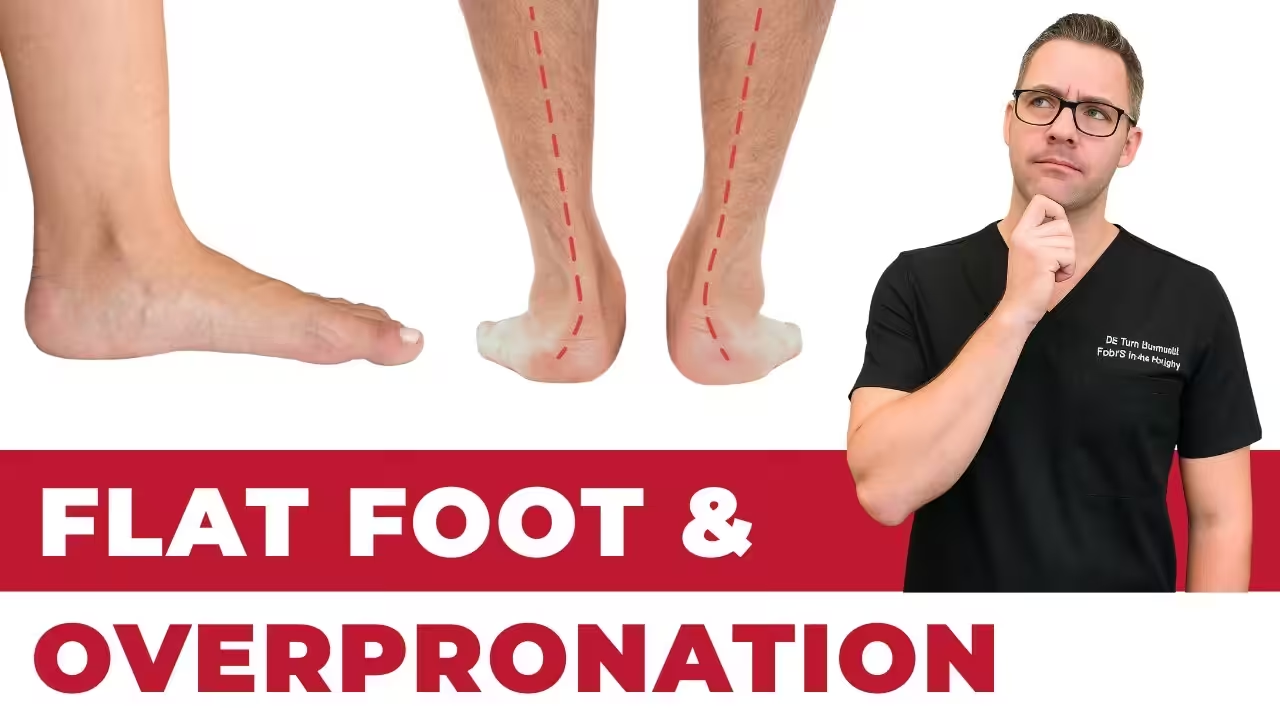
For flat feet and overpronation, semi-rigid insoles with a deep heel cup and structured arch shell deliver the most consistent results — Powerstep, Superfeet, and Currex top the podiatrist short list.
You’ve come to the right podiatry team. Dr. Tom Biernacki, DPM, FACFAS — board-certified foot & ankle surgeon with 3,000+ surgeries — explains exactly what the best insoles for flat feet and overpronation means and what works. Call (810) 206-1402 for same-day appointment at Howell or Bloomfield Township.
Quick answer: The best orthotics for flat feet overpronation have a structured polypropylene shell, deep heel cup (4mm+), and arch contour matched to your foot type. Top OTC picks: Powerstep Pinnacle, Superfeet Green, Sole Active. For chronic conditions, custom orthotics outperform OTC every time. Call (810) 206-1402.
Best Insoles for Flat Feet 2026: A Podiatrist’s 5 Picks (and Why Most Flat-Foot Patients Pick the Wrong One)
Flat feet don’t need foam cushion — they need semi-rigid arch control. Here are the 5 over-the-counter orthotics I actually hand out in my Howell and Bloomfield Township clinics, ranked by which flat-foot patient each one fits best.
The best insoles for flat feet are semi-rigid orthotics with a deep heel cup and structured medial post — not foam cushion inserts. My #1 pick is the PowerStep Pinnacle Maxx, a higher-density orthotic with a 7-degree medial wedge that controls rearfoot eversion without over-correcting. For patients who also have forefoot pain (metatarsalgia, neuroma), I prefer the PowerStep Pinnacle Plus Met. Athletic flat feet in running or court shoes do best with CURREX RunPro (High profile). The classic PowerStep Pinnacle is the everyday workhorse for mild-to-moderate flat feet. If a patient can’t tolerate PowerStep’s firmness, Spenco Total Support Max is the softer transition option. Cushion-only foam insoles are the single most common mistake flat-foot patients make — they make the problem worse.
What’s on This Page
- Quick Answer
- #1 Doctor’s Top Pick: PowerStep Pinnacle Maxx
- #2: PowerStep Pinnacle (Everyday)
- #3: PowerStep Pinnacle Plus Met (Flat Feet + Forefoot Pain)
- #4: CURREX RunPro High (Athletic Flat Feet)
- #5: Spenco Total Support Max (Softer Alternative)
- Head-to-Head Comparison
- Which PowerStep for Which Patient?
- When to See a Podiatrist Instead
- FAQs
#1 · PowerStep Pinnacle Maxx
The Pinnacle Maxx is what I reach for when a patient has moderate to severe flat feet — meaning visible arch collapse when standing, pain along the inside of the ankle, or early posterior tibial tendon dysfunction. The 7-degree medial post is aggressive enough to resist rearfoot eversion during midstance, which is where most flat-foot mechanics go wrong. The deep heel cradle locks the calcaneus so the arch support actually does its job.
Pros
- 7° medial wedge gives the most aggressive rearfoot control in the PowerStep line
- Deep heel cradle reduces pronation at heel strike (where flat feet fail first)
- Firm semi-rigid shell lasts 6-12 months of daily wear
- Fits most dress shoes, walking shoes, and athletic shoes after full-length trim
Cons
- Not for high-arch feet — will feel like standing on a rock
- Needs a 1-2 week break-in; jumping straight to 8-hour days causes arch soreness
- Too firm for patients with neuropathy or diabetic insensate feet
In my clinic, roughly 6 out of 10 flat-foot patients I see are in a foam cushion insole that’s making their pain worse. The Maxx is the orthotic I hand to the patient who has actual arch collapse and needs mechanical control — not a pillow. Start with 2 hours a day for the first three days, then build up.
#2 · PowerStep Pinnacle (Classic)
The classic Pinnacle is the one I recommend to most first-time orthotic wearers who have mild-to-moderate flat feet. The 4-degree medial wedge gives real arch support without the aggressive feel of the Maxx, so the break-in period is shorter and more people can tolerate it through a full workday on day one. This is the “safe first orthotic” for a flat-foot patient who isn’t yet sure they can handle a semi-rigid device.
Pros
- 4° medial post — meaningful arch support without overwhelming first-time users
- Medium-density EVA under the forefoot adds shock absorption
- Slim enough to fit in most dress shoes and loafers
- Shortest break-in period of any semi-rigid orthotic in this roundup
Cons
- Not enough support for severe flat feet or posterior tibial tendon dysfunction
- Lasts 6-9 months of daily wear — slightly less durable than the Maxx
- May compress into the shoe over time for heavier patients (200+ lbs)
This is the orthotic I put in my own daily walking shoes. It’s the one I give to patients who have mild flat feet plus general foot fatigue — not severe collapse. If the Maxx feels like too much, this is where I step them down to.
#3 · PowerStep Pinnacle Plus Met
Flat feet and forefoot pain travel together more often than most patients realize. When the arch collapses, the forefoot spreads — which is why so many flat-foot patients end up with metatarsalgia (ball-of-foot pain), Morton’s neuroma, or capsulitis of the second metatarsal. The Pinnacle Plus Met has the same 4-degree medial post as the classic Pinnacle, but with a built-in metatarsal dome that off-loads the ball of the foot. It’s the single best over-the-counter option for the “my arches are falling AND my forefoot burns” patient.
Pros
- Metatarsal pad placement is anatomically correct — sits proximal to the metatarsal heads
- Off-loads forefoot pressure while still supporting the arch
- Works for patients with flat feet + neuroma, metatarsalgia, or sesamoiditis
- Same durable semi-rigid shell as other PowerStep orthotics
Cons
- Met pad feels strange for the first few days — not everyone adjusts
- Won’t fit in shallow dress shoes or loafers after trim
- Not needed if the patient only has arch pain (use the classic Pinnacle instead)
A huge tell: when a flat-foot patient says “it’s not just my arch, the ball of my foot burns after 2 hours” — that’s the Pinnacle Plus Met patient. I see this overlap constantly in runners, teachers, nurses, and anyone who walks on concrete all day.
#4 · CURREX RunPro (High Profile)
Static PowerStep orthotics are built for all-day walking and standing. Athletic flat feet need something different — a dynamic orthotic that lets the foot flex through gait but still controls excessive pronation at toe-off. That’s what CURREX RunPro High does. It’s the first orthotic I recommend for a flat-footed runner, pickleball player, or tennis player who’s trying to keep training with minimal disruption.
Pros
- Flexible shell allows forefoot propulsion — doesn’t fight running mechanics
- High profile specifically sized for flat/low-arch feet (don’t buy the low or medium)
- Removable insole of most running shoes comes out cleanly to fit the CURREX
- Holds shape through thousands of miles of running
Cons
- Profile matters — the Low and Med variants are wrong for flat feet, buy the HIGH
- Less aggressive arch support than PowerStep Maxx for all-day standing
- Higher price point than most OTC athletic insoles
Runners with flat feet who buy a “stability” running shoe plus a rigid orthotic end up with a shoe that fights their mechanics. The CURREX RunPro High is the orthotic that lets you keep your neutral or mild-stability shoe and still get arch control where you actually need it — which is mostly at heel strike and toe-off.
#5 · Spenco Total Support Max
Not every flat-foot patient can tolerate PowerStep’s firmness. Sometimes a patient has mild flat feet plus general foot tenderness — often from years in bad shoes — and a semi-rigid orthotic feels like a concrete slab. Spenco Total Support Max is the step down. It still has a structured arch cradle and a medial post, but the shell is softer and the top layer is more forgiving. It’s the orthotic I recommend as a 30-60 day bridge before some patients step up to PowerStep.
Pros
- Softer shell is tolerable for patients who can’t adapt to PowerStep’s firmness
- Still has a real arch cradle — not a foam cushion
- Good bridge option for first-time orthotic users
- Lower price point than PowerStep
Cons
- Less arch control than any PowerStep — not enough for severe flat feet
- Wears out faster (4-6 months) than PowerStep
- Can bottom out under heavier patients
I use this specifically as a 30-60 day bridge. If a patient comes in telling me they “tried orthotics once and couldn’t stand them,” I’ll start them on the Spenco for a month before stepping up to PowerStep Pinnacle. Nine times out of ten, once their foot acclimates to ANY arch support, they tolerate the PowerStep just fine the second time around.
Head-to-Head Comparison
| Product | Best For | Arch Support | Firmness | Durability | Break-in |
|---|---|---|---|---|---|
| PowerStep Pinnacle Maxx | Severe flat feet, PTTD | 7° medial wedge (highest) | Firm | 6-12 months | 1-2 weeks |
| PowerStep Pinnacle | Mild-moderate flat feet, everyday | 4° medial post | Medium-firm | 6-9 months | 3-5 days |
| Pinnacle Plus Met | Flat feet + forefoot pain | 4° + met pad | Medium-firm | 6-9 months | 5-7 days |
| CURREX RunPro High | Running, court sports | Dynamic / flexible | Medium | Mileage-dependent | Short |
| Spenco Total Support Max | PowerStep-intolerant patients | Cradled, softer | Soft-medium | 4-6 months | Minimal |
Which Insole for Which Patient? (The Clinic Decision Tree)
If YES → Start with PowerStep Pinnacle Maxx (#1). You need the 7° medial wedge. If the Maxx is too aggressive, step down to the Spenco Total Support Max for 30-60 days, then retry the Maxx.
If YES → PowerStep Pinnacle Plus Met (#3). The built-in met pad off-loads the forefoot while still supporting the arch. This is the most under-used insole for flat-foot patients who have forefoot overlap.
If YES → CURREX RunPro HIGH (#4). Not medium, not low — HIGH. A static orthotic fights running mechanics; CURREX flexes with your foot. The profile size matters more than most patients realize.
If YES → PowerStep Pinnacle (#2), the classic. This is the “safe first orthotic” for mild-moderate flat feet with a short break-in period.
When OTC Insoles Aren’t Enough — Come See a Podiatrist
Over-the-counter orthotics work for most flat-foot patients, but there are specific situations where you should skip the self-treatment and come into the office:
- Pain along the inside of the ankle that’s worse with standing — this can be posterior tibial tendon dysfunction, which progresses quickly without proper treatment
- One foot flatter than the other (acquired flatfoot) — asymmetry is a red flag for tendon failure or ligament rupture
- Flat feet plus numbness, burning, or tingling — needs ruling out for neuropathy or tarsal tunnel syndrome
- Flat feet in a child under 7 who has pain — pediatric flat foot with pain is not normal and needs evaluation
- Tried 2 different semi-rigid orthotics for 60 days and still have pain — you likely need a custom orthotic or a different diagnosis
- Diabetes + flat feet — higher risk for ulceration; needs professional orthotic fitting
Frequently Asked Questions
Are flat feet actually a problem, or is this overhyped?
Why not just use a cushioned insole? It feels better at first.
How long does it take for an orthotic to work?
Can I wear the same orthotic in my work shoes and running shoes?
Do OTC orthotics work as well as custom orthotics?
Will orthotics weaken my foot muscles?
Why did you drop Superfeet Green and Dr. Scholl’s from your recommendations?
How often should I replace my orthotic?
The Bottom Line
Flat feet need structure, not cushion. Start with PowerStep Pinnacle Maxx if you have moderate-to-severe flat feet or Pinnacle (classic) if you have mild flat feet. Add the met-pad version if you have forefoot pain. Use CURREX RunPro HIGH for running. Spenco is the bridge for patients who can’t tolerate PowerStep firmness. Skip anything labeled “gel” or “cushion” for flat-foot use.
Tried OTC Orthotics and Still in Pain?
That’s when I want to see you in the office. We image the foot, rule out tendon dysfunction or structural pathology, and either custom-fit an orthotic or adjust treatment. Most flat-foot patients who’ve failed 2+ OTC options have a diagnosis we haven’t addressed yet.
(810) 206-1402Dr. Tom Also Recommends
For a broader orthotic roundup across conditions — plantar fasciitis, heel pain, Achilles tendinopathy, arch pain — see the full podiatrist-recommended orthotics guide. For the condition-specific guide, read posterior tibial tendon dysfunction if your flat feet are new or asymmetric.
👟 Dr. Tom’s Complete Footwear Library
Podiatrist-Approved Guides for Every Foot Type & Condition
Clinically reviewed by Dr. Tom Biernacki, DPM — Board-Certified Podiatrist
All guides are written and reviewed by licensed podiatrists. Schedule an appointment →
Frequently Asked Questions
How long do orthotics last?
OTC orthotics: 9-12 months. Custom orthotics: 3-5 years. Replace when the heel cup softens or you no longer feel arch support.
Are OTC or custom orthotics better?
For mild issues OTC works. For chronic plantar fasciitis, severe overpronation, or post-surgical recovery, custom orthotics outperform OTC by a wide margin.
Do orthotics weaken your foot muscles?
No clinical evidence supports this. Orthotics offload painful structures so you can move more, which strengthens muscles indirectly.
What is Flat feet?
Flat feet is a common foot/ankle condition that affects mobility and quality of life. Understanding the underlying cause is the first step in successful treatment. Our podiatrists at Balance Foot & Ankle perform a hands-on biomechanical exam, review your activity history, and use diagnostic imaging when appropriate to identify the root cause—not just treat the symptom. Many patients have been told to “rest and ice” without a deeper diagnostic workup; our approach is different.
Symptoms and warning signs
Common signs of flat feet include pain that worsens with activity, morning stiffness, swelling, tenderness when palpated, and difficulty bearing weight. If you experience sudden severe pain, inability to walk, visible deformity, numbness or color change, contact our office the same day or visit urgent care—these can signal a more serious injury such as a fracture, tendon rupture, or vascular compromise. Diabetics with any foot wound should seek same-day care.
Conservative treatment options
Most cases of flat feet respond to non-surgical care: structured rest, supportive footwear changes, custom orthotics, targeted stretching and strengthening protocols, anti-inflammatory medications when medically appropriate, and in-office procedures such as ultrasound-guided injections. We also offer advanced therapies including MLS laser therapy, EPAT/shockwave, regenerative injections, and image-guided procedures. Treatment is sequenced from least invasive to most invasive, and we explain the rationale at every step.
When is surgery considered?
Surgery is reserved for cases that fail 3-6 months of well-structured conservative care, when there is structural pathology (severe deformity, complete tear, advanced arthritis), or when imaging shows damage that will not heal without intervention. Our surgeons have performed 3,000+ foot and ankle procedures and prioritize minimally-invasive techniques whenever appropriate. We discuss recovery timelines, return-to-activity milestones, and realistic outcome expectations before any procedure is scheduled.
Recovery timeline and prevention
Recovery from flat feet varies based on severity and chosen treatment path. Conservative cases often improve within 4-8 weeks with consistent adherence to the protocol. Post-procedural recovery may range from a few days (in-office procedures) to several months (reconstructive surgery). Long-term prevention involves footwear assessment, activity modification, structured strengthening, and regular check-ins with your podiatrist if you have a history of recurrence. We provide written home-exercise plans and digital follow-up support.
Ready to feel better?
Same-week appointments available in Howell and Bloomfield Township, Michigan.
Book Your VisitWhat type of insole does a podiatrist recommend for flat feet?
Podiatrists typically recommend semi-rigid arch support insoles with a deep heel cup for flat feet and overpronation — such as PowerStep Pinnacle, Superfeet Blue, or CURREX RunPro. Full-length insoles that span the entire shoe are preferable to ¾-length for flat-footed patients, as full coverage provides more consistent midfoot control.
Can insoles permanently correct flat feet?
Insoles control overpronation and reduce stress on the plantar fascia, posterior tibial tendon, and metatarsals — but they do not structurally alter foot architecture. They are most effective as part of a broader plan that includes targeted stretching exercises, appropriate footwear, and, for moderate-to-severe cases, custom orthotics prescribed by a podiatrist.
How long does it take for flat-foot insoles to work?
Most patients notice reduced arch fatigue and step-off pain within 2–4 weeks. Full adaptation to new arch support typically takes 4–8 weeks. Wear the insoles daily rather than only during activity for faster conditioning. If discomfort persists beyond 8 weeks, schedule a podiatry evaluation to assess whether custom orthotics are appropriate.
For a complete clinical overview: our complete guide to orthotics and insoles for flat feet from a Michigan podiatrist — including when OTC insoles are sufficient and when custom orthotics are the better option
When an off-the-shelf insole is not the right answer
A good prefabricated insole suits a flexible foot with mild to moderate pronation, no fixed deformity and no ulcer risk — which covers a large share of people, and is why they are worth trying first. They stop being the right answer in fairly specific situations: a rigid or partly rigid flat foot that will not correct when you rise onto your toes, posterior tibial tendon dysfunction where the arch is actively collapsing, a significant leg-length difference, marked forefoot varus needing a posted correction, and anyone with diabetes and reduced sensation, where offloading has to be measured rather than guessed. The practical test is simple: if six to eight weeks in a well-chosen prefab has not meaningfully changed your symptoms, another prefab rarely will, and a weight-bearing exam plus custom orthotics is the sensible next step.
Balance Foot & Ankle sees patients at two Michigan offices: our Howell podiatry office, serving Livingston County, and our Bloomfield Township podiatry office, serving Bloomfield Hills, Birmingham, Pontiac and the rest of Oakland County. Dr. Tom Biernacki sees patients at both. Call (810) 206-1402 to book an appointment.
More questions patients ask
What are the best insoles for flat feet and overpronation?
Podiatrists most commonly recommend PowerStep Pinnacle, Superfeet Green, and Spenco Total Support insoles for flat feet and overpronation. These provide firm arch support, deep heel cups, and motion control to correct inward foot rolling and reduce pain in the arch, heel, and knee.
Do insoles really help overpronation?
Yes. Supportive insoles help correct overpronation by repositioning the arch and controlling excessive inward rolling of the foot. Clinical studies show orthotic insoles reduce pain and improve alignment in people with flat feet. For severe overpronation, custom orthotics prescribed by a podiatrist offer the best results.
How do I know if I need insoles for flat feet?
Signs that you may benefit from insoles include arch pain, heel pain (plantar fasciitis), knee or hip pain, shoes that wear unevenly on the inner edge, or a wet footprint that shows the entire sole of the foot. A podiatrist can perform a gait analysis and pressure mapping to determine if insoles are appropriate.
Still have a question about coverage or cost? Book online and we will check your benefits before your visit: Book in Howell · Book in Bloomfield Township. Prefer to talk it through first? Call (810) 206-1402.