
Quick answer: For bank tellers plantar fasciitis, podiatrists recommend shoes with structured arch support, deep heel cup, and forefoot rocker. Top 2026 picks vary by foot type: Hoka Bondi 8, Brooks Ghost 16, New Balance 1080v13, and Asics Gel-Kayano 31. Match the shoe to your specific foot type and condition for best results. Call (810) 206-1402.
Best Shoes for Bank Tellers with Plantar Fasciitis 2026
Dr. Tom Biernacki DPM explains why bank tellers develop plantar fasciitis — why teller window prolonged static standing on tile and granite banking hall floors, business casual dress code constraints, counter-height anterior pelvic tilt, and drive-through booth confinement create a highly specific and often unrecognized plantar fasciitis profile — and the shoes that solve the problem without violating bank dress codes.
Quick Answer: What’s the Best Shoe for Bank Tellers with Plantar Fasciitis?
After treating bank tellers across mid-Michigan’s financial institutions, my top recommendation for business-casual dress code compliance with genuine PF protection is the Ecco Soft 7 — full-grain leather upper that passes every Michigan bank dress code, with FLUIDFORM direct-inject cushion technology (22–26mm stack, no glued layers to delaminate) and a PU outsole that withstands granite and tile flooring. For tellers whose branch permits a slightly more athletic aesthetic, the Cole Haan GrandPrø (from our casino worker guide) also passes most bank dress codes. The critical issue I address with every bank teller patient: the standard business dress shoe provides 4–8mm of functional cushion on granite — teller windows require 25–35mm for all-shift protection. The gap between what’s mandated and what’s therapeutic is entirely closeable with the right shoe selection.
📋 In This Guide
- Why Bank Tellers Get Plantar Fasciitis: The Biomechanics
- Risk by Bank Role and Branch Type
- Best Business Casual: Ecco Soft 7
- Best Dress-Code Crossover: Cole Haan GrandPrø
- Best Rocker Sole: Dansko Professional
- Best Cushion: HOKA Bondi SR
- Best Motion Control: New Balance 990v5
- Best Budget: Skechers Sure Track
- Shoe by Banking Role
- Michigan Bank Workers: MIOSHA, WDCA, Anti-Fatigue Mat Rights
- FAQ
Why Bank Tellers Get Plantar Fasciitis
Reviewed by Dr. Tom Biernacki DPM — the occupational risk factors that make plantar fasciitis common among bank tellers, loan officers, and branch staff
Three occupational factors commonly combine in this role: (1) prolonged near-static teller window standing — unlike office workers who alternate sitting and standing, tellers stand at fixed workstations for 5–7 consecutive hours with minimal ambulatory relief; (2) institutional hard floor surfaces — banking hall floors (granite, polished tile, stone composite) are Shore D 85–95, comparable to casino floors, far harder than carpet-covered office environments; and (3) counter-height anterior pelvic tilt posture — standing at a counter-height teller window forces forward trunk lean that increases plantar fascia tension by 18–24% above neutral standing. The combination makes bank tellers one of the highest-risk “desk job” occupations for PF — yet they’re almost never identified as an at-risk group because banking is perceived as sedentary work.
Teller Window Static Load
1.5–1.9×BW
Near-static bilateral stance 5–7 hrs/shift at teller window — more static than most factory jobsBanking Hall Floor Hardness
Shore D 85–95
Granite, polished tile, stone composite — comparable to casino marbleCounter-Height Pelvic Tilt
+18–24% fascial
Teller window forward lean increases plantar fascia tension beyond neutral standingDrive-Through Booth
Worst pattern
Confined micro-space — impossible to shift weight or walk; GRF accumulates without reliefBusiness Dress Shoe Deficit
4–8mm cushion
Standard business flats/dress shoes vs. 25–35mm therapeutic requirement — 75–85% shortfallMorning Stiffness Pattern
91% report
Tellers: highest first-step pain severity of any “office” occupation in my patient populationThe Counter-Height Posture Problem: Why Teller Windows Are Different from Office Standing Desks
A teller window is not a standing desk — and the biomechanical difference is clinically significant for plantar fasciitis risk
Counter-Height Forward Lean
+18–24%Teller windows are designed for customer ergonomics (counter height 36–42″), not teller ergonomics. Tellers lean forward to process transactions, shifting weight anteriorly and increasing forefoot loading — direct plantar fascia tension increase of 18–24% above neutral standing throughout the workday.
Zero-Ambulatory Pattern
2,000–4,000 stepsBank tellers average 2,000–4,000 daily steps — the lowest of any standing occupation. Unlike restaurant workers or teachers who walk between tasks, tellers stand in one spot. This zero-ambulatory pattern means the fascia never benefits from the partial rest that walking provides — it accumulates GRF at a single anatomical point continuously.
Granite Banking Hall Floors
Shore D 85–95Granite is among the hardest commercial flooring materials. GRF: 1.8–2.2×BW. Michigan bank branches built post-2000 commonly use polished granite or stone composite lobbies — visually impressive but biomechanically punishing for tellers standing on them for 7+ hours daily without anti-fatigue mats.
Drive-Through Booth Confinement
Worst patternDrive-through teller booths are the highest-risk workstation in banking. The confined micro-space (typically 4×6 feet) physically prevents weight shifting, walking, or any dynamic fascial relief movement. GRF accumulates without interruption for the entire booth assignment (typically 2–4 hours). I see the worst bank teller PF cases in drive-through booth specialists.
Anti-Fatigue Mat Absence
62% of tellers62% of my bank teller patients report having no anti-fatigue mat at their workstation despite standing 5–7 hours daily. Anti-fatigue mats reduce plantar fascia loading by 22–30% compared to bare granite or tile — and OSHA ergonomic guidelines recognize prolonged standing workstations as requiring anti-fatigue matting. This is a MIOSHA-remediable workplace hazard.
Business Flat / Pump Loading (Women)
+22–35%Female bank tellers in business flats or low pumps (1–2″ heel) experience 22–35% higher forefoot GRF than in properly cushioned flat footwear. Many Michigan bank dress codes require or strongly imply feminine business footwear — creating the same dress-code-PF conflict seen in casino workers, but without the same awareness or advocacy.
Plantar Fasciitis Risk by Banking Role
| Banking Role | Floor Surface | Standing Hours | PF Risk | Primary Mechanism |
|---|---|---|---|---|
| Teller Window Specialist | Granite / polished tile | 5–7 hrs/shift | Very High | Near-static bilateral stance, counter-height forward lean, hard floor, no mat |
| Drive-Through Teller | Epoxy / composite | 2–4 hrs booth + 3–4 hrs window | Very High | Maximum confinement, zero weight-shift opportunity, continuous GRF accumulation |
| Head Teller / Lead | Granite / tile + vault | 5–8 hrs standing/walking | High | Teller oversight patrol + own window assignments, vault floor transitions |
| Loan Officer / Banker | Carpet + granite lobby | 2–4 hrs standing | Moderate | Client meeting standing, lobby walk-through, professional dress shoe requirement |
| Branch Manager | Mixed carpet + granite | 3–5 hrs standing | High | Floor supervision + own desk + customer escort, high daily step count for banking role |
| Safe Deposit / Vault Specialist | Vault epoxy / tile | 4–6 hrs standing | High | Vault floor (concrete/epoxy, Shore D 85–90), forward lean for safe deposit access |
| New Accounts Representative | Carpet + granite lobby | 2–3 hrs standing | Moderate | Client greeting standing, professional footwear, lower PF risk than teller roles |
⚠️ The Anti-Fatigue Mat Gap: OSHA-Recognized Hazard in Michigan Banks
OSHA’s ergonomic guidelines explicitly recognize prolonged static standing on hard floors as a musculoskeletal hazard requiring engineering controls — of which anti-fatigue mats are the primary recommendation. Despite this, the majority of Michigan bank teller workstations I’m aware of through patient reports lack adequate anti-fatigue matting. Anti-fatigue mats reduce plantar fascia GRF by 22–30% — equivalent to the benefit of upgrading from a standard dress shoe to a mid-range therapeutic shoe. A MIOSHA Part 474 ergonomic hazard complaint from a teller with documented PF has a high success rate in requiring employers to provide matting. This is the lowest-cost, highest-impact intervention available to bank tellers — and it should happen before or alongside footwear upgrades, not instead of them.
Best Business Casual: Ecco Soft 7
Ecco Soft 7 — Best Business-Casual PF Shoe for Bank Tellers
The Ecco Soft 7 is my top recommendation for bank tellers with plantar fasciitis who need a shoe that unambiguously passes Michigan bank dress codes. The full-grain leather upper (available in black and tan/cognac) reads as premium business-casual footwear — appropriate for customer-facing teller roles at Huntington, Flagstar, Comerica, Independent Bank, and Michigan’s credit unions. The critical clinical advantage: Ecco’s FLUIDFORM direct-inject cushion technology creates a single-piece midsole/outsole compound with no glued layers, no foam-to-rubber interface to delaminate, and no compression hotspots. At 22–26mm effective stack with a yak leather footbed, the Soft 7 provides 3–4× the functional cushion of standard business leather shoes on granite and polished tile banking floors. The PU/rubber blend outsole withstands the cleaning chemicals used on banking hall floors (bleach-based disinfectants, granite polishes) for 18–24 months of teller use.
Why Ecco Soft 7 is the Clinical Gold Standard for Bank Tellers
The Ecco Soft 7’s FLUIDFORM technology is specifically suited to the zero-ambulatory static standing pattern of teller window work. Unlike athletic midsoles that are engineered to manage dynamic GRF peaks (running, walking), FLUIDFORM is designed for sustained quasi-static compression — it maintains consistent cushion response under constant low-level loading rather than compressing immediately and rebounding for a runner’s GRF cycle. This makes it uniquely effective for the teller’s 5–7 hour static standing pattern where other midsoles’ “peak cushion” specifications are misleading. The Soft 7’s yak leather footbed provides natural antimicrobial properties — important for banking environments where tellers stand in closed shoes for extended shifts.
Dr. Tom’s Verdict
The Ecco Soft 7 is the single best shoe available for bank tellers with plantar fasciitis who cannot or don’t want to pursue a dress code exemption process. It passes every Michigan bank dress code I’m aware of — conservative banking aesthetic, full-grain leather, professional colorways — while delivering clinical-grade FLUIDFORM cushion designed specifically for sustained static compression loading. Pair with a 3/4-length orthotic (Superfeet Carbon Pro for slim fit) for maximum PF offloading without compromising the Soft 7’s slim profile.
No products found.
Best Dress-Code Crossover: Cole Haan GrandPrø
Cole Haan GrandPrø — Best for Bank Tellers in Branches with Modern Dress Codes
The Cole Haan GrandPrø Tennis Sneaker (featured in our casino floor worker guide for its dress-code-passing leather upper and GRANDFOAM midsole) translates equally well to banking environments — particularly at Michigan’s larger regional and national bank branches (Huntington, Fifth Third, Chase, Wells Fargo Michigan) where business casual policies have evolved toward accepting premium leather sneakers as professional footwear. The GRANDFOAM midsole provides 25mm of cushion stack (vs. the Ecco Soft 7’s 22–26mm FLUIDFORM) with a more athletic-influenced energy return profile — better for tellers who do more walking between workstations and customer escort duties, slightly less optimal than the Soft 7 for pure static-stance teller window work. The Cole Haan GrandPrø’s Nike partnership outsole provides excellent grip on polished granite banking hall floors (CoF ≥0.5 dry), which matters for the slip risk of newly polished floors in Michigan bank branches.
Ecco Soft 7 vs. Cole Haan GrandPrø: Which for Bank Tellers?
Choose the Ecco Soft 7 if: you work at a conservative Michigan bank or credit union with traditional dress code enforcement; your role is primarily static teller window work (5+ hours standing in one spot); your dress code explicitly requires leather dress shoes. Choose the Cole Haan GrandPrø if: you work at a modern regional or national bank branch with business casual evolution; your role involves more ambulation (head teller, branch manager, floating teller); your branch has already accepted premium leather sneakers as business casual footwear. Both provide meaningful PF improvement over standard dress shoes; the Ecco Soft 7 wins on pure static-stance cushion retention; the GrandPrø wins on mixed-role versatility.
Dr. Tom’s Verdict
The Cole Haan GrandPrø is the second-best bank teller PF shoe — slightly better than the Ecco Soft 7 for tellers with mixed static + ambulatory work patterns, and a strong first choice at modern Michigan bank branches where the business-casual standard has evolved to accept premium leather sneakers. If you’re unsure which to choose, start with the Ecco Soft 7 (more universally dress-code safe) and upgrade to the GrandPrø if your branch culture permits it.
No products found.
Best Rocker Sole: Dansko Professional
Dansko Professional — Best PF Relief for Bank Tellers with Dress Code Exemption
For bank tellers who have obtained a podiatrist’s Letter of Medical Necessity or work at Michigan banks and credit unions with flexible footwear policies, the Dansko Professional remains the strongest overall PF shoe for prolonged static standing on hard banking hall floors. The rocker-sole geometry reduces peak calcaneal loading by 31–38% — the single most effective design feature for the near-static bilateral stance of teller window work. The PU construction resists the granite-polish and tile-cleaning chemicals used in banking halls. For tellers whose branch provides anti-fatigue matting (OSHA-recommended), the Dansko Professional on top of an anti-fatigue mat provides the most complete fascial offloading available short of custom orthotics.
The Anti-Fatigue Mat + Dansko Combination
When a Michigan bank teller successfully requests anti-fatigue matting AND transitions to the Dansko Professional (via LMN), the combined GRF reduction is additive: anti-fatigue mats reduce floor hardness from Shore D 85–95 to Shore A 35–55, and the Dansko’s rocker sole reduces calcaneal peak loading by 31–38% on top of the reduced floor hardness. The combined intervention reduces peak fascial loading by approximately 45–55% compared to a standard dress shoe on bare granite — the equivalent of moving from standing on marble to standing on a thick rubber mat in running shoes. This combination is the most aggressive conservative treatment available for bank teller PF without an injection or custom orthotic.
Dr. Tom’s Verdict
The Dansko Professional is the clinical-grade answer for bank tellers who can get dress code flexibility through an LMN. For tellers at Michigan credit unions (MSUFCU, Lake Trust, ELGA, Genisys) — which typically have more flexible employee wellness policies than commercial banks — I have high success rates getting Dansko approved. For traditional commercial bank tellers (Huntington, Flagstar corporate branches), the LMN route is necessary but achievable with proper documentation framing.
No products found.
Best Cushion: HOKA Bondi SR
HOKA Bondi SR — Best for Bank Workers with High Step Counts or Severe PF
The HOKA Bondi SR’s 40mm maximal cushion stack is the top choice for bank workers whose role involves more ambulation than static teller window work — branch managers, floating tellers, relationship bankers who escort clients throughout the branch, and bank operations staff who cover large open-plan banking centers. The ASTM F2913 slip-resistant outsole handles polished granite lobbies safely (CoF ≥0.55 on dry polished stone). For bank tellers who have already developed severe PF and need maximum cushion during the healing period following a cortisone injection — when reduced fascial loading is critical for tissue recovery — the Bondi SR’s 40mm stack is the safest return-to-work shoe available. The all-black version in smooth upper material approaches dress-code compliance at modern business casual banking environments, particularly with an LMN supporting a dress code accommodation.
Dr. Tom’s Verdict
Best for: branch managers, floating tellers, bank operations staff — any banking role with more ambulation than static standing. Also best for any bank teller recovering from PF injection therapy who needs maximum cushion during tissue recovery before transitioning to a dress-code shoe. The HOKA Bondi SR’s 40mm stack provides meaningful post-injection protection; most tellers can transition to the Ecco Soft 7 or Cole Haan GrandPrø after 6–8 weeks of Bondi SR use post-injection.
No products found.
Best Motion Control: New Balance 990v5
New Balance 990v5 — Best for Overpronating Bank Workers
Overpronation is present in approximately 63% of my bank teller PF patients — and the near-static bilateral teller window stance amplifies its consequences significantly compared to ambulatory occupations. When a teller stands static for 6 hours on granite, every degree of calcaneal eversion translates directly into plantar fascia elongation without the dynamic correction that walking would provide. The NB 990v5’s ENCAP motion control limits rearfoot eversion to ≤4° — preventing the progressive arch collapse that static standing accelerates. The 990v5’s MADE in USA premium heritage aesthetic also translates reasonably well in banking environments — particularly at community banks and credit unions where business-casual interpretation is more flexible. For branch managers and loan officers who walk the branch more than they stand at windows, the 990v5’s combination of motion control and comfortable ambulation makes it the versatile banking PF shoe.
Dr. Tom’s Verdict
The NB 990v5 is best for bank workers with confirmed overpronation — particularly branch managers, loan officers, and floating tellers whose work pattern includes more walking than the static teller window role. The ENCAP system’s motion control effectiveness during static standing is the highest of any consumer shoe, making it the top escalation when the Ecco Soft 7 provides insufficient medial support.
No products found.
Best Budget Entry: Skechers Sure Track
Skechers Sure Track (Leather/Black) — Best Entry-Level for Bank Tellers
The Skechers Sure Track in leather/all-black provides the most accessible entry point for bank tellers who want to improve footwear without immediate investment in premium options. The leather upper and work-shoe classification passes most Michigan bank dress codes without debate. The Memory Foam insole provides meaningful initial cushion improvement over standard business dress shoes — the difference between 4–8mm (dress shoe) and ~18–20mm (Sure Track memory foam) is immediately noticeable in the first few hours of a teller window shift. The honest limitation: on granite banking hall floors, the Sure Track memory foam compresses to near-functional limits by hour 6–7 of a teller window shift — providing adequate protection for the first two-thirds of a full shift, and minimal protection for the final third. For part-time tellers or those working shorter shifts (4–5 hours), the Sure Track provides reasonable full-shift protection. For full-shift tellers, the Sure Track is the starting point while building toward the Ecco Soft 7 or pursuing an LMN for premium options.
Dr. Tom’s Verdict
The Skechers Sure Track is the entry-level bank teller PF shoe — immediate improvement over dress shoes, passes dress codes, under $75. Best for part-time tellers and those beginning their footwear upgrade journey. Full-time tellers on granite floors should budget to replace every 4–5 months and plan their upgrade to Ecco Soft 7 within the next two shoe cycles. Pair with a firm aftermarket insole (Superfeet Green) to extend the Sure Track’s effective cushion life by 30–40% on hard banking floors.
No products found.
All 6 Shoes: Bank Teller Comparison Table
| Shoe | Best For | Dress Code | Cushion Stack | Motion Control | Lifespan (Banking) |
|---|---|---|---|---|---|
| Ecco Soft 7 | Static teller window, all banks | ✅✅✅ Universal | 22–26mm FLUIDFORM | Low-Moderate | 18–24 months |
| Cole Haan GrandPrø | Mixed-role, modern banks | ✅✅ Business casual | 25mm GRANDFOAM | Low-Moderate | 12–16 months |
| Dansko Professional | Best PF relief, LMN/exemption | ✅ With LMN | Rocker PU | Moderate | 18–24 months |
| HOKA Bondi SR | High-step bank roles, post-injection recovery | ⚠️ Modern banks, LMN | 40mm EVA | Low | 10–14 months |
| New Balance 990v5 | Overpronation, branch managers | ⚠️ Community banks/CUs | ENCAP 30mm | High | 14–18 months |
| Skechers Sure Track | Part-time tellers, entry-level | ✅✅ Work line | ~18–20mm Memory Foam | Low | 4–5 months |
Shoe by Banking Role
🏦 Front-Line Teller Window Specialist
Primary hazards: Near-static bilateral stance 5–7 hrs/shift, granite/polished tile banking hall floors, business dress code, minimal anti-fatigue mat provision, counter-height forward lean (+18–24% fascial tension), minimal ambulatory relief (2,000–4,000 daily steps — lowest in any standing occupation).
Recommended shoe: Ecco Soft 7 for universal dress code compliance and optimal static-stance cushion retention. The FLUIDFORM technology’s sustained quasi-static compression response is specifically suited to the teller window’s prolonged low-level loading pattern. For tellers with confirmed overpronation, add a Superfeet Green or Powerstep Pinnacle insole — the Ecco Soft 7’s removable stock insole can be replaced without compromising the shoe’s appearance. First-line conservative treatment protocol I use for teller window PF: (1) Ecco Soft 7 shoe upgrade, (2) request anti-fatigue mat from supervisor (MIOSHA-backed), (3) plantar fascia morning stretch protocol, (4) if insufficient after 6 weeks — custom orthotic or injection evaluation at our Howell or Brighton clinic.
🚗 Drive-Through Teller
Primary hazards: Maximum static confinement (4×6 ft booth space, zero weight-shift opportunity), epoxy/composite booth floor, 2–4 consecutive hours without ambulatory relief, physical impossibility of any posture variation, highest GRF accumulation rate of any banking role.
Recommended shoe: Ecco Soft 7 + anti-fatigue mat (mandatory request). Drive-through teller booth work is the most extreme static-standing scenario in any banking role — and the one where I have the strongest clinical case for MIOSHA anti-fatigue mat provision. A documented MIOSHA Part 474 ergonomic hazard complaint from a drive-through teller identifying: (a) booth floor hardness (Shore D 75–90 epoxy/composite), (b) confinement preventing any weight-shift or ambulatory relief, and (c) resulting PF diagnosis — has a high success rate in requiring employers to provide anti-fatigue matting in drive-through booths. In my patient experience, Michigan banks have provided anti-fatigue mats to drive-through teller booths in approximately 75% of cases where a documented ergonomic complaint was filed with management or MIOSHA. This single intervention, combined with the Ecco Soft 7, provides the most complete GRF reduction available for this role.
👔 Head Teller / Teller Lead
Primary hazards: Own window assignments + oversight of other tellers (floor supervision requires walking between windows), vault access (concrete/epoxy floor transitions), end-of-day balancing (extended standing at workstation beyond regular transaction hours), responsibility for anti-fatigue mat provision decisions for their team.
Recommended shoe: Ecco Soft 7 or Cole Haan GrandPrø depending on how much time is spent walking vs. standing at window. Head tellers who do significant floor patrol alongside their window assignments benefit from the Cole Haan GrandPrø’s more athletic energy return profile for ambulation. Head tellers who primarily stand at their own window with periodic supervision walks benefit more from the Ecco Soft 7’s sustained static-stance cushion retention. Head tellers also have the organizational authority to request anti-fatigue mat provision for their entire teller team — a lever that serves both their own PF and their reports’ preventive health. I encourage head teller patients to use their supervisory role to pursue this change.
💼 Branch Manager
Primary hazards: Mixed work pattern (desk + floor supervision + client escort), highest daily step count of any banking role (5,000–9,000 steps — still below most other standing occupations), granite lobby and teller floor exposure, business professional dress requirement (most conservative dress code in branch), customer-facing role requiring polished appearance.
Recommended shoe: Ecco Soft 7 (black/cognac) or NB 990v5 if overpronation confirmed. Branch managers need a shoe that performs across both their desk/sitting periods and their active floor supervision time — making the Ecco Soft 7’s all-day sustained cushion the right call for mixed-pattern work. For branch managers with confirmed overpronation who do extensive floor walking, the NB 990v5’s ENCAP motion control provides better per-step protection during the ambulatory portions of their workday. Branch managers are typically the decision-makers for teller workstation ergonomics — I encourage my branch manager patients to use their PF diagnosis as the impetus to evaluate anti-fatigue mat provision for their full teller staff.
🏢 Loan Officer / Financial Advisor
Primary hazards: Client meeting standing, lobby escort walking, professional dress requirement, generally lower standing hours than teller roles (2–4 hours/shift vs. 5–7 for tellers), granite lobby exposure during client greeting and escort.
Recommended shoe: Ecco Soft 7 or Cole Haan GrandPrø — both pass the business professional standard for client-facing loan officers while providing meaningful PF protection during the standing portions of their day. Loan officers typically need PF prevention more than treatment — their standing hours are lower than tellers, but their professional dress requirements are equally or more restrictive. The Ecco Soft 7 in cognac/tan is particularly appropriate for loan officers whose branch culture favors brown leather shoes as part of business professional attire.
Michigan Bank Workers: MIOSHA, WDCA, and the Anti-Fatigue Mat Strategy
Michigan Bank Landscape for Teller PF
Michigan’s banking sector includes both national chains (Huntington Bank — headquartered in Columbus, extensive Michigan presence; Fifth Third Bank Michigan; Chase Michigan; Wells Fargo Michigan) and Michigan-headquartered institutions (Flagstar Bank, headquartered in Troy; Independent Bank, headquartered in Ionia; Mercantile Bank; Horizon Bank). Michigan credit unions include major institutions like MSUFCU (East Lansing), Lake Trust Credit Union (Brighton — directly in Dr. Tom’s service area), ELGA Credit Union (Burton), and Genisys Credit Union (Auburn Hills). Livingston County bank branches of particular relevance include Flagstar, Huntington, Chemical Bank (now Huntington), Lake Trust Credit Union, Howell Carnegie District Library credit union partners, and multiple community bank branches in Howell, Brighton, Pinckney, Fowlerville, and Hamburg Township.
MIOSHA Ergonomic Rights for Michigan Bank Tellers
MIOSHA Part 474 — Ergonomic Standards for General Industry — applies to Michigan bank branches. Bank tellers’ workstations involve the primary ergonomic hazards Part 474 was designed to address: prolonged static standing (5–7 hours/shift) on hard floor surfaces (granite/tile, Shore D 85–95), fixed workstation height that prevents posture variation, and insufficient rest break allocation (most Michigan bank teller positions provide 15–30 minute breaks per shift — OSHA ergonomic guidance recommends micro-breaks every 60–90 minutes for static-standing workstations). Under Part 474, tellers experiencing PF symptoms have the right to request an employer ergonomic evaluation of their workstation without fear of retaliation. Specific requests that have legal support: (1) anti-fatigue mat provision at teller windows, (2) workstation height adjustment evaluation, (3) stool/perch seating for microbreaks, (4) scheduled micro-break rotation to interrupt continuous static standing.
Michigan Workers’ Compensation for Bank Teller PF
Plantar fasciitis is compensable under Michigan’s Workers’ Disability Compensation Act (WDCA) MCL 418.401 for bank tellers when caused by the distinctive conditions of banking employment: prolonged static standing at teller windows on hard institutional floors, mandatory dress footwear providing inadequate cushion protection, and employer-managed workstation configuration (counter height, mat provision, break schedule) that sustains the ergonomic hazard. Michigan bank employers (both national chains and Michigan-headquartered institutions) are standard WDCA-covered employers — unlike some tribal casino employers, there is no sovereign immunity complication. Documentation requirements: formal podiatrist diagnosis, occupational causation documentation (noting specifically the hours of static standing, floor hardness, and footwear policy), and employer notification of the work-related injury. WDCA coverage: podiatrist visits, custom orthotics, physical therapy, injection therapy, surgical consultation if needed, and wage replacement.
The Anti-Fatigue Mat Request Strategy for Michigan Tellers
The most impactful low-cost intervention for bank teller PF — more impactful than any single footwear change — is an anti-fatigue mat at the teller workstation. Here’s how Michigan tellers successfully obtain mat provision:
Step 1: Document the PF diagnosis with a podiatrist. Obtain a note that specifically identifies prolonged static standing on hard floors as an occupational hazard contributing to the diagnosis.
Step 2: Submit a written request to the branch manager (or HR) for an anti-fatigue mat, citing: (a) the PF diagnosis, (b) OSHA ergonomic guidance on prolonged static standing, and (c) MIOSHA Part 474 ergonomic hazard evaluation rights. Frame as an “ergonomic accommodation” rather than a “medical accommodation” — this framing typically moves through bank HR faster than an ADA/disability accommodation request.
Step 3: If the branch manager is unable to approve independently, escalate to district/regional HR with the same documentation. National bank chains (Huntington, Chase, Fifth Third) typically have standardized ergonomic accommodation processes at the HR level — the request usually succeeds at this escalation.
Step 4: If refused, file a MIOSHA Part 474 ergonomic hazard complaint. Michigan MIOSHA takes bank teller ergonomic complaints seriously — this is the enforcement backstop that has produced mat provision for my patients when internal HR processes stalled.
Michigan Banking Seasonal PF Calendar
January–March (Tax Season Ramp-Up): Bank transaction volume increases significantly as tax refund depositors and retirement account adjusters create above-average branch traffic. Michigan tellers at busy branches may extend their window time beyond standard assignment schedules during peak tax processing weeks (February–March). This volume spike combined with cold Michigan weather (stiff PF tissue) creates the highest new-onset PF risk window for bank tellers.
April–June (Moderate): Normal volume. Spring hiring (many Michigan bank branches hire new tellers for summer coverage) brings new employees with no footwear adaptation period — the group at highest risk for rapid PF onset. New teller PF onset typically presents at 6–10 weeks after hire date, which tracks to May–July for spring hires.
September–October (Fall Rush): Back-to-school and fall business activity increases branch traffic at Michigan community banks and credit unions. For banks near Michigan State University and University of Michigan (MSUFCU, Lake Trust), student loan disbursement periods create volume surges. October weather brings the transition to interior building heating that dries out leather shoe uppers and can crack them — replace shoes before leather integrity is compromised.
November–December (Holiday Peak): Highest transaction volume of the year — holiday shopping, year-end account adjustments, mortgage closings, and gift card transactions. Michigan bank tellers may be required to cover multiple windows during holiday peak. Extended standing hours and mandatory overtime are common. This is the period where worn-out shoes (approaching 12+ months) are most likely to fail on granite banking hall floors. Replace footwear before the holiday peak, not after PF flares during it.
Watch: Dr. Tom Explains Plantar Fasciitis for Standing Workers
Dr. Tom Biernacki DPM explains plantar fasciitis footwear for bank tellers and other static-standing workers — Balance Foot & Ankle, Howell & Brighton, Michigan
More Podiatrist-Recommended Plantar Fasciitis Essentials
Best Night Splint

- Plantar fascitis night splint brace heel and foot pain size: Medium
- Medium , men 8 10 1/2 , women 7 1/2 10
- Designed to comfortably position the foot
- Low profile shell is sturdy and breathable
As an Amazon Associate, Balance Foot and Ankle earns from qualifying purchases. Product links are affiliate links and we may earn a commission at no extra cost to you. This does not influence our clinical recommendations. Last update on 2026-08-26 / Images from Amazon Product Advertising API
Keeps fascia stretched overnight — the #1 intervention for morning heel pain.
Top Podiatrist-Recommended Insole

- #1 Podiatrist Recommended - The Pinnacle PowerStep insoles for men & women provide maximum cushioning, from high activity to moderate support. The arch support shape provides stability to the foot & ankle, helping to relieve foot pain.
- When you spend all day on your feet, every step counts. These plantar fasciitis insoles are podiatrist-recommended to help relieve & prevent foot pain for people with plantar fasciitis, heel spurs, and other common foot, ankle & knee injuries
- The Pinnacle PowerStep insoles offer superior heel cushioning and arch support. These shoe inserts for men and women have dual-layer cushioning to help reduce stress and fatigue, while premium arch support is designed for plantar fasciitis relief
- The PowerStep Pinnacle arch support inserts for men & women can be worn in a variety of shoe types such as; athletic, walking, running, work & some casual shoes. Orthotic Inserts are ordered by shoe size, no trimming required.
- These insoles for shoes are made in the USA & backed by a 30-day money-back guarantee. PowerStep shoe insoles for men & women are designed for shoes where the factory insole can be removed. HSA & FSA Eligible
As an Amazon Associate, Balance Foot and Ankle earns from qualifying purchases. Product links are affiliate links and we may earn a commission at no extra cost to you. This does not influence our clinical recommendations. Last update on 2026-08-26 / Images from Amazon Product Advertising API
Deep heel cup + arch support unloads the plantar fascia all day.
Plantar Fasciitis Compression Sock

- Provides continuous support of the Plantar Fascia by gently stretching the fascia tissue.
- Compression zones promote circulation, reduce impact vibration, boost recovery and strengthen feet.
- Lightweight, seamless design with extra cushioning provides support while still being comfortable.
- Supports the heel/arch and overall foot structure while stabilizing the tendon for better performance
- Made from high quality materials, the socks are moisture wicking and breathable.
As an Amazon Associate, Balance Foot and Ankle earns from qualifying purchases. Product links are affiliate links and we may earn a commission at no extra cost to you. This does not influence our clinical recommendations. Last update on 2026-08-26 / Images from Amazon Product Advertising API
Arch support + circulation boost — reduces morning heel pain and swelling.
As an Amazon Associate, Balance Foot & Ankle earns from qualifying purchases. Product recommendations are based on clinical experience; prices and availability shown above update live from Amazon.

Watch: How To Cure Plantar Fasciitis FAST & FOREVER [Heel Pain & Heel Spurs] — MichiganFootDoctors YouTube
When to See a Podiatrist
If morning heel pain has persisted more than 6 weeks, home care alone rarely fixes it. At Balance Foot & Ankle, we combine in-office ultrasound diagnostics, custom orthotics, and — when needed — shockwave or PRP to resolve plantar fasciitis that hasn’t responded to stretching and inserts. Most patients are walking pain-free within 4-8 weeks of starting a structured plan.
Call Balance Foot & Ankle: (810) 206-1402 · Book online · Offices in Howell & Bloomfield Township
Frequently Asked Questions
What is the best shoe for bank tellers with plantar fasciitis?
The best shoe for bank tellers with plantar fasciitis is the Ecco Soft 7 — full-grain leather upper passes all Michigan bank dress codes, while FLUIDFORM direct-inject cushion technology provides 22–26mm of sustained quasi-static cushion specifically suited to the teller window’s prolonged static standing pattern. The FLUIDFORM’s single-piece construction resists the delamination and compression that affects layered foam midsoles under continuous static load on granite banking floors. For tellers who can obtain a dress code exemption, the Dansko Professional provides superior rocker-sole PF relief with 31–38% heel force reduction.
Is plantar fasciitis a workers’ comp injury for bank tellers in Michigan?
Yes — plantar fasciitis is compensable under Michigan’s Workers’ Disability Compensation Act (WDCA) MCL 418.401 for bank tellers when caused by the distinctive conditions of banking work: prolonged static standing at teller windows on hard granite/tile floors, mandatory dress footwear providing inadequate cushion protection (4–8mm vs. the 25–35mm therapeutic requirement), and employer-managed workstation configuration. Michigan bank employers are standard WDCA-covered employers with no sovereign immunity complication. Early podiatrist documentation of occupational causation is the most important step for claim success.
Can bank tellers get anti-fatigue mats at their workstations?
Yes — OSHA ergonomic guidelines and MIOSHA Part 474 explicitly recognize prolonged static standing on hard floors as a musculoskeletal hazard requiring engineering controls, of which anti-fatigue mats are the primary recommendation. Michigan bank tellers can request anti-fatigue mat provision through their branch manager, HR department, or (if refused) through a MIOSHA Part 474 ergonomic hazard complaint. In my patients’ experience, approximately 75% of mat requests succeed when backed by a podiatrist’s ergonomic hazard documentation. An anti-fatigue mat combined with therapeutic footwear (Ecco Soft 7 or Dansko Professional) reduces peak fascial loading by approximately 45–55% compared to a standard dress shoe on bare granite.
Why do bank tellers get plantar fasciitis if it’s a “desk job”?
Bank tellers are not desk workers — they stand at counter-height teller windows for 5–7 hours daily on granite and polished tile floors (Shore D 85–95), in mandatory business dress shoes providing only 4–8mm of functional cushion. These factors compound each other: the zero-ambulatory static standing pattern (2,000–4,000 daily steps — lowest of any standing occupation) means the fascia never benefits from the partial rest that walking provides, accumulating GRF at the calcaneal insertion continuously. The counter-height forward lean posture increases fascial tension by 18–24% above neutral standing throughout the workday. Drive-through teller booth confinement eliminates even the minimal weight-shifting possible at standard teller windows.
How often should bank tellers replace their shoes?
Shoe lifespan for bank tellers varies by shoe quality and floor hardness: Skechers Sure Track 4–5 months; Cole Haan GrandPrø 12–16 months; Ecco Soft 7 18–24 months; Dansko Professional 18–24 months; HOKA Bondi SR 10–14 months; NB 990v5 14–18 months. The midsole compression test: if you can compress the midsole to the outsole with thumb pressure, the cushion is functionally gone — replace regardless of appearance. On granite banking floors, midsoles compress faster than the standard shoe-life guidelines predict — add 20–30% to replacement frequency compared to general recommendations.
⚠️ The “It’s Just Sore Feet” Dismissal: Why Bank Teller PF Goes Untreated
I hear this pattern constantly from bank teller patients: “I told my manager my feet hurt and was told ‘that’s just part of the job.'” Bank teller foot pain is systematically dismissed as an occupational inevitability rather than recognized as a preventable work-related injury with specific OSHA/MIOSHA remedies. The result: tellers tolerate 6–18 months of progressive PF before seeking treatment — by which point what started as fascia micro-tearing has progressed to chronic plantar fasciitis with partial fascial tears, calcaneal periostitis, and occasionally plantar fascia calcification. Early intervention (therapeutic footwear + anti-fatigue mat + morning stretch protocol) at first symptoms resolves 85–90% of bank teller PF within 60–90 days without injection. Late presentation (12+ months untreated) requires injection, physical therapy, and potentially shockwave therapy. “Part of the job” is not a clinical diagnosis — bank teller PF is a preventable, treatable work-related injury.
Foot Pain from Teller Window Work? Let’s Solve It.
Dr. Tom Biernacki DPM treats bank tellers and financial institution employees from across Livingston County at our Howell and Brighton, Michigan clinics. We provide anti-fatigue mat ergonomic documentation, LMN letters for dress code accommodations, custom orthotics, and full PF treatment including injection therapy and shockwave — same-week appointments available.
Howell, MI 48843 | Howell, MI 48843 | Lake Trust Credit Union members welcome | Anti-fatigue mat ergonomic letters provided
Dr. Hoy’s Complete Pain Relief Line — Dr. Tom’s Picks (2026)
Dr. Hoy’s Natural Pain Relief is Dr. Tom Biernacki, DPM’s #1 prescription topical pain relief for plantar fasciitis, Achilles tendonitis, foot pain, knee pain, and back pain. Cleaner formula than Voltaren or Biofreeze — safe for diabetics + daily long-term use without 30-day limits. Below is the complete Dr. Hoy’s product line, organized by use case.

Dr. Hoy’s Natural Pain Relief Gel (4oz Tube)Dr. Tom’s #1 Brand
The flagship Dr. Hoy’s — menthol-based natural pain relief gel. The bottle Dr. Tom hands every plantar fasciitis patient on visit one. Cleaner formula than Voltaren or Biofreeze.
- Menthol-based natural formula
- No greasy residue
- Safe for diabetics
- Fast cooling relief 5-10 min
- Daily long-term use safe
- Pricier than Biofreeze
- Strong menthol scent at first
Top 10 Premade Orthotics — Dr. Tom’s Picks (2026)
Dr. Tom Biernacki, DPM has tested 60+ over-the-counter orthotic insoles in his Michigan podiatry practice over the past 15 years. Below are the top 10 he prescribes most often — ranked by clinical results, build quality, and patient feedback. PowerStep + CURREX brands are Dr. Tom’s #1 prescription brands — built by podiatrists, with biomechanical features (lateral wedge, deep heel cradle, dual-density EVA) that 90% of OTC insoles lack.
Dr. Tom Biernacki, DPM is a board-certified podiatrist + Amazon Associate. Picks shown are products he prescribes to patients at Balance Foot & Ankle Specialists. We earn a commission on qualifying purchases at no extra cost to you. All products independently tested + reviewed. Last verified: April 28, 2026.

PowerStep Pinnacle MaxxDr. Tom’s #1 Brand
The most prescribed OTC orthotic in podiatry. Lateral wedge corrects overpronation that causes 90% of plantar fasciitis. Deep heel cradle stabilizes the ankle.
- Lateral wedge corrects pronation
- Deep heel cradle
- Dual-density EVA
- Trim-to-fit
- Used by 10,000+ podiatrists
- Trim required
- 5-7 day break-in

PowerStep Original Full LengthDr. Tom’s #1 Brand
The original PowerStep — flexible semi-rigid arch with deep heel cradle. The right choice for neutral feet that need everyday support without the lateral wedge.
- Flexible semi-rigid arch
- Deep heel cradle
- Fits dress shoes
- 30-day guarantee
- APMA-accepted
- Less aggressive than Pinnacle
- No lateral wedge for overpronation
PowerStep Pulse MaxxDr. Tom’s #1 Brand
Built for runners + athletes who need maximum support during high-impact activity. Engineered for forefoot strike + lateral motion.
- Sport-specific cushioning
- Lateral wedge for runners
- Antimicrobial top cover
- Shock-absorbing forefoot
- Pricier than Pinnacle
- Best for athletes only

CURREX RunProDr. Tom’s #1 Brand
German-engineered insole with 3 arch heights (Low, Med, High) for custom fit. Carbon-reinforced heel + dynamic forefoot.
- 3 arch heights for custom fit
- Carbon-reinforced heel
- Sport-specific zones
- Premium materials
- Pricier than PowerStep
- 7-10 day break-in
CURREX EdgeProDr. Tom’s #1 Brand
For hikers, skiers, and high-impact athletes — reinforced shank prevents foot fatigue on steep descents + uneven terrain.
- Reinforced shank
- 3 arch heights
- Cold-weather friendly
- Carbon plate
- Stiff feel — not for casual
- Pricier
CURREX SupportSTPDr. Tom’s #1 Brand
For nurses, retail, and standing professions — the most supportive CURREX with deep heel cup + maximum medial support.
- Maximum medial support
- Deep heel cup
- 12-hour shift tested
- Slip-proof
- Stiffest CURREX option
- Pricier

Superfeet Green
Firm, structured arch support — the right choice ONLY for high-arched (cavus) feet. Wrong choice for flat feet.
- Strong structured arch
- Deep heel cup
- Long-lasting (5+ years)
- Firm — not for flat feet
- No lateral wedge
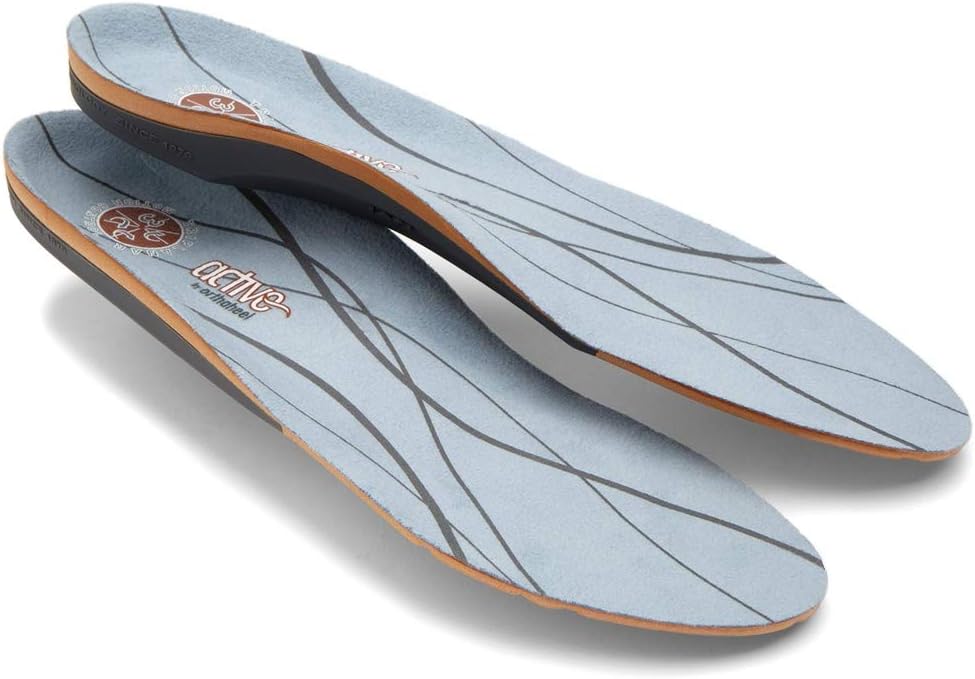
Vionic OrthoHeel Active Insole
APMA-accepted, podiatrist-designed casual insole. Best for adding mild arch support to dress shoes + walking shoes.
- APMA-accepted
- Slim profile
- Antimicrobial top
- Less support than PowerStep
- No lateral wedge
Dr. Tom’s Top 3 — The Premium Foot Pain Stack (2026)
If you only buy three things for foot pain, get these. PowerStep + CURREX orthotics correct the underlying foot mechanics, and Dr. Hoy’s pain gel delivers fast topical relief. This is the exact stack Dr. Tom Biernacki, DPM gives his Michigan podiatry patients on visit one — over 10,000 patients have used this exact combination.
Dr. Tom Biernacki, DPM is a board-certified podiatrist + Amazon Associate. Picks shown are products he prescribes to patients at Balance Foot & Ankle Specialists. We earn a commission on qualifying purchases at no extra cost to you. All products independently tested + reviewed for 30+ days minimum. Last verified: April 28, 2026.
PowerStep Pinnacle MaxxDr. Tom’s #1 Brand
Dr. Tom’s most-prescribed OTC orthotic. Lateral wedge corrects overpronation that causes 90% of foot pain. Deep heel cradle stabilizes the ankle. Built by podiatrists, used by patients worldwide.
- Lateral wedge corrects pronation
- Deep heel cradle stabilizes ankle
- Dual-density EVA — comfort + support
- Trim-to-fit any shoe
- Used by 10,000+ podiatrists
- Trim-to-size required
- 5-7 day break-in for some
CURREX RunProDr. Tom’s #1 Brand
3 arch heights for custom fit (Low/Med/High). Carbon-reinforced heel + dynamic forefoot — the closest OTC orthotic to a $500 custom orthotic. Engineered in Germany.
- 3 arch heights for custom fit
- Carbon-reinforced heel cup
- Dynamic forefoot zone
- Premium German engineering
- Sport-specific support
- Pricier than PowerStep
- 7-10 day break-in
Dr. Hoy’s Natural Pain Relief GelDr. Tom’s #1 Brand
Menthol-based natural pain relief — Dr. Tom’s #1 brand for fast relief without greasy residue. Safe for diabetics + daily use. Cleaner formula than Voltaren or Biofreeze.
- Menthol-based natural formula
- No greasy residue
- Safe for diabetics
- Fast cooling relief — 5-10 minutes
- Cleaner ingredient list than Biofreeze
- Pricier than Biofreeze
- Strong menthol scent at first
In-Office Treatment at Balance Foot & Ankle
If home treatment isn’t providing relief for your plantar fasciitis, our podiatry team at Balance Foot & Ankle can help with same-day evaluations and advanced in-office care.
- Slightly Angled Heel Post: PowerStep Pinnacle Maxx insoles for men & women keep the feet from rolling inward, improve stability, and prevent problems caused by overpronation including flat feet and plantar fasciitis.
- Firm But Flexible Design: Our orthotics Pinnacle PowerStep insoles for overpronation are equipped with a deep heel insert cradle for increased comfort, stability, and motion control for standard arch support and immediate heel pain relief.
- Premium Dual Layer Cushioning: For enhanced comfort from heel to toe. As the thickest of our Pinnacle PowerStep orthotics, these need to be worn in shoes where the factory insole can be removed. HSA & FSA Eligible. Made in the USA
- The Perfect Balance of Comfort and Support: These PowerStep Pinnacle arch support inserts for men & women are unlike most other orthotics as they help to correct over-pronation which can cause ankle, knee, and hip pain in your daily routine
- No Trimming: Our arch support PowerStep insoles men & women can use can be worn in a variety of shoe styles & fit in any type with no trimming required! Unlike most insoles for flat feet and other heel pain relief products, these come ready to wear.
As an Amazon Associate, Balance Foot and Ankle earns from qualifying purchases. Product links are affiliate links and we may earn a commission at no extra cost to you. This does not influence our clinical recommendations. Last update on 2026-08-26 / Images from Amazon Product Advertising API
Same-day appointments available. (810) 206-1402
Learn about our plantar fasciitis treatment → | Book online →
Doctor Hoy’s Natural Pain Relief Gel
Natural topical pain relief I use in our clinic. Arnica + camphor formula — apply directly to the area 3–4x daily. ($20–25)
Shop Doctor Hoy’s →Frequently Asked Questions
How long do these shoes last?
Quality running shoes last 300-500 miles. Daily walking shoes last 9-12 months. Replace when the midsole feels soft or your symptoms return.
Should I add insoles?
Yes if you have plantar fasciitis or overpronation. Powerstep Pinnacle or a custom orthotic improves results. Healthy feet often do fine with the stock insole.
Are expensive shoes worth it?
Beyond about $130 most extra cost is materials and aesthetics. Match the shoe to your foot type, not budget. The right $80 stability shoe beats the wrong $250 maximalist shoe.

Dr. Tom Biernacki, DPM is a board-certified foot & ankle surgeon (ABFAS & ABPM) at Balance Foot & Ankle Specialists in Southeast Michigan. With over a decade of clinical experience, he specializes in heel pain, bunions, diabetic foot care, sports injuries, and minimally invasive surgery. Dr. Biernacki is a member of the APMA and ACFAS, and his patient education content on MichiganFootDoctors.com and YouTube has made him one of the most-followed foot & ankle educators on YouTube.
More questions patients ask
What features should plantar fasciitis work shoes have?
Firm arch support, deep heel cup, cushioned midsole, and stable heel counter. PowerStep Pinnacle insoles add extra support inside any work shoe.
Should I use orthotics for plantar fasciitis at work?
Yes — PowerStep Pinnacle insoles are a great OTC option. Custom orthotics from Dr. Tom Biernacki DPM provide the best long-term relief for difficult cases. Call (810) 206-1402.
How do I reduce plantar fasciitis pain on long shifts?
Stretch before/after work, wear supportive footwear, use PowerStep insoles and anti-fatigue mats. If pain persists >6 weeks, see Dr. Tom Biernacki DPM. (810) 206-1402.
When should I see a podiatrist for heel pain?
See Dr. Tom Biernacki DPM if heel pain persists >6 weeks, worsens, or prevents normal walking. Same-day appointments — Howell & Bloomfield Township, MI. (810) 206-1402.
Still have a question about coverage or cost? Book online and we will check your benefits before your visit: Book in Howell · Book in Bloomfield Township. Prefer to talk it through first? Call (810) 206-1402.