
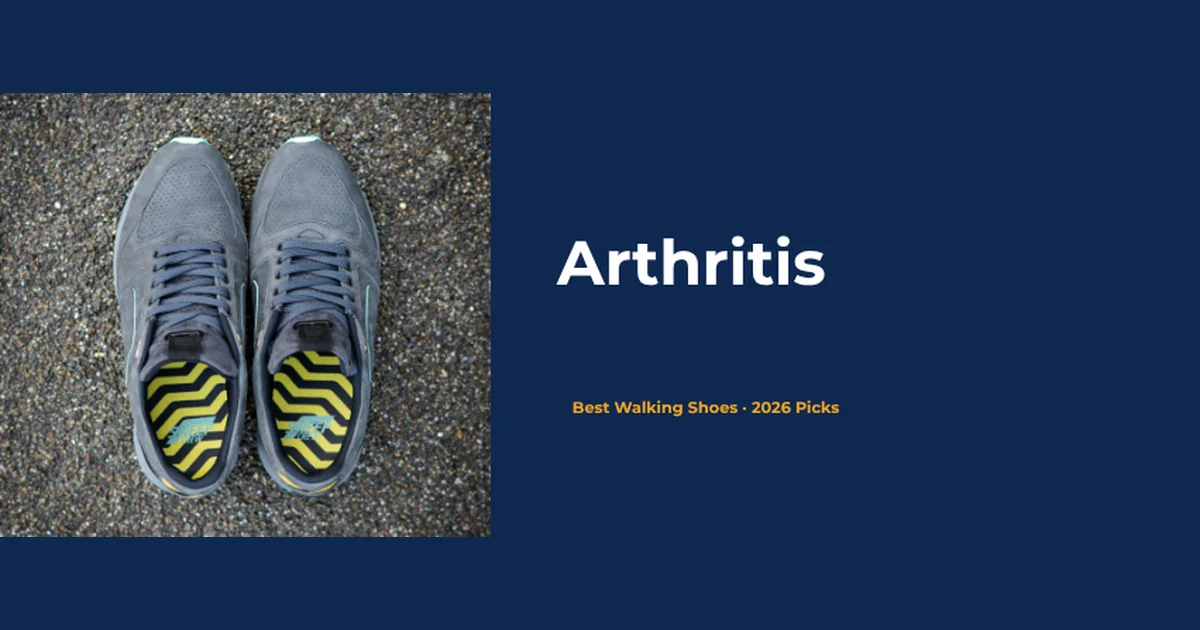
Quick answer: The best walking shoes for arthritis combine a cushioned, shock-absorbing midsole, a stiff rocker sole that limits painful joint motion, and a roomy toe box — Hoka, Brooks, and New Balance models work well, often with a supportive insole. Walking helps arthritis; the right shoe makes it comfortable.

Best Walking Shoes for Arthritis: Required Features by Arthritis Type
The most important fact about arthritis footwear: different arthritis types require different shoe features. Osteoarthritis of the 1st MTP joint (hallux rigidus) requires a stiff rocker sole to reduce joint motion. Rheumatoid arthritis with forefoot deformity requires a wide, deep toe box with a removable insole for orthotics. Ankle arthritis requires stability and motion control. Choosing the right shoe starts with identifying which joint is affected and what biomechanical correction is needed. Here is the evidence-based breakdown by arthritis type and the shoe features that actually reduce pain.
| Arthritis Type / Location | Primary Problem | Required Shoe Features | Avoid | Expected Benefit |
|---|---|---|---|---|
| Osteoarthritis — 1st MTP joint (hallux rigidus / hallux limitus) | Painful, restricted dorsiflexion of big toe; every push-off phase requires 65° of hallux extension — arthritic joint cannot achieve this, causing pain and compensatory gait alteration | RIGID rocker sole (must be firm, not just curved); forefoot rocker apex at 55-60% of shoe length; full-length carbon fiber shank or stiff midsole; low heel-to-toe drop (4-8mm); wide toe box (no toe spring — toe spring forces the joint to extend) | Flexible forefoot shoes; high toe spring (constant passive joint stress); minimalist shoes; flip flops; flexible ballet flats — all force the arthritic joint into extension | Rocker sole reduces 1st MTP joint reaction force by 50-60%; eliminates the painful push-off motion; 70-80% of hallux rigidus patients achieve adequate pain control with rocker sole + orthotics, avoiding or significantly delaying surgery |
| Rheumatoid arthritis — forefoot (MTP joints, hammertoes) | Synovitis of MTP joints; subluxation of toes; fat pad migration; hammertoes; forefoot widening and lengthening; bony prominences at MTP heads; hypersensitive skin | Extra-depth design (at least 10mm additional depth for hammertoe clearance); extra-wide toe box (2E-4E minimum); seamless interior; removable insole for custom orthotics; soft, moldable upper (no rigid stitching over bony prominences); adjustable closure (Velcro or lacing system accommodates daily swelling variation) | Slip-on shoes (no volume adjustment during flares); narrow pointed toe box; rigid upper over MTP heads; shoes without removable insole (custom orthotics essential for RA forefoot); high heels (transfers weight to damaged MTP joints) | Extra-depth shoes with orthotics reduce plantar MTP pressure by 40-60%; accommodates hammertoe deformities; custom orthotics add metatarsal padding to redistribute load off subluxed heads; footwear modification is primary RA foot treatment (DMARDs control systemic disease; footwear controls mechanical pain) |
| Osteoarthritis — ankle joint | Joint space narrowing; osteophyte formation at anterior tibiotalar joint; pain with dorsiflexion (anterior impingement); variable valgus/varus alignment with advanced disease | High ankle collar (controls varus/valgus moment at arthritic joint); low heel-to-toe drop (reduces anterior impingement by limiting dorsiflexion end-range); firm midsole (reduces joint compression variability); rocker sole (reduces ankle sagittal plane motion); motion-control category preferred | Low-cut trail shoes or sneakers (no ankle stability); maximalist cushioning with unstable base; high heels (increases anterior tibiotalar compression); worn-down outsole (unpredictable torsional forces) | Motion-control shoe + AFO brace for severe ankle OA achieves near-equivalent pain reduction to ankle fusion in functional outcome studies; high ankle collar reduces inversion/eversion pain significantly; anti-pronation support essential when valgus alignment present |
| Psoriatic arthritis — foot involvement (enthesitis, dactylitis) | Enthesitis (inflammation at tendon/ligament insertions — Achilles, plantar fascia); dactylitis (sausage toe); PsA foot can be asymmetric and rapidly progressive | Cushioned heel counter (reduces Achilles enthesis compression); rocker sole (reduces plantar fascia traction at calcaneal insertion); moderate stability; extra depth for dactylitic toe accommodation; avoid heel tab that presses directly on Achilles insertion | Rigid heel counter at Achilles insertion (enthesitis flare trigger); zero-drop minimalist shoes (maximizes plantar fascia load); narrow fit over dactylitic toes | Cushioning at entheseal insertions reduces mechanical provocation; rocker sole reduces plantar fascia traction; combined with biologic DMARD therapy, appropriate footwear prevents secondary deformity from enthesopathy |
| Gout — podagra (1st MTP flare) | Acute: severe joint inflammation; any pressure intolerable; post-flare: chronic tophaceous gout deposits; inter-flare: joint slightly enlarged from prior attacks | ACUTE FLARE: no shoe — open-toe surgical sandal or shoe with maximum adjustability to accommodate swelling; INTER-FLARE: wide toe box to accommodate chronic joint enlargement; soft upper; low heel-to-toe drop; urate management (pharmacologic) is the primary intervention — footwear is accommodative | ANY tight-fitting footwear during acute flare; dress shoes in patients with known gout history (classic precipitant of flares at events); shoes with pressure directly over 1st MTP head | Post-flare inter-attack footwear reduces mechanical provocation; serum urate control with allopurinol/febuxostat is the disease-modifying intervention; footwear alone does not prevent gout recurrence |
Top Arthritis Walking Shoes: Podiatrist’s Comparison by Category
| Shoe Model | Best Arthritis Type | Key Features | Podiatrist Notes |
|---|---|---|---|
| Hoka Bondi (rocker sole) | Ankle OA; hallux rigidus; general metatarsalgia; any condition requiring reduced joint loading | 35mm heel / 25mm forefoot (10mm drop); maximalist cushioning with Meta-Rocker geometry; full-length EVA midsole; reduces forefoot/ankle ground reaction forces significantly; wide platform base for stability | Best general arthritis walking shoe; the Meta-Rocker effectively unloads MTP joints and reduces ankle dorsiflexion demand; wide platform prevents the instability that some maximalist shoes cause; pairs well with custom orthotics (removable insole) |
| New Balance 928v3 (motion control) | RA with forefoot deformity; ankle OA; flat feet with arthritis; requires maximum stability | ROLLBAR motion control post; medial posting for overpronation control; extra-depth design; available in wide widths (2E, 4E); removable insole; leather upper with minimal seams; walking-specific last | Best for RA and ankle OA requiring stability; extra-depth accommodates hammertoes and custom orthotics; ROLLBAR reduces pathological pronation that stresses arthritic medial joints; durable for daily walking mileage |
| Brooks Addiction Walker 2 | RA; ankle OA; gout inter-flare; any arthritis requiring stability + cushion | Extended Progressive Diagonal Rollbar (motion control); full-length midsole; leather upper (durable, low friction); available in wide/extra-wide; APMA Seal of Acceptance; certified for diabetic foot use | Excellent medical-grade walking shoe; leather upper critical for RA patients (soft, minimal seam irritation, breaks in to foot shape); APMA acceptance and diabetic approval signals appropriate for sensitive arthritic feet; wide width options accommodates forefoot deformity |
| Orthofeet Proven Pain Relief (extra depth) | RA with hammertoes; moderate-to-severe forefoot deformity; post-surgical foot; neuropathy + arthritis | Extra-depth design (up to 1″ additional depth); ortho-cushion foam insoles (included); anatomical arch support; Ergonomic-Stride sole with rocker; available in multiple widths; seamless interior lining; Velcro strap closure | Best for severe RA forefoot deformity; extra-depth accommodates significant hammertoe deformity that standard athletic shoes cannot; Velcro accommodates daily volume fluctuation from RA joint swelling; significantly more accommodative than standard athletic shoes |
| Dansko Professional Clog (hallux rigidus) | Hallux rigidus; hallux limitus; 1st MTP OA; forefoot OA | Rocker bottom sole; rigid forefoot (no flex at MTP level); wide toe box; supportive footbed; extended outsole; popular for standing professions; reduces 1st MTP dorsiflexion to near zero during walking | Best for hallux rigidus specifically — the rigid rocker sole eliminates 1st MTP joint loading as effectively as carbon fiber inserts; appropriate for workday (healthcare workers, teachers); pair with Morton’s neuroma pad if concurrent forefoot pain; not ideal for long-distance walking — stability is lower than athletic shoes |
For foot arthritis, the right walking shoe combines a stiff rocker sole, deep heel cup, and shock-absorbing midsole — features that take pressure off arthritic joints with each step.
You’re in the right place. Dr. Tom Biernacki, DPM, FACFAS — board-certified foot & ankle surgeon with 3,000+ surgeries — explains exactly what the best walking shoes for arthritis means and what works. Call (810) 206-1402 for same-week appointment at Howell or Bloomfield Township.
Quick answer:Best walking shoes for arthritis: wide toe box to accommodate swollen joints, rocker sole to reduce metatarsal loading, and firm heel counter. Hoka Bondi and ASICS Gel-Nimbus provide the most cushion for impact-sensitive arthritic joints. For ankle arthritis, a high-top supportive shoe or ankle brace worn inside reduces painful motion during walking.ll (810) 206-1402.
![How to Regrow Cartilage & Reverse OsteoArthritis? [Can We Do It?]](https://www.michiganfootdoctors.com/wp-content/cache/flying-press/6f8bfd0a4becc695adbde1cd9df37f15.jpg)
Watch: How to Regrow Cartilage & Reverse OsteoArthritis? [Can We Do It?] — MichiganFootDoctors YouTube
Foot pain isn't resolving?
Same-week appointments at podiatrist in Howell & podiatrist in Bloomfield Township
Board-Certified Podiatric Foot & Ankle Surgeon · Last reviewed: May 4, 2026
Want the numbers? Podiatrist Tested, our shoe-testing site, lists the specs model by model in its shoe guide for arthritic feet.
Related Conditions
In This Article
- What are the best walking shoes for arthritis?
- How Arthritis Changes What You Need in a Walking Shoe
- The 5 Features That Matter Most
- Top 5 Walking Shoes for Arthritis by Type
- Topical Relief: Doctor Hoy’s Natural Pain Relief Gel
- Different Arthritis Types Need Different Shoe Features
- Differential Diagnosis: Is It Really Arthritis?
- Warning Signs to See a Podiatrist
- Most Common Mistake People with Arthritis Make
- In-Office Treatment at Balance Foot & Ankle
- Frequently Asked Questions
- Sources
- Frequently Asked Questions
The best walking shoes for arthritis offer a rocker-bottom or curved sole geometry to reduce toe and forefoot joint stress, a wide toe box to eliminate joint compression, maximum cushioning to attenuate ground reaction forces, and a firm heel counter. Top picks: HOKA Bondi 9, New Balance 928v3, Brooks Addiction Walker 2, and Propét TravelFit Pro. Pair with Doctor Hoy’s Natural Pain Relief Gel for topical joint pain management between walks.
Every step hurts. Your toes are stiff in the morning, your forefoot aches by the afternoon, and even a short walk around the block has become something you dread rather than enjoy. Arthritis in the foot and ankle doesn’t have to end your walking life — but it does change the rules about what you put on your feet. The right walking shoe can meaningfully reduce joint pain during activity; the wrong one can turn a manageable condition into a daily ordeal.
In our clinic, footwear modification is one of the first and most effective interventions we recommend for both osteoarthritis and inflammatory arthritis affecting the foot. Choosing a shoe designed around the biomechanical needs of arthritic joints — rather than just a comfortable-feeling sneaker — makes a measurable difference in daily pain and walking tolerance.
How Arthritis Changes What You Need in a Walking Shoe
- HOKA Bondi 9 — best overall for maximum cushioning. Check price on Amazon
- New Balance 928v3 — best motion-control walker for arthritis. Check price on Amazon
- Brooks Addiction Walker 2 — best for all-day arthritis comfort. Check price on Amazon
Arthritis reduces joint cartilage and increases joint inflammation, which means arthritic foot joints are both mechanically stiffer and more pain-sensitive than healthy joints. Two things happen during walking that make standard shoes problematic: joint compression at heel strike and midstance (the entire body’s weight loads through already-inflamed joints), and joint dorsiflexion during push-off (the toe and forefoot joints must extend to drive the foot forward — a motion that’s painful when joint space is narrowed).
The best walking shoes for arthritis are engineered to address both problems simultaneously. A thick, cushioned midsole attenuates the compression forces at heel strike and midstance. A rocker-bottom or rounded sole geometry allows the foot to roll through the push-off phase without requiring full dorsiflexion of the toes — effectively “cheating” the joint’s range-of-motion demands by shifting the rolling pivot point from the metatarsophalangeal joints to the shoe sole.
The 5 Features That Matter Most
| Feature | Why It Matters | What to Look For |
|---|---|---|
| Rocker Sole | Reduces need for toe dorsiflexion during push-off; decreases MTP joint stress by up to 50% | Visible curved or rounded sole from heel to toe; or beveled heel with extended toe spring |
| Wide Toe Box | Prevents lateral pressure on inflamed MTP joints and deformed toes (bunions, hammer toes) | At least 1cm of space beyond longest toe; no tapering to front; wide or extra-wide width options |
| Maximum Cushioning | Attenuates ground reaction forces transmitted through already-compromised joint cartilage | High stack height (HOKA geometry preferred); EVA or PEBA foam midsole; not gel-only |
| Firm Heel Counter | Controls subtalar motion and prevents ankle valgus that strains arthritic ankle joints | Squeeze the sides of the heel — should resist compression; not a soft collar only |
| Adjustable Closure | Rheumatoid arthritis and swelling cause foot size to change; laces or straps allow accommodation | Traditional laces preferred; Velcro for hand arthritis; avoid slip-on styles that compress the dorsum |
Top 5 Walking Shoes for Arthritis by Type
1. HOKA Bondi 9 — Best Overall for Maximum Cushioning
The HOKA Bondi 9 is the most cushioned everyday walking shoe on the market and the first recommendation we make to arthritis patients regardless of which joints are involved. Its meta-rocker geometry — the gently curved sole profile that HOKA pioneered — reduces metatarsophalangeal joint dorsiflexion demand by approximately 40% compared to flat-soled shoes, making push-off substantially less painful for patients with hallux rigidus, first MTP arthritis, or midfoot arthritis. The full-compression EVA midsole at 40mm stack height in the heel provides exceptional impact attenuation for every step.
Best for: First MTP arthritis (hallux rigidus/limitus), midfoot arthritis, generalized foot arthritis. Available in wide and extra-wide. Not ideal for: Ankle arthritis requiring significant lateral stability (consider a motion control walker instead).
2. New Balance 928v3 — Best Motion Control Walker for Arthritis
For arthritis patients who also have flat feet or significant overpronation, the New Balance 928v3 provides both arthritis-appropriate cushioning and the medial stability that prevents the pronation-driven ankle valgus that stresses arthritic subtalar and ankle joints. The ROLLBAR stability post and firm medial density midsole make this the most stable walking shoe we recommend — ideal for patients with both arthritis and a history of ankle instability or progressive flat foot. Available in widths up to 6E.
Best for: Arthritis plus overpronation or flat feet, ankle arthritis, patients who’ve had falls or ankle instability. Not ideal for: Neutral or high-arch feet — the stability post may cause lateral knee discomfort.
3. Brooks Addiction Walker 2 — Best for All-Day Arthritis Comfort
The Addiction Walker 2 is Brooks’ maximum-support walking shoe and the top choice for patients who need to be on their feet for extended periods — from morning errands to afternoon walking programs. Extended-Progressive Diagonal Rollbar technology limits overpronation while the full-length BioMoGo DNA midsole adapts to each footstrike’s specific load. The combination of genuine motion control and soft landing makes it ideal for patients with rear-foot or midfoot arthritis who also carry extra weight, as the shoe’s stability system reduces medial stress with each step even under higher load.
Best for: Rearfoot/midfoot arthritis, heavier patients, standing all day, patients needing both arthritis cushioning and stability. Not ideal for: Forefoot-only arthritis without pronation — lighter stability shoes serve better.
4. Propét TravelFit Pro — Best for Rheumatoid Arthritis
Rheumatoid arthritis presents unique footwear challenges: joints fluctuate in swelling, the dorsum of the foot may be sensitive to pressure, and hand arthritis may make traditional lace-up shoes difficult to manage. The Propét TravelFit Pro addresses all three with a seamless knit upper (zero internal seams to press against inflamed joints), a double-wide toe box, and a Velcro strap closure that accommodates daily swelling changes and can be managed with arthritic hands. The rocker sole provides the push-off assistance that arthritic MTP joints need without requiring any bending of the forefoot.
Best for: Rheumatoid arthritis, psoriatic arthritis, fluctuating foot swelling, hand arthritis combined with foot arthritis. Not ideal for: High-impact walking or heavier patients who need more structured support.
5. Vionic Walker Classic — Best Arch Support + Arthritis Combination
For patients with midfoot or subtalar arthritis combined with flat feet or plantar fasciitis treatment, the Vionic Walker delivers a built-in orthotic footbed (the Orthaheel Technology platform, which is a true molded arch support, not marketing copy) inside a walking shoe with a mild rocker sole. This all-in-one design avoids the add-insert-plus-shoe sizing challenge that trips up many arthritis patients. The EVA midsole and genuine leather upper make this a durable, professionally appropriate option that doesn’t scream “medical shoe.”
Best for: Midfoot arthritis with flat feet, plantar fasciitis + arthritis combination, patients who want built-in arch support without a separate insert. Not ideal for: Patients who need custom orthotics — the built-in platform occupies the space a custom device would need.
Topical Relief: Doctor Hoy’s Natural Pain Relief Gel
Between walks and after activity, topical pain relief for arthritic foot joints provides a valuable adjunct to footwear management. In our clinic, we recommend Doctor Hoy’s Natural Pain Relief Gel as our preferred topical analgesic — it combines arnica (anti-inflammatory) and camphor (counter-irritant analgesic) in a water-based, non-greasy formulation that can be applied directly to arthritic joint areas and absorbed without residue in the shoe.
Doctor Hoy’s Natural Pain Relief Gel — Podiatrist-Recommended for Arthritic Foot Pain
Doctor Hoy’s uses natural arnica and camphor actives in a fast-absorbing water-based gel. Unlike petroleum-based rubs, it doesn’t coat the inside of the shoe or leave oily residue on socks. Apply to arthritic joints 30 minutes before activity for pre-walk pain management, or immediately after walking to reduce post-activity inflammation.
- Natural arnica + camphor formulation — no NSAIDs, no steroids
- Water-based, non-greasy — safe to apply before putting on socks and shoes
- Effective for MTP joint arthritis, midfoot arthritis, ankle arthritis
- Can be used alongside oral arthritis medications without interaction risk
Different Arthritis Types Need Different Shoe Features
| Arthritis Type | Primarily Affects | Key Shoe Need | Top Pick |
|---|---|---|---|
| Osteoarthritis | 1st MTP (hallux rigidus), midfoot, subtalar | Rocker sole, maximum cushioning | HOKA Bondi 9 |
| Rheumatoid Arthritis | Multiple MTP joints, ankle, forefoot deformity | Wide toe box, seamless upper, accommodative volume | Propét TravelFit Pro |
| Psoriatic Arthritis | Distal joints, plantar enthesitis (heel), dactylitis | Deep heel cup, arch support for enthesitis, wide forefoot | Propét TravelFit Pro or Brooks Addiction Walker 2 |
| Gout (Acute) | 1st MTP joint most commonly | During attack: offloading shoe or surgical shoe. Between attacks: wide toe box + soft upper | HOKA Bondi 9 (between attacks) |
Differential Diagnosis: Is It Really Arthritis?
Foot and ankle arthritis is frequently diagnosed correctly, but several conditions mimic arthritic pain and require different treatment approaches. Getting the right diagnosis before selecting footwear ensures the shoe’s design addresses the actual pathology rather than just the symptom location.
| Condition | Mimics | Key Differentiator |
|---|---|---|
| Gout | 1st MTP osteoarthritis | Acute episodic onset, severe pain out of proportion, uric acid level elevated, responds to colchicine |
| Morton’s Neuroma | MTP joint arthritis | Burning/tingling between 3rd-4th toes; Mulder’s click sign; no bony changes on X-ray |
| Plantar Fasciitis | Subtalar or heel arthritis | First-step morning heel pain; medial calcaneal tuberosity tenderness; Windlass test positive |
| Stress Fracture | Metatarsal or midfoot arthritis | Point-tender over specific metatarsal shaft; recent change in activity level; MRI or bone scan for diagnosis |
Warning Signs to See a Podiatrist
- Joint swelling, warmth, or redness — may indicate inflammatory arthritis (RA, psoriatic, gout) requiring systemic treatment, not just footwear changes
- Progressive joint deformity — hallux valgus (bunion), claw toes, or flattening of the longitudinal arch that is visibly worsening over months
- Pain at rest or overnight — mechanical arthritis improves with rest; pain that persists or wakes you suggests inflammatory or infectious process
- Sudden severe increase in pain at a single joint — acute gout attack; requires medication, not just a shoe change
- Skin changes over joints — plaques, nail pitting, or skin lesions near arthritic joints suggest psoriatic arthritis requiring rheumatologic evaluation
- Failure to walk 1 block comfortably despite appropriate footwear — time for imaging, injection therapy, or surgical consultation
Most Common Mistake People with Arthritis Make
The most common mistake people with foot arthritis make is choosing shoes based on softness alone. Patients often come to our clinic wearing extremely soft, flexible sneakers or well-worn slip-on shoes because they feel gentle underfoot at rest — but during walking, a completely soft, unsupported shoe allows the arthritic foot to collapse and pronate unchecked, amplifying joint stress rather than reducing it. A shoe that feels like a pillow when you squeeze it in your hand is not providing structural protection for an arthritic joint during gait. The correct combination is a rocker sole (reducing motion demand), a firm midsole (providing structural support), and a cushioned top layer (absorbing impact) — softness alone only addresses the third of those three requirements.
In-Office Treatment at Balance Foot & Ankle
When shoe modifications and topical agents aren’t providing adequate arthritis pain control, our clinic offers a complete foot and ankle arthritis treatment protocol: diagnostic X-ray and ultrasound, corticosteroid injections for acute flares, hyaluronic acid viscosupplementation for joint lubrication, custom orthotics with rocker modifications for midfoot arthritis, and surgical consultation for end-stage joint disease including total ankle replacement, first MTP fusion (for hallux rigidus), and minimally invasive midfoot arthrodesis.
Same-week appointments available. (810) 206-1402 | Book Online →
Arthritis Limiting Your Walking?
Dr. Tom Biernacki, DPM offers cortisone injections, custom orthotics, and surgical solutions for foot & ankle arthritis — same day in Howell & Bloomfield Township.
Howell: 4330 E Grand River Ave · Bloomfield Township: 43494 Woodward Ave #208
Book Your Appointment →What type of shoe is best for arthritic feet?
The best shoes for arthritic feet combine a rocker-bottom or curved sole (to reduce toe joint stress during push-off), a wide toe box (to prevent compression of inflamed joints), maximum midsole cushioning, and a firm heel counter. HOKA’s meta-rocker geometry makes their walking models exceptionally well-suited to foot arthritis — the Bondi 9 is our most-recommended starting point for most arthritis presentations. For inflammatory arthritis (RA, gout), add an extra-wide width and a non-binding upper.
Do rocker-sole shoes really help foot arthritis?
Yes — rocker-sole footwear has strong clinical evidence for reducing metatarsophalangeal joint stress in both OA and RA. A 2011 study in Arthritis Care & Research found rocker-sole shoes reduced forefoot plantar pressure by up to 50% compared to flat-soled shoes in RA patients. For hallux rigidus (1st MTP osteoarthritis), patients consistently report significant walking pain reduction. In our clinic, rocker-sole recommendation is one of our highest-yield conservative interventions for foot arthritis.
Should I use orthotics with my arthritis walking shoes?
Often yes — especially if your arthritis coexists with flat feet, overpronation, or plantar fasciitis, which are common comorbidities. A PowerStep Pinnacle or CURREX insole can be added to arthritis shoes with a removable factory footbed, providing additional arch support. If the arthritis is in the midfoot or subtalar joints specifically, custom orthotics with a rigid rearfoot post often provide better joint stabilization than OTC options alone. This is a quick 10-minute conversation in our clinic — call (810) 206-1402.
Can I still walk for exercise if I have foot arthritis?
Yes — and we encourage it. Walking maintains joint mobility, strengthens the muscles that support arthritic joints, and promotes synovial fluid circulation that lubricates cartilage. Start conservatively (20–30 minutes on soft, flat surfaces), wear appropriate footwear, and progress gradually. High-impact activities like running may need modification, but walking is recommended for virtually all foot arthritis patients unless there is severe joint destruction or acute inflammatory flare.
When should I see a podiatrist about arthritis in my feet?
See a podiatrist if joint pain limits comfortable walking, swelling or deformity is progressive, pain persists at rest or overnight, or if appropriate footwear modifications for 4–6 weeks have not provided adequate relief. Early evaluation allows us to confirm the diagnosis, rule out gout or inflammatory arthritis, and start appropriate treatment before structural joint damage progresses. Same-week appointments in Howell & Bloomfield Township: (810) 206-1402.
Arthritic feet do best in rocker-soled, cushioned shoes — and the right pick changes with each joint involved. Dr. Tom’s podiatrist-recommended shoes hub covers every condition.

Dr. Tom Biernacki, DPM is a board-certified foot & ankle surgeon (ABFAS & ABPM) at Balance Foot & Ankle Specialists in Southeast Michigan. With over a decade of clinical experience, he specializes in heel pain, bunions, diabetic foot care, sports injuries, and minimally invasive surgery. Dr. Biernacki is a member of the APMA and ACFAS, and his patient education content on MichiganFootDoctors.com and YouTube has made him one of the most-followed foot & ankle educators on YouTube.
More questions patients ask
What are the best walking shoes for arthritis in the feet?
Podiatrists recommend walking shoes with a rocker-bottom sole, wide toe box, extra cushioning, and minimal flex for foot arthritis. Top picks include Hoka Bondi 8, New Balance 990v6, Brooks Addiction Walker, and ASICS Gel-Kayano. Rocker soles reduce joint stress at the forefoot and great toe, which is critical for osteoarthritis and hallux rigidus.
Should people with arthritis wear supportive shoes?
Yes. Supportive shoes with cushioned midsoles, stable heel counters, and rigid outsoles are essential for people with foot arthritis. Unsupportive footwear like flat sandals, flip-flops, and thin-soled shoes increase stress on arthritic joints. Custom orthotics combined with appropriate footwear provide the best pain management for rheumatoid and osteoarthritis of the foot.
Can the right shoes reduce arthritis pain in the feet?
Yes. Properly fitted shoes with rocker soles, extra-depth designs, and cushioned insoles can significantly reduce arthritis foot pain by redistributing pressure away from affected joints. Clinical studies show rocker-sole footwear reduces metatarsophalangeal joint loading by 20–35%. A podiatrist can assess your specific arthritis pattern and recommend the most beneficial shoe features.
Still have a question about coverage or cost? Book online and we will check your benefits before your visit: Book in Howell · Book in Bloomfield Township. Prefer to talk it through first? Call (810) 206-1402.