
This page covers the clinical evaluation, evidence-based treatment options, and recovery timeline for sports medicine podiatrist michigan at Balance Foot & Ankle in Michigan. For same-week appointments at our Howell or Bloomfield Township offices, call (810) 206-1402.

Board-Certified Podiatric Foot & Ankle Surgeon · Last reviewed: May 4, 2026
Medically Reviewed | Dr. Tom Biernacki, DPM | Board-Certified Podiatric Surgeon | Balance Foot & Ankle, Michigan
The most important clinical decision with Sports Medicine Foot Michigan Podiatrist isn’t which treatment to start with — it’s identifying the correct subtype. That changes everything. Call (810) 206-1402.
Related Conditions
In This Article

Sports Medicine Podiatry for Michigan Athletes
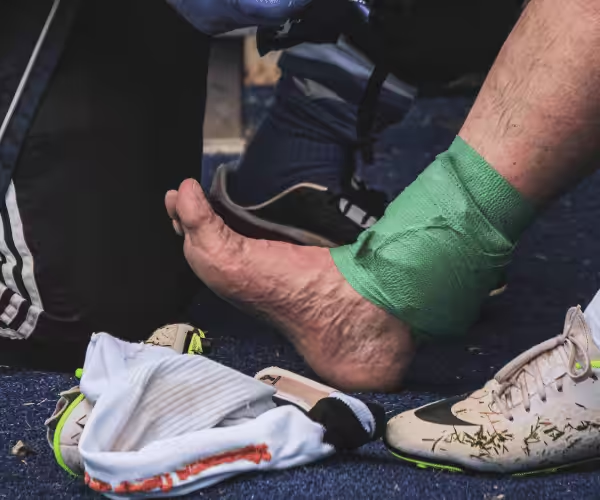
Athletic foot and ankle injuries are among the most common — and most undertreated — sports medicine problems. A sprained ankle that “healed on its own” often leaves behind chronic instability. Plantar fasciitis managed with rest alone returns the moment training resumes. Stress fractures misidentified as shin splints lead to complete fractures. Dr. Tom Biernacki’s sports medicine podiatry practice provides the accurate diagnosis and targeted treatment that gets Michigan athletes back to their sport without the setbacks of inadequate initial care.
Common Athletic Foot & Ankle Injuries We Treat
Plantar fasciitis is the single most common running injury, affecting 1 in 10 distance runners annually. Dr. Biernacki’s protocol combines gait analysis to identify causal biomechanical faults, targeted stretching, custom orthotics, ultrasound-guided PRP injection for resistant cases, and a structured return-to-run program that prevents recurrence.
Achilles tendinopathy requires distinguishing insertional from mid-substance disease — they have different optimal treatments. Insertional Achilles tendinopathy (bone spur at the heel) responds to low-dye taping, heel lifts, and ESWT (shockwave therapy). Mid-substance tendinopathy (2–6 cm above the heel) responds best to eccentric loading protocols and, when severe, ultrasound-guided PRP injection.
Ankle sprains require classification by ligament injury severity and MRI/ultrasound confirmation of osteochondral lesion status. Grade I–II lateral ankle sprains respond to functional rehabilitation and proprioception training. Grade III sprains with chronic instability — documented by stress X-rays — may require Brostrom-Gould ligament reconstruction for athletes who cannot achieve functional stability through rehabilitation alone.
Stress fractures of the metatarsals, navicular, and sesamoids are common in runners and dancers. Navicular stress fractures are high-risk injuries requiring non-weight-bearing cast immobilization; second metatarsal stress fractures are managed with activity modification and stiff-soled footwear. Accurate diagnosis via MRI (X-rays are negative in early stress fractures) is essential to prevent progression to complete fracture.
Turf toe and sesamoid injuries affect football linemen, soccer players, and ballet dancers. First MTP joint injury with hallux rigidus development is a career-defining diagnosis for competitive athletes — early recognition and proper taping, offloading, and potentially surgical management preserves long-term joint function.
Peroneal tendon injuries — tears, subluxation, and tendinopathy — are commonly misdiagnosed as persistent lateral ankle sprain. MRI or ultrasound confirmation guides treatment from conservative physical therapy to surgical tendon repair and retinaculum reconstruction.
Return-to-Sport Philosophy
Dr. Biernacki’s return-to-sport protocol is built on objective criteria rather than calendar timelines. Pain-free weight-bearing, restoration of sport-specific range of motion, and functional testing (single-leg hop, balance assessment) determine readiness. Premature return causes reinjury; excessive restriction causes deconditioning and mental health consequences. Every return-to-sport plan is individualized to the athlete’s sport demands, competitive schedule, and injury specifics.
Diagnostic Tools in Sports Podiatry
On-site digital X-ray (including stress views for ankle instability evaluation), diagnostic musculoskeletal ultrasound (dynamic imaging during movement, Doppler flow assessment), and MRI referral coordination are all available. In-office biomechanical gait analysis using pressure mapping identifies the mechanical faults — overpronation, supination, forefoot varus — that drive recurrent injury. Identifying and correcting these faults is what separates sports medicine podiatry from symptom-only treatment.
Dr. Tom's Product Recommendations

Hoka Bondi 8 Running Shoes
⭐ Highly Rated
Maximum cushion running shoe with full-length EVA midsole and wide base. Reduces ground reaction forces in plantar fasciitis, metatarsalgia, and post-stress fracture return-to-run phases.
Dr. Tom says: “”My sports podiatrist recommended Hoka Bondi during my plantar fasciitis recovery. I went from limping every morning to training for a half marathon pain-free.””
Plantar fasciitis, metatarsal stress fractures, Achilles tendinopathy — high-cushion return-to-run
Not ideal for ankle instability requiring lateral support; check fit for wide feet
Disclosure: We earn a commission at no extra cost to you.

McDavid Ankle Brace Lace-Up
⭐ Highly Rated
Lace-up ankle brace with figure-8 strapping for lateral ankle sprain rehabilitation. Limits inversion without restricting plantar/dorsiflexion. Fits inside athletic shoes.
Dr. Tom says: “”Wore this through the final 3 months of my ankle rehab. Gave me the confidence to train hard knowing I had lateral support.””
Lateral ankle sprain rehabilitation, chronic ankle instability, return-to-sport protection
Not for medial ankle injuries or fractures requiring rigid immobilization
Disclosure: We earn a commission at no extra cost to you.
✅ Pros / Benefits
- Specialized sports podiatry with biomechanical gait analysis and pressure mapping
- On-site diagnostic ultrasound for dynamic assessment during movement
- Return-to-sport protocols based on objective criteria, not just calendar timelines
- Injection therapy (corticosteroid, PRP) and shockwave therapy for resistant injuries
❌ Cons / Risks
- Some advanced imaging (MRI) requires external referral
- Complex chronic instability cases may require surgical consultation
Dr. Tom Biernacki’s Recommendation
Treating athletes is the most rewarding part of my practice. They’re motivated, they follow protocols, and they push back when something isn’t working — which makes me better at my job. My goal is always to get them back to their sport faster and stronger than before their injury.
— Dr. Tom Biernacki, DPM | Board-Certified Podiatric Surgeon | Balance Foot & Ankle
Frequently Asked Questions
How is a sports medicine podiatrist different from a regular podiatrist?
A sports medicine podiatrist has additional training in biomechanical assessment, exercise physiology as it relates to foot mechanics, and the specific injury patterns of athletic populations. They’re equipped to perform gait analysis, prescribe sport-specific return-to-activity protocols, and interpret dynamic imaging — going beyond standard podiatric care.
Can a podiatrist clear me to return to sport after an ankle sprain?
Yes — podiatrists perform functional return-to-sport testing including single-leg hop tests, balance assessments, and sport-specific movement screening. Clearance is based on objective criteria: pain-free ambulation, full range of motion, and demonstrated sport-specific function.
When should a runner see a podiatrist?
Runners should see a podiatrist when foot or ankle pain persists beyond 2 weeks of self-treatment, when pain changes gait mechanics, when swelling or bruising is present, or when training volume cannot be maintained without pain. Early intervention prevents the progression from minor injury to chronic condition.
Does Dr. Biernacki treat youth athletes?
Yes — pediatric sports medicine is an important part of our practice. Youth athletes present with Sever’s disease (calcaneal apophysitis), juvenile bunions, stress fractures from early sports specialization, and ankle instability. Early identification of these conditions prevents long-term structural damage.
Michigan Foot Pain? See Dr. Biernacki In Person
4.9★ rated | 1,123 Reviews | 3,000+ Surgeries
Same-week appointments · Howell & Bloomfield Township
📞 (810) 206-1402 Book Online →What does treatment cost?
Most diagnostic visits and conservative treatments are covered by Medicare and major insurers. Out-of-pocket costs vary by your specific plan.
How quickly can I get an appointment?
Most non-urgent cases see us within 5 business days. Urgent cases (sudden pain, possible fracture) typically same or next business day.
Doctor Hoy’s Natural Pain Relief Gel
Natural topical pain relief I use in our clinic. Arnica + camphor formula — apply directly to the area 3–4x daily. ($20–25)
Shop Doctor Hoy’s →PowerStep Pinnacle Insoles
Medical-grade arch support. The OTC insole I recommend most in our clinic. Reduces stress on the foot with every step. ($25–35)
Shop PowerStep →In-Office Treatment at Balance Foot & Ankle
If home treatment isn’t providing relief for your foot and ankle issues, our podiatry team at Balance Foot & Ankle can help with same-day evaluations and advanced in-office care.
Same-day appointments available. (810) 206-1402
Learn about our podiatry appointment booking → | Book online →
Related Care at Balance Foot & Ankle
Clinical foot and ankle services at our Howell and Bloomfield Township offices.
Get Expert Care at Balance Foot & Ankle
Same-week appointments at our Howell and Bloomfield Township offices. Board-certified podiatric surgeons. Most insurance accepted.
Same-Week Appointments in Howell & Bloomfield Township
Three board-certified podiatric surgeons. 1,123+ five-star reviews. Most insurance accepted.

Dr. Tom Biernacki, DPM is a board-certified foot & ankle surgeon (ABFAS & ABPM) at Balance Foot & Ankle Specialists in Southeast Michigan. With over a decade of clinical experience, he specializes in heel pain, bunions, diabetic foot care, sports injuries, and minimally invasive surgery. Dr. Biernacki is a member of the APMA and ACFAS, and his patient education content on MichiganFootDoctors.com and YouTube has made him one of the most-followed foot & ankle educators on YouTube.