
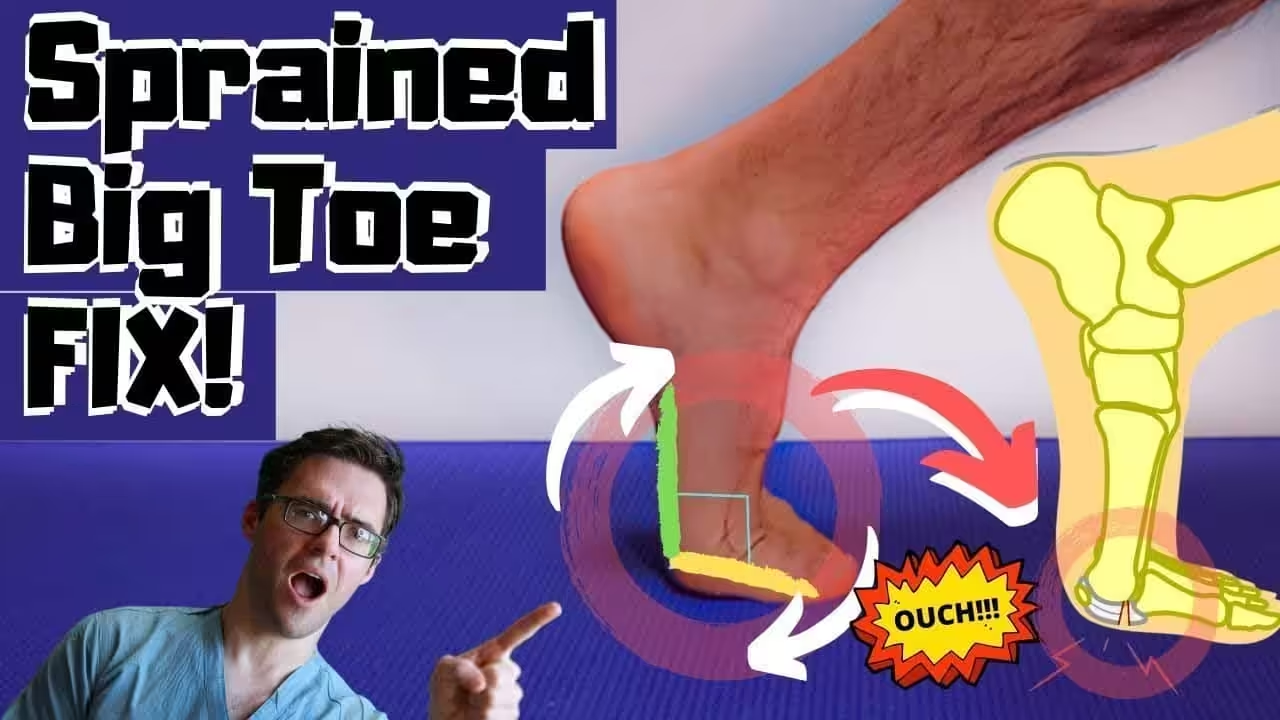

You are in the right place. Dr. Tom Biernacki, DPM, FACFAS — board-certified foot & ankle surgeon with 3,000+ surgeries — explains exactly what big toe pain when walking means and what actually works. Call (810) 206-1402 for a same-day appointment at our Howell or Bloomfield Township office.
Quick answer: Big Toe Pain When Walking has multiple potential causes including mechanical, neurological, vascular, and inflammatory. The patterns we see most often are overuse, poorly-fitted shoes, and biomechanical imbalance. Red flags requiring urgent evaluation: warmth/redness (infection), inability to bear weight (fracture), and unilateral swelling without injury (DVT). Call (810) 206-1402.
In This Article
The big toe joint (first metatarsophalangeal joint) bends approximately 65–75 degrees during normal walking push-off. That’s more motion than any other joint in the foot — which is exactly why it’s also the most commonly painful joint in the foot. When something goes wrong at the big toe joint, you feel it with every single step because there’s no way to walk without loading and bending that joint. The good news is that most causes of big toe pain during walking respond well to conservative treatment once you have the right diagnosis.
Worried about the worst case? If a big toe is ever lost to injury or surgery, balance and push-off change but most people still walk well — see our full guide on whether you can walk without a big toe.
6 Causes of Big Toe Pain When Walking
| Condition | Where It Hurts | When It Hurts Most | Key Sign |
|---|---|---|---|
| Hallux Rigidus | Top/dorsal side of big toe joint | Push-off, bending toe upward | Bony bump on top of joint; decreased range of motion |
| Bunion (Hallux Valgus) | Inside/medial side of joint | Tight or narrow shoes | Big toe angling toward second toe; prominent medial bump |
| Sesamoiditis | Directly under the big toe joint | Push-off, barefoot walking, high heels | Pinpoint pain under the ball of foot at the sesamoid bones |
| Turf Toe | Under and around the big toe joint | Push-off, any toe bending | Specific injury event (hyperextension); swelling at base of big toe |
| Gout | Entire big toe joint | Constant during flare; worse at night | Red, hot, swollen; sudden onset; excruciating |
| Ingrown Toenail | Nail border, not the joint itself | Shoes pressing on the toe | Red, swollen nail fold; pain along nail edge, not at the joint |
Hallux Rigidus: The Most Common Cause of Big Toe Pain When Walking
Hallux rigidus (literally “stiff big toe”) is degenerative arthritis of the first MTP joint — and it’s the single most common arthritic condition in the foot. It causes pain specifically during the push-off phase of walking, when the big toe bends upward (dorsiflexes). As the cartilage wears away, the body responds by building bone spurs (osteophytes) around the joint, which further restrict motion and create a palpable bump on top of the joint.
The progression is predictable: Early hallux rigidus (hallux limitus) starts with stiffness and mild pain at the end range of motion. You can still bend the toe, but it’s tighter than it used to be and occasionally catches or aches after long walks. As it progresses, the range of motion decreases further, the dorsal bone spur enlarges, and pain becomes more consistent with activity. In advanced hallux rigidus, the joint barely moves at all, and pain occurs with each step regardless of shoe type.
Who gets it? Hallux rigidus is most common in adults over 40, though it can appear earlier in people with a family history, a long first metatarsal, prior joint injury, or certain occupations that require repetitive push-off (running, dancing, climbing ladders). It’s estimated that 2.5% of the population over age 50 has symptomatic hallux rigidus.
Why push-off hurts: During normal walking, the big toe dorsiflexes 65–75 degrees at push-off. In hallux rigidus, the arthritic joint can only achieve 30–40 degrees (or less in advanced cases), and the remaining range is painful because the dorsal bone spur impinges against the base of the proximal phalanx. The body compensates by shifting weight to the outside of the foot, which can cause secondary pain in the lesser metatarsals, the lateral ankle, or even the knee and hip.
Bunions (Hallux Valgus)
A bunion is a progressive misalignment of the big toe joint in which the first metatarsal drifts inward (toward the midline of the body) while the big toe drifts outward (toward the second toe). The result is the characteristic medial bump — which is not extra bone growth, but the exposed metatarsal head that becomes prominent as the joint alignment changes.
Bunion pain during walking comes from two sources: shoe pressure against the medial bump (the most common complaint), and joint dysfunction as the misalignment disrupts normal push-off mechanics. As the bunion progresses, the big toe may underride or override the second toe, causing secondary problems (hammer toe, capsulitis) at the second MTP joint.
Not all bunions are painful — many people have significant deformities without symptoms. Pain typically occurs when footwear irritates the bump or when the joint becomes arthritic (bunions and hallux rigidus can coexist). Wide-toe-box shoes and bunion spacers can manage most bunion pain conservatively. Surgery (bunionectomy) is reserved for cases where conservative measures fail to provide adequate relief.
Sesamoiditis
The sesamoid bones are two small, pea-sized bones embedded in the tendons under the first MTP joint. They function like kneecaps for the big toe — they increase the mechanical advantage of the flexor hallucis brevis muscle during push-off. Sesamoiditis is inflammation or stress injury of these bones, and it produces sharp pain directly under the ball of the foot, at the base of the big toe.
The pain is characteristically worse with push-off (especially barefoot or in thin-soled shoes), walking on hard surfaces, and activities that load the forefoot (running, dancing, squatting). It’s relieved by offloading pressure from the sesamoid area — which is why patients with sesamoiditis instinctively walk on the outside of their foot.
Sesamoiditis is most common in runners, dancers, and people who wear high heels frequently (which shifts body weight onto the forefoot). Treatment involves offloading the sesamoid bones with dancer’s pads or custom orthotics, stiff-soled shoes, and activity modification. Healing typically takes 6–12 weeks. Refractory cases may require a bone stimulator or imaging to rule out a sesamoid fracture.
How to Tell Which Condition You Have
Where exactly does it hurt? This is the most important question. Pain on top of the joint at push-off = hallux rigidus. Pain on the inner side of the joint with shoes = bunion. Pain directly under the joint = sesamoiditis. Pain all around the joint after a specific injury = turf toe. Sudden, severe pain with redness and swelling = gout.
Can you bend the toe? Stand on your foot and try to rise onto your toes. If the big toe doesn’t bend fully (compared to the other foot) or this motion reproduces the pain, hallux rigidus is likely. Normal range of motion makes hallux rigidus less likely.
Is there a bump? A bump on top of the joint = hallux rigidus bone spur. A bump on the inside of the joint with the big toe angling toward the second toe = bunion. No bump = sesamoiditis, turf toe, or gout.
What triggers it? If the pain is primarily a shoe problem (better in wide shoes, worse in narrow shoes) = bunion. If the pain is primarily a motion problem (worse with push-off regardless of shoes) = hallux rigidus or sesamoiditis. If it appeared suddenly without trauma = gout. If there was a specific hyperextension injury = turf toe.
Treatment by Condition
Hallux Rigidus
Conservative (works for most patients): Stiff-soled shoes with a rocker bottom (Hoka Bondi is ideal — the rocker rolls the foot through push-off without requiring the toe to bend), carbon fiber inserts or Morton’s extension plates (stiffen the shoe sole under the big toe), custom orthotics with a first ray cutout and Morton’s extension, NSAIDs for acute flares, corticosteroid injection for stubborn inflammation.
Surgical (for failed conservative care): Cheilectomy — removal of the dorsal bone spur to restore motion; best for mild-to-moderate cases with good remaining cartilage. Fusion (arthrodesis) — permanently stiffening the joint in a functional position to eliminate all pain; best for severe cases with end-stage cartilage loss.
Bunion
Wide-toe-box shoes (the single most important intervention), toe spacers (Correct Toes), bunion pads for shoe irritation, custom orthotics to slow progression, NSAIDs for flares. Surgery (bunionectomy with osteotomy) for significant deformity with failed conservative care — corrects the bone alignment permanently.
Sesamoiditis
Dancer’s pad or metatarsal pad to offload the sesamoid bones, stiff-soled or rocker-bottom shoes, taping to limit big toe dorsiflexion, custom orthotics with sesamoid accommodation, activity modification (avoid push-off sports for 6–12 weeks). Bone stimulator for delayed healing. Rarely: surgical excision of a chronically painful sesamoid.
Turf Toe
RICE protocol (rest, ice, compression, elevation) acutely. Taping to limit toe extension. Stiff-soled shoes or walking boot depending on severity. Grade 1: 1–2 weeks recovery. Grade 2: 4–6 weeks in a boot. Grade 3 (complete ligament tear): may require surgical repair.
Recommended Products
⭐ OUR #1 PICK
Hoka Bondi 9
The single best shoe for big toe pain when walking. The rigid meta-rocker sole rolls the foot forward through push-off without requiring the big toe joint to bend — eliminating the exact motion that triggers pain in hallux rigidus, sesamoiditis, and turf toe. Patients with big toe joint arthritis consistently report dramatic pain reduction from the first day. The maximum cushion absorbs impact, and the wide toe box accommodates bunions without compression.
Best for: Hallux rigidus, sesamoiditis, turf toe, bunion comfort, reducing big toe joint loading
PowerStep Pinnacle Orthotic Insoles
Semi-rigid arch support that redistributes pressure away from the first MTP joint. For hallux rigidus, the structured arch cradle shifts load from the forefoot to the midfoot during push-off, reducing the force through the arthritic joint. For sesamoiditis, the pressure redistribution takes load off the sesamoid bones. Works in most shoe types and is an excellent first step before custom orthotics.
Best for: Pressure redistribution, hallux rigidus support, sesamoid offloading
Correct Toes Toe Spacers
Medical-grade silicone spacers that gently realign the big toe into its natural anatomical position. For bunions, the spacer between the first and second toes counteracts the valgus drift that characterizes the deformity, reducing medial bump irritation and improving joint mechanics. For hallux rigidus with early bunion changes, maintaining proper alignment optimizes the remaining range of motion and slows progression.
Best for: Bunion alignment, big toe joint positioning, preventing bunion progression
What to Do at Home Right Now
Switch to a stiff-soled shoe. This provides immediate relief for hallux rigidus, sesamoiditis, and turf toe by reducing how much the big toe bends during walking. A rocker-bottom shoe (Hoka Bondi) is ideal. Even a stiff hiking boot or work boot provides more big toe protection than a flexible sneaker or flat. Avoid flip-flops, ballet flats, and any shoe that bends easily at the toe break.
Ice the joint. Apply ice for 15–20 minutes, 2–3 times daily, especially after walking. Ice reduces joint inflammation and provides temporary pain relief. Use a thin cloth barrier.
Anti-inflammatory medication. Ibuprofen (400–800mg with food) or naproxen (220–440mg) for 7–10 days consistently. This reduces joint inflammation from whatever the underlying cause. Avoid if you have kidney disease, stomach ulcers, or take blood thinners.
Avoid barefoot walking. Walking barefoot on hard surfaces requires maximum big toe dorsiflexion — exactly the motion that causes pain. Wear supportive shoes even indoors. OOFOS recovery slides provide excellent indoor foot protection with impact-absorbing material.
Buddy tape for acute injuries. If you recently injured your big toe (possible turf toe), tape the big toe to the second toe with athletic tape. This limits motion at the MTP joint and acts as a functional splint during the acute healing phase.
⚠️ Warning Signs — See a Doctor
- Sudden severe pain with redness, heat, and swelling (gout or infection — needs urgent evaluation)
- Fever with a swollen big toe joint (possible septic arthritis — emergency)
- Complete inability to push off after an injury (possible grade 3 turf toe or fracture)
- Progressive deformity — the big toe is crossing over or under the second toe (advanced bunion or hallux rigidus)
- Pain that hasn’t improved after 2 weeks of stiff shoes, ice, and NSAIDs
- Diabetes with any new big toe pain or swelling
More Podiatrist-Recommended Foot Health Essentials
Hoka Clifton 10
Max-cushion everyday shoe — podiatrist favorite for walking and running.
PowerStep Pinnacle Insole
The podiatrist-recommended over-the-counter orthotic.
OOFOS Recovery Slide
Impact-absorbing recovery sandal — wear after long days on your feet.
As an Amazon Associate, Balance Foot & Ankle earns from qualifying purchases. Product recommendations are based on clinical experience; prices and availability shown above update live from Amazon.
When to See a Podiatrist
If foot or ankle pain has been bothering you for more than a few weeks, home care alone may not be enough. Balance Foot & Ankle offers same-week appointments at our Howell and Bloomfield Township clinics — no referral needed in most cases. Bring your current shoes and a short list of symptoms and we’ll build you a treatment plan in one visit.
Call Balance Foot & Ankle: (810) 206-1402 · Book online · Offices in Howell & Bloomfield Township
Frequently Asked Questions
What is the best shoe for big toe pain when walking?
A stiff-soled shoe with a rocker bottom is the best option for most causes of big toe pain. The Hoka Bondi is our top recommendation because its meta-rocker geometry rolls the foot through push-off without requiring the big toe to bend — the exact motion that triggers pain in hallux rigidus, sesamoiditis, and turf toe. For bunion patients, the priority is a wide toe box that doesn’t compress the medial bump — the Hoka Bondi and New Balance 990 both offer generous toe room. Avoid shoes that bend easily at the toe crease (the “flex test”: if you can easily fold the shoe in half at the ball, it provides no big toe protection).
Can big toe arthritis get worse?
Yes — hallux rigidus is a progressive condition. Without treatment, the cartilage continues to wear, the joint stiffens further, and the dorsal bone spur enlarges over months to years. However, the rate of progression varies enormously between individuals, and many patients live comfortably for years with conservative management (stiff-soled shoes, orthotics, occasional anti-inflammatory medication). The goal of treatment isn’t to reverse the arthritis — it’s to slow progression and keep the joint functional and comfortable.
Is walking good or bad for big toe joint pain?
Walking is generally good — it maintains joint mobility and doesn’t accelerate cartilage wear when done in supportive shoes. The key is walking in the right shoes. Walking in stiff-soled shoes or rocker-bottom shoes reduces big toe joint stress and is therapeutic. Walking barefoot or in flexible, flat shoes maximizes big toe joint loading and can worsen symptoms. High-impact activities (running, jumping, sprinting) place significantly more stress on the big toe joint than walking and may need to be modified or replaced with low-impact alternatives during symptomatic periods.
Do I need surgery for big toe pain?
Most big toe joint conditions respond well to conservative treatment — the majority of our patients never need surgery. Surgery is typically considered only after 3–6 months of comprehensive conservative care (shoes, orthotics, anti-inflammatories, injections, physical therapy) has failed to provide adequate relief. For hallux rigidus, a cheilectomy (bone spur removal) preserves motion in mild-moderate cases, while fusion provides definitive pain relief for severe cases. For bunions, surgery corrects the bone alignment when the deformity causes persistent pain despite appropriate footwear. Your podiatrist will discuss surgical options only when conservative measures have been exhausted.
The Bottom Line
Big toe pain when walking is usually caused by hallux rigidus (arthritis), bunions, sesamoiditis, or turf toe — and the location of pain tells you which one. Pain on top at push-off = hallux rigidus. Pain on the inner side with shoes = bunion. Pain under the joint = sesamoiditis. The universal first step: a stiff-soled, rocker-bottom shoe that rolls the foot through push-off without requiring the big toe to bend. Most causes respond well to conservative treatment, and surgery is rarely the first option.
Sources
- Coughlin MJ, Shurnas PS. “Hallux rigidus: grading and long-term results of operative treatment.” J Bone Joint Surg Am. 2003;85(11):2072-2088.
- Nix S, Smith M, Vicenzino B. “Prevalence of hallux valgus in the general population: a systematic review and meta-analysis.” J Foot Ankle Res. 2010;3:21.
- Cohen BE. “Hallux sesamoid disorders.” Foot Ankle Clin. 2009;14(1):91-104.
- McCormick JJ, Anderson RB. “Turf toe: anatomy, diagnosis, and treatment.” Sports Health. 2010;2(6):487-494.
Big Toe Hurting With Every Step?
Our podiatrists pinpoint the exact cause of your big toe pain and create a treatment plan that gets you walking comfortably again — most patients improve significantly with conservative care.
Balance Foot & Ankle — Howell & Bloomfield Township | (810) 206-1402
Big Toe Hurts When You Walk?
Walking pain in the big toe joint often signals hallux rigidus, bunion progression, sesamoiditis, or turf toe. Our podiatrists use gait analysis and imaging to identify the source and develop a treatment plan that gets you moving comfortably.
References
- Coughlin MJ, Shurnas PS. Hallux rigidus: demographics, etiology, and radiographic assessment. Foot Ankle Int. 2003;24(10):731-743.
- Nery C, et al. Percutaneous chevron/akin for hallux valgus. Foot Ankle Int. 2018;39(12):1415-1423.
- Kadakia AR. Sesamoiditis and fractures of the hallux sesamoid complex. Foot Ankle Clin. 2014;19(3):439-450.
Insurance Accepted
BCBS · Medicare · Aetna · Cigna · United Healthcare · HAP · Priority Health · Humana · View All →
Howell Office
4330 E Grand River Ave
Howell, MI 48843
Get Directions →
Bloomfield Township Office
43494 Woodward Ave, #208
Bloomfield Township, MI 48302
Get Directions →
Your Board-Certified Podiatrists



Ready to Get Back on Your Feet?
Same-week appointments available at both locations.
Dr. Tom’s Big Toe Pain Management Protocol
- PowerStep Pinnacle — Hallux rigidus and turf toe: stiff-shell PowerStep Pinnacle limits first MTP dorsiflexion, reducing the primary pain trigger during toe-off phase of gait.
- Doctor Hoy’s Natural Pain Relief Gel — Big toe joint inflammation and gout pain: arnica + camphor gel applied to the MTP joint 3-4x daily reduces periarticular inflammation between appointments.
- Foot Petals Tip Toes — Sesamoiditis in women’s dress shoes: Foot Petals Tip Toes cushions the 1st MTP sesamoid complex specifically where full insoles won’t fit.
Big toe pain worsening with walking or limiting your activity? Hallux rigidus staging and sesamoid evaluation needed. Balance Foot & Ankle → (810) 206-1402
In-Office Treatment at Balance Foot & Ankle
If home treatment isn’t providing relief for your foot and ankle conditions, our podiatry team at Balance Foot & Ankle can help with same-day evaluations and advanced in-office care.
Ready to feel better?
Same-week appointments available in Howell and Bloomfield Township, Michigan.
Ready to fix this for good?
Reading goes only so far. The fastest path to relief is a 30-minute office visit with Dr. Biernacki — same-day Howell or Bloomfield Township. Call (810) 206-1402 or use our online booking.
Get Expert Care at Balance Foot & Ankle
Same-week appointments at our Howell and Bloomfield Township offices. Board-certified podiatric surgeons. Most insurance accepted.

Dr. Tom Biernacki, DPM is a double board-certified podiatrist and foot & ankle surgeon at Balance Foot & Ankle Specialists in Southeast Michigan. With over a decade of clinical experience, he specializes in heel pain, bunions, diabetic foot care, sports injuries, and minimally invasive surgery. Dr. Biernacki is a member of the APMA and ACFAS, and his patient education content on MichiganFootDoctors.com and YouTube has reached over one million views.
Dr. Tom Biernacki, DPM is a board-certified foot & ankle surgeon (ABFAS & ABPM) at Balance Foot & Ankle Specialists in Southeast Michigan. With over a decade of clinical experience, he specializes in heel pain, bunions, diabetic foot care, sports injuries, and minimally invasive surgery. Dr. Biernacki is a member of the APMA and ACFAS, and his patient education content on MichiganFootDoctors.com and YouTube has made him one of the most-followed foot & ankle educators on YouTube.