

You are in the right place. Dr. Tom Biernacki, DPM, FACFAS — board-certified foot & ankle surgeon with 3,000+ surgeries — explains exactly what chipped ankle bone means and what actually works. Call (810) 206-1402 for a same-week appointment at our Howell or Bloomfield Township office.
Foot or ankle pain that isn’t getting better? A podiatrist can diagnose it in one visit — pick a real appointment time online, 24/7: Howell or Bloomfield Township. Takes about a minute, 24/7.
Quick answer: Need a podiatrist’s opinion on this? Call Balance Foot & Ankle at (810) 206-1402 for same-week appointments in Howell or Bloomfield Township, Michigan. Most insurance accepted, including Medicare.

Medically Reviewed by Dr. Tom Biernacki, DPM, FACFAS — Board-certified podiatric surgeon | Balance Foot & Ankle | Last updated: May 2026
Quick Answer: Chipped Ankle Bone
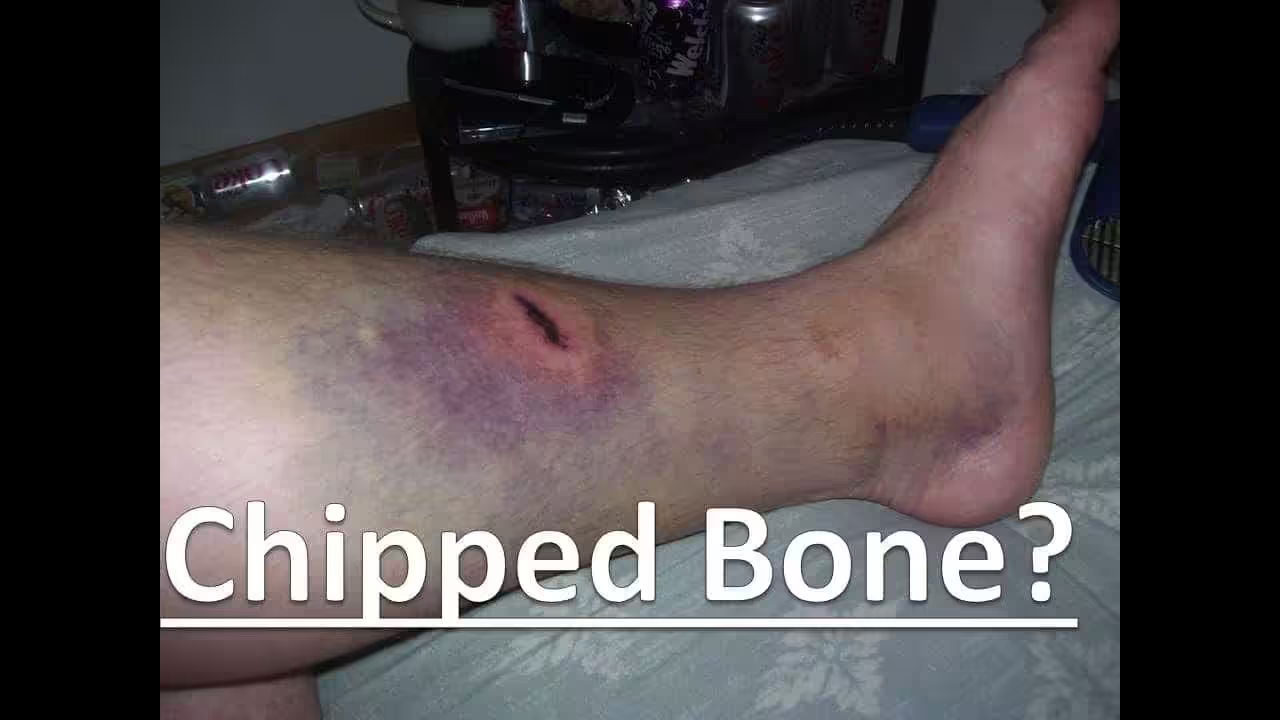
A chipped ankle bone (avulsion fracture) occurs when a tendon or ligament pulls off a small fragment of bone at its attachment point during a forceful ankle sprain or twist. It causes localized pain at the chip site, swelling, and bruising — symptoms nearly identical to a ligament sprain. Most ankle avulsion fractures are stable and heal in 4–8 weeks with a walking boot; displaced fragments may require surgery. X-ray is required to confirm the diagnosis.
A “chipped bone” in the ankle is the common name for an avulsion fracture — one of the most frequently missed diagnoses after ankle injuries. When the ankle rolls violently, the ligaments and tendons attached to the ankle bones can pull so forcefully that they tear off a small chip of bone at their insertion point rather than rupturing the soft tissue itself.
The most common sites for ankle avulsion fractures are the base of the 5th metatarsal (where the peroneus brevis tendon attaches), the anterior process of the calcaneus (heel bone), and the lateral process of the talus. These chips are easily missed on routine ankle X-rays when the radiologist is focused on the main ankle bones.
Common Sites for Ankle Bone Chips (Avulsion Fractures)
| Location | Structure That Avulses | Mechanism | Treatment |
|---|---|---|---|
| Base of 5th metatarsal | Peroneus brevis tendon | Ankle inversion | Boot 4–6 weeks; rarely surgery |
| Anterior process of calcaneus | Bifurcate ligament | Inversion + plantarflexion | Boot 6–8 weeks |
| Lateral malleolus tip | ATFL ligament | Ankle sprain | Boot 4–6 weeks |
| Lateral talar process | Lateral ligament complex | Dorsiflexion + inversion | CT scan often needed; may need surgery |
Chipped Bone vs. Ankle Sprain: How to Tell
Clinically, ankle avulsion fractures and ligament sprains present almost identically: lateral pain, swelling, bruising, and limited weight-bearing after a twist. The key distinguishing feature is point tenderness directly over bone rather than over the ligament. Ottawa Ankle Rules identify patients needing X-ray — if there is tenderness at the posterior tip of the fibula or the base of the 5th metatarsal, imaging is necessary. However, some chips (particularly the anterior process of the calcaneus) lie outside the Ottawa zones and require clinical suspicion plus additional foot X-rays.
Watch: Ankle Fracture & Recovery Tips
Dr. Tom explains ankle fracture types including avulsion chips, recovery timelines, and return-to-activity guidelines:

Book a same-day ankle evaluation → | (810) 206-1402
⚠️ When to see a podiatrist:
- Inability to bear weight after ankle injury
- Significant swelling and bruising over the ankle bone
- Bone fragment visible on X-ray with joint instability
- Persistent pain and swelling after 2 weeks
⭐ 4.4★ | 5K+ Sold
Protects a chipped ankle bone during healing — allows limited walking while reducing stress on the fracture site.
⭐ 4.6★ | 30K+ Sold
Supports the ankle during late-stage chip fracture healing and prevents re-injury returning to activity.
Ready to Get Relief? Same-Week Appointments Available
Board-certified podiatric surgeon | Howell & Bloomfield Township, MI | Most Insurance Accepted
4.9★ | 1,123 Reviews | 3,000+ Surgeries
Or call: (810) 206-1402
Frequently Asked Questions
How long does a chipped ankle bone take to heal?
Most ankle avulsion fractures heal in 4–8 weeks in a walking boot with restricted activity. The 5th metatarsal base avulsion — the most common type — typically heals in 4–6 weeks. Larger fragments or those involving weight-bearing joint surfaces (talar process) may take 8–12 weeks or require surgical fixation. Bone healing can be confirmed with follow-up X-ray at 6–8 weeks.
Can you walk on a chipped ankle bone?
For small, non-displaced avulsion fractures, limited walking in a protective boot is generally permitted. Unrestricted walking without immobilization risks fragment displacement and delayed union. Walking on a chipped bone at the base of the 5th metatarsal is particularly discouraged, as this site has a history of delayed healing and refracture if not properly protected.
Does a chipped bone in the ankle require surgery?
The majority of ankle avulsion fractures do not require surgery. Surgery is considered when the fragment is significantly displaced (>2mm with joint involvement), when a large fragment includes articular cartilage that would affect joint mechanics, or when non-union (failure to heal) occurs after adequate conservative management. The lateral talar process avulsion is most likely to need surgical consideration due to its role in ankle joint stability.
How is a chipped ankle bone diagnosed?
Standard ankle X-rays identify most avulsion fractures, but positioning matters — the 5th metatarsal base is sometimes cut off on standard ankle views and requires a dedicated foot X-ray. Anterior process of calcaneus avulsions are frequently missed on standard views and may need an oblique view or CT scan. If clinical suspicion is high despite normal X-rays, MRI can detect bone marrow edema at avulsion sites within 24–48 hours of injury.
What happens if a chipped ankle bone doesn’t heal?
Non-union of an ankle avulsion fragment — where the chip fails to reattach to the parent bone — results in a fibrous scar connecting the fragment rather than bone. This typically causes chronic, activity-related pain at the avulsion site. Treatment options for non-union include bone stimulator therapy, surgical excision of the fragment (if small and symptomatic), or ORIF with screws and bone graft (for larger fragments with joint involvement).
Ankle Injury That Won’t Heal? Could Be a Bone Chip.
Dr. Tom Biernacki, DPM provides same-day ankle X-ray evaluations at Howell and Bloomfield Township.
Related: Signs of a Broken Ankle | Chipped Bone in the Foot | Chipped Shin Bone | Strained Ankle Ligaments
Recovery Support for Ankle Bone Injuries
- Plantar Fasciitis Compression Socks — Chipped ankle bone with swelling: graduated compression socks significantly reduce periarticular edema during immobilization.
- Doctor Hoy’s Natural Pain Relief Gel — Ankle pain during healing: arnica + camphor topical applied around the ankle joint (away from open skin) 3-4x daily.
- PowerStep Pinnacle — Post-immobilization return to function: arch support inside your shoe reduces subtalar motion that stresses healing osteochondral fragments.
Ankle chip fracture with persistent pain or locking? Osteochondral lesions may require surgical debridement. Evaluation at Balance Foot & Ankle → (810) 206-1402
In-Office Treatment at Balance Foot & Ankle
If home treatment isn’t providing relief for your ankle condition, our podiatry team at Balance Foot & Ankle can help with same-week evaluations and advanced in-office care.
Ready to feel better?
Same-week appointments available in Howell and Bloomfield Township, Michigan.
Book Your VisitReady to fix this for good?
Reading goes only so far. The fastest path to relief is a 30-minute office visit with Dr. Biernacki — same-week, Howell or Bloomfield Township. Call (810) 206-1402 or use our online booking.
Get Expert Care at Balance Foot & Ankle
Same-week appointments at our Howell and Bloomfield Township offices. Board-certified podiatric surgeons. Most insurance accepted.

Dr. Tom Biernacki, DPM is a board-certified foot & ankle surgeon (ABFAS & ABPM) at Balance Foot & Ankle Specialists in Southeast Michigan. With over a decade of clinical experience, he specializes in heel pain, bunions, diabetic foot care, sports injuries, and minimally invasive surgery. Dr. Biernacki is a member of the APMA and ACFAS, and his patient education content on MichiganFootDoctors.com and YouTube has made him one of the most-followed foot & ankle educators on YouTube.