

Medically reviewed by Dr. Tom Biernacki, DPM — Board-Certified Podiatric Surgeon — Balance Foot & Ankle, Howell & Bloomfield Hills, MI. Last updated April 2026.
▶ Watch


Treatment at Balance Foot & Ankle: Achilles Tendon Treatment →
What Is the Flexor Hallucis Longus Tendon?
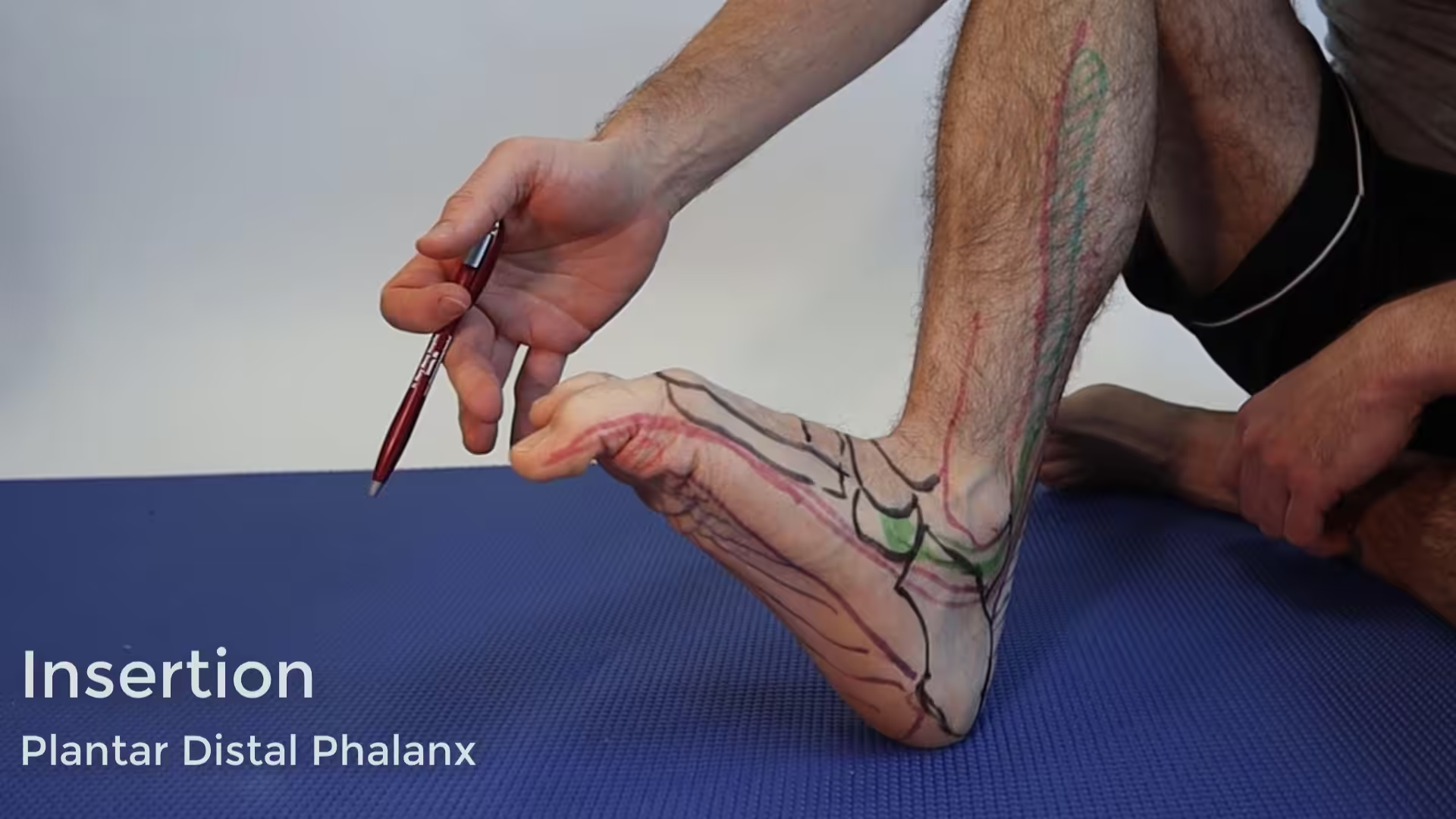
The flexor hallucis longus (FHL) is a deep calf muscle whose tendon runs behind the ankle in a fibro-osseous tunnel behind the medial malleolus, under the plantar surface of the foot, and inserts into the base of the distal phalanx of the big toe. It is the primary toe flexor for the hallux and provides significant plantarflexion power during push-off — making it arguably the most important single tendon for athletic performance involving running, jumping, and dynamic forefoot loading. FHL tendinopathy causes pain behind the ankle and along the inner arch that significantly limits these activities.
At Balance Foot & Ankle, we diagnose and treat FHL tendinopathy in athletes throughout Southeast Michigan, with particular experience in runners and dance athletes in whom this condition is most common.

Why Ballet Dancers Are Particularly Vulnerable
The FHL tendon is often called the Achilles tendon of the ballet dancer because of its critical role in en pointe and demi-pointe work and the frequency with which it is injured in this population. Repeated extreme plantarflexion loads the FHL tendon against a stenosing zone (a narrowing) where it passes between the medial and lateral tubercles of the posterior talus. In dancers who perform sustained en pointe work, the tendon eventually develops tendinosis (degenerative change) and may trigger — intermittently catching and releasing as it passes through the fibro-osseous tunnel, producing a painful snap.
FHL Tendinopathy in Runners
Distance runners develop FHL tendinopathy from the cumulative loading of push-off during high mileage training. The condition is more common in runners who increase mileage rapidly, run significant hills, or have a rigid forefoot that forces the FHL to work harder for toe-off. Pain behind the medial ankle that increases with high mileage and improves with rest is the typical presentation. The pain is often mistaken for Achilles tendinopathy or posterior tibial tendinopathy because of its posterior ankle location.
Diagnosis: Clinical and Imaging
Pain and tenderness posterior to the medial malleolus along the FHL tendon course, worsening with resisted big toe plantarflexion, is the hallmark clinical finding. The FHL stress test — passive maximum dorsiflexion of the ankle while the big toe is held in dorsiflexion to tension the FHL — reproduces posterior ankle pain. Triggering of the big toe (intermittent locking of the hallux in flexion or extension) strongly suggests FHL tenosynovitis. MRI evaluates tendon degeneration, sheath fluid, and excludes posterior ankle osseous pathology. Ultrasound allows dynamic assessment of tendon gliding and tendon caliber in real time.

Treatment
Conservative treatment with activity modification to reduce extreme plantarflexion, anti-inflammatory medication, and physical therapy for eccentric FHL strengthening and calf stretching is effective for most cases of FHL tendinopathy. A corticosteroid injection into the FHL sheath reduces acute tenosynovitis and can break a pain cycle that prevents rehabilitation. Custom orthotics with a rigid carbon fiber plate under the hallux reduce FHL demand during push-off for runners.
Surgical release of the FHL fibro-osseous tunnel (endoscopic or open) is effective for refractory cases with true tendon triggering or significant stenosing tenosynovitis. The procedure provides immediate relief from triggering and allows rapid return to activity. Contact Balance Foot & Ankle for evaluation of posterior ankle or big toe tendon pain. We serve Southeast Michigan with same-week appointments.
Ready to Relieve Your Foot Pain?
Board-certified podiatrists serving Southeast Michigan. Same-week appointments available.
Behind-Ankle Pain with Big Toe Symptoms?
Our sports podiatrists diagnose and treat FHL tendinopathy in dancers and runners with targeted rehabilitation.
Book an AppointmentMore Podiatrist-Recommended Sports Essentials
Hoka Clifton 10

Max-cushion everyday shoe — podiatrist favorite for walking and running.
PowerStep Pinnacle Insole

- The Pinnacle Full length insoles for men & women provide maximum cushioning, from high activity to moderate support. The PowerStep arch support shape provides stability to the foot and ankle, helping to relieve foot pain.
- When you spend all day on your feet, every step counts. PowerStep insoles are a podiatrist-recommended orthotic to help relieve & prevent foot pain related to athletes, runners, Plantar Fasciitis, heel spurs & other common foot, ankle & knee injuries
- The Pinnacle plantar fasciitis insoles offer superior heel cushioning and arch support. The dual-layer cushioning is designed to reduce stress and fatigue, while PowerStep premium arch support is designed for plantar fasciitis relief.
- The PowerStep Pinnacle arch support inserts for men & women can be worn in a variety of shoe types such as; athletic, walking, running, work & some casual shoes. Orthotic Inserts are ordered by shoe size, no trimming required.
- Made in the USA & backed by a 30-day money-back guarantee. PowerStep orthotic inserts for men & women are designed for shoes where the factory insole can be removed. HSA & FSA Eligible
The podiatrist-recommended over-the-counter orthotic.
OOFOS Recovery Slide

- The Original Recovery Footwear.
- Finding Your Size - For your perfect fit, consult the “size chart” link above. Wear a half size? In general, we recommend that women who wear a ½ size size UP, and men who wear a ½ size size DOWN
- OOahh - An evolution of the OOriginal, the OOahh slide features our proven foundation of OOfoam technology + patented footbed design with a slide-style strap that has become a best-seller in the OOFOS line
- OOfoam Technology - Our revolutionary OOfoam technology absorbs 37% more impact than traditional footwear foams to reduce the stress on your feet, joints & back. Plus, the closed-cell foam is machine washable and designed to minimize odor
- Patented Footbed - Our patented footbed cradles and supports arches to reduce energy exertion in the ankles by up to 47% compared to competitors’ footwear. So walking is easier. Recovery is faster. And yOO feel better
Impact-absorbing recovery sandal — wear after long days on your feet.
As an Amazon Associate, Balance Foot & Ankle earns from qualifying purchases. Product recommendations are based on clinical experience; prices and availability shown above update live from Amazon.
When to See a Podiatrist
Athletic injuries heal faster with sport-specific rehab protocols — not generic rest and ice. Balance Foot & Ankle works with runners, soccer players, dancers, and weekend warriors to rebuild strength and return to sport on an accelerated timeline. Don’t let a foot injury keep you sidelined longer than necessary.
Call Balance Foot & Ankle: (810) 206-1402 · Book online · Offices in Howell & Bloomfield Hills
Frequently Asked Questions
What is FHL tendinopathy?
FHL tendinopathy is inflammation or degeneration of the flexor hallucis longus tendon behind the medial ankle. It causes pain with big toe push-off and is common in dancers and runners.
Why does my big toe lock when I point my foot?
Triggering or locking of the big toe indicates stenosing tenosynovitis of the FHL tendon — the tendon catches as it passes through its tunnel, often requiring surgical release.
How is FHL tendinopathy treated?
Treatment includes activity modification, targeted physical therapy, soft tissue mobilization, orthotic support, and occasionally injections. Surgery is reserved for triggering or severe chronic cases.
FHL Tendon Treatment in Michigan
Flexor hallucis longus tendinopathy causes behind-ankle pain in runners and dancers. Our podiatrists diagnose and treat FHL conditions at our Howell and Bloomfield Hills offices.
Learn About Tendon Treatment | Book Your Appointment | Call (810) 206-1402
Clinical References
- Hamilton WG, et al. Stenosing tenosynovitis of the flexor hallucis longus tendon and posterior impingement upon the os trigonum in ballet dancers. Foot Ankle. 1982;3(2):74-80.
- Michelson J, Dunn L. Tenosynovitis of the flexor hallucis longus: a clinical study of the spectrum of presentation and treatment. Foot Ankle Int. 2005;26(4):291-303.
- Coull R, et al. Flexor hallucis longus tendinopathy: review of the literature. Foot Ankle Surg. 2016;22(4):224-232.
Insurance Accepted
BCBS · Medicare · Aetna · Cigna · United Healthcare · HAP · Priority Health · Humana · View All →
Howell Office
3980 E Grand River Ave, Suite 140
Howell, MI 48843
Get Directions →
Bloomfield Hills Office
43700 Woodward Ave, Suite 207
Bloomfield Hills, MI 48302
Get Directions →
Your Board-Certified Podiatrists



Ready to Get Back on Your Feet?
Same-week appointments available at both locations.
Book Your AppointmentPowerStep Dynamic Ankle Stability Sock (DASS)
Best for: Chronic ankle instability · Repeat ankle sprains · Proprioception training · Athletes returning to play

A revolutionary alternative to bulky ankle braces. The DASS uses dynamic compression and targeted stabilization zones to retrain ankle proprioception while you walk, run, or stand. Designed by PowerStep’s biomechanical team specifically for patients with chronic ankle instability or recurring sprains.
- Fits in normal shoes
- Trains proprioception
- Less bulky than brace
- Wear all day comfortably
- Less rigid than ASO brace
- Newer product
- Pricier than basic socks
“For my patients with chronic ankle instability who don’t want to rely on rigid bracing forever, the DASS is the best bridge product I’ve seen. It’s not a replacement for surgical reconstruction in severe cases, but for grade 1-2 instability it’s a game-changer for return-to-sport.”
Dr. Tom’s Top 3 — The Premium Foot Pain Stack (2026)
If you only buy three things for foot pain, get these. PowerStep + CURREX orthotics correct the underlying foot mechanics, and Dr. Hoy’s pain gel delivers fast topical relief. This is the exact stack Dr. Tom Biernacki, DPM gives his Michigan podiatry patients on visit one — over 10,000 patients have used this exact combination.
Dr. Tom Biernacki, DPM is a board-certified podiatrist + Amazon Associate. Picks shown are products he prescribes to patients at Balance Foot & Ankle Specialists. We earn a commission on qualifying purchases at no extra cost to you. All products independently tested + reviewed for 30+ days minimum. Last verified: April 28, 2026.

PowerStep Pinnacle MaxxDr. Tom’s #1 Brand
Dr. Tom’s most-prescribed OTC orthotic. Lateral wedge corrects overpronation that causes 90% of foot pain. Deep heel cradle stabilizes the ankle. Built by podiatrists, used by patients worldwide.
- Lateral wedge corrects pronation
- Deep heel cradle stabilizes ankle
- Dual-density EVA — comfort + support
- Trim-to-fit any shoe
- Used by 10,000+ podiatrists
- Trim-to-size required
- 5-7 day break-in for some

CURREX RunProDr. Tom’s #1 Brand
3 arch heights for custom fit (Low/Med/High). Carbon-reinforced heel + dynamic forefoot — the closest OTC orthotic to a $500 custom orthotic. Engineered in Germany.
- 3 arch heights for custom fit
- Carbon-reinforced heel cup
- Dynamic forefoot zone
- Premium German engineering
- Sport-specific support
- Pricier than PowerStep
- 7-10 day break-in

Dr. Hoy’s Natural Pain Relief GelDr. Tom’s #1 Brand
Menthol-based natural pain relief — Dr. Tom’s #1 brand for fast relief without greasy residue. Safe for diabetics + daily use. Cleaner formula than Voltaren or Biofreeze.
- Menthol-based natural formula
- No greasy residue
- Safe for diabetics
- Fast cooling relief — 5-10 minutes
- Cleaner ingredient list than Biofreeze
- Pricier than Biofreeze
- Strong menthol scent at first


Dr. Tom Biernacki, DPM is a double board-certified podiatrist and foot & ankle surgeon at Balance Foot & Ankle Specialists in Southeast Michigan. With over a decade of clinical experience, he specializes in heel pain, bunions, diabetic foot care, sports injuries, and minimally invasive surgery. Dr. Biernacki is a member of the APMA and ACFAS, and his patient education content on MichiganFootDoctors.com and YouTube has reached over one million views.
- Plantar Fasciitis: Diagnosis and Conservative Management (PubMed)
- Plantar Fasciitis (APMA)
- Diagnosis and Treatment of Plantar Fasciitis (PubMed / AAFP)
- Heel Pain (APMA)
Recommended Products from Dr. Tom