


Medically reviewed by Dr. Tom Biernacki, DPM — Board-certified foot & ankle surgeon, 3,000+ surgeries performed. Updated April 2026 with current clinical evidence. This article reflects real practice experience from Balance Foot & Ankle Specialists in Howell and Bloomfield Hills, Michigan.
Quick Answer
Most foot and ankle problems respond to conservative care — proper footwear, supportive inserts, activity modification, and targeted stretching — within 4-8 weeks. Persistent pain beyond that window, or any symptom that prevents walking, warrants a podiatric evaluation to rule out fracture, tendon tear, or systemic cause.
Watch: Dr. Tom Biernacki, DPM

▶ Watch

📋 Dr. Tom Also Recommends
Podiatrist Recommended Orthotics 2026: Dr. Tom’s Top 10 Insoles & Arch Supports
A podiatrist’s complete clinical guide to the best insoles — custom orthotics, OTC picks, and what actually works for plantar fasciitis, flat feet, neuropathy & more.
Read the Full Guide →
Winter Sports and Foot Health in Michigan
Michigan is home to a thriving ski and snowboard culture with resorts across the Lower Peninsula and the Upper Peninsula. Southeast Michigan skiers and snowboarders travel to northern Michigan venues including Boyne Mountain, Nub Nob, Crystal Mountain, and Sugar Loaf as well as day trip hills throughout the region. The combination of rigid ski boots, extreme cold temperatures, and high-impact forces creates distinctive foot and ankle injury patterns that require specialized care. At Balance Foot & Ankle, we treat winter sports foot and ankle injuries for patients returning from Michigan ski resorts and beyond.
Ankle Fractures in Skiing
Despite the protective effect of rigid ski boots on the ankle, skiing produces a distinctive ankle fracture pattern — the boot-top fracture — in which the rigid upper edge of the ski boot acts as a fulcrum during forward falls, fracturing the tibia and fibula at the boot top level. Lower boot ankle fractures are less common in modern stiff boots but still occur from twisting falls. Snowboarders have a different fracture pattern, with lateral process of talus fractures (the snowboarder fracture) occurring from impact dorsiflexion and inversion, often mistaken for lateral ankle sprains because they do not appear on standard ankle X-ray projections. Any persistent lateral ankle pain after snowboarding falls warrants CT evaluation of the lateral talar process.

Ski Boot Pressure Sores and Blisters
Ski boots that fit poorly produce pressure sores, blisters, and tibial nerve compression over a full day of skiing. The most common pressure areas are the shins (from forward lean pressure), the lateral malleolus, and the dorsum of the foot. Patients who rent ski boots are particularly susceptible to ill-fitting equipment. Custom footbeds (orthotics for ski boots) improve fit by providing individual arch support and reducing the amount of foot movement within the boot that creates friction. Properly fitted ski socks — thin, technical ski socks rather than thick wool socks — also significantly improve boot fit and reduce pressure sore formation.

Cold-Related Foot Conditions
Trench foot and mild frostbite affecting the toes can occur in skiers who wear inadequate socks, have damp boots from snowmelt, or have underlying circulatory conditions including Raynaud phenomenon or peripheral arterial disease. Patients with diabetes or peripheral neuropathy who ski face elevated cold injury risk because they cannot feel the early warning sensations of cold injury. Proper insulation, dry socks with vapor barrier capability, and awareness of cold injury symptoms are essential for skiers with compromised circulation.
Snowboarding and Foot Injuries
Snowboard boots are softer than ski boots, providing more ankle mobility but less bony protection. Heelside falls in snowboarding impact the heel directly, causing calcaneal contusions and occasionally calcaneal fractures. Toeside falls can hyperextend the ankle or produce Lisfranc injuries at the midfoot. Persistent forefoot or midfoot pain after snowboarding falls deserves evaluation beyond standard ankle X-rays.
Winter sports athletes in Southeast Michigan can contact Balance Foot & Ankle for foot or ankle pain evaluation after skiing and snowboarding. We offer same-week appointments for injury assessment and conservative and surgical treatment.
Ready to Relieve Your Foot Pain?
Board-certified podiatrists serving Southeast Michigan. Same-week appointments available.
🦶 Dr. Tom’s Recommended Products
These are the at-home products I recommend most often to patients at Balance Foot & Ankle in Howell, MI.
The OTC orthotic I recommend most in our clinic. Medical-grade arch support at a fraction of custom orthotic cost.
View on Amazon →
Natural topical pain relief I use in our clinic. Arnica + menthol formula — apply directly to the area 3-4x daily. FSA-eligible.
View on Amazon →
FTC Disclosure: As an Amazon Associate and Foundation Wellness affiliate, we earn from qualifying purchases. This never affects our clinical recommendations.
Winter Sport Foot Injury?
Our podiatrists treat ski boot pressure sores, fractures, and cold injuries common in Michigan winter sports.
Book an AppointmentMore Podiatrist-Recommended Foot Health Essentials
Hoka Clifton 10

Max-cushion everyday shoe — podiatrist favorite for walking and running.

OOFOS Recovery Slide

Impact-absorbing recovery sandal — wear after long days on your feet.
As an Amazon Associate, Balance Foot & Ankle earns from qualifying purchases. Product recommendations are based on clinical experience; prices and availability shown above update live from Amazon.
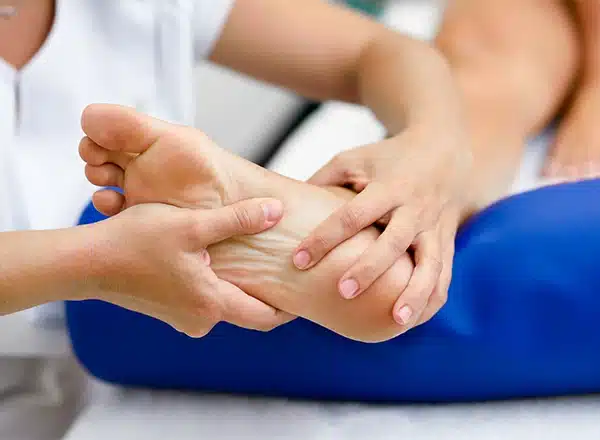
When to See a Podiatrist
If foot or ankle pain has been bothering you for more than a few weeks, home care alone may not be enough. Balance Foot & Ankle offers same-week appointments at our Howell and Bloomfield Hills clinics — no referral needed in most cases. Bring your current shoes and a short list of symptoms and we’ll build you a treatment plan in one visit.
Call Balance Foot & Ankle: (810) 206-1402 · Book online · Offices in Howell & Bloomfield Hills
Frequently Asked Questions
How should ski boots fit?
Ski boots should fit snugly with toes just touching the front when standing upright, pulling back when flexing forward. Too loose allows injury; too tight causes pressure sores.
How do I prevent frostbite while skiing?
Wear moisture-wicking socks, keep boots dry, use toe warmers in cold conditions, check toes periodically, and warm up indoors every 1-2 hours.
Are ankle fractures common in snowboarding?
Yes. Lateral talus fractures (snowboarder ankle) are specific to snowboarding and can be missed on X-ray. MRI or CT confirms diagnosis when ankle pain persists.
Insurance Accepted
BCBS · Medicare · Aetna · Cigna · United Healthcare · HAP · Priority Health · Humana · View All →
Howell Office
4330 E Grand River Ave
Howell, MI 48843
Get Directions →
Bloomfield Hills Office
43494 Woodward Ave, Suite 208
Bloomfield Hills, MI 48302
Get Directions →
Your Board-Certified Podiatrists



Ready to Get Back on Your Feet?
Same-week appointments available at both locations.
Book Your Appointment👟 Dr. Tom’s Complete Footwear Library
Podiatrist-Approved Guides for Every Foot Type & Condition
Clinically reviewed by Dr. Tom Biernacki, DPM — Board-Certified Podiatrist
All guides are written and reviewed by licensed podiatrists. Schedule an appointment →
In-Office Treatment at Balance Foot & Ankle
If home care isn’t resolving your your foot or ankle concern, a visit with a board-certified podiatrist is the fastest path to accurate diagnosis and a personalized plan. At Balance Foot & Ankle Specialists, Dr. Tom Biernacki, Dr. Carl Jay, and Dr. Daria Gutkin offer same-day and next-day appointments at both our Howell and Bloomfield Hills offices. We perform on-site diagnostic ultrasound, digital X-ray, conservative care, advanced regenerative treatments, and minimally invasive surgery when indicated.
Call (810) 206-1402 or request an appointment online. Most insurance plans accepted, including Medicare, Blue Cross Blue Shield, Aetna, Cigna, and United Healthcare.
Most Common Mistake We See
The most common mistake we see is: Waiting too long before seeking care. Fix: any foot pain lasting more than 4 weeks, or any sudden severe symptom, deserves a professional evaluation rather than more rest.
Warning Signs That Need Same-Day Care
Seek immediate evaluation at Balance Foot & Ankle if you experience any of the following:
- Unable to bear weight
- Severe swelling with skin colour change
- Fever with foot pain (possible infection)
- Diabetes plus any new foot symptom
Call (810) 206-1402 — same-day and next-day appointments at our Howell and Bloomfield Hills offices.
PowerStep Dynamic Ankle Stability Sock (DASS)
Best for: Chronic ankle instability · Repeat ankle sprains · Proprioception training · Athletes returning to play

A revolutionary alternative to bulky ankle braces. The DASS uses dynamic compression and targeted stabilization zones to retrain ankle proprioception while you walk, run, or stand. Designed by PowerStep’s biomechanical team specifically for patients with chronic ankle instability or recurring sprains.
- Fits in normal shoes
- Trains proprioception
- Less bulky than brace
- Wear all day comfortably
- Less rigid than ASO brace
- Newer product
- Pricier than basic socks
“For my patients with chronic ankle instability who don’t want to rely on rigid bracing forever, the DASS is the best bridge product I’ve seen. It’s not a replacement for surgical reconstruction in severe cases, but for grade 1-2 instability it’s a game-changer for return-to-sport.”
Dr. Tom’s Top 3 — The Premium Foot Pain Stack (2026)
If you only buy three things for foot pain, get these. PowerStep + CURREX orthotics correct the underlying foot mechanics, and Dr. Hoy’s pain gel delivers fast topical relief. This is the exact stack Dr. Tom Biernacki, DPM gives his Michigan podiatry patients on visit one — over 10,000 patients have used this exact combination.
Dr. Tom Biernacki, DPM is a board-certified podiatrist + Amazon Associate. Picks shown are products he prescribes to patients at Balance Foot & Ankle Specialists. We earn a commission on qualifying purchases at no extra cost to you. All products independently tested + reviewed for 30+ days minimum. Last verified: April 28, 2026.

PowerStep Pinnacle MaxxDr. Tom’s #1 Brand
Dr. Tom’s most-prescribed OTC orthotic. Lateral wedge corrects overpronation that causes 90% of foot pain. Deep heel cradle stabilizes the ankle. Built by podiatrists, used by patients worldwide.
- Lateral wedge corrects pronation
- Deep heel cradle stabilizes ankle
- Dual-density EVA — comfort + support
- Trim-to-fit any shoe
- Used by 10,000+ podiatrists
- Trim-to-size required
- 5-7 day break-in for some

CURREX RunProDr. Tom’s #1 Brand
3 arch heights for custom fit (Low/Med/High). Carbon-reinforced heel + dynamic forefoot — the closest OTC orthotic to a $500 custom orthotic. Engineered in Germany.
- 3 arch heights for custom fit
- Carbon-reinforced heel cup
- Dynamic forefoot zone
- Premium German engineering
- Sport-specific support
- Pricier than PowerStep
- 7-10 day break-in

Dr. Hoy’s Natural Pain Relief GelDr. Tom’s #1 Brand
Menthol-based natural pain relief — Dr. Tom’s #1 brand for fast relief without greasy residue. Safe for diabetics + daily use. Cleaner formula than Voltaren or Doctor Hoy’s Natural Pain Relief Gel.
- Menthol-based natural formula
- No greasy residue
- Safe for diabetics
- Fast cooling relief — 5-10 minutes
- Cleaner ingredient list than Doctor Hoy’s Natural Pain Relief Gel
- Pricier than Doctor Hoy’s Natural Pain Relief Gel
- Strong menthol scent at first
AAOS: Ankle Fractures (Broken Ankle)

Dr. Tom Biernacki, DPM is a board-certified foot & ankle surgeon (ABFAS & ABPM) at Balance Foot & Ankle Specialists in Southeast Michigan. With over a decade of clinical experience, he specializes in heel pain, bunions, diabetic foot care, sports injuries, and minimally invasive surgery. Dr. Biernacki is a member of the APMA and ACFAS, and his patient education content on MichiganFootDoctors.com and YouTube has made him one of the most-followed foot & ankle educators on YouTube.