


Quick answer: Flexor Hallucis Longus Tendon Tear Surgery is a common foot/ankle topic that affects many patients. The 2026 evidence-based approach combines proper diagnosis, conservative-first treatment, and escalation only when needed. We treat this regularly at our Howell and Bloomfield Hills practices. Call (810) 206-1402.
![Heel Bursitis & Achilles Tendon Bursitis [Best HOME Treatment!]](https://www.michiganfootdoctors.com/wp-content/cache/flying-press/f2850da852ba9539b6bf4f72ae5062fe.jpg)
Watch: Heel Bursitis & Achilles Tendon Bursitis [Best HOME Treatment!] — MichiganFootDoctors YouTube

Medically Reviewed by Dr. Tom Biernacki, DPM, FACFAS
Board-certified podiatrist & foot surgeon | Balance Foot & Ankle, Howell & Bloomfield Hills, MI | Last updated: May 2026
The flexor hallucis longus (FHL) tendon controls downward movement of the big toe and provides push-off power during gait. Complete FHL tendon tears are uncommon but serious — they produce sudden loss of big toe flexion strength, deep medial ankle pain, and an inability to perform a single-leg calf raise. Surgical repair is typically indicated for complete tears in active patients, involving direct tendon repair or tendon transfer (FDL transfer). Recovery takes 4–6 months. Partial tears and FHL tendinopathy are usually managed conservatively with excellent outcomes.
FHL Tendon Conditions — Spectrum from Tendinopathy to Complete Tear
FHL pathology exists on a spectrum. Most patients have tendinopathy or a partial tear that responds to conservative care. Complete tears are less common but require surgical decision-making. Accurate diagnosis with MRI determines where on the spectrum a patient falls.
| Condition | MRI Finding | Key Symptom | Treatment |
|---|---|---|---|
| FHL Tendinopathy | Thickening, signal change, intact fibers | Medial ankle/arch pain; functional toe flexion | Conservative — PT, orthotics, injection |
| Partial FHL Tear | Partial fiber disruption; some continuity | Weakness; pain with resisted toe flexion | Conservative first; surgery if failed |
| Complete FHL Tear | Full discontinuity; tendon retraction | Loss of IP joint flexion; push-off deficit | Surgery in active patients |
| FHL Stenosing Tenosynovitis | Tendon constriction at fibro-osseous tunnel | Triggering or locking of big toe (“trigger toe”) | Injection; surgical release if refractory |
Surgical Options for FHL Tendon Tears
The choice of surgical technique depends on the location of the tear, the degree of retraction, tissue quality, and the patient’s functional demands. Dr. Biernacki will review MRI findings and discuss the most appropriate approach based on your specific anatomy and goals.
- Direct primary repair: When the tear is acute (less than 6 weeks old) and the tendon ends can be approximated without tension, direct suture repair restores near-native anatomy. This is the preferred approach for acute complete tears identified promptly.
- FDL tendon transfer: When the tear is chronic (tendon ends retracted and scarred) or when tendon quality is poor, the flexor digitorum longus (FDL) tendon is transferred to power great toe flexion. The FDL, which flexes the lesser toes, is redirected to the FHL insertion — a well-established technique with reliable outcomes. The lesser toes typically function adequately after transfer.
- Tendon sheath release: For stenosing tenosynovitis (trigger toe), surgical release of the fibro-osseous tunnel through a small medial incision decompresses the constricted tendon without tendon sacrifice. Recovery is significantly faster than tear repair — typically 3–4 weeks.
- Post-operative protocol: Non-weight-bearing for 4–6 weeks in a cast or boot after repair or transfer, followed by progressive weight-bearing in a walking boot, then physical therapy targeting great toe flexion strength, balance, and push-off mechanics. Full return to athletic activity at 4–6 months.
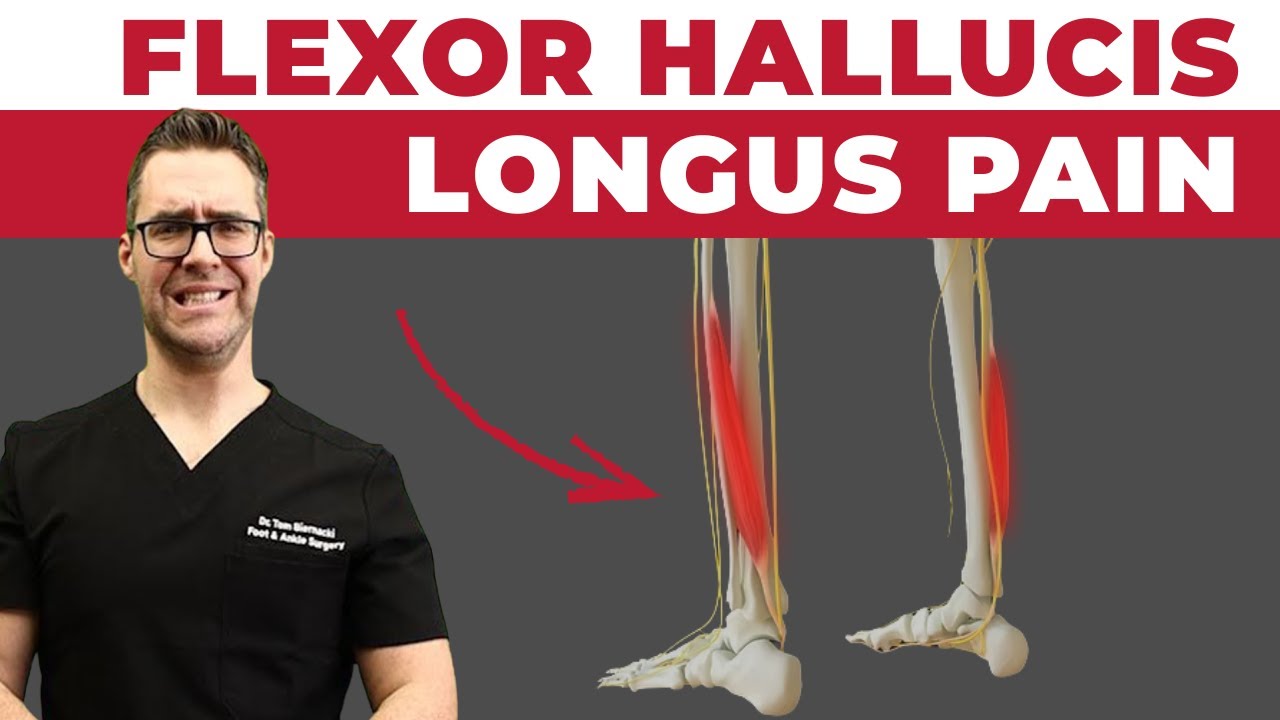
Watch: Flexor Hallucis Longus Pain — FHL Tendon Treatment Guide
Dr. Tom Biernacki explains FHL tendonitis and tendon pathology — causes, how to distinguish it from other medial ankle conditions, and the full treatment spectrum from conservative care to surgery:
Book a surgical consultation → · (810) 206-1402
The most common mistake with FHL tears is delaying surgical evaluation until the tendon has retracted significantly. A complete FHL tear that is repaired within 4–6 weeks of injury can typically be reapproximated directly — a simpler, more anatomical repair with better functional outcomes. A tear that is allowed to retract and scar over 3–6 months requires tendon transfer instead, which is a more complex procedure with a longer recovery. If you experience sudden loss of big toe flexion strength — especially in the setting of a pop or acute medial ankle pain — seek podiatric evaluation within days, not weeks. The window for primary repair closes quickly.
Frequently Asked Questions — FHL Tendon Tear & Surgery
What are the symptoms of an FHL tendon tear?
Complete FHL tears produce a characteristic loss of big toe flexion at the interphalangeal (IP) joint — you cannot curl the tip of the big toe downward against resistance. There is typically acute pain and swelling along the medial ankle behind the medial malleolus where the FHL tendon runs through its fibro-osseous tunnel. Push-off power during walking is reduced. Partial tears present more subtly — medial ankle pain, weakness with resisted toe flexion, and possibly a palpable nodule or triggering sensation (trigger toe) as scar tissue catches in the tendon sheath.
Who is most at risk for FHL tendon tears?
FHL tears are most common in ballet dancers and gymnasts (due to extreme plantarflexion demands that load the FHL at its tunnel), runners with sudden training load increases, and middle-aged patients with pre-existing FHL tendinopathy. Steroid injections into the FHL tendon sheath carry a small risk of tendon weakening — a reason podiatrists exercise caution with this injection site. Athletes who experience sudden medial ankle pain and swelling during push-off or a jump landing should be evaluated for FHL pathology alongside more common diagnoses like Achilles tendon injury and ankle sprain.
Can an FHL tear heal without surgery?
Partial FHL tears often respond to conservative management: activity modification, a walking boot for 4–6 weeks, physical therapy, and MLS laser therapy. Many partial tears achieve adequate healing without surgery. Complete tears, however, do not heal spontaneously — the tendon ends retract and scar tissue fills the gap. In lower-demand patients (minimal walking, older adults), living with a complete FHL tear is often manageable with footwear modification and toe-flexion aids. In active patients who require push-off power for work, sport, or walking, surgical reconstruction is the appropriate choice.
How long is recovery from FHL tendon surgery?
Recovery follows a predictable timeline: non-weight-bearing in a cast or boot for 4–6 weeks to protect the repair, progressive weight-bearing in a walking boot for weeks 6–10, transition to regular footwear at 10–12 weeks, and physical therapy focusing on great toe flexion strength and push-off power from weeks 6–20. Return to low-impact activity at 4 months, full return to sport at 5–6 months. FDL transfer recovery is slightly longer than direct repair due to the need for motor re-education — the FDL must learn its new role as great toe flexor.
Will I lose function after FHL surgery?
Outcomes after FHL repair or FDL transfer are generally excellent for activities of daily living. Most patients regain near-normal walking and stair-climbing function. Push-off strength typically returns to 80–90% of the unaffected side in motivated rehabilitation patients. Dancers and elite athletes may notice subtle push-off deficits at maximal performance levels, but the majority of athletic patients return to their preinjury sport. The FDL transfer produces slightly less power than a native FHL repair — this is a factor in timing: early repair when direct reconstruction is possible preserves more function than waiting for a transfer.
Big Toe Weakness or Medial Ankle Pain?
FHL tendon tears are time-sensitive — early evaluation preserves more surgical options. Dr. Biernacki offers same-day appointments at Howell and Bloomfield Hills with same-week MRI referral when needed.
Book a Consultation (810) 206-1402Related Tendon & Surgical Guides
- Tendon Transfer Surgery — Principles & Recovery
- Achilles Tendon Rupture Surgery
- Foot Surgery Preparation Checklist
- Post-Surgery Foot Wound Care Guide
- Peroneal Tendonitis — Lateral Tendon Comparison
In-Office Treatment at Balance Foot & Ankle
If home treatment isn’t providing relief for your Achilles tendinitis, our podiatry team at Balance Foot & Ankle can help with same-day evaluations and advanced in-office care.
Same-day appointments available. (810) 206-1402
Doctor Hoy’s Natural Pain Relief Gel
Natural topical pain relief I use in our clinic. Arnica + camphor formula — apply directly to the area 3–4x daily. ($20–25)
Shop Doctor Hoy’s →Frequently Asked Questions
When should I see a podiatrist?
If symptoms persist past 2 weeks, affect your normal activity, or are accompanied by red-flag symptoms (warmth, redness, swelling, inability to bear weight).
What does treatment cost?
Most diagnostic visits and conservative treatments are covered by Medicare and major insurers. Out-of-pocket costs vary by your specific plan.
How quickly can I get an appointment?
Most non-urgent cases see us within 5 business days. Urgent cases (sudden pain, possible fracture) typically same or next business day.
What is Foot pain?
Foot pain is a common foot/ankle condition that affects mobility and quality of life. Understanding the underlying cause is the first step in successful treatment. Our podiatrists at Balance Foot & Ankle perform a hands-on biomechanical exam, review your activity history, and use diagnostic imaging when appropriate to identify the root cause—not just treat the symptom. Many patients have been told to “rest and ice” without a deeper diagnostic workup; our approach is different.
Symptoms and warning signs
Common signs of foot pain include pain that worsens with activity, morning stiffness, swelling, tenderness when palpated, and difficulty bearing weight. If you experience sudden severe pain, inability to walk, visible deformity, numbness or color change, contact our office the same day or visit urgent care—these can signal a more serious injury such as a fracture, tendon rupture, or vascular compromise. Diabetics with any foot wound should seek same-day care.
Conservative treatment options
Most cases of foot pain respond to non-surgical care: structured rest, supportive footwear changes, custom orthotics, targeted stretching and strengthening protocols, anti-inflammatory medications when medically appropriate, and in-office procedures such as ultrasound-guided injections. We also offer advanced therapies including MLS laser therapy, EPAT/shockwave, regenerative injections, and image-guided procedures. Treatment is sequenced from least invasive to most invasive, and we explain the rationale at every step.
When is surgery considered?
Surgery is reserved for cases that fail 3-6 months of well-structured conservative care, when there is structural pathology (severe deformity, complete tear, advanced arthritis), or when imaging shows damage that will not heal without intervention. Our surgeons have performed 3,000+ foot and ankle procedures and prioritize minimally-invasive techniques whenever appropriate. We discuss recovery timelines, return-to-activity milestones, and realistic outcome expectations before any procedure is scheduled.
Recovery timeline and prevention
Recovery from foot pain varies based on severity and chosen treatment path. Conservative cases often improve within 4-8 weeks with consistent adherence to the protocol. Post-procedural recovery may range from a few days (in-office procedures) to several months (reconstructive surgery). Long-term prevention involves footwear assessment, activity modification, structured strengthening, and regular check-ins with your podiatrist if you have a history of recurrence. We provide written home-exercise plans and digital follow-up support.
Ready to feel better?
Same-week appointments available in Howell and Bloomfield Hills, Michigan.
Book Your VisitGet Expert Care at Balance Foot & Ankle
Same-week appointments at our Howell and Bloomfield Hills offices. Board-certified podiatric surgeons. Most insurance accepted.

Dr. Tom Biernacki, DPM is a board-certified foot & ankle surgeon (ABFAS & ABPM) at Balance Foot & Ankle Specialists in Southeast Michigan. With over a decade of clinical experience, he specializes in heel pain, bunions, diabetic foot care, sports injuries, and minimally invasive surgery. Dr. Biernacki is a member of the APMA and ACFAS, and his patient education content on MichiganFootDoctors.com and YouTube has made him one of the most-followed foot & ankle educators on YouTube.