
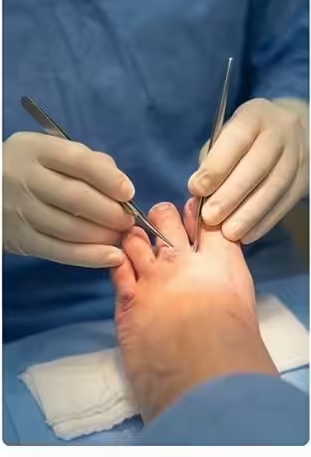

Hammertoe surgery recovery typically runs 4-6 weeks of soft-soled shoe wear plus 6-12 weeks back to regular activity. Proper buddy taping in week 2 makes the difference between a pain-free toe and a stiff one.
You’ve come to the right podiatry team. Dr. Tom Biernacki, DPM, FACFAS — board-certified foot & ankle surgeon with 3,000+ surgeries — explains exactly what hammertoe surgery recovery in Michigan means and what works. Call (810) 206-1402 for same-week appointment at Howell or Bloomfield Township.
Swelling is the part of hammertoe recovery that surprises people most. The toe can stay puffy and a little red for 3–6 months, which is normal and does not mean the surgery failed. Call (810) 206-1402.
Quick Answer
Most people walk in a surgical shoe right after hammertoe surgery, move into a wide regular shoe at about 6–8 weeks, and see the final result at 3–6 months, once the swelling settles. If a pin is used, it comes out in the office at 4–6 weeks. Same-week appointments in Howell + Bloomfield Township: (810) 206-1402.
▶ Watch
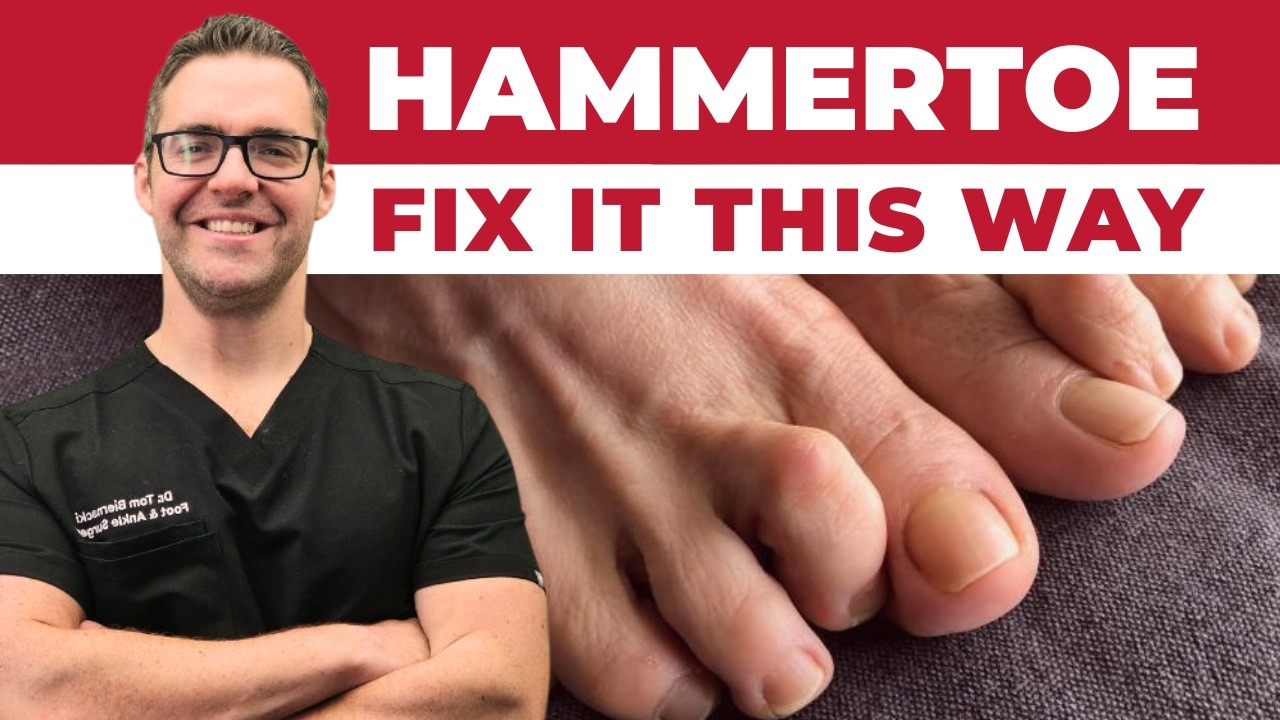
Hammertoe surgery — the correction of an abnormally flexed toe joint through bony realignment, joint release, or fusion — is among the most commonly performed elective foot procedures. The decision to proceed with surgery requires careful patient selection: hammertoes that cannot be adequately managed with wider footwear, orthotics, and padding, and cause consistent pain or functional limitation, are appropriate surgical candidates. At Balance Foot & Ankle in Southeast Michigan, Dr. Tom Biernacki performs hammertoe correction and provides realistic expectations for the recovery process.
Surgical Procedures for Hammertoe
The surgical approach depends on whether the hammertoe is flexible (can be straightened passively) or rigid (fixed deformity that cannot be corrected without surgery). Flexible hammertoe: flexor tendon lengthening or transfer is often sufficient — the flexor tendon is released or transferred to the top of the toe, eliminating the flexion deformity without bone work. Minimal recovery. Rigid hammertoe: proximal interphalangeal (PIP) joint arthroplasty — the cartilage and a small portion of bone from the PIP joint is removed, allowing the toe to be straightened. The corrected position is held with either: a temporary K-wire (Kirschner wire) — a small metal pin left protruding from the tip of the toe for 4–6 weeks until healing; or an implant (IntraFix, StayFuse) — an internal device that provides correction without an external pin. Most patients prefer the internal implant due to practical concerns about showering and activity with a pin. Correction of underlying metatarsal alignment (Weil osteotomy) may be combined when the hammertoe is caused by a long or elevated metatarsal.
On the day of surgery: hammertoe correction is an outpatient procedure, usually done under local anesthesia with IV sedation, so you go home the same day. Straightening one toe takes about 15–20 minutes, and several toes can be corrected in the same session. You walk out in a flat surgical shoe.
Recovery Timeline
Day 1–2: surgical shoe for weight-bearing; minimal swelling management (ice, elevation above heart level). Week 1–2: continued surgical shoe; dressing changes per surgeon instructions; limited weight-bearing on the forefoot. Week 3–6: progression to wider normal shoe or post-operative sandal as swelling allows; pin removal at 4–6 weeks if K-wire was used (a simple in-office procedure). Month 2–3: most patients in normal footwear; residual swelling is normal and continues to improve for 3–6 months. Month 3–6: final result — the toe’s appearance and function stabilize. Important reality: hammertoe toes are swollen and red for weeks to months after surgery — this is normal. The final result takes 3–6 months to fully appreciate. Some patients find shoes difficult to fit for 2–3 months due to swelling — factor this into scheduling if you have important life events planned.
Caring for Your Toe After Surgery
Pain and swelling: pain is usually worst in the first 48–72 hours. Keep the foot raised above the level of your heart as much as you can during the first week; elevation does more to control swelling than anything else. Ice for 20 minutes at a time over the dressing, and take pain medicine exactly as prescribed.
If a pin was used: keep the pin and dressing clean and dry, follow the pin-care instructions you were given, and protect the pin from catching on socks or bedsheets. It comes out in the office at 4–6 weeks; removal takes about a minute and is usually only mildly uncomfortable. A little drainage around the pin can be normal.
Shoes: wear the surgical shoe until you are cleared to change. After that, choose a wide, deep toe box, because the toe stays swollen and tender for weeks, and avoid pointed shoes for several months.
Call us the same day if you notice:
- Redness that is spreading, or warmth and swelling that are getting worse instead of better
- A fever over 101°F
- Drainage that is yellow or cloudy, or smells bad
- A pin that seems to be moving or is getting more painful
- A toe that looks pale, blue or dark, or feels cold
Driving: after surgery on the right foot, wait until you are off prescription pain medicine and can brake hard without pain, usually 3–4 weeks. After left-foot surgery, if you drive an automatic, it is often 1–2 weeks. Check with your surgeon before you drive.
Frequently Asked Questions
How long is recovery from hammertoe surgery?
Most patients fit into a normal wide shoe by 6–8 weeks after hammertoe surgery. Return to work in a sedentary job is typically 1–2 weeks; return to a standing job or walking intensively takes 4–6 weeks. Return to athletic footwear and sports takes 3–4 months. Full resolution of swelling takes 3–6 months. Single hammertoe surgery has a shorter recovery than multiple toe corrections done simultaneously.
Does hammertoe surgery require pins?
Not necessarily — both K-wire (temporary external pin) and internal implant fixation are available. K-wires are less expensive and have a long track record, but require pin care for 4–6 weeks and pin removal in the office. Internal implants (IntraFix, StayFuse, etc.) avoid the external pin and allow normal showering from day one — at a higher procedural cost. Dr. Biernacki discusses both options and recommends based on the specific deformity characteristics and patient preference.
Can hammertoe surgery be done on multiple toes at once?
Yes — correcting multiple hammertoes simultaneously is common and reduces total recovery time compared to staged procedures. Most patients do well with 2–4 hammertoe corrections at one session. More than 4–5 toes at once can make post-operative swelling management more challenging and slow return to normal footwear. Simultaneous correction of hammertoes and bunion is a frequent combination that requires careful surgical planning to ensure proper toe alignment relative to the corrected bunion.
Ready to address your hammertoe? Contact Balance Foot & Ankle in Southeast Michigan for a hammertoe evaluation and surgical consultation with Dr. Biernacki.
Dr. Tom’s Recommended Products for Hammertoes
📍 Located in Michigan?
Our board-certified podiatrists treat this condition at two convenient locations. Most new patients are seen the same week.
These are products I personally use and recommend to my patients at Balance Foot & Ankle.
- PediFix Hammer Toe Crest Pad — Loops over curled toe to straighten and cushion — reduces corns on dorsal PIP joint against shoe box
- Correct Toes Toe Spacers — Realigns all five toes to anatomical position — slows hammertoe progression and reduces forefoot crowding
- Wide Toe Box Shoes — New Balance 574 — Wider last accommodates hammer toe deformity without friction — significantly extends time between surgical intervention
Affiliate disclosure: As an Amazon Associate, Balance Foot & Ankle earns from qualifying purchases. We only recommend products we trust for our own patients.
Dr. Tom’s Recommended Insoles
PowerStep is the brand I prescribe most — medical-grade OTC support without the custom orthotic price tag.
- PowerStep Pinnacle Insoles — The OTC orthotic I recommend most — medical-grade arch support at a fraction of custom orthotic cost. Works in most shoes.
- PowerStep Maxx Insoles — For severe arch pain or flat feet — maximum correction and support when Pinnacle isn’t enough.
Affiliate disclosure: As an Amazon Associate, Balance Foot & Ankle earns from qualifying purchases. We only recommend products we trust for our own patients.
🧦 Dr. Tom’s Pick: DASS Medical Compression Socks
Medical-grade 15-20 mmHg graduated compression. DASS socks are the brand I recommend most to patients with swollen feet, poor circulation, and post-surgery recovery. Graduated compression means tightest at the ankle, gradually releasing up the leg — promoting upward venous blood flow.
View DASS Compression Socks on Amazon →Affiliate disclosure: As an Amazon Associate, Balance Foot & Ankle earns from qualifying purchases.
Insurance Accepted
BCBS · Medicare · Aetna · Cigna · United Healthcare · HAP · Priority Health · Humana · View All →
Howell Office
4330 E Grand River Ave
Howell, MI 48843
Get Directions →
Bloomfield Township Office
43494 Woodward Ave, #208
Bloomfield Township, MI 48302
Get Directions →
Your Board-Certified Podiatrists



Ready to Get Back on Your Feet?
Same-week appointments available at both locations.
Book Your AppointmentIn Our Clinic
Hammertoes come to our clinic in two flavors: flexible (the toe still passively straightens) and rigid (it doesn’t). For flexible hammertoes we use gel toe crests, roomier toe boxes, custom orthotics to address the underlying instability, and sometimes night splints. Rigid hammertoes with a corn on top of the PIP joint, or a callus under the metatarsal head, usually need a minor outpatient procedure (PIP arthroplasty or fusion) to straighten the toe. The patients who wait too long develop fixed deformities and skin breakdown — we would much rather address a flexible hammertoe early.
In-Office Treatment at Balance Foot & Ankle
When conservative care isn’t enough, Dr. Tom Biernacki and the team at Balance Foot & Ankle offer advanced, same-day options — including Hammertoe Treatment Michigan at our Howell and Bloomfield Township clinics.
Same-week appointments available. Call (810) 206-1402 or book online.
Our podiatrists treat the underlying cause, not just the symptom. Same-week appointments at our Howell and Bloomfield Township, Michigan offices.

Dr. Tom Biernacki, DPM is a board-certified foot & ankle surgeon (ABFAS & ABPM) at Balance Foot & Ankle Specialists in Southeast Michigan. With over a decade of clinical experience, he specializes in heel pain, bunions, diabetic foot care, sports injuries, and minimally invasive surgery. Dr. Biernacki is a member of the APMA and ACFAS, and his patient education content on MichiganFootDoctors.com and YouTube has made him one of the most-followed foot & ankle educators on YouTube.
More questions patients ask
What is a hammertoe?
A hammertoe is a deformity where the toe bends abnormally at the middle joint, creating a hammer-like appearance. It typically affects the second through fifth toes and results from muscle imbalance, tight shoes, genetics, or underlying conditions like arthritis. Without treatment, flexible hammertoes become rigid and may require surgical correction. Dr. Biernacki offers both conservative and surgical treatment options.
Can hammertoes be fixed without surgery?
Flexible hammertoes (those that can still be straightened manually) often respond to conservative treatment including toe splints, padding, shoe modifications, custom orthotics, and stretching exercises. Once a hammertoe becomes rigid, surgery may be necessary. Early intervention provides the best outcomes for non-surgical management.
What does hammertoe surgery involve?
Modern hammertoe correction typically involves a minimally invasive approach where Dr. Biernacki releases the contracted tendon and removes a small bone segment through a tiny incision. Recovery involves wearing a surgical shoe for 3-4 weeks with most patients returning to regular shoes within 6 weeks. Success rates exceed 90% with low recurrence rates.
Still have a question about coverage or cost? Book online and we will check your benefits before your visit: Book in Howell · Book in Bloomfield Township. Prefer to talk it through first? Call (810) 206-1402.