

Medically reviewed by Dr. Tom Biernacki, DPM · Board-Certified Podiatric Surgeon · Last reviewed: April 2026 · Editorial Policy
Quick Answer
Lisfranc Injury Treatment 2026 Podiatrist relates to foot/ankle injury — typically caused by trauma or twist. Most patients improve in 4-8 weeks with conservative care. Same-week appointments in Howell + Bloomfield Twp: (810) 206-1402.

Medically reviewed by Dr. Tom Biernacki, DPM — Board-Certified Podiatric Surgeon — Balance Foot & Ankle, Howell & Bloomfield Hills, MI. Last updated April 2026.
Treatment at Balance Foot & Ankle: Foot Emergency Guide →
▶ Watch

Medically Reviewed by Dr. Tom Biernacki, DPM — Board-Certified Podiatrist, Balance Foot & Ankle Specialists, Michigan. Last updated April 2026.
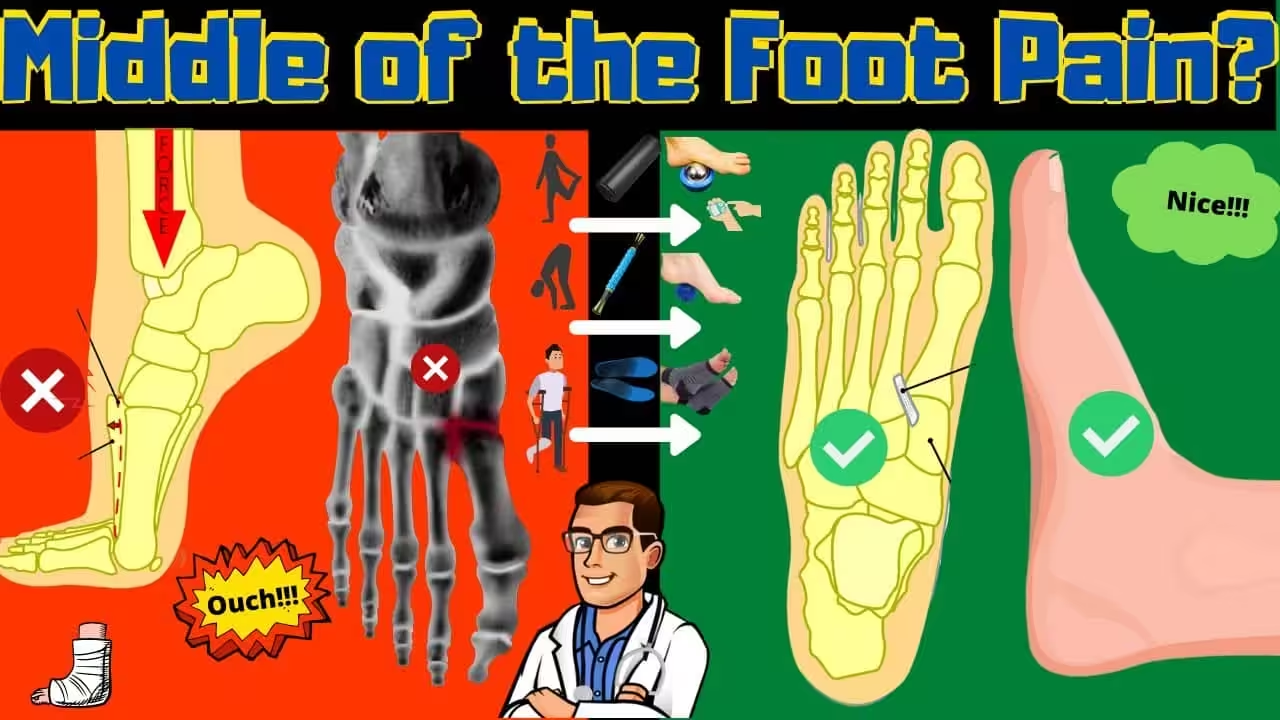
The Lisfranc injury — a sprain, fracture, or fracture-dislocation of the tarsometatarsal (Lisfranc) joint complex in the midfoot — is one of the most frequently missed significant foot injuries in emergency medicine. Studies estimate that 20–40% of Lisfranc injuries are initially misdiagnosed as simple “foot sprains,” leading to delayed treatment and progressively worse outcomes. Understanding why this injury is so important, how it is identified, and what treatment entails can make the difference between full recovery and chronic midfoot disability.
What Is the Lisfranc Joint?
The Lisfranc joint complex refers to the articulations between the five metatarsal bases and the tarsal bones (cuneiforms and cuboid) that form the midfoot. The keystone of this complex is the Lisfranc ligament — a strong interosseous ligament connecting the medial cuneiform to the base of the second metatarsal. This ligament is the primary stabilizer preventing lateral displacement of the forefoot relative to the midfoot.
The second metatarsal base is recessed between the first and third cuneiforms in a “Roman arch” configuration that provides intrinsic bony stability — making the Lisfranc joint normally one of the most stable joints in the foot. When disrupted, however, this stability is catastrophically lost.
How Lisfranc Injuries Happen
Two distinct injury mechanisms produce Lisfranc injuries:
- High-energy trauma: Motor vehicle accidents, falls from height, direct crush injuries — producing obvious fracture-dislocations visible on plain X-ray
- Low-energy axial load: The “dancer’s fracture” mechanism — a fall with the foot plantarflexed and axially loaded, as when stumbling on stairs or landing from a jump. This mechanism produces subtle Lisfranc ligament sprains with minimal or no bony displacement that are easily missed on non-weight-bearing X-rays
Why Lisfranc Injuries Are Missed
The critical diagnostic failure is performing non-weight bearing foot X-rays in an acutely injured patient who is unable to fully load the foot. The Lisfranc joint is dynamically stabilized — instability is unmasked only under load. A weight-bearing X-ray (or stress X-ray under anesthesia) may reveal 2–3mm of diastasis (widening) between the first and second metatarsal bases that is invisible on standard films.
The diagnostic hallmarks of Lisfranc injury on weight-bearing radiographs include:
- Diastasis ≥2mm between the first and second metatarsal bases
- Fleck sign — a small avulsion fracture at the base of the second metatarsal from the Lisfranc ligament attachment
- Loss of alignment between the medial border of the second metatarsal and medial border of the middle cuneiform
When plain X-rays are inconclusive in a patient with midfoot pain after trauma, MRI provides definitive soft tissue assessment of the Lisfranc ligament complex.
Treatment: Surgical vs. Non-Surgical
Treatment depends on joint stability and displacement:
- Stable Lisfranc sprain (no diastasis, no displacement): Non-weight bearing cast for 6–8 weeks, followed by progressive loading in a boot. These injuries heal reliably with proper immobilization but require strict non-weight bearing compliance.
- Unstable or displaced Lisfranc injury: Surgical stabilization is required. Options include open reduction and internal fixation (ORIF) with screws or plates, or primary Lisfranc arthrodesis (fusion) for injuries with significant comminution or cartilage damage. Delayed or inadequate treatment of displaced Lisfranc injuries leads to progressive midfoot arthritis, arch collapse, and chronic pain.
Recovery and Long-Term Outcomes
Recovery from Lisfranc surgery is measured in months, not weeks. Non-weight bearing continues for 6–8 weeks postoperatively, followed by progressive weight bearing in a boot and physical therapy through months 3–6. Return to full sport is typically 6–12 months. Even with optimal treatment, post-traumatic midfoot arthritis develops in a proportion of patients — the severity correlates directly with the amount of initial displacement and delay to treatment. This is why prompt accurate diagnosis is so critical.
Midfoot Pain After an Injury? Don’t Wait.
Dr. Biernacki provides expert Lisfranc injury evaluation with weight-bearing imaging at Balance Foot & Ankle — Bloomfield Hills and Howell, MI.
📞 (810) 206-1402 | Request Appointment →
📧 Get Dr. Tom’s Free Lab Test Guide
Discover the 5 lab tests every person over 35 should ask their doctor about — explained in plain English by a board-certified physician.
📍 Located in Michigan?
Our board-certified podiatrists treat this condition at two convenient locations. Same-day appointments often available.

Insurance Accepted
BCBS · Medicare · Aetna · Cigna · United Healthcare · HAP · Priority Health · Humana · View All →
Howell Office
3980 E Grand River Ave, Suite 140
Howell, MI 48843
Get Directions →
Bloomfield Hills Office
43700 Woodward Ave, Suite 207
Bloomfield Hills, MI 48302
Get Directions →
Your Board-Certified Podiatrists



Ready to Get Back on Your Feet?
Same-week appointments available at both locations.
Book Your AppointmentDifferential Diagnosis: What Else Could It Be?
Not every case of lisfranc (midfoot) injury is straightforward. In our clinic we routinely rule out three look-alike conditions before confirming the diagnosis. If your symptoms don’t match the classic presentation, one of these may explain the pain — which is why physical exam matters more than self-diagnosis.
| Condition | How It Differs |
|---|---|
| Midfoot sprain | No diastasis on X-ray; able to bear weight after initial pain. |
| Navicular stress fracture | Dorsal midfoot pain with impact loading; stress fx confirmed on MRI. |
| Cuboid syndrome | Lateral midfoot pain, often following ankle inversion; relieved by cuboid whip. |
Red Flags — When to See a Podiatrist Now
Seek same-day evaluation at Balance Foot & Ankle if you notice any of the following:
- Pain out of proportion to injury severity
- Plantar bruising across the arch (classic Lisfranc sign)
- Inability to bear weight for >24 hours
- Widening of tarsometatarsal joints on weight-bearing X-ray
Call (810) 206-1402 or request an appointment. Our Howell and Bloomfield Hills offices reserve same-day slots for urgent foot and ankle issues.
In Our Clinic: What We See
Clinical perspective from Dr. Tom Biernacki, DPM — Balance Foot & Ankle, Howell & Bloomfield Hills, MI:
Lisfranc injury is the most-missed foot injury in primary care and emergency rooms. Patients walk in weeks after a misstep complaining of midfoot pain that never resolves. In our clinic the first clue is often the bruising pattern — plantar bruising across the arch is pathognomonic. Weight-bearing X-rays comparing both feet reveal the widening that non-weight-bearing films miss. Non-displaced Lisfranc sprains can heal in a boot; any displacement requires surgery. Dr. Biernacki has handled dozens of missed Lisfranc injuries and always comments: if a midfoot sprain isn’t significantly better at 3 weeks, get weight-bearing films — don’t wait.
More Podiatrist-Recommended Ankle Sprain Essentials
Stability Walking/Running Shoe
Brooks Adrenaline GTS 25 — lateral support during recovery walking.
KT Tape for Ankle Support
KT Tape — proprioceptive support for athletic return-to-play.
Supportive Insole

PowerStep Pinnacle — arch support reduces re-injury risk during recovery.
As an Amazon Associate, Balance Foot & Ankle earns from qualifying purchases. Product recommendations are based on clinical experience; prices and availability shown above update live from Amazon.
When to See a Podiatrist
A sprain that hasn’t fully recovered after 6 weeks often has residual ligament laxity or occult fracture that keeps the ankle unstable. Balance Foot & Ankle X-rays and stress-tests every lingering sprain — if the ligament is torn, we offer bracing, PRP, and (for chronic instability) minimally-invasive repair. Don’t keep re-rolling the same ankle; let us stabilize it properly.
Call Balance Foot & Ankle: (810) 206-1402 · Book online · Offices in Howell & Bloomfield Hills
In-Office Treatment at Balance Foot & Ankle
When conservative care isn’t enough, Dr. Tom Biernacki and the team at Balance Foot & Ankle offer advanced, same-day options — including Foot & Ankle Fracture Repair Michigan at our Howell and Bloomfield Hills clinics.
Same-day appointments available. Call (810) 206-1402 or book online.
Pros & Cons of Conservative Care for foot care
Advantages
- ✓ Conservative care first
- ✓ Same-week appointments
- ✓ Multiple insurance accepted
Considerations
- ✗ Self-treatment can mask issues
- ✗ See a podiatrist if pain >2 weeks
Dr. Tom’s Recommended Products for foot care
Affiliate disclosure: As an Amazon Associate, Balance Foot & Ankle earns from qualifying purchases. We only recommend products we use with patients.


Footnanny Heel Cream Dr. Tom’s Pick
Best for: Daily moisturizer for cracked heels
Ready to Get Back on Your Feet?
Same-day appointments in Howell + Bloomfield Twp. Most insurance accepted. Dr. Tom Biernacki, DPM & team.
Book Today — Same-Day Appointments Available
Call Now: (810) 206-1402
About Your Care Team at Balance Foot & Ankle
Dr. Tom Biernacki, DPM · Board-Certified Foot & Ankle Surgeon. Specializes in conservative-first care, minimally invasive bunion surgery, and complex reconstruction.
Dr. Carl Jay, DPM · Accepting new patients. Specializes in sports medicine, athletic injuries, and routine podiatric care.
Dr. Daria Gutkin, DPM, AACFAS · Accepting new patients. Specializes in surgical reconstruction and pediatric podiatry.
Locations: 4330 E Grand River Ave, Howell, MI 48843 · 43494 Woodward Ave Suite 208, Bloomfield Twp, MI 48302
Hours: Mon–Fri 8:00 AM – 5:00 PM · (810) 206-1402

Dr. Tom Biernacki, DPM is a double board-certified podiatrist and foot & ankle surgeon at Balance Foot & Ankle Specialists in Southeast Michigan. With over a decade of clinical experience, he specializes in heel pain, bunions, diabetic foot care, sports injuries, and minimally invasive surgery. Dr. Biernacki is a member of the APMA and ACFAS, and his patient education content on MichiganFootDoctors.com and YouTube has reached over one million views.
- Diagnosis and Treatment of Plantar Fasciitis (PubMed / AAFP)
- Heel Pain (APMA)
- Hallux Valgus (Bunions): Evaluation and Management (PubMed)
- Bunions (Mayo Clinic)