
Medically reviewed by Dr. Tom Biernacki, DPM — Board-Certified Podiatric Surgeon — Balance Foot & Ankle, Howell & Bloomfield Hills, MI. Last updated April 2026.
Why Runners Develop Morton’s Neuroma
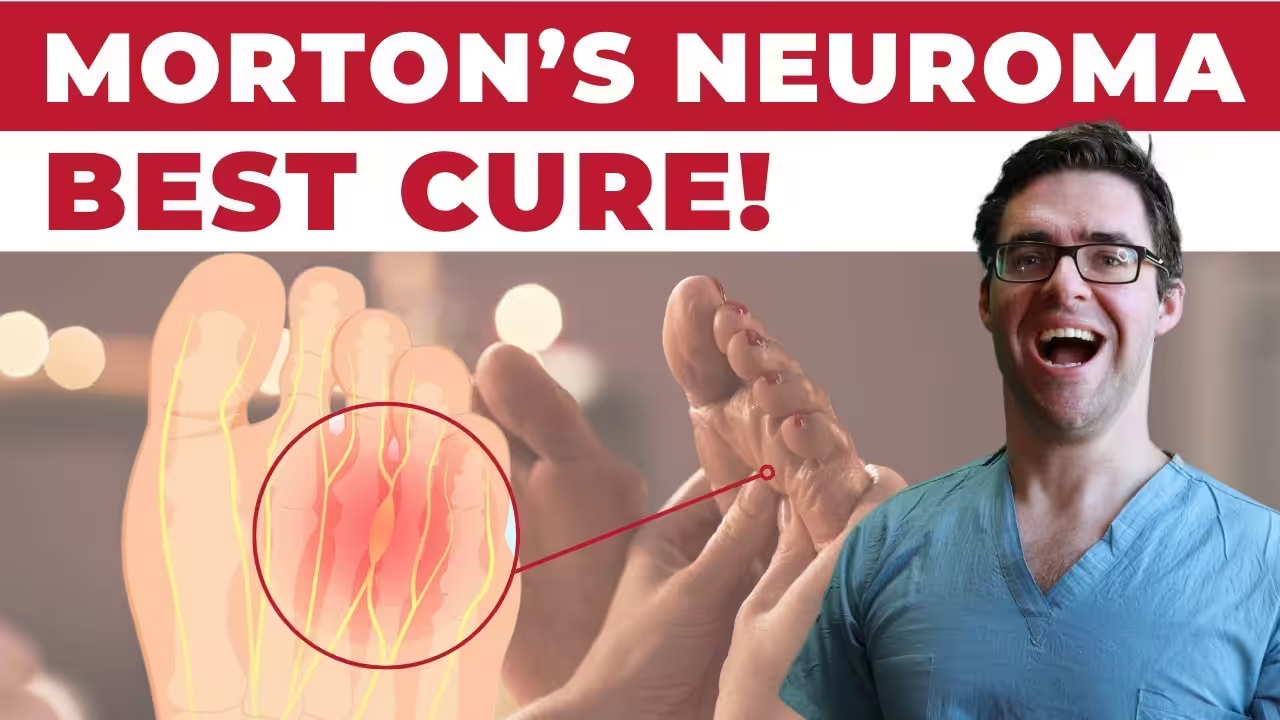
Morton’s neuroma—an irritation and thickening of the common digital nerve in the forefoot, most often between the third and fourth metatarsals—is particularly common in runners. Running subjects the forefoot to repetitive high-impact loading with each footstrike, compressing the interdigital nerve against the deep transverse metatarsal ligament with every stride. The cumulative effect of thousands of footstrikes per run creates a mechanically unfavorable environment for the nerve, especially in runners with forefoot strike patterns, narrow toe box shoes, or training volume increases that outpace tissue adaptation.
Additional runner-specific risk factors include: tight, narrow running shoes that compress the metatarsal heads together; high heel drop shoes that shift loading to the forefoot; increasing weekly mileage too quickly; running on hard surfaces; and pes planus (flat foot) or pes cavus (high arch), both of which alter forefoot mechanics in ways that increase nerve compression. Women runners are affected more often than men, partly due to footwear differences.
Symptoms in Runners
Runners with Morton’s neuroma typically describe burning, tingling, or electric shock sensations in the third or fourth toe webspace during or after runs. Some describe the sensation of running on a pebble or a fold in the sock between the toes. Symptoms often begin after a certain mileage threshold—runners notice the pain starts at mile 3 or 4 and forces them to stop. Removing the shoe and massaging the foot provides temporary relief. As the condition progresses, symptoms may appear earlier in runs, during walking, or at rest. The Mulder’s click—a palpable and sometimes audible click when compressing the forefoot from side-to-side—is a classic diagnostic finding.
Treatment for Running Athletes
The first intervention is footwear modification—the most impactful conservative treatment for runners. Switch to a running shoe with a wider toe box and lower heel drop. The metatarsal heads should not feel compressed when the shoe is on. Brands with particularly roomy toe boxes include Altra, Topo Athletic, and Brooks wide-width options. A metatarsal pad placed just proximal to (behind) the metatarsal heads in the shoe spreads the metatarsals apart, reduces nerve compression, and can provide immediate symptomatic relief in many runners—this is inexpensive and often dramatically effective.
Reducing training volume during the acute phase allows inflammation to subside. Cross-training (swimming, cycling, pool running) maintains fitness while reducing forefoot impact. Custom orthotics with metatarsal pads and forefoot offloading provide superior long-term mechanical control compared to over-the-counter insoles and are appropriate when symptoms persist or recur. Corticosteroid injection directly into the affected interspace provides significant relief in 60–70% of cases and is appropriate after 4–6 weeks of conservative measures. Alcohol sclerosing injections (a series of dilute alcohol injections to shrink the nerve) are used at some specialty centers as an alternative to steroid injection, with variable evidence.
Surgical neurectomy (removing the affected segment of nerve) is reserved for runners who fail 6–12 months of comprehensive conservative treatment. It reliably eliminates neuroma pain in approximately 80–85% of cases and typically allows return to running at 6–12 weeks, though permanent numbness in the affected toe webspace is an expected outcome. Recurrence of the neuroma (stump neuroma) occurs in a minority of cases.
Frequently Asked Questions
Can I keep running with Morton’s neuroma?
Many runners can continue running with Morton’s neuroma using appropriate shoe modifications (wider toe box, metatarsal pad) and training adjustments (reduced mileage, softer surfaces). The key is not running through significant pain—pain during running indicates ongoing nerve compression that perpetuates inflammation and delays recovery. If shoe changes and a metatarsal pad allow you to run comfortably without significant symptoms, continuing running at a reduced intensity while pursuing conservative treatment is reasonable. If pain forces you to stop or alter gait, a more complete running break and more aggressive treatment (injection, orthotics) is appropriate before returning to full training.
How long does Morton’s neuroma take to heal in runners?
With appropriate shoe modification and metatarsal padding, mild-to-moderate Morton’s neuroma in runners often improves significantly within 4–8 weeks. More established or severe neuromas may take 3–6 months of conservative management before symptoms fully resolve. A corticosteroid injection typically provides significant relief within 1–2 weeks of injection and may allow return to normal training sooner. Runners who modify footwear and use a metatarsal pad but continue high-mileage training without adjustment often find symptoms persist despite treatment—some period of mileage reduction is almost always necessary. After surgical neurectomy, runners typically return to training at 6–8 weeks with gradual mileage buildup, reaching full training volume at 3–4 months.
What type of running shoe is best for Morton’s neuroma?
The most important feature is a wide toe box—the forefoot should not feel compressed when the shoe is laced. Zero-drop or low heel drop shoes reduce forefoot loading during running. Shoes with a rocker sole geometry can also reduce forces at the forefoot. Brands with notably wide toe boxes include Altra (zero-drop, wide toe box standard across all models), Topo Athletic, New Balance wide widths, and Hoka One One (which also has excellent cushioning to reduce impact). Minimalist shoes with little cushioning are generally not appropriate for Morton’s neuroma as they increase forefoot loading. Adding a metatarsal pad inside any shoe provides the most direct mechanical relief by separating the metatarsal heads and reducing nerve compression at the site.
Medical References & Sources
- American Orthopaedic Foot & Ankle Society — Morton’s Neuroma
- PubMed Research — Morton’s Neuroma in Athletes
- PubMed Research — Morton’s Neuroma Treatment Outcomes
Dr. Tom Biernacki, DPM is a board-certified podiatric surgeon at Balance Foot & Ankle in Howell and Bloomfield Hills, Michigan. He evaluates and treats Morton’s neuroma in runners and athletes using conservative approaches, injections, and surgical neurectomy when needed.
Dr. Tom’s Recommended Products for Ball of Foot Pain
📍 Located in Michigan?
Our board-certified podiatrists treat this condition at two convenient locations. Same-day appointments often available.
These are products I personally use and recommend to my patients at Balance Foot & Ankle.
- Metatarsal Pads by Footminders (6-Pack) — Adhesive gel pads positioned behind metatarsal heads — offloads Morton’s neuroma compression point
- PowerStep SlimTech 3/4 Length Insoles — Thin 3/4-length insole with metatarsal pad built in — fits dress and narrow shoes where full insoles won’t
- HOKA Bondi 8 — Maximum forefoot cushioning with wide toe box — reduces metatarsal head load with each step
Affiliate disclosure: As an Amazon Associate, Balance Foot & Ankle earns from qualifying purchases. We only recommend products we trust for our own patients.
Dr. Tom’s Pick: Women’s Shoe Comfort Inserts
For women who want comfort without giving up their shoes — Foot Petals cushions work in heels, flats, and sandals.
- Foot Petals Ball of Foot Cushions — Targeted metatarsal cushioning — fits in any shoe to relieve ball-of-foot pain immediately.
- Foot Petals Tip Toes — Slim toe box cushion — ideal for narrow shoes and dress flats.
Affiliate disclosure: As an Amazon Associate, Balance Foot & Ankle earns from qualifying purchases.
👟 Dr. Tom’s Pick: FLAT SOCKS for Minimalist & Zero-Drop Shoes
Ultra-thin flat-knit socks designed specifically for zero-drop, barefoot, and minimalist shoes. No bunching, no seams — just foot-contact-the-ground feel with moisture control.
View FLAT SOCKS on Amazon →📧 Get Dr. Tom’s Free Lab Test Guide
Discover the 5 lab tests every person over 35 should ask their doctor about — explained in plain English by a board-certified physician.
Affiliate disclosure: As an Amazon Associate, Balance Foot & Ankle earns from qualifying purchases.
Join 950,000+ Learning About Foot Health
Dr. Tom shares honest medical advice, supplement reviews, and treatment guides you won’t find anywhere else.
Subscribe on YouTube →Medically Reviewed by: Dr. Tom Biernacki, DPM — Board-Certified Podiatrist, Balance Foot & Ankle Specialists
Morton’s Neuroma Ruining Your Runs?
Runners are especially prone to Morton’s neuroma. Our sports podiatrists offer targeted treatments — from custom orthotics to minimally invasive procedures — to eliminate the pain.
Sources
- Pastides P et al. “Morton’s interdigital neuroma: a clinical review.” Foot Ankle Int. 2012;33(6):514-521.
- Thomson CE et al. “Interventions for the treatment of Morton’s neuroma.” Cochrane Database Syst Rev. 2004;(3):CD003118.
- Bhatia M, Thomson L. “Morton’s neuroma — current concepts review.” J Clin Orthop Trauma. 2020;11(3):406-409.

Dr. Tom Biernacki, DPM is a double board-certified podiatrist and foot & ankle surgeon at Balance Foot & Ankle Specialists in Southeast Michigan. With over a decade of clinical experience, he specializes in heel pain, bunions, diabetic foot care, sports injuries, and minimally invasive surgery. Dr. Biernacki is a member of the APMA and ACFAS, and his patient education content on MichiganFootDoctors.com and YouTube has reached over one million views.
Frequently Asked Questions
Why does the ball of my foot hurt when I walk?
When should I see a doctor for ball of foot pain?
Recommended Products from Dr. Tom