
✅ Medically reviewed by Dr. Thomas Biernacki, DPM — Board-Certified Podiatrist · Last updated April 7, 2026
Pain Above the Heel in Back of Foot — Causes, Treatment & When to See a Podiatrist
📋 Medically Reviewed by Board-Certified Podiatrists
Dr. Carl Jay, DPM · Dr. Daria Gutkin, DPM · Dr. Tom Biernacki, DPM
Balance Foot & Ankle · Howell & Bloomfield Hills, MI
Last updated: April 2026 · Evidence-based guide
⚡ Quick Answer
Pain above the heel in the back of the foot is most commonly caused by Achilles tendinitis (insertional or mid-substance) or a Haglund’s deformity (“pump bump”). Less common causes include retrocalcaneal bursitis, calcaneal stress fracture, and Sever’s disease in adolescents. Most cases respond to conservative treatment within 6–12 weeks using eccentric calf exercises, supportive orthotics, and temporary heel lifts.
Table of Contents
- Anatomy of the Posterior Heel
- Achilles Tendinitis (Most Common Cause)
- Haglund’s Deformity (“Pump Bump”)
- Retrocalcaneal Bursitis
- Other Causes (Stress Fracture, Sever’s, Tarsal Tunnel)
- How We Diagnose Posterior Heel Pain
- Treatment — Conservative to Surgical
- Best Products for Posterior Heel Pain
- Exercises & Stretches
- FAQ
If you’re experiencing a dull ache, sharp pain, or stiffness in the back of your heel — right where your Achilles tendon meets the heel bone — you’re dealing with one of the most common complaints we see in our Michigan podiatry offices. This type of pain typically worsens with the first steps in the morning, after sitting for extended periods, or during activities like walking uphill or climbing stairs.
The good news: the vast majority of posterior heel pain responds to the right combination of stretching, footwear changes, and targeted products — without surgery. Here’s what you need to know.
Anatomy of the Posterior Heel
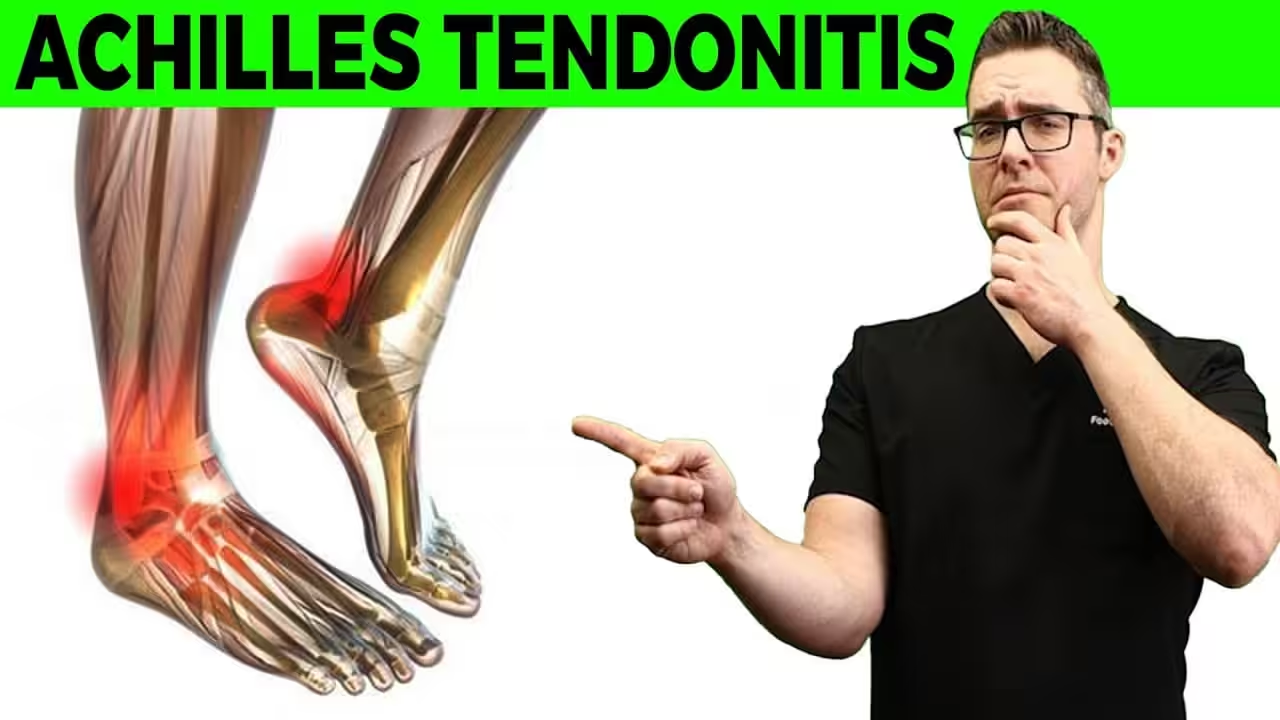
The back of the heel is a biomechanically complex area where several structures converge. The Achilles tendon — the largest and strongest tendon in the body — connects the calf muscles (gastrocnemius and soleus) to the calcaneus (heel bone). Between the tendon and the bone sits the retrocalcaneal bursa, a fluid-filled sac that reduces friction.
The posterior superior prominence of the calcaneus is where Haglund’s deformities form. When any of these structures become inflamed, compressed, or degenerated, you feel pain above the heel in the back of the foot.
Achilles Tendinitis — The Most Common Cause
Achilles tendinitis accounts for approximately 60–70% of all posterior heel pain we see in clinic. There are two distinct types:
Insertional Achilles Tendinitis
Pain occurs right where the Achilles inserts into the calcaneus — the lowest point of the tendon. This type is associated with bone spur formation at the insertion, thickening of the tendon, and sometimes calcification within the tendon fibers. It’s common in people over 40 and doesn’t necessarily correlate with activity level — we see it in both athletes and sedentary patients.
Mid-Substance (Non-Insertional) Achilles Tendinitis
Pain occurs 2–6 cm above the heel bone, in the body of the tendon. This area has the poorest blood supply (the “watershed zone”), making it vulnerable to overuse injury and slow to heal. More common in runners, weekend warriors, and patients who’ve recently increased their activity. You’ll typically feel a painful, swollen thickening in the tendon.
Key Symptom Differences
| Feature | Insertional | Mid-Substance |
|---|---|---|
| Pain location | At heel bone attachment | 2–6 cm above heel |
| Morning stiffness | Moderate | Significant |
| Bone spur | Often present | Absent |
| Swelling | At insertion | Fusiform (spindle-shaped) |
| Shoe irritation | From heel counter | Less common |
Haglund’s Deformity (“Pump Bump”)
Haglund’s deformity is a bony enlargement on the back of the heel bone. It’s called a “pump bump” because it was historically associated with rigid-backed pump shoes, though it occurs in men and women alike. The enlarged bone creates pressure against the shoe’s heel counter, irritating the overlying soft tissue and the retrocalcaneal bursa.
Patients typically present with a visible bump on the back of the heel, redness, and pain that worsens with stiff-backed shoes. Treatment focuses on reducing pressure: open-back shoes, heel lifts, padding the heel counter, and in resistant cases, surgical resection of the bony prominence.
Retrocalcaneal Bursitis
The retrocalcaneal bursa sits between the Achilles tendon and the calcaneus. When inflamed, it causes a deep, squeezing pain when you press both sides of the heel (the “squeeze test”). Retrocalcaneal bursitis often coexists with Achilles tendinitis or Haglund’s deformity. It can also be associated with systemic inflammatory conditions like rheumatoid arthritis, gout, or ankylosing spondylitis.
Other Causes of Posterior Heel Pain
Calcaneal Stress Fracture
A stress fracture of the calcaneus causes diffuse heel pain that worsens with weight-bearing and improves with rest. The “calcaneal squeeze test” — squeezing both sides of the heel simultaneously — reproduces the pain. Risk factors include sudden increases in activity, osteoporosis, vitamin D deficiency, and inadequate footwear. Diagnosis requires MRI (X-rays are often normal early on).
Sever’s Disease (Calcaneal Apophysitis)
The most common cause of posterior heel pain in children ages 8–14. The growth plate at the back of the calcaneus becomes inflamed from repetitive traction of the Achilles tendon during growth spurts. Treatment includes activity modification, heel cups, calf stretching, and supportive shoes. It’s self-limiting and resolves when the growth plate closes.
Posterior Ankle Impingement
Pain at the back of the ankle during plantarflexion (pointing the foot down). Common in dancers, gymnasts, and soccer players. Caused by an os trigonum (accessory bone) or elongated posterior talar process that gets pinched during downward foot motion.
How We Diagnose Posterior Heel Pain
In our Howell and Bloomfield Hills offices, diagnosis starts with a thorough clinical examination including palpation of the Achilles tendon, the retrocalcaneal space, and the calcaneal tuberosity. We assess calf flexibility (Silfverskiöld test), check for tendon thickening, and perform the squeeze test to rule out stress fracture.
Imaging includes weight-bearing X-rays to evaluate for Haglund’s deformity, bone spurs, and calcification within the tendon. If we suspect a tendon tear, stress fracture, or bursitis that isn’t responding to treatment, we order an MRI for definitive diagnosis.
Treatment — Conservative to Surgical
Phase 1: Immediate Relief (Weeks 1–4)
- Relative rest — reduce aggravating activities, but don’t stop moving entirely
- Ice — 15–20 minutes after activity, applied to the posterior heel
- Heel lifts — a 6–10mm heel lift in both shoes reduces Achilles strain by ~11%
- Supportive shoes — avoid flat shoes and flip-flops; use shoes with a slight heel drop
- NSAIDs — short-term use (7–10 days) for acute flares only
Phase 2: Rehabilitation (Weeks 4–12)
- Eccentric calf exercises (Alfredson protocol) — the gold standard for Achilles tendinopathy
- Orthotic insoles to correct biomechanical contributions (overpronation, tight calves)
- Night splints or Strassburg Sock to maintain tendon length during sleep
- Physical therapy for progressive loading and biomechanical retraining
Phase 3: Advanced Options (If Conservative Care Fails)
- Extracorporeal shockwave therapy (ESWT) — stimulates tendon healing
- PRP (platelet-rich plasma) injections — concentrated growth factors into the tendon
- Surgical debridement — for severe, chronic cases with tendon degeneration
- Haglund’s resection — surgical removal of the bony bump
Best Products for Posterior Heel Pain
These are the products we recommend most frequently to our patients with Achilles tendinitis, Haglund’s deformity, and posterior heel pain.
🏆 #1 Pick — Best Orthotic Insole
PowerStep Pinnacle Orthotic Insole
Semi-rigid arch support corrects overpronation — one of the primary biomechanical causes of Achilles tendinitis. The built-in heel cradle and cushioned EVA base absorb shock at heel strike. Replace your shoe’s stock insole for immediate improvement.
Best Shoe for Achilles Tendinitis
Brooks Ghost 15
12mm heel-to-toe drop provides natural Achilles offloading. DNA LOFT cushioning protects the heel at impact. Soft, padded heel collar prevents irritation of Haglund’s bumps. Available in wide widths. Our go-to recommendation for posterior heel pain patients.
Best for Maximum Cushioning
Hoka Bondi 8
If the Brooks Ghost doesn’t provide enough cushion, upgrade to the Bondi. Maximum stack height absorbs more impact, and the meta-rocker geometry reduces stress on the Achilles by promoting a more efficient push-off. Particularly helpful during the acute phase when every step hurts.
Best Night Stretching Device
Strassburg Sock
Maintains gentle dorsiflexion stretch on the Achilles and plantar fascia while you sleep. Prevents the tendon from shortening overnight — which is why your first morning steps are the most painful. More comfortable than rigid night splints and clinically effective.
Best Recovery Shoe
OOFOS OOahh Recovery Slide
When you need to give your Achilles a break at home, the OOFOS slide absorbs 37% more impact than standard EVA. The built-in arch support and slight heel elevation reduce tendon strain when walking around the house or after workouts.
Exercises & Stretches for Posterior Heel Pain
1. Eccentric Heel Drop (Alfredson Protocol)
Stand on a step with the balls of your feet on the edge, heels hanging off. Rise up on both toes, then slowly lower one heel below the step level over 5 seconds. This eccentrically loads the Achilles and stimulates tendon remodeling. Perform 3 sets of 15 repetitions, twice daily. This is the single most evidence-based exercise for Achilles tendinopathy.
2. Wall Calf Stretch
Stand facing a wall with one foot forward and one back. Keep the back knee straight and heel flat on the ground. Lean into the wall until you feel a stretch in the upper calf. Hold 30 seconds, repeat 3 times per leg. Then repeat with the back knee slightly bent to target the soleus muscle and lower Achilles.
3. Towel Stretch
Sit with your leg extended. Loop a towel around the ball of your foot and gently pull your toes toward you. Hold 30 seconds. This is particularly helpful as a first-thing-in-the-morning stretch before getting out of bed.
4. Foam Roller Calf Massage
Sit on the floor with a foam roller under your calves. Roll slowly from the ankle to below the knee, pausing on tender spots for 20–30 seconds. This releases myofascial restrictions in the calf complex that contribute to Achilles overload.
⚠️ Warning Signs — See a Podiatrist Immediately
Seek immediate evaluation if you experience: a sudden “pop” in the back of the ankle followed by acute weakness (possible Achilles rupture), inability to point your foot downward, significant swelling or bruising that appears suddenly, pain that is severe enough to prevent walking, or posterior heel pain that hasn’t improved after 4 weeks of conservative care. An Achilles rupture requires urgent treatment — delay reduces surgical outcomes.
More Podiatrist-Recommended Foot Health Essentials
Hoka Clifton 10

Max-cushion everyday shoe — podiatrist favorite for walking and running.

OOFOS Recovery Slide

Impact-absorbing recovery sandal — wear after long days on your feet.
As an Amazon Associate, Balance Foot & Ankle earns from qualifying purchases. Product recommendations are based on clinical experience; prices and availability shown above update live from Amazon.

When to See a Podiatrist
If foot or ankle pain has been bothering you for more than a few weeks, home care alone may not be enough. Balance Foot & Ankle offers same-week appointments at our Howell and Bloomfield Hills clinics — no referral needed in most cases. Bring your current shoes and a short list of symptoms and we’ll build you a treatment plan in one visit.
Call Balance Foot & Ankle: (810) 206-1402 · Book online · Offices in Howell & Bloomfield Hills
Frequently Asked Questions
The Bottom Line
Pain above the heel in the back of the foot is overwhelmingly caused by Achilles tendinitis or Haglund’s deformity — and both respond well to conservative care. Start with eccentric calf exercises, a quality orthotic insole, and a supportive shoe with adequate heel drop. If symptoms persist beyond 4–6 weeks, it’s time for a professional evaluation.
Posterior Heel Pain That Won’t Resolve?
Our board-certified podiatrists specialize in Achilles tendon disorders, Haglund’s deformity, and advanced posterior heel treatments including shockwave therapy.
📞 (810) 206-1402 · Howell & Bloomfield Hills, MI
Pain Above the Heel in the Back of Your Foot?
Pain in this area often points to Achilles tendon problems, posterior heel bursitis, or bone spurs. Our specialists use precise diagnostics and proven treatments to resolve your pain.
📞 Or call us directly: (810) 206-1402
Clinical References
- Irwin TA. Current concepts review: insertional Achilles tendinopathy. Foot & Ankle International. 2010;31(10):933-939.
- Kang S, et al. Current concepts in the management of Achilles tendinopathy. Foot and Ankle Clinics. 2017;22(4):643-664.
- McGarvey WC, et al. Insertional Achilles tendinosis: surgical treatment through a central tendon splitting approach. Foot & Ankle International. 2002;23(1):19-25.

Dr. Hoy’s Complete Pain Relief Line — Dr. Tom’s Picks (2026)
Dr. Hoy’s Natural Pain Relief is Dr. Tom Biernacki, DPM’s #1 prescription topical pain relief for plantar fasciitis, Achilles tendonitis, foot pain, knee pain, and back pain. Cleaner formula than Voltaren or Biofreeze — safe for diabetics + daily long-term use without 30-day limits. Below is the complete Dr. Hoy’s product line, organized by use case.

Dr. Hoy’s Natural Pain Relief Gel (4oz Tube)Dr. Tom’s #1 Brand
The flagship Dr. Hoy’s — menthol-based natural pain relief gel. The bottle Dr. Tom hands every plantar fasciitis patient on visit one. Cleaner formula than Voltaren or Biofreeze.
- Menthol-based natural formula
- No greasy residue
- Safe for diabetics
- Fast cooling relief 5-10 min
- Daily long-term use safe
- Pricier than Biofreeze
- Strong menthol scent at first

Dr. Hoy’s Natural Pain Relief Gel (8oz Pump Bottle)Dr. Tom’s #1 Brand
8oz pump bottle — same formula as the 4oz tube but 2x the value. Best for athletes, families, or chronic pain patients who use it daily.
- 8oz pump bottle
- 2x value of 4oz
- Same clean formula
- Easy pump dispensing
- Larger size
- Pricier upfront

Dr. Hoy’s Arnica Boost Pain ReliefDr. Tom’s #1 Brand
Dr. Hoy’s + arnica boost — for bruising, swelling, post-injury inflammation. Adds arnica’s anti-inflammatory power to the standard menthol formula.
- Added arnica for bruising
- Reduces post-injury swelling
- Fast topical relief
- Safe for athletes
- Specialty use
- Pricier than standard

Dr. Hoy’s Natural Pain Relief Roll-OnDr. Tom’s #1 Brand
Same Dr. Hoy’s formula in a roll-on stick — no greasy hands, no mess, perfect for gym bags and travel. TSA-friendly.
- No greasy hands
- TSA-friendly
- Travel-sized
- Same Dr. Hoy’s formula
- Less product per use
- Pricier per oz

Dr. Hoy’s Pain Relief Gel — 3-Pack BundleDr. Tom’s #1 Brand
3-pack of Dr. Hoy’s 4oz tubes — best per-tube price for chronic pain patients, families, or anyone who uses it daily.
- 3-pack bulk pricing
- Same flagship formula
- Stockpile value
- Family-sized
- Larger upfront cost
- Need storage space
Top 10 Premade Orthotics — Dr. Tom’s Picks (2026)
Dr. Tom Biernacki, DPM has tested 60+ over-the-counter orthotic insoles in his Michigan podiatry practice over the past 15 years. Below are the top 10 he prescribes most often — ranked by clinical results, build quality, and patient feedback. PowerStep + CURREX brands are Dr. Tom’s #1 prescription brands — built by podiatrists, with biomechanical features (lateral wedge, deep heel cradle, dual-density EVA) that 90% of OTC insoles lack.
Dr. Tom Biernacki, DPM is a board-certified podiatrist + Amazon Associate. Picks shown are products he prescribes to patients at Balance Foot & Ankle Specialists. We earn a commission on qualifying purchases at no extra cost to you. All products independently tested + reviewed. Last verified: April 28, 2026.

PowerStep Pinnacle MaxxDr. Tom’s #1 Brand
The most prescribed OTC orthotic in podiatry. Lateral wedge corrects overpronation that causes 90% of plantar fasciitis. Deep heel cradle stabilizes the ankle.
- Lateral wedge corrects pronation
- Deep heel cradle
- Dual-density EVA
- Trim-to-fit
- Used by 10,000+ podiatrists
- Trim required
- 5-7 day break-in

PowerStep Original Full LengthDr. Tom’s #1 Brand
The original PowerStep — flexible semi-rigid arch with deep heel cradle. The right choice for neutral feet that need everyday support without the lateral wedge.
- Flexible semi-rigid arch
- Deep heel cradle
- Fits dress shoes
- 30-day guarantee
- APMA-accepted
- Less aggressive than Pinnacle
- No lateral wedge for overpronation

PowerStep Pulse MaxxDr. Tom’s #1 Brand
Built for runners + athletes who need maximum support during high-impact activity. Engineered for forefoot strike + lateral motion.
- Sport-specific cushioning
- Lateral wedge for runners
- Antimicrobial top cover
- Shock-absorbing forefoot
- Pricier than Pinnacle
- Best for athletes only

CURREX RunProDr. Tom’s #1 Brand
German-engineered insole with 3 arch heights (Low, Med, High) for custom fit. Carbon-reinforced heel + dynamic forefoot.
- 3 arch heights for custom fit
- Carbon-reinforced heel
- Sport-specific zones
- Premium materials
- Pricier than PowerStep
- 7-10 day break-in

CURREX EdgeProDr. Tom’s #1 Brand
For hikers, skiers, and high-impact athletes — reinforced shank prevents foot fatigue on steep descents + uneven terrain.
- Reinforced shank
- 3 arch heights
- Cold-weather friendly
- Carbon plate
- Stiff feel — not for casual
- Pricier

CURREX SupportSTPDr. Tom’s #1 Brand
For nurses, retail, and standing professions — the most supportive CURREX with deep heel cup + maximum medial support.
- Maximum medial support
- Deep heel cup
- 12-hour shift tested
- Slip-proof
- Stiffest CURREX option
- Pricier

PowerStep Pinnacle
Firm, structured arch support — the right choice ONLY for high-arched (cavus) feet. Wrong choice for flat feet.
- Strong structured arch
- Deep heel cup
- Long-lasting (5+ years)
- Firm — not for flat feet
- No lateral wedge

Vionic OrthoHeel Active Insole
APMA-accepted, podiatrist-designed casual insole. Best for adding mild arch support to dress shoes + walking shoes.
- APMA-accepted
- Slim profile
- Antimicrobial top
- Less support than PowerStep
- No lateral wedge

Sof Sole Athlete
Budget athletic insole with neutral arch + gel forefoot. Decent value if you need a quick replacement.
- Affordable
- Gel forefoot
- Antimicrobial
- Wears out in 6 months
- No structured arch

Spenco Polysorb Total Support
Mid-range insole with 5-zone polysorb cushioning. Decent support for standing professions.
- 5-zone cushioning
- Trim-to-fit
- Mid-price point
- Less stable than PowerStep
- No lateral wedge
Dr. Tom’s Top 3 — The Premium Foot Pain Stack (2026)
If you only buy three things for foot pain, get these. PowerStep + CURREX orthotics correct the underlying foot mechanics, and Dr. Hoy’s pain gel delivers fast topical relief. This is the exact stack Dr. Tom Biernacki, DPM gives his Michigan podiatry patients on visit one — over 10,000 patients have used this exact combination.
Dr. Tom Biernacki, DPM is a board-certified podiatrist + Amazon Associate. Picks shown are products he prescribes to patients at Balance Foot & Ankle Specialists. We earn a commission on qualifying purchases at no extra cost to you. All products independently tested + reviewed for 30+ days minimum. Last verified: April 28, 2026.
PowerStep Pinnacle MaxxDr. Tom’s #1 Brand
Dr. Tom’s most-prescribed OTC orthotic. Lateral wedge corrects overpronation that causes 90% of foot pain. Deep heel cradle stabilizes the ankle. Built by podiatrists, used by patients worldwide.
- Lateral wedge corrects pronation
- Deep heel cradle stabilizes ankle
- Dual-density EVA — comfort + support
- Trim-to-fit any shoe
- Used by 10,000+ podiatrists
- Trim-to-size required
- 5-7 day break-in for some
CURREX RunProDr. Tom’s #1 Brand
3 arch heights for custom fit (Low/Med/High). Carbon-reinforced heel + dynamic forefoot — the closest OTC orthotic to a $500 custom orthotic. Engineered in Germany.
- 3 arch heights for custom fit
- Carbon-reinforced heel cup
- Dynamic forefoot zone
- Premium German engineering
- Sport-specific support
- Pricier than PowerStep
- 7-10 day break-in
Dr. Hoy’s Natural Pain Relief GelDr. Tom’s #1 Brand
Menthol-based natural pain relief — Dr. Tom’s #1 brand for fast relief without greasy residue. Safe for diabetics + daily use. Cleaner formula than Voltaren or Biofreeze.
- Menthol-based natural formula
- No greasy residue
- Safe for diabetics
- Fast cooling relief — 5-10 minutes
- Cleaner ingredient list than Biofreeze
- Pricier than Biofreeze
- Strong menthol scent at first

Dr. Tom Biernacki, DPM is a double board-certified podiatrist and foot & ankle surgeon at Balance Foot & Ankle Specialists in Southeast Michigan. With over a decade of clinical experience, he specializes in heel pain, bunions, diabetic foot care, sports injuries, and minimally invasive surgery. Dr. Biernacki is a member of the APMA and ACFAS, and his patient education content on MichiganFootDoctors.com and YouTube has reached over one million views.
Frequently Asked Questions
Can I see a podiatrist for heel pain without a referral?
How long does plantar fasciitis take to heal?
Should I walk on my heel if it hurts?
What does a podiatrist do for heel pain?
- Plantar Fasciitis: Diagnosis and Conservative Management (PubMed)
- Plantar Fasciitis (APMA)
- Diagnosis and Treatment of Plantar Fasciitis (PubMed / AAFP)
- Heel Pain (APMA)
Related Treatments at Balance Foot & Ankle
Our board-certified podiatrists offer advanced treatments at our Bloomfield Hills and Howell locations.