

Pediatric clubfoot responds dramatically to the Ponseti casting method when started in infancy — and the right relapse management with bracing prevents the deformity from returning.
You’re in the right place. Dr. Tom Biernacki, DPM, FACFAS — board-certified foot & ankle surgeon with 3,000+ surgeries — explains exactly what pediatric clubfoot Ponseti method means and what works. Call (810) 206-1402 for same-day appointment at Howell or Bloomfield Township.
Medically reviewed by Dr. Tom Biernacki, DPM · Board-Certified Podiatric Surgeon · Last reviewed: April 2026 · Editorial Policy
The most important clinical decision with Pediatric Clubfoot Ponseti Method Relapse Management isn’t which treatment to start with — it’s identifying the correct subtype. That changes everything. Call (810) 206-1402.
Quick Answer
Pediatric Clubfoot: The Ponseti Casting Method, Bracing, and relates to foot pain — typically caused by overuse, footwear, or biomechanics. Most patients improve in 6-12 weeks with conservative care. Same-week appointments in Howell + Bloomfield Township: (810) 206-1402.
Medically reviewed by Dr. Tom Biernacki, DPM — Board-certified foot & ankle surgeon, 3,000+ surgeries performed. Updated April 2026 with current clinical evidence. This article reflects real practice experience from Balance Foot & Ankle Specialists in Howell and Bloomfield Township, Michigan.
Quick Answer
Most foot and ankle problems respond to conservative care — proper footwear, supportive inserts, activity modification, and targeted stretching — within 4-8 weeks. Persistent pain beyond that window, or any symptom that prevents walking, warrants a podiatric evaluation to rule out fracture, tendon tear, or systemic cause.
Watch: Dr. Tom Biernacki, DPM
Medically Reviewed by Dr. Tom Biernacki, DPM — Board-Certified Podiatrist, Balance Foot & Ankle Specialists, Michigan. Last updated April 2026.
Congenital clubfoot (talipes equinovarus) — the most common congenital musculoskeletal deformity, affecting 1 in 1,000 live births — is characterized by four components: equinus (plantar flexion), varus (heel inversion), adductus (forefoot supination and adduction), and cavus (plantar-flexed first ray). The Ponseti method of serial casting has become the global standard of care for clubfoot correction since the early 2000s, achieving correction rates of 90–95% while avoiding the morbidity of the extensive surgical releases previously performed — a paradigm shift that transformed clubfoot management from a complex surgical procedure to a primarily non-operative treatment.
▶ Watch
Ponseti Casting Technique and Tenotomy
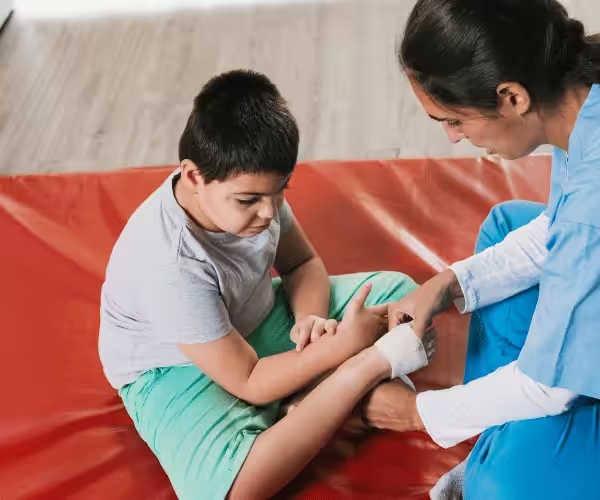
Timing: treatment begins in the first weeks of life when the foot ligaments and bones are most malleable; correction becomes progressively more difficult with delay. Casting sequence: serial long-leg plaster casts changed weekly — each cast corrects components in the specific order: cavus correction first (supination of the forefoot to improve the arch), then abduction with counter-pressure over the talar head, then progressive external rotation; equinus is corrected last; typically 4–6 casts over 4–6 weeks. Percutaneous Achilles tenotomy: required in 80–90% of Ponseti-treated clubfeet — the Achilles tendon is the last component corrected; office procedure under local anesthesia; the tendon heals with 1cm of new tendon growth within 3 weeks. Post-casting bracing (Foot Abduction Brace, FAB): the most critical component for preventing relapse — the Dennis-Browne bar with open-toe sandals at 60–70° of external rotation; worn 23 hours/day for 3 months, then nightly until age 4–5; brace compliance is the single most important predictor of relapse prevention.
Relapse Management
Relapse incidence: 20–30% of Ponseti-corrected clubfeet relapse, almost always due to brace non-compliance; early relapse (before age 3) responds to repeat casting and tenotomy. Tibialis anterior tendon transfer (TATT): the standard surgical procedure for dynamic relapse from overactive tibialis anterior — transfer of the tendon from the medial cuneiform to the third cuneiform achieves balanced dorsiflexion and corrects recurrent dynamic supination; performed after age 3–4 when the tendon is large enough for transfer. Residual deformity in older children (>8 years): bony surgical corrections — calcaneal osteotomy for residual heel varus; plantar fascia release for cavus; cuneiform osteotomy for forefoot adductus. Dr. Biernacki at Balance Foot & Ankle evaluates clubfoot relapses and complex pediatric foot deformities at our Bloomfield Township and Howell offices. Call (810) 206-1402 for pediatric foot consultations.
📧 Get Dr. Tom’s Free Lab Test Guide
Discover the 5 lab tests every person over 35 should ask their doctor about — explained in plain English by a board-certified physician.
📍 Located in Michigan?
Our board-certified podiatrists treat this condition at two convenient locations. Same-day appointments often available.
More Podiatrist-Recommended Pediatric Essentials
Hoka Clifton 10

Watch: Pediatric Heel Pain in Children **The Cause Will Shock You!** — MichiganFootDoctors YouTube
Max-cushion everyday shoe — podiatrist favorite for walking and running.

OOFOS Recovery Slide

Impact-absorbing recovery sandal — wear after long days on your feet.
As an Amazon Associate, Balance Foot & Ankle earns from qualifying purchases. Product recommendations are based on clinical experience; prices and availability shown above update live from Amazon.
When to See a Podiatrist
Children’s foot pain is never normal — flat feet, in-toeing, heel pain (Sever’s disease), and curly toes all have effective non-surgical treatments when caught early. Balance Foot & Ankle evaluates pediatric patients with gentle, age-appropriate exams and parent-friendly treatment plans. Most pediatric issues resolve with the right inserts and guided activity modification.
Call Balance Foot & Ankle: (810) 206-1402 · Book online · Offices in Howell & Bloomfield Township
Frequently Asked Questions
When should I see a podiatrist?
See a podiatrist for any foot or ankle pain that persists more than 2 weeks, doesn’t improve with rest, limits your daily activities, or is accompanied by swelling, numbness, or skin changes. People with diabetes or circulation problems should see a podiatrist regularly even without symptoms.
What does a podiatrist treat?
Podiatrists diagnose and treat all conditions of the foot, ankle, and lower leg including plantar fasciitis, bunions, hammertoes, toenail problems, heel pain, nerve pain, diabetic foot care, sports injuries, fractures, and foot deformities — both surgically and non-surgically.
What can I expect at my first podiatry visit?
Your first visit includes a full medical history, physical examination of your feet and gait, and in-office diagnostic imaging if needed (X-rays, ultrasound). We’ll discuss your diagnosis and create a plan tailored to your foot type. Most visits take 30–45 minutes.
Need Treatment at Balance Foot & Ankle?
Dr. Tom Biernacki, Dr. Carl Jay, and Dr. Daria Gutkin see patients at our Howell and Bloomfield Township offices.
Book Online or call (810) 206-1402
Insurance Accepted
BCBS · Medicare · Aetna · Cigna · United Healthcare · HAP · Priority Health · Humana · View All →
Howell Office
4330 E Grand River Ave
Howell, MI 48843
Get Directions →
Bloomfield Township Office
43494 Woodward Ave, #208
Bloomfield Township, MI 48302
Get Directions →
Your Board-Certified Podiatrists



Ready to Get Back on Your Feet?
Same-week appointments available at both locations.
Book Your AppointmentMost Common Mistake We See
The most common mistake we see is: Waiting too long before seeking care. Fix: any foot pain lasting more than 4 weeks, or any sudden severe symptom, deserves a professional evaluation rather than more rest.
Warning Signs That Need Same-Day Care
Seek immediate evaluation at Balance Foot & Ankle if you experience any of the following:
- Unable to bear weight
- Severe swelling with skin colour change
- Fever with foot pain (possible infection)
- Diabetes plus any new foot symptom
Call (810) 206-1402 — same-day and next-day appointments at our Howell and Bloomfield Township offices.
In-Office Treatment at Balance Foot & Ankle
When conservative care isn’t enough, Dr. Tom Biernacki and the team at Balance Foot & Ankle offer advanced, same-day options — including Pediatric Foot Care in Michigan at our Howell and Bloomfield Township clinics.
Same-day appointments available. Call (810) 206-1402 or book online.
Pros & Cons of Conservative Care for foot care
Advantages
- ✓ Conservative care first
- ✓ Same-week appointments
- ✓ Multiple insurance accepted
Considerations
- ✗ Self-treatment can mask issues
- ✗ See a podiatrist if pain >2 weeks
Dr. Tom’s Recommended Products for foot care
Affiliate disclosure: As an Amazon Associate, Balance Foot & Ankle earns from qualifying purchases. We only recommend products we use with patients.
Footnanny Heel Cream Dr. Tom’s Pick
Best for: Daily moisturizer for cracked heels
Ready to Get Back on Your Feet?
Same-day appointments in Howell + Bloomfield Township. Most insurance accepted. Dr. Tom Biernacki, DPM & team.
Book Today — Same-Day Appointments Available
Call Now: (810) 206-1402
About Your Care Team at Balance Foot & Ankle
Dr. Tom Biernacki, DPM · Board-Certified Foot & Ankle Surgeon. Specializes in conservative-first care, minimally invasive bunion surgery, and complex reconstruction.
Dr. Carl Jay, DPM · Accepting new patients. Specializes in sports medicine, athletic injuries, and routine podiatric care.
Dr. Daria Gutkin, DPM, AACFAS · Accepting new patients. Specializes in surgical reconstruction and pediatric podiatry.
Locations: 4330 E Grand River Ave, Howell, MI 48843 · 43494 Woodward Ave Suite 208, Bloomfield Township, MI 48302
Hours: Mon–Fri 8:00 AM – 5:00 PM · (810) 206-1402
Frequently Asked Questions
When should I see a podiatrist?
If symptoms persist past 2 weeks, affect your normal activity, or are accompanied by red-flag symptoms (warmth, redness, swelling, inability to bear weight).
What does treatment cost?
Most diagnostic visits and conservative treatments are covered by Medicare and major insurers. Out-of-pocket costs vary by your specific plan.
How quickly can I get an appointment?
Most non-urgent cases see us within 5 business days. Urgent cases (sudden pain, possible fracture) typically same or next business day.
Ready to fix this for good?

Reading goes so far. The fastest path is a 30-minute office visit. Same-day Howell or Bloomfield Township. Call (810) 206-1402.
In-Office Treatment at Balance Foot & Ankle
If home treatment isn’t providing relief for your foot and ankle conditions, our podiatry team at Balance Foot & Ankle can help with same-day evaluations and advanced in-office care.
Same-day appointments available. (810) 206-1402
Doctor Hoy’s Natural Pain Relief Gel
Natural topical pain relief I use in our clinic. Arnica + camphor formula — apply directly to the area 3–4x daily. ($20–25)
Shop Doctor Hoy’s →Ready for Expert Care?
Same-day appointments in Howell & Bloomfield Township, MI.
4.9★ | 1,123 Reviews | 3,000+ Surgeries
Or call: (810) 206-1402

Dr. Tom Biernacki, DPM is a board-certified foot & ankle surgeon (ABFAS & ABPM) at Balance Foot & Ankle Specialists in Southeast Michigan. With over a decade of clinical experience, he specializes in heel pain, bunions, diabetic foot care, sports injuries, and minimally invasive surgery. Dr. Biernacki is a member of the APMA and ACFAS, and his patient education content on MichiganFootDoctors.com and YouTube has made him one of the most-followed foot & ankle educators on YouTube.