
Medically reviewed by Dr. Tom Biernacki, DPM · Board-Certified Podiatric Surgeon · Last reviewed: April 2026 · Editorial Policy
The most important clinical decision with Warts On Feet Treatment isn’t which treatment to start with — it’s identifying the correct subtype. That changes everything. Call (810) 206-1402.
Related Conditions
Quick Answer
Warts on Feet (Plantar Warts): Treatment Options and When to relates to foot pain — typically caused by overuse, footwear, or biomechanics. Most patients improve in 6-12 weeks with conservative care. Same-week appointments in Howell + Bloomfield Township: (810) 206-1402.
Quick Answer
A plantar wart is an HPV-caused skin growth on the sole of the foot. It looks like a callus but interrupts the skin lines and often shows tiny black dots (thrombosed capillaries). OTC 40% salicylic acid works for mild cases; persistent warts need cryotherapy, laser, or excision.
Watch: Dr. Tom Biernacki, DPM
Medically reviewed by Dr. Tom Biernacki, DPM — Board-Certified Podiatric Surgeon — Balance Foot & Ankle, Howell & Bloomfield Township, MI. Last updated April 2026.
▶ Watch
👟 Dr. Tom Also Recommends
Podiatrist Recommended Shoes 2026: Dr. Tom’s Top Picks for Every Condition
The right footwear can make or break your recovery. Dr. Tom’s complete guide to the best shoes for plantar fasciitis, flat feet, neuropathy, bunions & more — with clinical picks for every foot type.
See Dr. Tom’s Top Shoe Picks →What Are Plantar Warts?
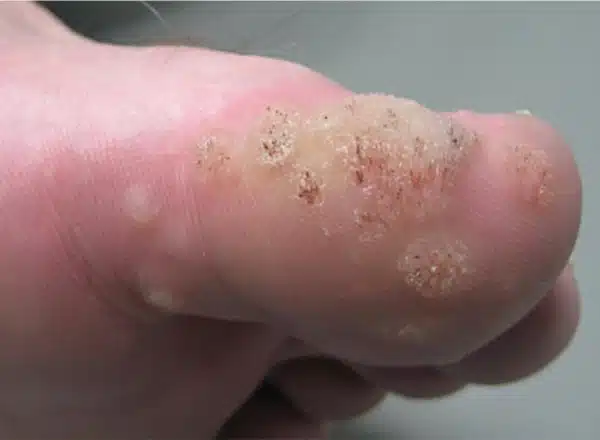

Plantar warts (verruca plantaris) are benign skin growths caused by human papillomavirus (HPV) infection of the plantar (bottom) surface of the foot. The virus infects the outer layer of skin (epidermis) through small cuts or breaks in the skin and causes abnormal cell proliferation—the rough, thickened, cauliflower-textured growth characteristic of warts. Unlike warts elsewhere on the body, plantar warts are driven inward by body weight, making them painful when walking—the sensation is often described as walking with a pebble in the shoe. On close inspection, plantar warts have small black dots (thrombosed capillaries—”wart seeds” as patients often call them) and interrupt the normal skin ridges (dermatoglyphics), distinguishing them from calluses, which follow the skin line pattern.
Mosaic warts are clusters of multiple smaller plantar warts that coalesce over a broad area, typically on the ball of the foot. They are harder to treat than single warts because the infection involves a larger surface area. Plantar warts are contagious—transmitted through contact with contaminated surfaces (pool decks, locker rooms, showers) or from one person to another through skin contact. They can spread to other areas of the same foot by autoinoculation.
Over-the-Counter Treatment: Salicylic Acid
OTC salicylic acid products (Compound W, PowerStep Wart Remover, medicated patches at 17–40% concentration) are the first-line self-treatment for plantar warts. Salicylic acid works by gradually destroying the wart tissue and stimulating the immune response. For best results: soak the foot in warm water for 5 minutes, file away dead surface tissue with a pumice stone or emery board, apply the salicylic acid product, cover with a bandage, and repeat daily. Consistent daily treatment for 8–12 weeks is required—partial or inconsistent treatment allows warts to persist. Success rates with optimal OTC salicylic acid use are approximately 50–70%, but many patients stop treatment prematurely. Salicylic acid should not be used in patients with diabetes, neuropathy, or poor circulation.
In-Office Treatment Options
Cryotherapy—application of liquid nitrogen (-196°C) to freeze and destroy wart tissue—is the most common in-office treatment. Freezing causes cellular destruction and stimulates an immune response. Multiple sessions (typically every 2–3 weeks) are usually required; single-session cure rates are lower than sometimes expected. Cryotherapy is painful and can cause blistering, but recovery is relatively quick. Cantharidin (blister beetle extract) is a blistering agent applied in-office that causes a blister to form under the wart, lifting it off the skin; it is painless on application and highly effective for many patients. Immunotherapy (Candida antigen injection or topical imiquimod) stimulates the immune system to recognize and destroy the HPV-infected tissue—useful for stubborn or widespread mosaic warts. Pulsed dye laser destroys the blood vessels feeding the wart, causing it to die; it is effective for recalcitrant warts that have failed other treatments. Surgical excision is generally avoided for plantar warts because of scar formation that can be more painful than the original wart.
Frequently Asked Questions
Will a plantar wart go away on its own?
Yes—plantar warts can resolve spontaneously as the immune system eventually recognizes and clears the HPV infection. In children, warts commonly resolve on their own within 2 years without treatment. In adults, spontaneous resolution is less predictable and may take 2–5 years or may not occur. Given that plantar warts cause pain with every step and can spread to other areas, treatment is usually appropriate rather than watchful waiting in adults. The decision between treating now versus waiting depends on pain level, number of warts, and how long the warts have been present. Any wart that is growing, spreading, or causing significant pain should be treated.
How do I know if I have a wart or a callus on my foot?
Three features help distinguish plantar warts from calluses. First, skin lines: calluses follow the normal skin ridge pattern (like fingerprints), while warts interrupt the skin lines because they grow through the epidermis and distort the normal ridges. Second, black dots: plantar warts often contain small black dots (thrombosed capillaries); calluses do not. Third, pain pattern: calluses hurt most with direct downward pressure (like pressing a bruise); warts often hurt more with side-to-side pinching (squeezing the wart from both sides is more painful than pressing directly on it). If you are unsure, a podiatrist can definitively identify the lesion by paring away the surface with a blade—warts bleed with small capillary bleeding at the surface; calluses reveal homogeneous keratinized tissue without bleeding.
How many treatments does it take to get rid of a plantar wart?
The number of treatments varies considerably by method and wart characteristics. OTC salicylic acid requires 8–12 weeks of daily treatment. In-office cryotherapy typically requires 3–6 sessions every 2–3 weeks. Cantharidin treatment may resolve warts in 1–3 applications. Immunotherapy requires multiple sessions over several months. No single treatment is 100% effective in all cases, and combination approaches (e.g., cryotherapy plus salicylic acid between sessions) are often more effective than any single treatment alone. Plantar warts in immunocompromised patients, mosaic warts, and warts that have been present for years tend to be most treatment-resistant. Persistence with a consistent treatment approach over months is often required—warts that appear unresponsive after 2–3 treatments may eventually respond to continued treatment or a change in approach.
Medical References & Sources
- PubMed Research — Plantar Wart Treatment Outcomes
- American Podiatric Medical Association — Warts
- PubMed Research — Cantharidin and Immunotherapy for Recalcitrant Plantar Warts
Dr. Tom Biernacki, DPM is a board-certified podiatric surgeon at Balance Foot & Ankle in Howell and Bloomfield Township, Michigan. He treats plantar warts with cryotherapy, cantharidin, immunotherapy, and laser, tailoring the approach to wart size, duration, and patient response to prior treatment.
Dr. Tom’s Recommended Products for Plantar Warts
📍 Located in Michigan?
Our board-certified podiatrists treat this condition at two convenient locations. Same-day appointments often available.
These are products I personally use and recommend to my patients at Balance Foot & Ankle.
- Compound W Nitrofreeze Wart Remover — Cryogenic freeze spray reaches -57°C — destroys the HPV-infected keratinocyte column in a single application
- PowerStep Clear Away Wart Remover — Salicylic acid 40% medicated pads — breaks down wart tissue over 4–8 weeks for at-home plantar wart treatment
- Duct Tape (3M Scotch — Heavy Duty) — Occlusion therapy with duct tape has equivalent efficacy to cryotherapy in randomized trials for plantar warts
📧 Get Dr. Tom’s Free Lab Test Guide
Discover the 5 lab tests every person over 35 should ask their doctor about — explained in plain English by a board-certified physician.
Affiliate disclosure: As an Amazon Associate, Balance Foot & Ankle earns from qualifying purchases. We only recommend products we trust for our own patients.
Join 950,000+ Learning About Foot Health
Dr. Tom shares honest medical advice, supplement reviews, and treatment guides you won’t find anywhere else.
Subscribe on YouTube →Insurance Accepted
BCBS · Medicare · Aetna · Cigna · United Healthcare · HAP · Priority Health · Humana · View All →
Howell Office
4330 E Grand River Ave
Howell, MI 48843
Get Directions →
Bloomfield Township Office
43494 Woodward Ave, #208
Bloomfield Township, MI 48302
Get Directions →
Your Board-Certified Podiatrists



Ready to Get Back on Your Feet?
Same-week appointments available at both locations.
Book Your AppointmentDifferential Diagnosis: What Else Could It Be?
Several conditions share symptoms with Plantar Wart and are commonly misdiagnosed in the first office visit. Considering these alternatives is part of every Balance Foot & Ankle exam:
- Corn or callus. Skin lines run continuously through the lesion — wart interrupts them with black dots.
- Porokeratosis. Thin keratotic rim around a central plug, painful with side compression.
- Foreign body granuloma. History of stepping on something — ultrasound or X-ray finds the fragment.
If your symptoms don’t fit the textbook pattern, ask your podiatrist which differentials they ruled out — that conversation often shortcuts months of trial-and-error treatment.
In Our Clinic
Plantar warts in our clinic most often show up in active teenagers and adults who share locker-room showers. They hurt with lateral pinching (unlike calluses, which hurt with direct pressure), and on debridement we see the telltale black dots (thrombosed capillaries). For stubborn warts we use a layered approach: in-office cantharidin or liquid nitrogen, home 40 % salicylic acid nightly, occlusion with duct tape, and occasionally pulsed-dye laser for resistant lesions. Most clear within 3–6 months; the immune system does most of the work. We do NOT aggressively cut or burn — scars on the weight-bearing foot cause more pain than the wart.
Most Common Mistake We See
The most common mistake we see is: Digging at the wart with tools, which spreads HPV to surrounding skin. Fix: apply salicylic acid only to the wart surface, cover with tape, and replace every 2 days for 12 weeks.
Warning Signs That Need Same-Day Care
Seek immediate evaluation at Balance Foot & Ankle if you experience any of the following:
- Rapidly spreading lesions
- Not responding after 3 months of proper OTC treatment
- Diabetes or immunocompromise
- Bleeding or dark streaks (rule out melanoma)
Call (810) 206-1402 — same-day and next-day appointments at our Howell and Bloomfield Township offices.
Pros & Cons of Conservative Care for foot care
Advantages
- ✓ Conservative care first
- ✓ Same-week appointments
- ✓ Multiple insurance accepted
Considerations
- ✗ Self-treatment can mask issues
- ✗ See a podiatrist if pain >2 weeks
In This Article
- Quick Answer
- Differential Diagnosis: What Else Could It Be? Several conditions share symptoms with Plantar Wart and are commonly misdiagnosed in the first office visit. Considering these alternatives is part of every Balance Foot & Ankle exam: Corn or callus. Skin lines run continuously through the lesion — wart interrupts them with black dots. Porokeratosis. Thin keratotic rim around a central plug, painful with side compression. Foreign body granuloma. History of stepping on something — ultrasound or X-ray finds the fragment. If your symptoms don’t fit the textbook pattern, ask your podiatrist which differentials they ruled out — that conversation often shortcuts months of trial-and-error treatment. In Our Clinic Plantar warts in our clinic most often show up in active teenagers and adults who share locker-room showers. They hurt with lateral pinching (unlike calluses, which hurt with direct pressure), and on debridement we see the telltale black dots (thrombosed capillaries). For stubborn warts we use a layered approach: in-office cantharidin or liquid nitrogen, home 40 % salicylic acid nightly, occlusion with duct tape, and occasionally pulsed-dye laser for resistant lesions. Most clear within 3–6 months; the immune system does most of the work. We do NOT aggressively cut or burn — scars on the weight-bearing foot cause more pain than the wart. Most Common Mistake We See
- Warning Signs That Need Same-Day Care
- In-Office Treatment at Balance Foot & Ankle
- Frequently Asked Questions
Dr. Tom’s Recommended Products for foot care
Affiliate disclosure: As an Amazon Associate, Balance Foot & Ankle earns from qualifying purchases. We only recommend products we use with patients.
Footnanny Heel Cream Dr. Tom’s Pick
Best for: Daily moisturizer for cracked heels
Ready to Get Back on Your Feet?
Same-day appointments in Howell + Bloomfield Township. Most insurance accepted. Dr. Tom Biernacki, DPM & team.
Book Today — Same-Day Appointments Available
Call Now: (810) 206-1402
About Your Care Team at Balance Foot & Ankle
Dr. Tom Biernacki, DPM · Board-Certified Foot & Ankle Surgeon. Specializes in conservative-first care, minimally invasive bunion surgery, and complex reconstruction.
Dr. Carl Jay, DPM · Accepting new patients. Specializes in sports medicine, athletic injuries, and routine podiatric care.
Dr. Daria Gutkin, DPM, AACFAS · Accepting new patients. Specializes in surgical reconstruction and pediatric podiatry.
Locations: 4330 E Grand River Ave, Howell, MI 48843 · 43494 Woodward Ave Suite 208, Bloomfield Township, MI 48302
Hours: Mon–Fri 8:00 AM – 5:00 PM · (810) 206-1402
Ready for Expert Care?
Same-day appointments in Howell & Bloomfield Township, MI.
4.9★ | 1,123 Reviews | 3,000+ Surgeries
Or call: (810) 206-1402
