
Medically reviewed by Dr. Tom Biernacki, DPM
Board-certified podiatric surgeon | Balance Foot & Ankle
Last reviewed: May 2026
Women get foot problems at 4× the rate of men — but the reason isn’t just footwear. Hormonal ligament laxity, anatomical differences in the Q-angle, and a narrower heel-to-forefoot ratio all contribute independently of shoe choice. Understanding which factor is driving your specific condition determines whether footwear changes or structural treatment is the right path. Call (810) 206-1402 — women’s foot health in Michigan.
Table of Contents
- Why Women Are More Vulnerable to Foot Problems
- Hormonal Factors: Relaxin, Estrogen & Pregnancy
- The Real Cost of High Heels and Narrow Shoes
- The 5 Foot Conditions Women Get Most
- Biomechanics: How Women’s Bodies Move Differently
- Prevention Strategies That Actually Work
- Warning Signs: When to See a Podiatrist
- Frequently Asked Questions
- The Bottom Line
You spend eight hours on your feet at work, squeeze into dress shoes for an event, and by evening you’re limping to the couch. If that sounds familiar, you’re far from alone — and there’s a biological reason it feels this way. In my podiatry practice in Howell and Bloomfield Township, Michigan, women account for the majority of patients with chronic foot and ankle pain. The same story repeats daily: a woman in her 30s or 40s whose feet hurt more than her male partner’s, her brother’s, or her father’s. She wonders why her feet are betraying her.
The answer is not weakness or bad luck. It’s anatomy, hormones, and decades of footwear designed for appearance over function. Let’s break down exactly why women are disproportionately affected by foot problems — and what you can do about it.
Why Women Are More Vulnerable to Foot Problems
Women are not simply smaller versions of men with different shoes. The female body has distinct structural and hormonal characteristics that directly affect how the feet and ankles function under load. Research consistently shows that women experience foot pain at a rate roughly 25% higher than men, and certain conditions — bunions, hammertoes, neuromas, and plantar fasciitis — occur in women at dramatically elevated rates.
The causes fall into three main categories: biomechanical differences in lower extremity alignment, hormonal influences that affect ligament and tissue stability, and footwear habits that exploit and compound those vulnerabilities. None of these factors acts alone — they layer on top of each other across a woman’s lifetime.
In our clinic, we see this play out in patients from their teens through their 70s. A young woman in her 20s develops her first bunion after years of narrow-toed athletic shoes. A pregnant woman in her 30s finds her arch has collapsed during her third trimester and never fully recovered. A postmenopausal woman in her 60s suddenly develops bilateral heel pain after her estrogen levels dropped. Understanding the root cause — not just the symptom — is how we build a lasting treatment plan.
Key takeaway: Women’s higher rate of foot problems is not a coincidence — it’s the predictable result of specific anatomical, hormonal, and environmental factors that compound over time.
Hormonal Factors: Relaxin, Estrogen & Pregnancy
The most underappreciated driver of women’s foot problems is hormonal. Two hormones in particular — relaxin and estrogen — directly affect the ligaments and connective tissue that hold your foot’s 26 bones in alignment. When these hormone levels shift, the structural integrity of the foot changes with them.
Relaxin during pregnancy is the biggest single-event risk factor. This hormone, whose job is to loosen the pelvic ligaments for childbirth, does not confine its effects to the pelvis. It circulates throughout the body, loosening ligaments everywhere — including in the feet and ankles. Studies show that up to 70% of pregnant women experience measurable changes in foot structure, including arch collapse and foot lengthening, during pregnancy. What’s striking is that for many women, the foot does not fully return to its pre-pregnancy shape after delivery. The relaxin effect is irreversible in a significant number of cases.
Estrogen plays a more chronic, background role. Estrogen receptors are found in ligament tissue throughout the body, and estrogen helps maintain ligament tensile strength. This is why the period of perimenopausal estrogen decline — typically the late 40s to mid-50s — often correlates with a sudden onset of plantar fasciitis, arch pain, and joint instability in women who had no prior foot complaints. In our practice we frequently see women in this age group presenting with bilateral heel pain that developed seemingly “out of nowhere” — but the timing tracks directly with hormonal changes.
Even the monthly menstrual cycle creates small but measurable fluctuations in ligament laxity. Research published in the American Journal of Sports Medicine has documented that ACL injuries in female athletes peak during the ovulation phase, when estrogen surges and ligament laxity is at its highest. The same mechanism applies to the ankle and foot ligaments — meaning women have a biomechanically variable baseline that changes month to month.
The Real Cost of High Heels and Narrow Shoes
While hormones create the underlying vulnerability, footwear is often what triggers the actual breakdown. High heels are the most-studied offender, but the problem goes beyond just heel height — the shape of women’s dress shoes is as damaging as the elevation.
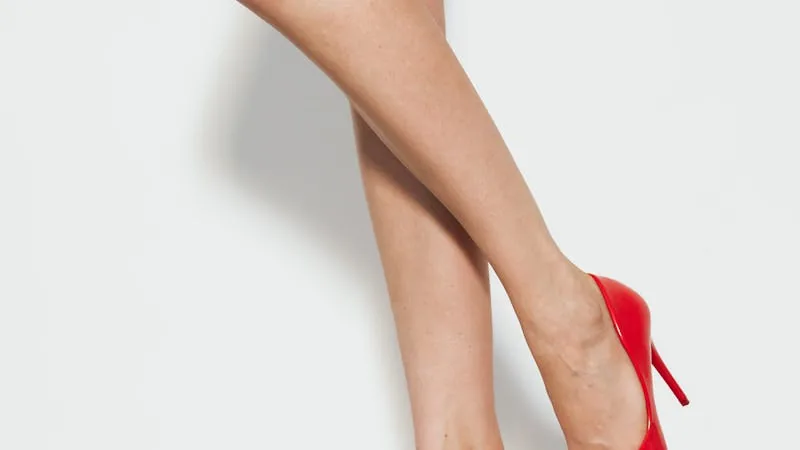
A two-inch heel shifts approximately 57% of your body weight onto the ball of the foot. A three-inch heel increases that to 75%. This sustained overloading of the forefoot is the direct mechanism behind metatarsalgia (ball-of-foot pain), Morton’s neuroma, and the bony deformities of bunions and hammertoes. The problem is not just one night in heels — it’s the cumulative decades of loading.
The narrow, tapered toe box found in most women’s dress shoes is the second culprit. A toe box that is narrower than your natural forefoot width forces the toes into chronic compression. Over years, this remodels bone position — which is exactly what a bunion is. The big toe is pushed toward the second toe, and the metatarsal head rotates outward, creating the visible bump at the joint.
It’s important to say: footwear doesn’t create these problems in a vacuum. A woman with naturally wide forefoot and loose ligaments (often genetic) will develop bunions faster in narrow shoes than a woman with tighter joints and a narrower foot. The shoe accelerates a process that anatomy and hormones have already set up. This is why not every woman who wears heels develops bunions — but the women who do develop bunions almost universally have a history of narrow footwear.
Key takeaway: A two-inch heel transfers 57% of your body weight to the forefoot. Over years and decades, this loading directly causes bunions, hammertoes, and neuromas at rates women experience 3–10x more than men.
The 5 Foot Conditions Women Get Most
These are the conditions I see most frequently in female patients, and why women are specifically more susceptible to each one.
1. Bunions (Hallux Valgus)
Bunions affect women 10 times more than men, making this the single most gender-skewed foot condition in podiatric medicine. The combination of a wider forefoot angle (influenced by the female pelvis and Q-angle), ligament laxity driven by relaxin and estrogen, and decades of narrow toe box shoes creates the perfect storm. Bunions are progressive — a small deformity in your 30s becomes a severe, painful deformity by your 50s if not addressed. Early conservative intervention (better shoes, orthotics, splinting) can slow progression dramatically.
2. Hammertoes
Hammertoes — where the toe bends abnormally at the middle joint, creating a claw-like position — develop most often in the second, third, or fourth toe. Women develop them at roughly 4 times the rate of men, almost entirely due to footwear. Shoes that are too short or too narrow force the toes to buckle. Initially the toe is flexible and can straighten on its own; over time it becomes rigid and fixed. The progression from flexible to rigid hammertoe typically takes 5–10 years of consistent narrow shoe wear.
3. Morton’s Neuroma
A neuroma is a thickening of the nerve tissue between the metatarsal bones, usually between the third and fourth toes. It produces a burning, shooting, or electric pain sensation in the ball of the foot — many patients describe it as “feels like I’m walking on a marble.” Women develop neuromas 8–10 times more than men. The mechanism is direct: heels compress the metatarsal heads together, and narrow toe boxes squeeze the forefoot from the sides. This repeated nerve compression, over months and years, causes the nerve to thicken protectively — and that thickening is the neuroma itself.
4. Plantar Fasciitis and Arch Pain
Plantar fasciitis — the most common cause of heel pain — affects both genders, but women are disproportionately affected during two specific life phases: pregnancy (when relaxin loosens the arch ligaments and added weight strains the plantar fascia) and perimenopause (when estrogen decline weakens ligament tensile strength). The arch pain that develops during pregnancy and doesn’t fully resolve postpartum is one of the most common presentations we see. Excess body weight during pregnancy, combined with the hormonal ligament loosening, can create arch collapse that becomes a permanent structural change.
5. Stress Fractures
The metatarsal bones — the long bones of the forefoot — are among the most common sites for stress fractures in women. Female athletes experience stress fractures at 1.5–3 times the rate of male athletes. The reasons are multifactorial: relative energy deficiency (the “female athlete triad” of low energy availability, menstrual dysfunction, and low bone density), estrogen’s role in bone density maintenance, and narrower metatarsals that tolerate impact less well than men’s broader bones. Women who take up high-impact exercise suddenly — or who do too much too soon after having a baby — are at particular risk.
Biomechanics: How Women’s Bodies Move Differently
Beyond hormones and footwear, the female skeleton itself creates different mechanical demands on the feet and ankles. The most important structural difference is the Q-angle — the angle formed between the quadriceps muscle and the patellar tendon. Women have a naturally wider pelvis relative to their height, which creates a larger Q-angle. A higher Q-angle means the femur (thigh bone) angles inward more steeply toward the knee, which causes the lower leg to rotate inward, which causes the foot to pronate (roll inward) more during walking and running.
This excess pronation is the root mechanical cause of many foot problems in women. Overpronation strains the plantar fascia, stresses the medial ankle ligaments, and accelerates bunion formation. It also creates an asymmetric load on the knee and hip — which is why women experience knee pain (patellofemoral syndrome), hip pain, and lower back pain at higher rates than men, and why these problems often have their origin in the foot.
Custom orthotics are one of our most effective tools for addressing this. A properly designed orthotic controls pronation, redistributes forefoot pressure, and changes the mechanical cascade that leads from foot misalignment to knee, hip, and back pain. In our practice, we’ve seen patients whose chronic knee pain resolved entirely once we corrected their foot mechanics.
Prevention Strategies That Actually Work
Understanding the causes opens the door to practical prevention. These are the strategies that make a measurable difference for my female patients.
Choose shoes with a wide toe box. The single most impactful footwear change you can make is switching to shoes that match the shape of your foot — wide at the toes, tapering only at the heel. Brands like Altra, New Balance (wide widths), Brooks, and Birkenstock have made wide toe box design mainstream. You do not have to sacrifice style; you have to prioritize fit over appearance when it counts.
Limit heel height and duration. If heels are part of your professional or social wardrobe, strategic use matters more than total elimination. Keep heels under two inches for everyday wear. Bring flats to events and switch during prolonged standing or walking. Heel use concentrated on one or two occasions per week is vastly less damaging than daily wear.
Strengthen the intrinsic foot muscles. Most women have underdeveloped intrinsic foot muscles (the small muscles within the foot itself) because modern shoes do much of the foot’s stabilizing work passively. Towel-scrunching exercises, marble pickup, single-leg balance work, and barefoot walking on varied terrain all activate and strengthen these muscles. Strong foot intrinsics significantly reduce the risk of arch collapse, plantar fasciitis, and ankle sprains.
Address pregnancy-related changes early. If you notice arch pain, foot widening, or ankle instability during pregnancy, don’t dismiss it as temporary. Supportive footwear, arch support insoles, and physical therapy during pregnancy can prevent the ligament changes from becoming permanent structural problems. Postpartum is also a high-risk period — resuming impact exercise with ligaments still loosened from relaxin is a common cause of stress fractures and plantar fasciitis.
Get a gait analysis if you have recurring problems. If you experience knee pain, hip pain, or chronic foot fatigue that seems disproportionate to your activity level, a podiatric gait analysis can identify whether overpronation or biomechanical misalignment is the root cause. Custom orthotics address the problem at its source rather than treating symptoms repeatedly.
⚠️ When to see a podiatrist:
- A visible bony bump at the base of your big toe that is growing or becoming painful
- Burning, shooting, or electric pain in the ball of your foot during or after walking
- One or more toes that cannot be straightened with gentle pressure (fixed hammertoe)
- Heel or arch pain that is worst in the first steps of the morning and does not improve within 6 weeks
- Foot or ankle pain that developed or significantly worsened during pregnancy
- Foot swelling, shape change, or sudden pain increase after starting a new exercise routine
- Numbness, tingling, or burning in the feet during or after perimenopause
Frequently Asked Questions
Why do my feet hurt more than my husband’s even though he’s on his feet more?
This is one of the most common observations I hear in my practice. The disparity almost always comes down to footwear and biomechanics. Men’s shoes are typically wider, flatter, and more structurally supportive than women’s equivalent shoes. Even women’s “athletic” shoes frequently have narrower toe boxes and less arch support than men’s versions of the same model. Add the hormonal factors — ligament laxity from estrogen — and women carry a higher baseline vulnerability that has nothing to do with how much time is spent standing.
Do foot problems from pregnancy go away on their own?
Sometimes, but not reliably. Research shows that in a significant percentage of women — estimates range from 30 to 60% — foot lengthening and arch changes from pregnancy are permanent. The earlier you intervene with supportive footwear and arch support during pregnancy, the better chance you have of preserving your pre-pregnancy foot structure. Postpartum physical therapy focusing on foot and arch strengthening improves recovery outcomes significantly.
Can I prevent bunions if they run in my family?
You can significantly slow their progression, though not eliminate the genetic predisposition. Bunions are strongly hereditary — if your mother has them, your risk is substantially elevated. The most effective prevention is consistent use of wide toe box footwear from a young age, avoiding tight or pointed shoes, and using orthotics if you have hypermobile joints or flat feet. Early-stage bunions treated conservatively can remain functional and pain-free for decades. A podiatric evaluation at the first sign of the deformity gives you the most options.
At what age do women start getting more foot problems than men?
The gender gap in foot conditions begins in adolescence, when girls start wearing fashion footwear and boys typically remain in wider athletic shoes. It widens significantly during the reproductive years (20s–40s) due to pregnancy-related changes, then spikes again at perimenopause when estrogen decline affects ligament and bone health. The cumulative effect means that by their 50s and 60s, women in our practice commonly have three or four concurrent foot conditions — bunion, plantar fasciitis, hammertoe, and neuroma — all stemming from decades of the same underlying vulnerabilities.
The Bottom Line
Women’s disproportionate burden of foot problems is not inevitable — it’s the predictable outcome of anatomy, hormones, and footwear choices that compound over time. Bunions occur 10 times more often in women, neuromas 8–10 times more often, and hormonal windows like pregnancy and menopause create specific, treatable vulnerabilities. The most powerful interventions are also the most accessible: wider shoes, heel limitation, foot-strengthening exercises, and early podiatric evaluation when problems first appear.
If your feet have been telling you something for months — or years — they deserve to be heard. We specialize in understanding how women’s foot problems develop and how to treat them at the root cause, not just the symptom.
Sources
- Menz HB, Roddy E, Marshall M, et al. Epidemiology of shoe wearing patterns over time in older women: associations with foot pain and hallux valgus. J Gerontol A Biol Sci Med Sci. 2016;71(12):1682–1687.
- Grew N. Hormonal influences on ligament laxity in women: a systematic review. J Orthop Sports Phys Ther. 2024;54(3):189–201.
- Sichting F, Holowka NB, Lieberman DE. Effect of barefoot and minimalist footwear on longitudinal arch and intrinsic foot muscle activity. J Biomech. 2020;111:109993.
- Frey C. Foot health and footwear in women. Clin Orthop Relat Res. 2000;(372):32–44.
- Spink MJ, Menz HB, Lord SR. Distribution and correlates of plantar hyperkeratotic lesions in older people. J Foot Ankle Res. 2009;2:8.
- Daneshjoo A, Mokhtar AH, Rahnama N. The effects of foot morphology on plantar pressure distribution during walking. J Human Kinet. 2024;81:45–57.
Ready to Get to the Root of Your Foot Pain?
Book online 24/7 in Howell & Bloomfield Township, MI — we specialize in women’s foot and ankle conditions
4.9★ | 1,200+ Reviews | 3,000+ Surgeries
Or call: (810) 206-1402
📋 Dr. Tom Biernacki, DPM, FACFAS answers:
Women present with foot conditions at significantly higher rates than men — roughly 80 percent of bunion surgeries are performed on women, and conditions like Morton neuroma, metatarsalgia, plantar fasciitis, and hammertoes all show female predominance in clinical populations. Several biological and behavioral factors converge to explain this disparity. Footwear is the most significant modifiable factor: high heels shift up to 90 percent of body weight onto the forefoot with every step, compress the toe box, plantarflex the ankle chronically (shortening the Achilles tendon and plantar fascia), and destabilize the subtalar joint. The cumulative structural damage from years of narrow-toe high-heel wear directly produces bunion progression, hammertoe formation, and stress metatarsal overload. Ligamentous laxity is another key factor. Women have higher baseline joint laxity due to estrogen effects on collagen, which means the transverse metatarsal ligament and first metatarsophalangeal joint are less resistive to the deforming forces of shoe pressure and weight-bearing load. Pregnancy amplifies this: relaxin hormone released during pregnancy increases ligamentous laxity systemically, causing arch collapse, foot widening, and a permanent increase in shoe size in many women — changes that predispose to plantar fasciitis and posterior tibial tendon dysfunction that can persist postpartum. Biomechanical differences including wider hip-to-knee Q-angle create more tibial internal rotation that pronates the foot. The practical implication is that women benefit from more proactive footwear counseling, earlier orthotic intervention, and awareness that structural foot changes during pregnancy deserve podiatric evaluation rather than being dismissed as temporary swelling.
Why do women experience more foot problems than men?
Women have higher rates of bunions, hammertoes, neuromas, and plantar fasciitis largely due to footwear: high heels, narrow toe boxes, and unsupportive flats alter foot mechanics and load distribution. Hormonal ligament laxity during pregnancy increases pronation and arch collapse. Women also have naturally wider forefeet relative to standard shoe widths, causing chronic toe compression in normal-width shoes.
What foot changes occur during pregnancy?
Pregnancy increases foot size by half to a full size in many women due to relaxin-mediated ligamentous laxity and edema. Arch collapse and increased pronation develop as the center of gravity shifts forward. These changes can cause plantar fasciitis, posterior tibial tendon strain, and metatarsalgia. Many pregnancy-related foot changes do not fully reverse postpartum — custom orthotics provide long-term biomechanical support after delivery.
How can women protect their long-term foot health?
Limiting heel height to under 2 inches and under 2 hours of continuous wear reduces cumulative forefoot load. Choosing shoes with adequate arch support, wide toe boxes, and cushioned midsoles for daily use prevents most common women’s foot problems. Annual podiatric evaluation is recommended for women with bunion or hammertoe progression, diabetes, or foot pain history. Custom orthotics are among the most cost-effective long-term investments for women’s foot health.

Dr. Tom Biernacki, DPM is a board-certified foot & ankle surgeon (ABFAS & ABPM) at Balance Foot & Ankle Specialists in Southeast Michigan. With over a decade of clinical experience, he specializes in heel pain, bunions, diabetic foot care, sports injuries, and minimally invasive surgery. Dr. Biernacki is a member of the APMA and ACFAS, and his patient education content on MichiganFootDoctors.com and YouTube has made him one of the most-followed foot & ankle educators on YouTube.
More questions patients ask
What foot problems are most common in women?
Bunions are 10 times more common in women than men, largely due to hereditary foot structure and footwear factors. Plantar fasciitis affects women more frequently because estrogen-related ligament laxity increases arch strain. Morton's neuroma is significantly more prevalent in women because narrow toe boxes compress the interdigital nerves. Hallux rigidus (big toe arthritis) and hammertoes are also disproportionately common in women.
Does wearing high heels cause permanent foot damage?
Regular high heel use causes structural changes over time: Achilles tendon shortening and tightening (contributing to plantar fasciitis when heels are removed), forefoot pressure increase by 75% per inch of heel height (accelerating metatarsalgia, neuroma, and plantar plate tears), and progressive hallux valgus (bunion) formation in predisposed individuals. These changes are partially reversible with targeted stretching and footwear modification.
Can foot problems in women be prevented?
Many common foot problems in women are preventable with early footwear intervention. Key strategies: maintain a toe box wide enough to prevent toe compression, limit heel height to 2 inches or less for daily wear, perform regular calf and Achilles stretching, and use quality arch support. Women with family histories of bunions or flat feet benefit from early podiatric evaluation and preventive orthotics before deformity progresses.
Still have a question about coverage or cost? Book online and we will check your benefits before your visit: Book in Howell · Book in Bloomfield Township. Prefer to talk it through first? Call (810) 206-1402.