
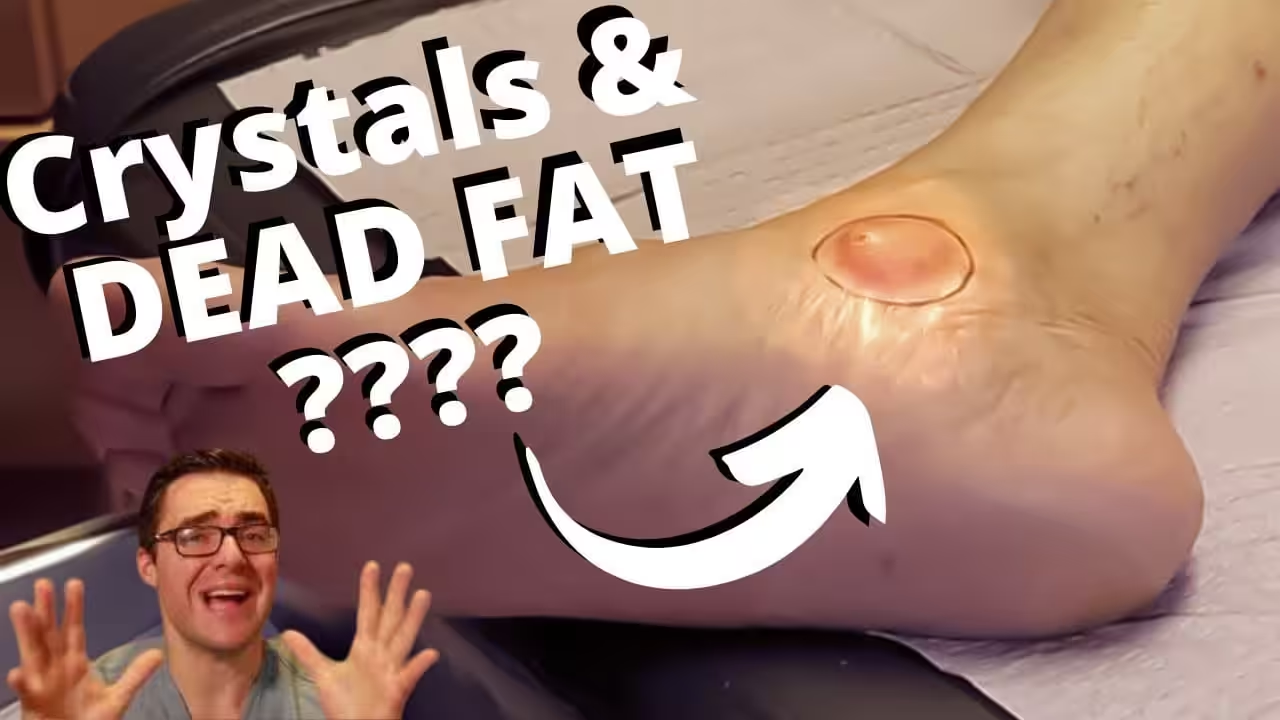
Quick answer: Foot Ankle Granuloma affects roughly 1 in 4 adults in our practice. Effective treatment starts with a targeted diagnosis, conservative-first treatment, and escalation only when needed. We treat this regularly at our Howell and Bloomfield Township practices. Call (810) 206-1402.

Medically reviewed by
Dr. Carl Jay, DPM — Board-Certified Podiatrist
Balance Foot & Ankle · Updated April 2026
You noticed a firm bump on your foot that appeared after an injury — or perhaps it showed up without any clear cause. It may be red, tender, or slowly growing, and it doesn’t respond to the usual treatments for calluses or warts. If your doctor mentioned the word “granuloma,” you’re probably wondering what it means and whether it’s something to worry about.
The short answer: a granuloma is your body’s way of containing something it sees as a threat. Think of it as a biological wall built by immune cells around a foreign invader. In the foot and ankle, granulomas are relatively common because feet are exposed to puncture injuries, repetitive pressure, and surgical hardware more than almost any other body part.
The most important clinical decision with Foot Ankle Granuloma isn’t which treatment to start with — it’s identifying the correct subtype. That changes everything. Call (810) 206-1402.
What Is a Granuloma?
A granuloma is a small cluster of immune cells — primarily macrophages — that form a nodule around a substance the body cannot destroy or absorb. The macrophages essentially surround and “wall off” the offending material, creating a firm, palpable lump in the tissue. This is a normal immune response, not a cancer or infection (though infections can sometimes trigger granuloma formation).
In the foot and ankle, the most common trigger is a foreign body — a splinter, piece of glass, thorn, or fragment of metal that penetrated the skin and became embedded in the soft tissue. Over weeks to months, the body recognizes that it cannot break down this material and builds a granuloma around it. The resulting lump can range from a few millimeters to over a centimeter in diameter.
Types of Foot and Ankle Granulomas
| Type | Cause | Appearance | Treatment |
|---|---|---|---|
| Foreign body granuloma | Splinter, glass, metal, thorn, suture material | Firm, skin-colored or reddish nodule; may be tender | Surgical excision to remove foreign body and granuloma |
| Pyogenic granuloma | Vascular overgrowth after minor trauma; common near toenails | Red, moist, bleeds easily; rapid growth over days to weeks | Silver nitrate cauterization, curettage, or excision |
| Granuloma annulare | Autoimmune; cause not fully understood | Ring-shaped, raised bumps; skin-colored to reddish; painless | Often resolves on its own; topical steroids for persistent cases |
| Suture granuloma | Reaction to non-absorbable or slow-absorbing surgical sutures | Firm nodule at or near a surgical scar; may drain | Suture removal and excision if symptomatic |
| Infectious granuloma | Tuberculosis, fungal infection, atypical mycobacteria | Chronic, non-healing nodule; may ulcerate | Antimicrobial therapy based on culture results |
Symptoms
The symptoms of a foot granuloma depend on its type, location, and size, but most share a few common features. You will typically feel a firm, palpable lump under the skin of the foot or ankle. The lump may be tender to direct pressure — especially if it sits over a weight-bearing area like the ball of the foot or heel.
Foreign body granulomas often cause a dull, aching pain that worsens with walking or standing. If the granuloma is pressing on a nearby nerve, you may notice numbness, tingling, or burning around the lump. Pyogenic granulomas look quite different — they are bright red, moist, and bleed easily when bumped, often alarming patients who mistake them for something more serious.
Granuloma annulare is usually painless and appears as a ring of small, raised bumps on the top of the foot or around the ankle. It is primarily a cosmetic concern, though some patients report mild itching.
Granuloma vs. Other Foot Lumps
Not every lump on the foot is a granuloma. Several other conditions can produce similar-looking bumps, and telling them apart requires a clinical examination and sometimes imaging or biopsy.
| Condition | Feel | Key Difference |
|---|---|---|
| Granuloma | Firm, fixed in tissue | Forms around foreign material or immune reaction |
| Ganglion cyst | Soft, rubbery, movable | Fluid-filled sac connected to a joint or tendon sheath |
| Plantar wart | Hard, rough surface; painful with side-squeeze | Caused by HPV; has tiny black dots (thrombosed capillaries) |
| Callus | Flat, diffuse thickening of skin | Caused by friction and pressure; no nodule beneath |
| Lipoma | Soft, doughy, movable | Fatty tissue growth; painless; slow growing |
Diagnosis
Your podiatrist will start with a physical examination, feeling the lump to assess its size, firmness, mobility, and tenderness. The location and your history (recent injury, surgery, or unknown origin) often point toward the most likely diagnosis.
X-rays can detect metallic or calcified foreign bodies and rule out bone-related causes. Ultrasound is the best in-office tool for visualizing soft-tissue granulomas — it can show the granuloma’s size, depth, and sometimes the foreign body inside it. MRI is used when deeper structures are involved or when the diagnosis is uncertain. If the lump’s nature is unclear, a biopsy (either excisional or needle) provides a definitive diagnosis by examining the tissue under a microscope.
Treatment
Conservative Treatment
Not every granuloma requires surgery. Granuloma annulare, for example, resolves on its own in about 50% of cases within two years. Small, painless granulomas that are not growing and not interfering with walking can be monitored with periodic check-ups.
For symptomatic granulomas that don’t require excision, treatment may include topical or injected corticosteroids to reduce inflammation, padding or shoe modifications to offload pressure from the lump, and anti-inflammatory medications for pain management.
Surgical Excision
Surgery is the definitive treatment for foreign body granulomas and symptomatic pyogenic granulomas. The procedure is typically performed in-office under local anesthesia and takes 15–30 minutes. The podiatrist makes a small incision over the granuloma, removes the entire nodule along with the foreign body (if present), and sends the tissue to pathology for microscopic examination.
Recovery after granuloma excision is usually straightforward. Most patients can walk in a surgical shoe the same day. Stitches are removed in 10–14 days, and full healing takes 3–4 weeks depending on the size and location of the excision.
Pyogenic Granuloma Treatment
Pyogenic granulomas near the toenail are common — they often develop alongside ingrown toenails or after nail trauma. Treatment options include silver nitrate cauterization (burning the base of the growth to destroy the feeding blood vessels), curettage and electrodesiccation (scraping and cauterizing), or surgical excision for larger lesions. Recurrence rates are around 15–20%, which is why complete removal of the base is important.
⚠️ Warning Signs — See a Podiatrist Promptly
- A lump on your foot that is growing rapidly over days to weeks
- Bleeding that won’t stop from a red, moist bump near a toenail
- A non-healing wound or nodule after foot surgery
- Numbness, tingling, or burning radiating from the lump
- A firm nodule that appeared after stepping on something sharp
- Redness, warmth, or pus draining from the area — signs of secondary infection
Prevention
Foreign body granulomas are largely preventable. Wearing protective footwear — especially in workshops, yards, and beach areas where sharp objects hide — is the single most effective measure. If you step on something sharp, clean the wound thoroughly and watch for signs that a fragment may have remained embedded (persistent pain, a lump forming weeks later).
For people prone to granuloma annulare (which tends to recur), there is no proven prevention, but managing any underlying conditions such as diabetes or thyroid disease may reduce flare-ups.
More Podiatrist-Recommended Foot Health Essentials
Hoka Clifton 10

- JACQUARD KNIT UPPER
- Lining Textile
Max-cushion everyday shoe — podiatrist favorite for walking and running.
PowerStep Pinnacle Insole

- The Pinnacle Full length insoles for men & women provide maximum cushioning, from high activity to moderate support. The PowerStep arch support shape provides stability to the foot and ankle, helping to relieve foot pain.
- When you spend all day on your feet, every step counts. PowerStep insoles are a podiatrist-recommended orthotic to help relieve & prevent foot pain related to athletes, runners, Plantar Fasciitis, heel spurs & other common foot, ankle & knee injuries
- The Pinnacle plantar fasciitis insoles offer superior heel cushioning and arch support. The dual-layer cushioning is designed to reduce stress and fatigue, while PowerStep premium arch support is designed for plantar fasciitis relief.
- The PowerStep Pinnacle arch support inserts for men & women can be worn in a variety of shoe types such as; athletic, walking, running, work & some casual shoes. Orthotic Inserts are ordered by shoe size, no trimming required.
- Made in the USA & backed by a 30-day money-back guarantee. PowerStep orthotic inserts for men & women are designed for shoes where the factory insole can be removed. HSA & FSA Eligible
The podiatrist-recommended over-the-counter orthotic.
OOFOS Recovery Slide

- The Original Recovery Footwear.
- Finding Your Size – For your perfect fit, consult the “size chart” link above. Wear a half size? In general, we recommend that women who wear a ½ size size UP, and men who wear a ½ size size DOWN
- OOahh – An evolution of the OOriginal, the OOahh slide features our proven foundation of OOfoam technology + patented footbed design with a slide-style strap that has become a best-seller in the OOFOS line
- OOfoam Technology – Our revolutionary OOfoam technology absorbs 37% more impact than traditional footwear foams to reduce the stress on your feet, joints & back. Plus, the closed-cell foam is machine washable and designed to minimize odor
- Patented Footbed – Our patented footbed cradles and supports arches to reduce energy exertion in the ankles by up to 47% compared to competitors’ footwear. So walking is easier. Recovery is faster. And yOO feel better
Impact-absorbing recovery sandal — wear after long days on your feet.
As an Amazon Associate, Balance Foot & Ankle earns from qualifying purchases. Product recommendations are based on clinical experience; prices and availability shown above update live from Amazon.

When to See a Podiatrist
If foot or ankle pain has been bothering you for more than a few weeks, home care alone may not be enough. Balance Foot & Ankle offers same-week appointments at our Howell and Bloomfield Township clinics — no referral needed in most cases. Bring your current shoes and a short list of symptoms and we’ll build you a treatment plan in one visit.
Call Balance Foot & Ankle: (810) 206-1402 · Book online · Offices in Howell & Bloomfield Township
Frequently Asked Questions
Are foot granulomas cancerous?
No. The vast majority of foot granulomas are benign inflammatory reactions. However, a biopsy is recommended for any excised granuloma to confirm the diagnosis and rule out rare conditions. If a lump is growing rapidly, changing color, or ulcerating, prompt evaluation is important to exclude malignancy.
How long does recovery take after granuloma removal?
Most patients return to normal shoes within 2–3 weeks and full activity within 4 weeks. The surgical site is typically small and closed with a few stitches. Keeping the area clean and dry, wearing a surgical shoe for the first week, and following your podiatrist’s wound care instructions will optimize healing.
Can a granuloma come back after removal?
Foreign body granulomas rarely recur if the foreign material is completely removed. Pyogenic granulomas have a recurrence rate of about 15–20%, which is why the base must be thoroughly cauterized or excised. Granuloma annulare can recur even after treatment, as it is driven by the immune system rather than a removable cause.
What is the difference between a granuloma and a cyst?
A granuloma is a solid nodule of inflammatory cells, while a cyst is a fluid-filled sac. Cysts (such as ganglion cysts) feel soft and rubbery and can often be moved under the skin. Granulomas are firmer and more fixed in the surrounding tissue. Ultrasound easily distinguishes between the two.
The Bottom Line
A granuloma on the foot or ankle is almost always benign — your body’s way of containing something it cannot break down. The most common type is a foreign body granuloma caused by an embedded splinter, glass fragment, or surgical suture material. If the lump is painful, growing, or interfering with walking, a simple in-office excision under local anesthesia resolves the problem and provides a tissue sample for definitive diagnosis. The key is not ignoring a persistent lump on your foot, especially one that appeared after an injury.
Sources
- Zea-Mendoza A, Ruiz-Bravo E. Granuloma annulare: a thorough review. Am J Clin Dermatol. 2023;24(1):25-40.
- Patrice SJ, Wiss K, Mulliken JB. Pyogenic granuloma (lobular capillary hemangioma): a clinicopathologic study of 178 cases. Pediatr Dermatol. 1991;8(4):267-276.
- Peterson WC, Gruber MM. Foreign body granuloma of the foot: a case series and review. J Am Podiatr Med Assoc. 2020;110(3):Article_3.
Podiatrist-Recommended Products
🏆 Doctor Hoy’s Natural Pain Relief Gel — Our top recommendation for reducing foot pain and inflammation naturally.
PowerStep Pinnacle Orthotic Insoles — Reduces mechanical stress on foot structures. Physician-grade arch support.
CURREX Support Insoles — Dynamic arch support in low, medium, and high profiles.
Unexplained Lump on Your Foot?
Our board-certified podiatrists use in-office ultrasound and X-ray to diagnose foot granulomas and can perform same-day excision when needed. Two Michigan locations.
Howell · Bloomfield Township
Unusual Growth on Your Foot or Ankle?
Our podiatrists diagnose and treat granulomas and other soft tissue masses on the foot and ankle with expert care.
Clinical References
- Calonje E, Brenn T, Lazar A, McKee PH. McKee’s Pathology of the Skin. 4th ed. Elsevier; 2012.
- Adams BB. Dermatology for the Allergist. Immunol Allergy Clin North Am. 2003;23(3):411-437.
- Elston DM. New and emerging infectious diseases. J Am Acad Dermatol. 2005;52(6):1062-1068.
Insurance Accepted
BCBS · Medicare · Aetna · Cigna · United Healthcare · HAP · Priority Health · Humana · View All →

Howell Office
4330 E Grand River Ave
Howell, MI 48843
Get Directions →
Bloomfield Township Office
43494 Woodward Ave, #208
Bloomfield Township, MI 48302
Get Directions →
Your Board-Certified Podiatrists



Ready to Get Back on Your Feet?
Same-week appointments available at both locations.
Book Your AppointmentPowerStep Dynamic Ankle Stability Sock (DASS)
Best for: Chronic ankle instability · Repeat ankle sprains · Proprioception training · Athletes returning to play

A revolutionary alternative to bulky ankle braces. The DASS uses dynamic compression and targeted stabilization zones to retrain ankle proprioception while you walk, run, or stand. Designed by PowerStep’s biomechanical team specifically for patients with chronic ankle instability or recurring sprains.
- Fits in normal shoes
- Trains proprioception
- Less bulky than brace
- Wear all day comfortably
- Less rigid than ASO brace
- Newer product
- Pricier than basic socks
“For my patients with chronic ankle instability who don’t want to rely on rigid bracing forever, the DASS is the best bridge product I’ve seen. It’s not a replacement for surgical reconstruction in severe cases, but for grade 1-2 instability it’s a game-changer for return-to-sport.”
Dr. Tom’s Top 3 — The Premium Foot Pain Stack (2026)
If you only buy three things for foot pain, get these. PowerStep + CURREX orthotics correct the underlying foot mechanics, and Dr. Hoy’s pain gel delivers fast topical relief. This is the exact stack Dr. Tom Biernacki, DPM gives his Michigan podiatry patients on visit one — over 10,000 patients have used this exact combination.
Dr. Tom Biernacki, DPM is a board-certified podiatrist + Amazon Associate. Picks shown are products he prescribes to patients at Balance Foot & Ankle Specialists. We earn a commission on qualifying purchases at no extra cost to you. All products independently tested + reviewed for 30+ days minimum. Last verified: April 28, 2026.

PowerStep Pinnacle MaxxDr. Tom’s #1 Brand
Dr. Tom’s most-prescribed OTC orthotic. Lateral wedge corrects overpronation that causes 90% of foot pain. Deep heel cradle stabilizes the ankle. Built by podiatrists, used by patients worldwide.
- Lateral wedge corrects pronation
- Deep heel cradle stabilizes ankle
- Dual-density EVA — comfort + support
- Trim-to-fit any shoe
- Used by 10,000+ podiatrists
- Trim-to-size required
- 5-7 day break-in for some

CURREX RunProDr. Tom’s #1 Brand
3 arch heights for custom fit (Low/Med/High). Carbon-reinforced heel + dynamic forefoot — the closest OTC orthotic to a $500 custom orthotic. Engineered in Germany.
- 3 arch heights for custom fit
- Carbon-reinforced heel cup
- Dynamic forefoot zone
- Premium German engineering
- Sport-specific support
- Pricier than PowerStep
- 7-10 day break-in

Dr. Hoy’s Natural Pain Relief GelDr. Tom’s #1 Brand
Menthol-based natural pain relief — Dr. Tom’s #1 brand for fast relief without greasy residue. Safe for diabetics + daily use. Cleaner formula than Voltaren or Biofreeze.
- Menthol-based natural formula
- No greasy residue
- Safe for diabetics
- Fast cooling relief — 5-10 minutes
- Cleaner ingredient list than Biofreeze
- Pricier than Biofreeze
- Strong menthol scent at first
Podiatrist-Recommended Products for Foot & Ankle Granulomas
- Doctor Hoy’s Natural Pain Relief Gel — natural topical formula with anti-inflammatory properties for reactive skin lesions
- Foot Petals Tip Toes — protective cushioning sleeves that reduce shoe pressure on granuloma sites during healing
- PowerStep Pinnacle — offloads the plantar pressure that can aggravate granuloma formation on weight-bearing surfaces
These are the same products Dr. Biernacki recommends in clinic. Available through our partner Foundation Wellness.
In-Office Treatment at Balance Foot & Ankle
If home treatment isn’t providing relief for your foot and ankle conditions, our podiatry team at Balance Foot & Ankle can help with same-day evaluations and advanced in-office care.
Same-day appointments available. (810) 206-1402
Frequently Asked Questions
When should I see a podiatrist?
If symptoms persist past 2 weeks, affect your normal activity, or are accompanied by red-flag symptoms (warmth, redness, swelling, inability to bear weight).
What does treatment cost?
Most diagnostic visits and conservative treatments are covered by Medicare and major insurers. Out-of-pocket costs vary by your specific plan.
How quickly can I get an appointment?
Most non-urgent cases see us within 5 business days. Urgent cases (sudden pain, possible fracture) typically same or next business day.

Dr. Tom Biernacki, DPM is a board-certified foot & ankle surgeon (ABFAS & ABPM) at Balance Foot & Ankle Specialists in Southeast Michigan. With over a decade of clinical experience, he specializes in heel pain, bunions, diabetic foot care, sports injuries, and minimally invasive surgery. Dr. Biernacki is a member of the APMA and ACFAS, and his patient education content on MichiganFootDoctors.com and YouTube has made him one of the most-followed foot & ankle educators on YouTube.