
What Is a Ganglion Cyst?
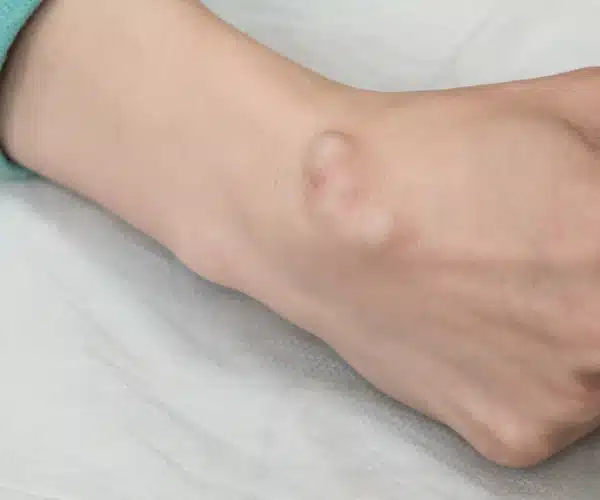
A ganglion cyst is a benign, fluid-filled sac arising from a joint capsule or tendon sheath. The fluid inside is thick, jelly-like synovial fluid (similar to joint fluid but more concentrated). Ganglion cysts are the most common soft tissue masses of the foot and ankle, typically appearing as smooth, firm lumps on the top of the foot, the ankle, or occasionally the sole. They are not cancerous and do not spread, but they can cause pain, pressure on adjacent structures, and cosmetic concern.
Written & Reviewed By
Dr. Tom Biernacki, DPM
Board-Certified Podiatric Physician & Surgeon · Michigan Foot Doctors · Balance Foot & Ankle
Serving Howell, Brighton, Hartland, Fowlerville, Pinckney, South Lyon & Milford, MI
The exact cause of ganglion cysts is not fully understood. Current theory suggests they arise from myxoid degeneration of connective tissue, with the cyst developing a communication with the adjacent joint or tendon sheath that allows fluid to accumulate. They occur in all age groups but are most common in women ages 20–40. Some appear after trauma, repetitive activity, or joint stress; others develop without identifiable cause. Ganglion cysts can fluctuate in size—often larger after activity and smaller at rest—and occasionally disappear completely, only to return later.
Common Locations on the Foot
On the foot and ankle, ganglion cysts most commonly arise from the dorsum (top) of the foot—particularly from the joints between the tarsal bones or metatarsal-tarsal joints. They also commonly originate from the ankle joint anteriorly (front of ankle), from the peroneal or posterior tibial tendon sheaths (sides of ankle), and occasionally from small joints in the toes. The sole of the foot is a less common but particularly problematic location because plantar cysts are compressed with weight-bearing, causing pain with walking. Plantar fibroma (a fibrous nodule in the plantar fascia) is a different entity sometimes confused with a plantar ganglion.
Treatment Options
Observation
For asymptomatic or minimally symptomatic ganglion cysts, observation is appropriate—many cysts spontaneously resolve. Approximately 40–58% of foot and ankle ganglion cysts resolve without treatment over 1–2 years. If the cyst is not causing significant pain, functional limitation, or neurological symptoms from nerve compression, watchful waiting is a reasonable approach. Activity modification, appropriate footwear to avoid pressure on the cyst, and reassurance are appropriate initial management.
Aspiration
Aspiration—draining the cyst with a needle in-office—is a simple, low-risk procedure that provides immediate size reduction and often temporary pain relief. The recurrence rate after aspiration alone is high (50–80%), because the cyst connection to the joint or tendon sheath remains. Aspiration combined with injection of corticosteroid or a sclerosing agent may reduce recurrence rates modestly. Aspiration is most useful for patients who want symptom relief without surgery or who want confirmation of the diagnosis.
Surgical Excision
Surgical excision is the definitive treatment for symptomatic, recurrent, or cosmetically bothersome ganglion cysts. The procedure involves removing the cyst along with its stalk (the communication with the joint or tendon sheath)—excision of the stalk is critical to reducing recurrence. Even with complete excision including the stalk, recurrence rates of 5–15% are reported. Open excision is the traditional approach; arthroscopic excision for ankle ganglions reduces surgical trauma and recovery time. Recovery after excision is typically 2–4 weeks for dorsal cysts; plantar cysts may require longer recovery due to weight-bearing pressure on the surgical site.
Frequently Asked Questions
Is a ganglion cyst on the foot dangerous?
Ganglion cysts are benign—they do not turn into cancer, do not spread, and do not invade surrounding structures in a malignant way. The main risks are mechanical: a large cyst can compress adjacent nerves (causing numbness, tingling, or burning pain), interfere with joint motion, or cause pain from shoe pressure. A cyst on the plantar (bottom) surface can be painful with weight-bearing. Any soft tissue lump on the foot should be evaluated to confirm it is a ganglion cyst and not something else—while most foot lumps are benign, soft tissue sarcomas and other tumors do occasionally occur in the foot. An MRI can definitively characterize the cyst and rule out other pathology if the diagnosis is uncertain.
Can a ganglion cyst go away on its own?
Yes—ganglion cysts can and do resolve spontaneously. Studies show that 40–58% of foot and ankle ganglion cysts resolve without treatment over months to years. This is why observation is appropriate for asymptomatic cysts. Cysts may also fluctuate in size—enlarging during periods of activity and shrinking with rest—and may temporarily disappear before returning. If your cyst is not causing symptoms, watching it for 6–12 months before pursuing treatment is reasonable. However, if the cyst is causing pain, nerve symptoms, or functional limitation, treatment rather than continued observation is appropriate.
What does a ganglion cyst on the foot feel like?
A ganglion cyst typically feels like a smooth, rounded, firm-to-rubbery lump beneath the skin. It may feel soft if large and fluid-filled, or quite firm if the fluid is thick and concentrated. The cyst is generally mobile—it can be slightly moved side to side—but is attached at its base to the underlying joint or tendon. It transilluminates (light shines through it) on examination, which helps distinguish it from solid tumors. Ganglion cysts may be painless, or may produce aching pain with activity, tenderness when pressed, or neurological symptoms if adjacent nerves are compressed. The pain is typically intermittent—worse with activity and shoe pressure, better at rest. If a lump is fixed (cannot be moved), hard, and rapidly growing, these are features that warrant urgent evaluation to rule out malignancy.
Medical References & Sources
- American Orthopaedic Foot & Ankle Society — Ganglion Cysts
- PubMed Research — Ganglion Cyst Treatment Outcomes
- PubMed Research — Ganglion Cyst Natural History
Dr. Tom Biernacki, DPM is a board-certified podiatric surgeon at Balance Foot & Ankle in Howell and Bloomfield Hills, Michigan. He evaluates and treats foot and ankle ganglion cysts with aspiration and surgical excision when indicated.
Frequently Asked Questions
Q: What does a ganglion cyst on the foot feel like?
A: A soft-to-firm, rubbery bump that may be 1cm-5cm. Usually painless unless pressing on a nerve or tendon. May fluctuate in size. Transillumination (shining a light through it) confirms fluid content vs. solid mass.
Q: Do ganglion cysts go away on their own?
A: About 40-50% resolve spontaneously within 6-12 months. Watchful waiting is reasonable if asymptomatic. The old ‘Bible treatment’ (hitting it with a book) is not recommended—it can rupture into deeper tissue.
Q: How do doctors treat ganglion cysts?
A: Aspiration (needle drainage): quick in-office procedure, 50-70% recurrence rate. Surgical excision: removes the cyst stalk and reduces recurrence to <10%. Cortisone injection reduces inflammation if causing pain.
Q: Are ganglion cysts dangerous?
A: No—they’re benign. But any new foot mass should be evaluated to rule out more serious conditions. Dr. Tom can diagnose with clinical exam and ultrasound without radiation.
📊 Did You Know?
Ganglion cysts are the most common benign soft tissue masses of the foot
They account for 50-70% of all benign soft tissue masses. Aspiration has 50% recurrence; surgical excision reduces this to <10%.
Michigan’s Podiatry Leader
Ready to Stop the Pain?
Dr. Tom Biernacki, DPM · Same-Week Appointments Available
Howell · Brighton · Hartland · South Lyon · Milford · Fowlerville · Pinckney
📧 Get Dr. Tom’s Free Lab Test Guide
Discover the 5 lab tests every person over 35 should ask their doctor about — explained in plain English by a board-certified physician.
Join 950,000+ Learning About Foot Health
Dr. Tom shares honest medical advice, supplement reviews, and treatment guides you won’t find anywhere else.
Subscribe on YouTube →📍 Located in Michigan?
Our board-certified podiatrists treat this condition at two convenient locations. Same-day appointments often available.

Dr. Tom Biernacki, DPM is a double board-certified podiatrist and foot & ankle surgeon at Balance Foot & Ankle Specialists in Southeast Michigan. With over a decade of clinical experience, he specializes in heel pain, bunions, diabetic foot care, sports injuries, and minimally invasive surgery. Dr. Biernacki is a member of the APMA and ACFAS, and his patient education content on MichiganFootDoctors.com and YouTube has reached over one million views.