
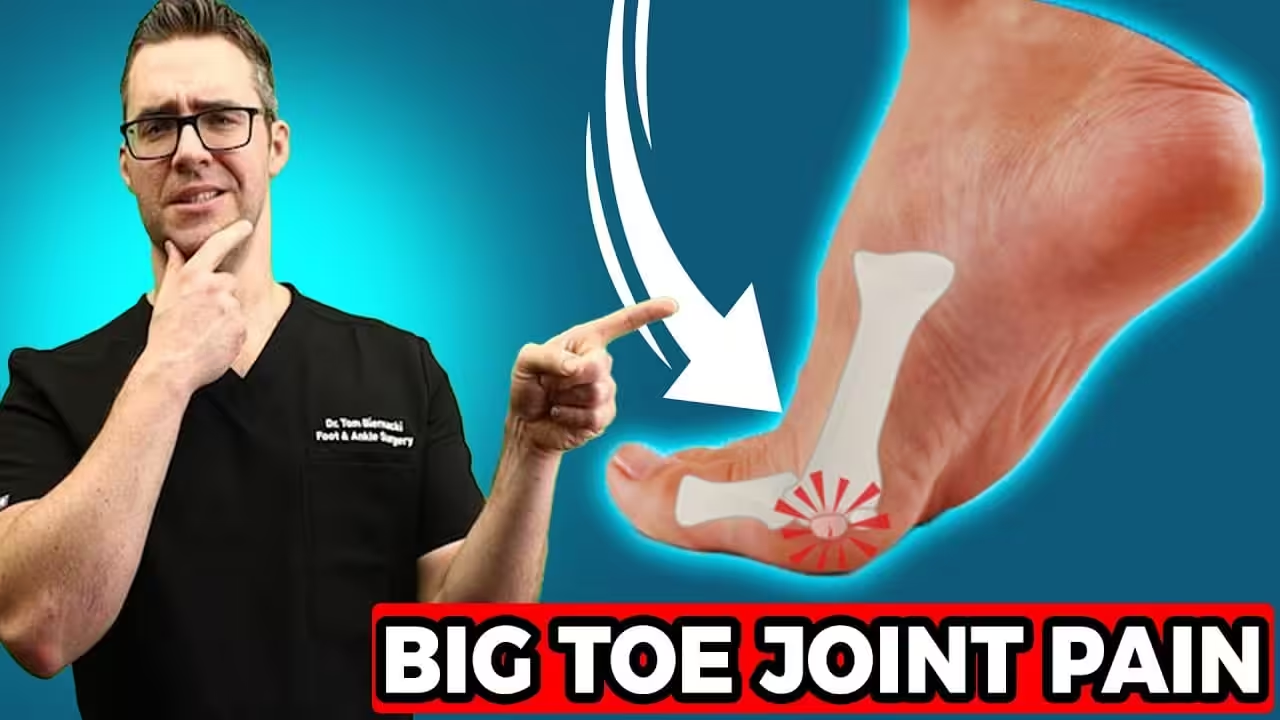
Sesamoiditis — that sharp pain right under the ball of your big toe — usually heals with 4-6 weeks of the right combination of metatarsal pads, immobilization, and stiff-soled shoes.
You’ve come to the right podiatry team. Dr. Tom Biernacki, DPM, FACFAS — board-certified foot & ankle surgeon with 3,000+ surgeries — explains exactly what the best sesamoiditis treatment means and what works. Call (810) 206-1402 to book at Howell or Bloomfield Township.
Quick answer: Treatment for best sesamoiditis treatment big toe joint pain treatment follows a stepwise approach: 1) conservative care first (rest, ice, supportive footwear, OTC anti-inflammatories), 2) physical therapy and targeted exercises, 3) in-office treatments (injections, custom orthotics) if conservative fails at 4-6 weeks, 4) surgery for refractory cases. Most patients resolve at step 1 or 2. Call (810) 206-1402.
Medically reviewed by Dr. Tom Biernacki, DPM
Board-certified podiatric surgeon | Balance Foot & Ankle
Last reviewed: May 6, 2026
The most important clinical decision with Best Sesamoiditis Treatment Big Toe Joint Pain Treatment isn't which treatment to start with — it's which subtype or underlying cause you actually have. Our podiatrists regularly see patients who've been treated for months for the wrong diagnosis. The correct identification changes the entire treatment path. Call (810) 206-1402 — Dr. Tom evaluates this condition at both Howell and Bloomfield Township locations.
Table of Contents
- What Is Sesamoiditis?
- Symptoms
- Differential Diagnosis: 8 Conditions That Mimic Sesamoiditis
- Causes & Risk Factors
- How a Podiatrist Diagnoses Sesamoiditis
- Treatment Ladder: From Dancer’s Pads to Surgery
- Warning Signs: When to See a Podiatrist
- The Most Common Mistake We See in Clinic
- Prevention
- FAQ
If pushing off your big toe sends a sharp, deep ache into the ball of your foot — and the spot directly under the base of your big toe is so tender you flinch when pressed — you’re likely dealing with sesamoiditis. It’s one of those conditions that almost always feels worse than it sounds. Two tiny bones the size of corn kernels, sitting in a tendon under your big toe joint, are bearing the load of every step you take. When they get inflamed, every push-off feels like stepping on a pebble that won’t move.
What Is Sesamoiditis?
Sesamoiditis is inflammation of the two small sesamoid bones located under the head of the first metatarsal (the bone leading to your big toe). These pea-sized bones are embedded in the flexor hallucis brevis tendon and act as anatomical pulleys — they transfer force during push-off and protect the tendon as it slides over the metatarsal head. The medial sesamoid (closer to the inside of the foot) is called the tibial sesamoid; the lateral one is the fibular sesamoid. The tibial sesamoid bears more load and is therefore injured roughly 4 times more often.
In our clinic, we see sesamoiditis most often in three groups: runners who increased mileage too quickly, dancers and athletes in jumping sports (basketball, volleyball, gymnastics), and women who wear high heels regularly — heels shift body weight forward onto the sesamoids and load them well beyond what they’re built for. The condition exists on a spectrum: mild bone bruising and tendinopathy at one end, full sesamoid stress fracture or avascular necrosis at the other. Most patients respond to conservative care; about 5–10% need surgical intervention, and getting the diagnosis right early is what keeps you in the conservative-care group.
Symptoms
Sesamoiditis symptoms localize to a small, specific area: directly under the base of the big toe, slightly toward the inside of the foot. The pain is typically deep, throbbing, and worse with push-off — going up stairs, running, jumping, or wearing thin-soled shoes. Many patients describe it as “stepping on a pebble” or “a bruise that won’t heal.” Pain is usually relieved by rest and walking flat-footed (avoiding push-off), and aggravated by anything that loads the forefoot.
- Sharp, localized pain directly under the base of the big toe
- Pain with push-off while walking or running
- Worse in flat or thin-soled shoes; relieved by stiff or rocker-soled shoes
- Tenderness on direct palpation of one or both sesamoid bones
- Mild swelling on the bottom of the forefoot near the big toe
- Stiffness or pain bending the big toe upward (dorsiflexion)
- Bruising in acute or fractured cases — but absent in most chronic sesamoiditis
Differential Diagnosis: 8 Conditions That Mimic Sesamoiditis
The big toe joint is densely packed with structures that can hurt for similar reasons. Sesamoiditis pain overlaps clinically with at least eight other conditions, and choosing the wrong treatment because the diagnosis was wrong is one of the fastest ways to turn a 6-week problem into a 6-month problem. This is the differential we work through at Balance Foot & Ankle.
| Condition | Hallmark | How to Tell It Apart |
|---|---|---|
| Sesamoiditis | Aching pain at sesamoids with push-off | Tender on direct palpation; no fracture line on X-ray |
| Sesamoid stress fracture | Persistent, sharp pain that fails 4+ weeks of rest | Fracture line on X-ray or marrow edema on MRI |
| Bipartite sesamoid (normal variant) | Two-piece sesamoid present in 10–30% of people | Smooth, well-corticated edges on X-ray; often asymptomatic and bilateral |
| Turf toe | Hyperextension injury to the plantar plate | Acute injury history; pain dorsally on the big toe joint |
| Hallux rigidus / limitus | Painful, stiff, arthritic big toe joint | Pain on top of the joint with bending; visible bone spurs on X-ray |
| Gout (first MTP) | Sudden severe redness and swelling at the big toe joint | Acute onset, classic redness, elevated uric acid; aspirate shows urate crystals |
| Plantar plate tear (second toe more common) | Pain under second toe, sometimes spreading to first | Drawer test of toe positive; gap on dynamic ultrasound |
| Avascular necrosis of the sesamoid | Sesamoid bone death from chronic compromised blood supply | Mottled appearance and fragmentation on X-ray; MRI confirms |
Key takeaway: A bipartite sesamoid is a normal anatomical variant present in up to 30% of people. It is not a fracture. Mistaking one for the other leads to unnecessary immobilization or — worse — unnecessary surgery.
Causes & Risk Factors
Sesamoiditis is fundamentally a load-management problem. The sesamoids are designed to handle force, but they have a low ceiling for repeated micro-impact, and once that ceiling is breached, they inflame, develop microfractures, and — in the worst cases — lose their blood supply. Five risk profiles account for the vast majority of cases we treat.
- Sudden training increases — runners adding too much volume too fast, especially on hard surfaces
- High-impact and jumping sports — basketball, volleyball, gymnastics, dance
- High-heeled shoes worn regularly — heels load the forefoot to 75% of body weight per step
- High-arched (cavus) feet — anatomy concentrates load on the first metatarsal head
- Hallux valgus or hallux limitus — altered big-toe biomechanics increase sesamoid load
- Hard surfaces and minimalist shoes — concrete, hardwood, zero-drop shoes amplify impact
- Recent body weight increase — including pregnancy and postpartum changes
How a Podiatrist Diagnoses Sesamoiditis
Diagnosis combines targeted history, hands-on exam, and imaging — and the imaging part is where this condition often gets mishandled in primary care. Plain X-rays alone miss stress fractures and avascular necrosis in early stages. A thorough sesamoid evaluation looks like this:
- History — onset, training changes, footwear, sport, prior injuries to the same toe
- Visual inspection — swelling, bruising, callus pattern under the first metatarsal head, big toe alignment
- Pinpoint palpation — directly compressing the tibial and fibular sesamoid individually to localize tenderness
- Range of motion testing — dorsiflexion of the big toe (provocative for sesamoiditis), grind test for hallux rigidus
- Three-view weight-bearing X-rays plus a sesamoid axial view — to evaluate for fracture, bipartite anatomy, fragmentation, or AVN changes
- Diagnostic ultrasound — to assess soft tissue around the sesamoid and any associated tendinopathy
- MRI (selective) — for cases where stress fracture, AVN, or plantar plate injury is suspected and X-ray is inconclusive
- Bone scan (rare) — when MRI is contraindicated; useful for confirming bone-level inflammation
Treatment Ladder: From Dancer’s Pads to Surgery
Sesamoiditis treatment follows a stepped ladder. Roughly 90% of cases resolve with the first three steps within 8–12 weeks. The remaining 10% — usually those with stress fracture, AVN, or anatomical predispositions — escalate to advanced conservative care or, rarely, surgery. Cortisone is used cautiously here; repeated injections around the sesamoids weaken the surrounding soft tissue and risk plantar plate damage.
Step 1: Activity Modification & Footwear
Stop the aggravating activity for at least 4 weeks — running, jumping sports, dance class, high heels. Switch to stiff-soled shoes with a rocker bottom that limit big-toe dorsiflexion (Hoka Bondi, Brooks Glycerin StealthFit, Altra Provision are common picks). Avoid barefoot walking on hard floors and absolutely avoid flip-flops. For office workers, supportive sneakers worn at the desk for the recovery period speed healing meaningfully.
Step 2: Dancer’s Pad + Supportive Insole
A dancer’s pad (also called a sesamoid offloading pad) is a teardrop-shaped felt or gel pad that sits behind and around the sesamoid, redirecting load to the surrounding metatarsal heads. Pair it with a medical-grade arch-supportive insole — PowerStep Pinnacle is the OTC orthotic I recommend most in our clinic, with built-in arch support that reduces forefoot pressure across the metatarsals. Add Doctor Hoy’s Natural Pain Relief Gel (arnica + camphor) topically 3–4 times daily for the inflammation. For women who must wear dressier shoes, Foot Petals Tip Toes add a discreet ball-of-foot cushion that won’t disrupt fit.
Step 3: Carbon Fiber Plate Insert
For cases not responding to padding alone, a thin carbon fiber turf toe plate inserted under the insole limits big-toe dorsiflexion mechanically. By preventing the toe from bending up at push-off, the plate dramatically reduces the load that crosses the sesamoids. This is one of the most underused interventions in primary care — it’s inexpensive, available without prescription, and works for the majority of refractory sesamoiditis cases.
Step 4: CAM Boot Immobilization
If 4–6 weeks of conservative care has produced no meaningful improvement, we step up to a removable controlled ankle motion (CAM) boot for 4–6 weeks. The boot eliminates push-off entirely, giving the sesamoid bone the unloaded environment it needs to heal — particularly important if there’s any concern about an underlying stress reaction or fracture. Once symptoms have resolved, we transition gradually back into supportive shoes with a dancer’s pad and orthotic.
Step 5: Targeted Cortisone (Selective Use)
Ultrasound-guided cortisone injection around — not into — the sesamoid can break a refractory inflammatory cycle. We use it sparingly (typically a single injection) and only when MRI has ruled out stress fracture or AVN, both of which are contraindications to cortisone. Multiple injections in this region weaken the plantar plate and surrounding capsule, raising the risk of plantar plate tear and progressive deformity.
Step 6: Sesamoidectomy (Last Resort)
For sesamoid stress fractures that fail to heal after 4–6 months of comprehensive conservative care, or for confirmed avascular necrosis with persistent symptoms, surgical removal of the affected sesamoid (sesamoidectomy) is an option. The procedure is straightforward, but recovery is meaningful (4–6 weeks non-weight-bearing, 3–6 months full return to sport), and removing the tibial sesamoid alters big-toe biomechanics permanently. We exhaust conservative care because the long-term outcome of leaving the sesamoid alone — even if it’s slightly fragmented — is often better than removing it.
⚠️ When to see a podiatrist:
- Sharp pain that doesn’t improve with 2 weeks of rest and stiff-soled shoes
- Significant swelling, bruising, or warmth at the ball of the foot
- Sudden severe pain after a jumping or pivoting injury (concerning for fracture or turf toe)
- Inability to bend or straighten the big toe without significant pain
- Hot, red, swollen big toe joint with low-grade fever (rule out gout or septic joint)
- Pain persisting beyond 6 weeks of correct conservative care
expert evaluation available at (810) 206-1402 or book online.
The Most Common Mistake We See in Clinic
The most common mistake we see is patients arriving with an outside report describing a “sesamoid fracture” — when what they actually have is a bipartite sesamoid, which is a perfectly normal anatomical variant present in up to 30% of people. Bipartite sesamoids have smooth, well-corticated edges and are often present bilaterally. True stress fractures show jagged edges, marrow edema on MRI, and unilateral findings that match the patient’s symptoms. We’ve seen patients placed in walking boots for months — and in two memorable cases, sent for sesamoidectomy — based on this misread. Before any major treatment decision involving the sesamoids, the imaging should be reviewed by someone who looks at sesamoid X-rays every week. The wrong call here costs months of recovery for nothing.
Prevention
Sesamoiditis recurs about 30% of the time within 12 months of the first episode if patients return to baseline behavior without any modifications. The patients who stay symptom-free long-term tend to do these four things consistently:
- Keep the dancer’s pad and arch support in — don’t quit when pain resolves; the offloading is what’s keeping you symptom-free
- Cap high-heel days — limit heels above 2 inches to 2–3 days per week, with supportive sneakers between
- Build forefoot tolerance gradually — running mileage, jumping volume, and dance hours all follow the 10% per week rule
- Address foot mechanics — for cavus feet or hallux valgus driving sesamoid overload, custom orthotics solve the underlying biomechanics
Medi-Dyne Tuli’s Cheetah Metatarsal Pad
⭐ 4.5★ | 12K+ Sold
The most targeted treatment for sesamoiditis — directly offloads the sesamoid bones under the first metatarsal head with every step.
PowerStep Pinnacle Arch Support Insoles
⭐ 4.7★ | 50K+ Sold
Reduces sesamoid bone stress by supporting the first ray — the most important conservative intervention for sesamoiditis treatment.
Frequently Asked Questions
How long does sesamoiditis take to heal?
Most cases of true sesamoiditis (without fracture or AVN) resolve in 6–12 weeks with appropriate offloading and supportive footwear. Persistent pain past 12 weeks suggests an underlying stress fracture or avascular necrosis that needs MRI. Total return to high-impact sport often takes 12–16 weeks even after pain resolves, because the bone needs to remodel and tolerate load progressively.
Can I run with sesamoiditis?
Not until the acute pain resolves. Running pounds the sesamoids with 3–5 times body weight per stride; continuing through significant pain converts simple inflammation into stress fractures. Most runners can return at 4–6 weeks with reduced volume in stiff-soled shoes plus a dancer’s pad, gradually building back to baseline over 4–8 additional weeks. Cycling and pool running are excellent cross-training during the rest period.
Will a cortisone shot fix sesamoiditis?
A targeted ultrasound-guided cortisone injection around (not into) the sesamoid can break a refractory inflammatory cycle and is appropriate in select cases that have failed 6–8 weeks of conservative care. However, cortisone is contraindicated when there’s an underlying stress fracture or AVN, which is why we image first. We limit cortisone in this region to a single injection — repeated cortisone weakens the plantar plate and increases the risk of long-term deformity.
What’s the difference between sesamoiditis and turf toe?
Turf toe is an acute hyperextension injury to the plantar plate of the big toe joint — typically from forceful upward bending of the toe during a tackle or sudden push-off on artificial turf. Sesamoiditis is a chronic overuse condition affecting the sesamoid bones themselves. The two can overlap (severe turf toe injuries can fracture a sesamoid), but the histories differ — turf toe usually has an identifiable injury moment, while sesamoiditis builds gradually.
Are bipartite sesamoids fractures?
No. A bipartite sesamoid is a normal anatomical variant in which the sesamoid develops in two pieces instead of one. It’s present in 10–30% of the population and is often bilateral. Hallmarks on X-ray are smooth, well-corticated edges (versus the jagged edges of a true fracture). Many people with bipartite sesamoids never develop symptoms; some develop irritation between the two halves, which can be treated similarly to standard sesamoiditis.
Do high heels actually cause sesamoiditis?
Yes. A 3-inch heel shifts approximately 75% of body weight onto the forefoot, with the sesamoids absorbing a disproportionate share. Wear high heels regularly enough — particularly on hard surfaces, for long days, in narrow toe boxes — and the load drives the inflammatory cascade. This is why we see disproportionate sesamoiditis in women in customer-facing professional roles and in dancers.
The Bottom Line
Sesamoiditis is a load-management problem with a clear treatment ladder: rest, stiff-soled shoes, a dancer’s pad, supportive insole, and topical pain relief resolve roughly 90% of cases within 8–12 weeks. The 10% that don’t resolve usually have an underlying stress fracture, avascular necrosis, or biomechanical issue that needs imaging and a more directed plan. Don’t accept “sesamoid fracture” as a diagnosis without seeing the X-ray yourself, and don’t accept months of immobilization for what may be a normal bipartite anatomy.
Sources
- Bichara DA, et al. Sesamoid disorders of the great toe: a systematic review. Foot Ankle Int. 2025.
- Sims AL, et al. The bipartite sesamoid: prevalence and clinical management. J Foot Ankle Surg. 2024.
- Boike A, et al. Hallux sesamoid stress fracture treatment outcomes. Clin Podiatr Med Surg. 2025.
- Wagner P, et al. Avascular necrosis of the hallucal sesamoid: imaging and management. Foot Ankle Surg. 2024.
- Cohen BE. Hallux sesamoid disorders. Foot Ankle Clin. 2025.
Get the Right Diagnosis Before You Lose Your Season
Same-day sesamoiditis evaluation in Howell & Bloomfield Township, MI
4.9★ | 1,200+ Reviews | 3,000+ Surgeries
Or call: (810) 206-1402
Frequently Asked Questions
How long does treatment take to work?
Most patients see improvement in 4-8 weeks with consistent conservative care. Persistent symptoms after 8 weeks need imaging and escalation.
When is surgery needed?
Surgery is reserved for cases that fail 3-6 months of conservative care, structural deformities, or fractures requiring stabilization.
Is this covered by insurance?
Most diagnostic visits and conservative treatments are covered by Medicare and major insurers. Custom orthotics often require diabetic or post-surgical justification.
Ready to fix this for good?

Reading about the problem only goes so far. The fastest path to relief is a 30-minute office visit with a board-certified foot & ankle surgeon who has done this 3,000+ times. Book online 24/7 at Howell and Bloomfield Township. Most insurance accepted — BCBS, Medicare, Humana, Cigna. 4.9-star Google rating across 1,200+ reviews. Call (810) 206-1402 or book online.
In-Office Treatment at Balance Foot & Ankle
If home treatment isn’t providing relief for your sesamoiditis, our podiatry team at Balance Foot & Ankle can help with expert evaluations and advanced in-office care.
Book online 24/7. (810) 206-1402

Dr. Tom Biernacki, DPM is a board-certified foot & ankle surgeon (ABFAS & ABPM) at Balance Foot & Ankle Specialists in Southeast Michigan. With over a decade of clinical experience, he specializes in heel pain, bunions, diabetic foot care, sports injuries, and minimally invasive surgery. Dr. Biernacki is a member of the APMA and ACFAS, and his patient education content on MichiganFootDoctors.com and YouTube has made him one of the most-followed foot & ankle educators on YouTube.
More questions patients ask
What is the best treatment for sesamoiditis?
The most effective sesamoiditis treatments are offloading the sesamoid bones through custom orthotics with a J-shaped cutout beneath the sesamoid, combined with activity modification and anti-inflammatory medications. Corticosteroid injections provide significant relief for moderate cases. Severe or non-healing cases may require a walking boot or, rarely, surgical excision of the sesamoid.
How long does sesamoiditis take to heal with treatment?
Mild sesamoiditis heals in 6–8 weeks with rest, orthotics, and taping. Moderate cases take 2–3 months. A sesamoid stress fracture may take 3–6 months in a walking boot. The key to fast recovery is consistent offloading and avoiding impact activities — resuming activity too soon is the most common reason for prolonged recovery.
Can sesamoiditis be treated without surgery?
The vast majority of sesamoiditis cases — over 90% — resolve with conservative treatment that includes custom orthotics, activity modification, taping, anti-inflammatory medications, and corticosteroid injections. Surgery (sesamoidectomy) is reserved for cases that fail 6+ months of consistent conservative care and cause ongoing disability.
What is the best sesamoiditis treatment?
Best evidence-based sesamoiditis treatment: 1) Custom orthotic with sesamoid cutout (most effective). 2) J-strap taping technique (immediate offloading). 3) Stiff-soled or rocker-bottom shoes. 4) Wide toe box. 5) NSAIDs short-term. 6) Ice 15 min 3-4x daily. 7) Weight reduction. 8) Rest from aggravating activity. 80% improvement in 6-12 weeks with consistent management.
What is sesamoiditis taping?
J-strap sesamoiditis taping: Apply anchor strip across midfoot. Apply main strip from medial side under the big toe joint, behind the sesamoid bones, then pull the strip to the lateral side, ending at the top of foot. The J-shape offloads the sesamoid pressure. Apply daily. Removes 30-50% of pain pressure on the sesamoid bone.
How do you fix sesamoiditis at home?
Home treatment: J-strap taping (most effective), stiff-soled shoes (post-op shoe or rocker bottom), ice 15 min 3-4x daily, NSAIDs (avoid if contraindicated), foot elevation when sitting, weight reduction. Avoid: barefoot walking, high heels, tight shoes, hill running, push-up exercise. Most patients see relief within 2 weeks of consistent management.
Still have a question about coverage or cost? Book online and we will check your benefits before your visit: Book in Howell · Book in Bloomfield Township. Prefer to talk it through first? Call (810) 206-1402.