

Quick answer: Podiatrists most often recommend running shoes from Brooks, HOKA, ASICS, and New Balance because they balance cushioning, support, and durability. Match the shoe to your foot: stability or motion-control models for flat feet and overpronation, neutral cushioned models for high arches and supination.
The most important clinical decision with Podiatrist Recommended Running Shoes isn't which treatment to start with — it's which subtype or underlying cause you actually ha

- ENGINEERED MESH
- Lining Textile
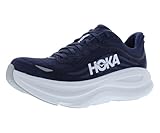
- ENGINEERED MESH
- Lining Textile
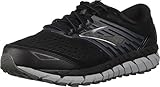
- SHOE SIZE: “D” = Medium width
- FOOT SUPPORT: Ideal for runners with a medium to high arch looking for neutral support.
- CUSHIONED FEEL: Soft and protective, these shoes provide just the right amount of cushion in each step to let you float through your run, walk and everyday life.
- PLUSH CUSHIONING AND FLOAT FEEL: BioMoGo DNA midsole cushioning dynamically adapts to your stride, providing comfortable cushioning for just-right softness underfoot to let you float through your stride.
- SOFT, COMFORTABLE AND VERSITLE FIT: The shoe’s internal bootie surrounds your foot in all-day comfort, no matter how your foot naturally moves whether you’re on a run, walk or the gym.
As an Amazon Associate, Balance Foot and Ankle earns from qualifying purchases. Product links are affiliate links and we may earn a commission at no extra cost to you. This does not influence our clinical recommendations. Last update on 2026-08-21 / Images from Amazon Product Advertising API
ve. Our podiatrists regularly see patients who've been treated for months for the wrong diagnosis. The correct identification changes the entire treatment path. Call (810) 206-1402 — Dr. Tom evaluates this condition at both Howell and Bloomfield Township locations.
Top Podiatrist-Recommended Men’s Running Shoes for Support, Stability & Pain Relief
Best Men’s Supportive Shoes!

Foot Doctor Approved. Runner Tested.
- ENGINEERED MESH
- Lining Textile
- ENGINEERED MESH
- Lining Textile
Running with the wrong shoes can lead to heel pain, arch fatigue, shin splints, and chronic foot injuries. Our podiatrists at Balance Foot & Ankle Specialist recommend men’s running shoes designed for proper biomechanics, cushioning, and long-distance comfort—all backed by clinical experience.
Schedule Your Consultation TodayWhy Running Shoes Matter for Foot Health
The right running shoes absorb shock, protect joints, and support your natural gait. Poorly designed shoes can worsen foot conditions like plantar fasciitis, tendonitis, and stress fractures. Quality running shoes help prevent injury and allow you to run longer with less pain.
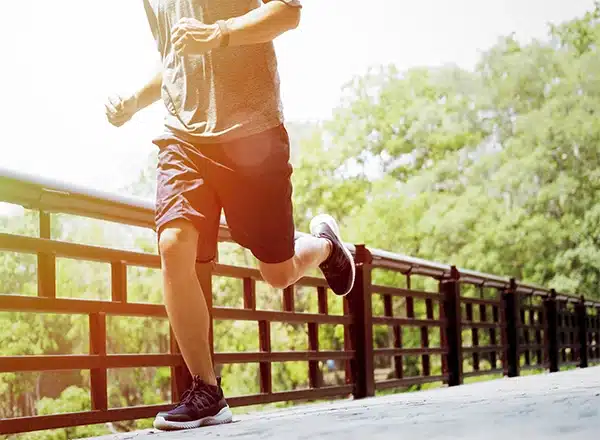
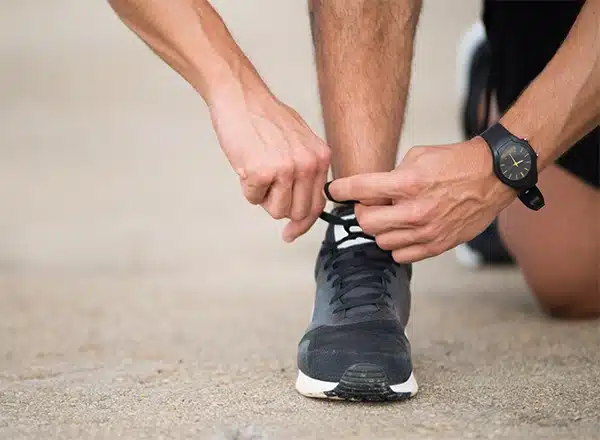
How to Choose the Best Running Shoes
When selecting running shoes, look for arch support, heel stabilization, midsole cushioning, and the right fit for your foot type—neutral, flat-footed, or high-arched. Consider whether you run on pavement, trails, or treadmills. Features like wide toe boxes, breathable uppers, and durable outsoles also matter for long-term comfort.
How Our Podiatrists Help You Choose the Right Shoe
Our podiatrists at Balance Foot & Ankle Specialist evaluate your gait, running form, and foot structure to recommend the ideal running shoe. If needed, we offer 3D custom orthotics that fit inside most running shoes to improve alignment, reduce pain, and enhance performance.

Best Patient Reviews
Excelent shoes You Will feel the difference the Bad things is the price and these shoes might not ve use for running every day. – Julio Gonzalez
The Boston Shoe continues to deliver year-after-year. Light, comfortable, and fast. Nice “pop” in the step, and smooth roll-forward. – Brian Monroe
Very light and comfy. Perfect for running. I’m really happy with this buy! – Mohammed Syed
This is my second pair in the last few years and they have been the best runners I have owned in a long time. Durable and comfortable. – Canuck

Trusted Footwear Recommendations From Michigan’s Leading Podiatrists
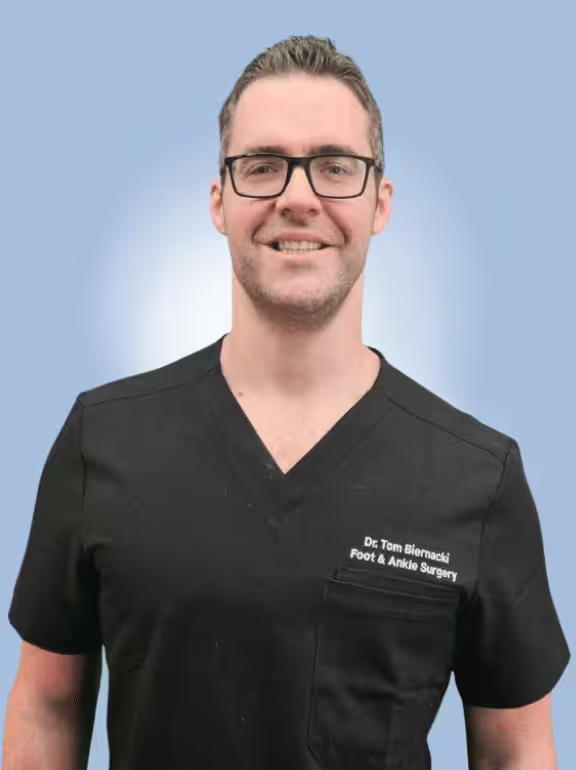
Dr. Tom Biernacki DPM
(Podiatrist, Wound Care, Foot & Ankle Specialist)
Dr. Tom Biernacki, DPM, is a highly respected and experienced podiatrist proudly serving patients in Howell, Michigan, and throughout Oakland County. With a strong commitment to personalized patient care, Dr. Biernacki specializes in diagnosing and treating a many foot and ankle conditions, including chronic foot pain, sports injuries, diabetic foot care, and structural deformities. His practice offers comprehensive services such as routine foot care, advanced wound care, and both non-surgical and surgical solutions for complex issues affecting the lower extremities. Known for his compassionate approach and attention to detail, Dr. Biernacki works closely with each patient to create a customized treatment plan that ensures the best possible outcome.
Dr. Carl Jay DPM (Podiatric Surgeon & Foot Doctor)
Dr. Carl Jay is a board-certified foot and ankle surgeon and proud partner at Balance Foot & Ankle. After completing his residency at the Genesys Regional Medical Center program, he took his talents to Texas. There he covered trauma call, treated complex wounds in the Wound Care Center, and cared for a many patients in private practice, from diabetic limb preservation to sports medicine.
Dr. Jay certainly enjoyed practicing in the Lone Star State. (I mean that amazing warm weather and sunshine.)Family brought him back to Michigan.
Now serving the Detroit Metro area, Dr. Jay brings advanced treatment modalities and years of surgical and clinical experience to every patient encounter. He’s passionate about delivering expert, compassionate care that helps people move better and live better.




Over 10,000 Patients Helped
Advanced 3D Orthotic Scanning Available
Running With Pain? Get a Professional Foot Evaluation
If you experience arch pain, heel pain, shin splints, or recurring injuries while running, our podiatrists can help. Visit our Howell or Bloomfield Township location for a full evaluation and optional 3D custom orthotic scanning designed specifically for runners.
Book Appointment – Howell Book Appointment – Bloomfield Township810-206-1402
Top 3 Men’s Running Shoes


Podiatrist Recommended Orthotics:
- These are our recommended orthotics.
- There are different types for different shoes.
- Women’s shoes usually need a less bulky orthotic, but allow for less correction.
- A full length orthotic requires a running shoe, boot or comfortable walking/dress shoe.
- We recommend doing everything you can to get a good supportive shoe that can fit a full length orthotic.
- This is the best way to maximize your orthotics for great results.

Best Men’s Socks:

These Are The Best Running Shoes






![How To BEST Measure Shoe Size [Foot Size & Width] Kids & Adults!](https://www.michiganfootdoctors.com/wp-content/cache/flying-press/b68c26c20379d735847082f86718581c.jpg)
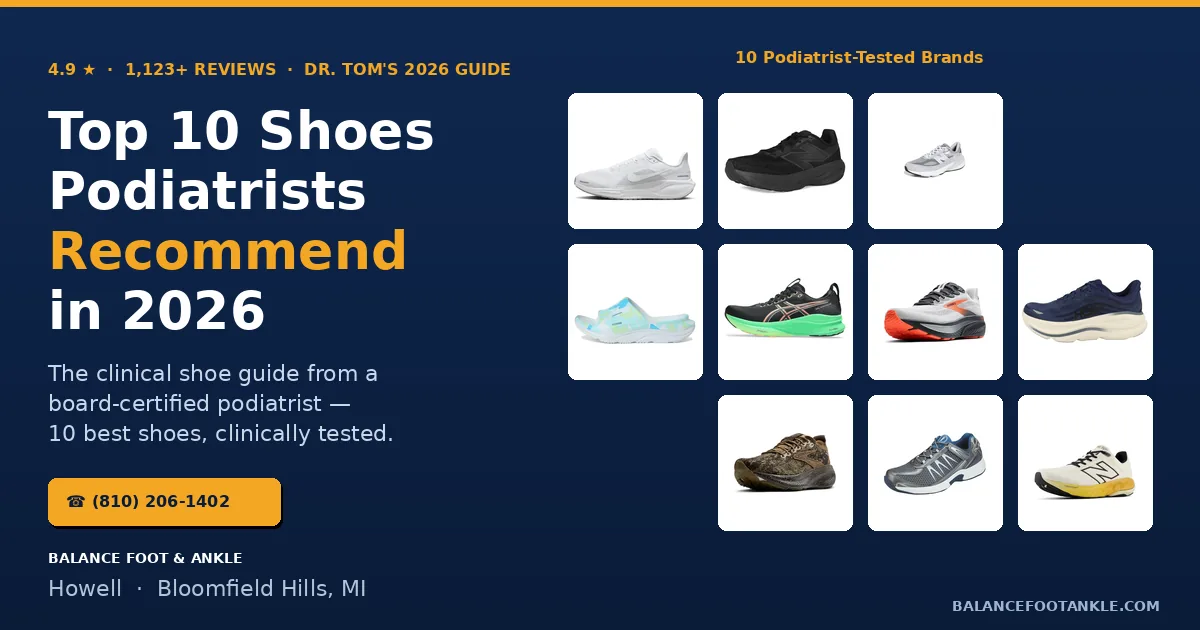
More Podiatrist-Recommended Shoes Essentials
Hoka Clifton 10

Max-cushion neutral runner — podiatrist favorite for all-day comfort.
Brooks Adrenaline GTS 25
Stability runner for overpronators — great for flat feet and bunions.
New Balance 990v6
Premium walking shoe with wide toe box — bunion and flat-foot friendly.
As an Amazon Associate, Balance Foot & Ankle earns from qualifying purchases. Product recommendations are based on clinical experience; prices and availability shown above update live from Amazon.
When to See a Podiatrist
The right shoe shape, last, and stability category is more important than brand. Balance Foot & Ankle evaluates your foot type (neutral, pronator, supinator, high-arched) and recommends specific shoe models that match. Bringing in your current pair lets us spot wear patterns that reveal gait issues — a free 5-minute assessment that can prevent years of foot pain.
Call Balance Foot & Ankle: (810) 206-1402 · Book online · Offices in Howell & Bloomfield Township
FAQ: Men’s Running Shoes
 What should I look for in men’s running shoes?
Look for proper cushioning, arch support, stability, and a comfortable fit. The right shoe should match your running style and foot shape.
How do I know my running shoe size?Always measure your feet while standing and leave about a thumb’s width of space at the toe. Running shoes often run half a size larger than casual shoes.
Do men’s running shoes differ from women’s?Yes. Men’s shoes are usually wider and designed to support more weight, while women’s shoes tend to have a narrower heel and different cushioning
How often should I replace my running shoes?Most running shoes should be replaced every **300–500 miles** or when you notice reduced cushioning, worn-out tread, or discomfort.
Are expensive running shoes always better?Not necessarily. Comfort, fit, and support are more important than price. A well-fitting mid-range shoe can perform better than an ill-fitting high-end shoe.
Should I choose neutral or stability running shoes?Neutral shoes are best for runners with a normal gait, while stability shoes are designed for those who overpronate (feet roll inward). A gait analysis can help you decide.
Can I use running shoes for other sports or the gym?Running shoes are designed for forward motion, so while they can be used for light gym workouts, they aren’t ideal for activities requiring lateral movement, like basketball or tennis.
Are custom orthotics helpful with running shoes?Yes. If you have flat feet, plantar fasciitis, or other foot issues, custom orthotics can improve comfort, support, and running efficiency when paired with the right shoe.
Related Treatment Guides
Dr. Tom’s #1 Insole Recommendation
If there’s one upgrade I recommend to every runner and healthcare worker, it’s replacing the stock insole. I wear CURREX RunPro Performance Insoles in my own running shoes. Most OTC insoles are rigid and static — they force your foot into a fixed position regardless of your gait. CURREX uses dynamic flex zones that adapt to your specific arch profile and movement pattern. They’re available in Low, Regular, and High arch versions, meaning there’s one matched to your actual anatomy.
In our clinic, we recommend CURREX for patients who need meaningful support but aren’t yet at the custom orthotic stage. At approximately $55–60, it delivers real biomechanical benefit at a fraction of custom device cost. Not ideal for: patients with severe structural deformities or diabetic patients requiring therapeutic footwear.
🏃 CURREX RunPro Performance Insoles | ~$55–60 | Shop at Foundation Wellness →
Available in Low / Regular / High arch. Free shipping. Foundation Wellness partner product — 30% supports Balance Foot & Ankle.
💡 Use Your FSA/HSA Benefits: Many of these podiatrist-recommended products qualify for tax-free FSA or HSA reimbursement. Use it or lose it — check deadlines with your plan administrator. View all FSA/HSA eligible foot care products →
Ready to See a Podiatrist? Book Your Appointment
Dr. Tom Biernacki, DPM sees patients at Balance Foot & Ankle Specialists in Howell & Bloomfield Township, MI. Most insurance plans accepted — Medicare, Blue Cross, Aetna, Priority Health & more.
🏃 Dr. Tom’s #1 Insole Pick for Runners: CURREX RunPRO
After fitting thousands of patients, Dr. Biernacki consistently recommends CURREX RunPRO insoles for runners experiencing heel pain, arch fatigue, or shin splints. Their dynamic arch profile adapts to your natural foot shape — unlike rigid orthotics that force your foot into a fixed position.
- 3 arch profiles (low, medium, high) — choose the one that matches your arch height for a genuinely custom fit
- Deep heel cup for rearfoot stability and maximum impact absorption on pavement
- Moisture-wicking top cover — keeps feet dry during long runs and prevents blister hot spots
- FSA/HSA eligible — check your benefits before purchasing; many patients get these covered
👉 Shop CURREX RunPRO on Amazon — Dr. Tom’s recommended insole for runners
⚠️ Still in pain after trying these products for 4–6 weeks?
That’s your signal to see a podiatrist. Self-treatment has a limit — when products aren’t enough, in-office treatment can resolve what home care can’t.
📞 (810) 206-1402 | Book Online →
Same-day appointments. Howell & Bloomfield Township. Most insurance accepted.
Need the Right Running Shoes?
Our podiatrists provide biomechanical assessments and personalized running shoe recommendations to optimize your performance and prevent injuries.
Clinical References
- Nigg BM, Baltich J, Hoerzer S, Enders H. Running shoes and running injuries: mythbusting and a proposal for two new paradigms. Br J Sports Med. 2015;49(20):1290-1294.
- Richards CE, Magin PJ, Callister R. Is your prescription of distance running shoes evidence-based? Br J Sports Med. 2009;43(3):159-162.
- Knapik JJ, Trone DW, Tchandja J, Jones BH. Injury-reduction effectiveness of prescribing running shoes on the basis of foot arch height. J Strength Cond Res. 2014;28(11):3091-3099.
Insurance Accepted
BCBS · Medicare · Aetna · Cigna · United Healthcare · HAP · Priority Health · Humana · View All →
Howell Office
4330 E Grand River Ave
Howell, MI 48843
Get Directions →
Bloomfield Township Office
43494 Woodward Ave, #208
Bloomfield Township, MI 48302
Get Directions →
Your Board-Certified Podiatrists



Ready to Get Back on Your Feet?
Same-week appointments available at both locations.
Book Your Appointment👟 Dr. Tom’s Complete Footwear Library
Podiatrist-Approved Guides for Every Foot Type & Condition
Clinically reviewed by Dr. Tom Biernacki, DPM — Board-Certified Podiatrist
All guides are written and reviewed by licensed podiatrists. Schedule an appointment →
Dr. Tom’s Complete Running Foot Care Stack
- CURREX RunPro — The insole I put in my own running shoes. Dynamic flex zones adapt to your gait pattern in any recommended running shoe.
- PowerStep Pinnacle — For runners who prefer firmer arch control: PowerStep Pinnacle inside any podiatrist-recommended shoe.
- Doctor Hoy’s Natural Pain Relief Gel — Post-run recovery: arnica + camphor gel applied to the plantar fascia and Achilles after each run reduces DOMS and speeds return to training.
Foot pain during or after recommended running shoes? Gait analysis at Balance Foot & Ankle → (810) 206-1402
Visit Balance Foot & Ankle — Same-Day Appointments Available
Our podiatry team serves patients throughout Michigan including Howell, Brighton, and Bloomfield Township. If you’re dealing with heel pain, ingrown toenails, or a foot injury, we have same-day appointment availability.
Same-day appointments available. (810) 206-1402
Frequently Asked Questions
What running shoes do podiatrists most often recommend?
Podiatrists most commonly recommend: Brooks Ghost (neutral, daily trainer), ASICS Gel-Kayano (stability, overpronators), Hoka Clifton or Bondi (maximum cushioning, forefoot pain), New Balance 1080 (neutral, long-distance cushioning), Saucony Guide (mild stability), and On Cloudrunner 2 (neutral, everyday versatility). The best shoe depends entirely on your foot type, gait pattern, and injury history — no single model works for everyone.
