
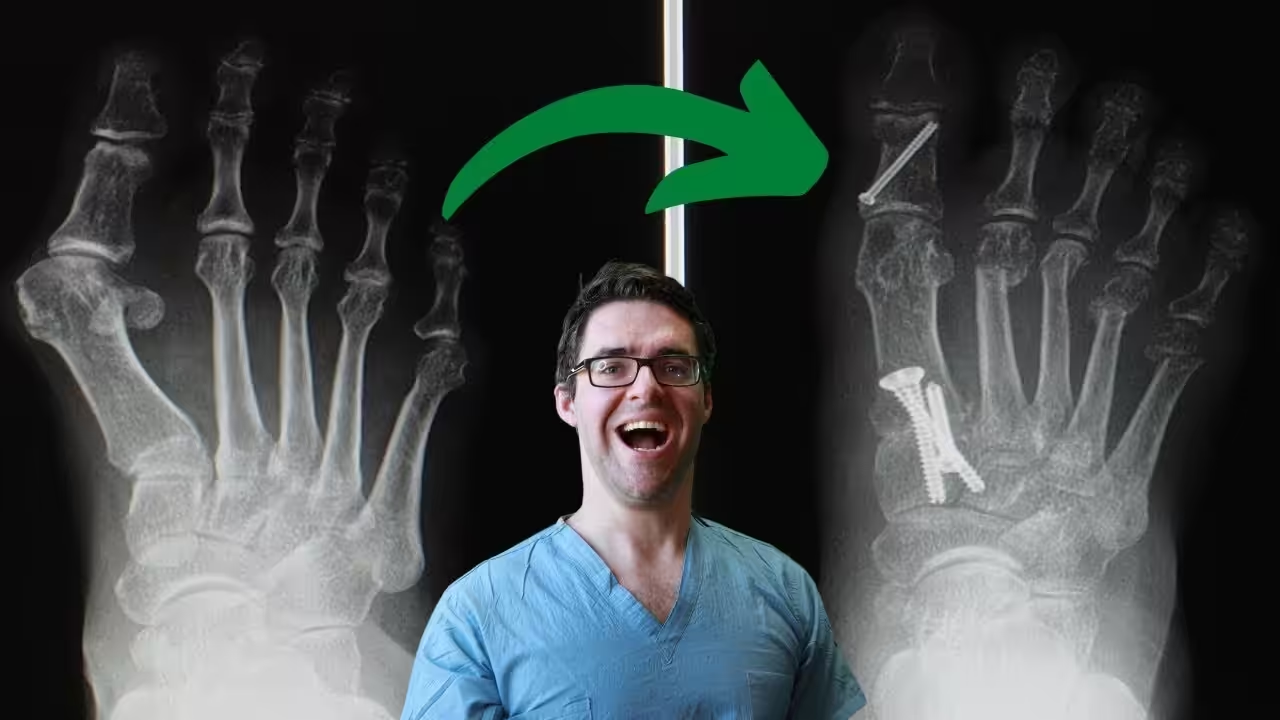
Quick answer: Big Toe Joint Pain Replacement Recovery Time has multiple potential causes including mechanical, neurological, vascular, and inflammatory. The patterns we see most often are overuse, poorly-fitted shoes, and biomechanical imbalance. Red flags requiring urgent evaluation: warmth/redness (infection), inability to bear weight (fracture), and unilateral swelling without injury (DVT). Call (810) 206-1402.
✅ Medically reviewed by Dr. Tom Biernacki, DPM — Board-Certified Podiatrist · Last updated April 6, 2026
Big Toe Joint Pain Replacement Surgery [Best Recovery Time]
Big toe joint pain replacement recovery time can be less that a few weeks until you are back into your shoes. You will feel about 50% at 6 weeks. Big Toe Joint Pain Replacement Surgery [Best Recovery Time] Overview:- Big toe joint pain replacement recovery time can be less that a few weeks until you are back into your shoes.
- Suture recovery generally is not needed due to dissolving stitches.
- You can then progress into a surgical shoe within the first 2-3 weeks.
- As long as this is a very supportive shoe.
- You will feel about 50% at 6 weeks.
What is a big toe joint replacement?
- A first metatarsophalangeal (MTP) joint replacement treats arthritis of the big toe.
- The arthritis in the joint is excised and it is replaced with an implant similar to a knee or a hip replacement.
- Yes if you are found necessary to need this procedure, then it is covered by insurance.
- Please visit our clinic for evaluation and a pre-authorization can be completed if it is found to be necessary.
What are the goals of a big toe joint replacement?
- The main goals are to get rid of the pain while still retaining some joint motion.

When should I avoid big toe joint replacement surgery?
- Usually someone who is very active and young would not be best suited for this procedure due to durability concerns.
- Diabetics should consult their doctor before this surgery.
- Those who engage in excessive activity may overload the MTP joint and wear it out, which should be considered before surgery.

Big toe joint replacement overview:
- An incision is made over the first MTP joint and carried down to the joint.
- The joint surfaces along with a small amount of bone are removed from the arthritic joint.
- Bone spurs are removed.
- The canals of the bones are then opened and the implants are placed.
- The joint capsule and skin are closed with stitches.
- Deformity should be corrected during the surgery, as the implant will fail if this is not corrected.
- After surgery, a soft dressing of gauze and tape is placed over the toe and foot.
- The joint is initially immobilized but early motion is started to prevent stiffness.
- Physical therapy may be used to increase motion and strength at the first MTP joint.
- You should keep the foot elevated as much as possible to reduce swelling.
- Stitches are usually removed 10 to 15 days after surgery. You will then wear a supportive shoe.
What are some complications of big toe joint replacement surgery?
- With first MTP joint replacement, one of the most frequent complications is silicone synovitis, which can occur if a silicone implant is used.
- This is caused by small particles of silicone wearing off of the joint replacement implant.
- Another complication is failure of the implant and need for further surgery.
- Other complications include death of the bone due to interruption of the blood supply, infection, pain at the base of the second toe, and delayed wound healing.
- There can be recurrent deformity, bony overgrowth and disintegration of bone around the implant.
- Additionally implant displacement, instability of the joint, and injury to the nerves of the big toe can occur.
What is the big toe joint replacement recovery time?
- Rehabilitation protocols vary from podiatric surgeon to podiatric surgeon.
- Generally it can result in resuming walking almost immediately with protection.
- There may be a brief period of time where you should not put weight on the foot, but in general you will get back to limited walking within a few weeks after your surgery.
- It depends on the requirements of your occupation and your pain tolerance.
- When you can tolerate pain without pain medication and you are able to walk without assistive devices, you can return to a sedentary occupation (desk work, etc.).
- For more physically strenuous occupations, the time until it is safe to return to work will be longer, perhaps as long as 12 weeks.
- You and your physician decide when it is right for you to return to work.
- Strenuous physical activity can lead to early failure.
- Light activity, such as walking and cycling, can be performed after the initial healing is complete.
- It is difficult to predict how much motion a patient will regain after surgery.
- But generally it is not as good as without any arthritis.
- Strenuous physical activity can lead to early failure.
- Light activity, such as walking and cycling, can be performed after the initial healing is complete.
- It is difficult to predict how much motion a patient will regain.

What doctor performs big toe joint replacement surgery?
- Both podiatrists and foot and ankle trained orthopedic surgeons are able to perform a big toe joint replacement procedure.
- Pros and Cons of 1st MTPJ fusions
Related Treatment Guides
📧 Get Dr. Tom’s Free Lab Test Guide
Discover the 5 lab tests every person over 35 should ask their doctor about — explained in plain English by a board-certified physician.
📍 Located in Michigan?
Our board-certified podiatrists treat this condition at two convenient locations. Same-day appointments often available.
Considering Big Toe Joint Replacement?
Big toe joint replacement (hemiarthroplasty or total joint implant) preserves motion while eliminating arthritic pain. Our foot surgeons discuss all surgical options including replacement, fusion, and cheilectomy to find the best fit for your lifestyle.
References
- Coughlin MJ, Shurnas PS. Hallux rigidus: grading and long-term results of operative treatment. J Bone Joint Surg Am. 2003;85(11):2072-2088.
- Raikin SM, et al. Failed metallic hemiarthroplasty of the hallux metatarsophalangeal joint. Foot Ankle Int. 2014;35(6):563-571.
- Glazebrook M, et al. Midterm outcomes of a synthetic cartilage implant for the first metatarsophalangeal joint. Foot Ankle Int. 2019;40(4):374-383.
Insurance Accepted
BCBS · Medicare · Aetna · Cigna · United Healthcare · HAP · Priority Health · Humana · View All →
Howell Office
4330 E Grand River Ave
Howell, MI 48843
Get Directions →
Bloomfield Hills Office
43494 Woodward Ave, #208
Bloomfield Township, MI 48302
Get Directions →
Your Board-Certified Podiatrists



Ready to Get Back on Your Feet?
Same-week appointments available at both locations.
Book Your AppointmentPodiatrist-Recommended Products
🏆 Doctor Hoy’s Natural Pain Relief Gel — Our top recommendation for reducing foot pain and inflammation naturally. Apply daily to affected areas.
PowerStep Pinnacle Orthotic Insoles — Reduces mechanical stress on foot structures. Physician-grade support in an OTC package.
CURREX Support Insoles — Dynamic arch support in low, medium, and high arch profiles.
More Podiatrist-Recommended Foot Health Essentials
Hoka Clifton 10


Max-cushion everyday shoe — podiatrist favorite for walking and running.

OOFOS Recovery Slide

Impact-absorbing recovery sandal — wear after long days on your feet.
As an Amazon Associate, Balance Foot & Ankle earns from qualifying purchases. Product recommendations are based on clinical experience; prices and availability shown above update live from Amazon.
When to See a Podiatrist
If foot or ankle pain has been bothering you for more than a few weeks, home care alone may not be enough. Balance Foot & Ankle offers same-week appointments at our Howell and Bloomfield Hills clinics — no referral needed in most cases. Bring your current shoes and a short list of symptoms and we’ll build you a treatment plan in one visit.
Call Balance Foot & Ankle: (810) 206-1402 · Book online · Offices in Howell & Bloomfield Hills
⚕ Doctor Recommended
Doctor Hoy’s Natural Pain ReliefTopical relief for foot & ankle pain
View Product →What is Foot pain?
Foot pain is a common foot/ankle condition that affects mobility and quality of life. Understanding the underlying cause is the first step in successful treatment. Our podiatrists at Balance Foot & Ankle perform a hands-on biomechanical exam, review your activity history, and use diagnostic imaging when appropriate to identify the root cause—not just treat the symptom. Many patients have been told to “rest and ice” without a deeper diagnostic workup; our approach is different.
Symptoms and warning signs
Common signs of foot pain include pain that worsens with activity, morning stiffness, swelling, tenderness when palpated, and difficulty bearing weight. If you experience sudden severe pain, inability to walk, visible deformity, numbness or color change, contact our office the same day or visit urgent care—these can signal a more serious injury such as a fracture, tendon rupture, or vascular compromise. Diabetics with any foot wound should seek same-day care.
Conservative treatment options
Most cases of foot pain respond to non-surgical care: structured rest, supportive footwear changes, custom orthotics, targeted stretching and strengthening protocols, anti-inflammatory medications when medically appropriate, and in-office procedures such as ultrasound-guided injections. We also offer advanced therapies including MLS laser therapy, EPAT/shockwave, regenerative injections, and image-guided procedures. Treatment is sequenced from least invasive to most invasive, and we explain the rationale at every step.
When is surgery considered?
Surgery is reserved for cases that fail 3-6 months of well-structured conservative care, when there is structural pathology (severe deformity, complete tear, advanced arthritis), or when imaging shows damage that will not heal without intervention. Our surgeons have performed 3,000+ foot and ankle procedures and prioritize minimally-invasive techniques whenever appropriate. We discuss recovery timelines, return-to-activity milestones, and realistic outcome expectations before any procedure is scheduled.
Recovery timeline and prevention
Recovery from foot pain varies based on severity and chosen treatment path. Conservative cases often improve within 4-8 weeks with consistent adherence to the protocol. Post-procedural recovery may range from a few days (in-office procedures) to several months (reconstructive surgery). Long-term prevention involves footwear assessment, activity modification, structured strengthening, and regular check-ins with your podiatrist if you have a history of recurrence. We provide written home-exercise plans and digital follow-up support.
Ready to feel better?
Same-week appointments available in Howell and Bloomfield Hills, Michigan.
Book Your VisitIn-Office Treatment at Balance Foot & Ankle
If home treatment isn’t providing relief for your foot and ankle conditions, our podiatry team at Balance Foot & Ankle can help with same-day evaluations and advanced in-office care.

Dr. Tom Biernacki, DPM is a board-certified foot & ankle surgeon (ABFAS & ABPM) at Balance Foot & Ankle Specialists in Southeast Michigan. With over a decade of clinical experience, he specializes in heel pain, bunions, diabetic foot care, sports injuries, and minimally invasive surgery. Dr. Biernacki is a member of the APMA and ACFAS, and his patient education content on MichiganFootDoctors.com and YouTube has made him one of the most-followed foot & ankle educators on YouTube.