Same-Week Appointments at Balance Foot & Ankle
Three board-certified podiatric surgeons. 950K+ YouTube subscribers. 1,123+ five-star reviews. Howell & Bloomfield Hills, Michigan.
Best Shoes for Nurses & Healthcare Workers 2026: Podiatrist Guide to All-Day Comfort
🏥 Reviewed by Dr. Tom Biernacki, DPM — Board-Certified Podiatrist & Foot Surgeon
Balance Foot & Ankle | Howell & Brighton, Michigan
Dr. Biernacki treats more nurses, nurses’ aides, surgical technicians, and hospital staff than any other patient population in his clinic. The foot and ankle injuries he sees in healthcare workers are almost always preventable — and almost always trace back to inadequate footwear. This guide reflects what he actually recommends to his healthcare worker patients, not sponsored content.
⭐ 4.9/5 — 1,123+ Google Reviews | Call: (517) 315-6810
⚡ Quick Answer: Best Shoes for Nurses 2026
Best Overall (Classic Clog): Dansko Professional Clog — the gold standard for a reason: rocker sole, anatomical arch, true lateral stability. Best Maximum Cushion: HOKA Bondi 8 — for nurses with plantar fasciitis, heel pain, or any condition requiring maximal cushioning. Best Budget Sneaker: Skechers Work Sure Track — ASTM slip-resistant rating, memory foam, under $80. Best for Wide Feet: Dansko XP 2.0 — wider toe box than the Professional, lighter construction.
The average nurse walks 4–5 miles per shift. In a 12-hour shift with minimal sit-down time, that means 8,000–10,000 steps on hard hospital floors with virtually no cushioning underfoot. Over a 30-year nursing career, that accumulates to roughly 50 million footsteps — and the foot and ankle pathology that results is predictable: plantar fasciitis, posterior tibial tendon dysfunction, metatarsalgia, bunion progression, and chronic Achilles tendinopathy are all dramatically overrepresented in healthcare workers compared to the general population.
Shoe selection is not a luxury for nurses — it’s a clinical intervention. A shoe that fails to provide adequate arch support, cushioning, and lateral stability doesn’t just cause discomfort: it actively loads the plantar fascia and Achilles tendon in ways that cause real structural injury over months and years. Dr. Tom Biernacki has spent over a decade treating the feet of healthcare workers in Livingston County, and the pattern is consistent: the patients who invested in proper footwear early have dramatically less pathology than those who wore cheap sneakers or unsupported clogs through their 20s and 30s.
In this guide, we evaluate the six best shoes for nurses and healthcare workers against the criteria that actually matter for a long clinical career: arch support quality, cushioning durability over a 12-hour shift, slip resistance rating, footwear fit for common clinical foot shapes, ease of cleaning and infection control, and long-term structural foot health outcomes. Every product here has been vetted against those criteria — not by a general consumer reviewer, but by a practicing podiatrist who sees the consequences of bad footwear choices daily.
What Makes a Shoe Truly Nurse-Worthy: The Clinical Criteria
✅ Dr. Biernacki’s 6-Point Evaluation Criteria for Nursing Shoes
- Arch support quality: Medial longitudinal arch must be supported through the full midstance phase. Flat insoles — even memory foam — compress to ineffective within 2–3 hours on hard floors.
- Cushioning durability: Must maintain cushioning properties for a full 12-hour shift. EVA foam compresses by up to 40% over a shift; dual-density or PU midsoles hold up better.
- Slip resistance: ASTM F2913 or SRC rating mandatory. Hospital floors — especially wet OR and kitchen areas — require a minimum dynamic coefficient of friction of 0.42.
- Toe box width: Narrow toe boxes accelerate bunion formation and hammer toe development. The toe box should allow full toe splay without compression against the upper.
- Heel counter rigidity: A firm heel counter controls rearfoot motion and is essential for nurses with overpronation, flat feet, or posterior tibial tendon issues.
- Cleanability: Hospital-grade disinfectants (quaternary ammonium, bleach solutions) damage certain shoe materials. Leather and smooth synthetics withstand cleaning; mesh uppers do not.
The single most common shoe mistake Dr. Biernacki sees in healthcare workers is prioritizing immediate comfort over structural support. A pillow-soft shoe that feels great in the store often collapses in arch support within 3–4 hours on hard floors, leaving the plantar fascia unsupported for the second half of a 12-hour shift — when cumulative loading is already maximal. This is why shoes with firmer, structured midsoles and real arch geometry outperform ultra-plush options for nurses despite initially feeling less cushy in the fitting room.
Slip resistance is non-negotiable and frequently undervalued until an incident occurs. The National Safety Council estimates that same-level falls — many involving wet hospital floors — cost the healthcare industry over $45 billion annually. Shoes without a true ASTM F2913-rated slip-resistant outsole put nurses at real risk, particularly in ORs, wet corridors, and cleaning areas. All six picks in this guide carry a verified slip-resistance rating appropriate for healthcare environments.
Infection control compatibility has become increasingly important in a post-pandemic clinical environment. Mesh-upper athletic shoes — however comfortable — are nearly impossible to adequately disinfect after blood or fluid exposure. Smooth leather, full-grain materials, and seamless synthetic uppers that can withstand quaternary ammonium compound wiping are strongly preferred. Several popular nurse shoe brands now offer antimicrobial insole treatments and seamless interiors to reduce bacterial colonization — an important secondary benefit for long-term foot health.
Watch: Podiatrist’s Guide to Preventing Foot Pain in Healthcare Workers
6 Best Shoes for Nurses & Healthcare Workers 2026 — Podiatrist Picks
Each shoe below was evaluated using the six clinical criteria above. Dr. Biernacki recommends these specific models to his healthcare worker patients — not as affiliate suggestions, but as genuinely validated tools for long-term foot health in a demanding profession.
1. Dansko Professional Clog — Best Overall Nursing Shoe
The Dansko Professional has been the dominant nursing shoe for over 30 years — not through marketing, but through genuine word-of-mouth among nurses who spend their entire careers on their feet. Dr. Biernacki recommends it to more healthcare worker patients than any other single product, and the reason is simple: it does everything right. The rocker-bottom sole reduces forefoot loading by passively rolling the foot through the toe-off phase of gait, meaningfully reducing metatarsal head pressure over thousands of daily steps. The polyurethane midsole maintains its properties through a full shift in a way that EVA foam alternatives cannot match.
The anatomically contoured footbed provides genuine medial arch support — not the cosmetic arch found in most clogs, but a real raised arch that loads the plantar fascia correctly throughout midstance. The reinforced toe box has a protective steel or composite cap in the work-rated versions, but more importantly for nurses, it gives the toes a roomy environment to spread naturally under load. Bunion progression is significantly slower in nurses who wear roomy-toe-box footwear throughout their careers, and the Dansko Professional’s wide toe box is one of its most clinically important features.
The clog design — open heel — is a practical preference for many nurses for rapid donning and doffing between cases. Some clinicians prefer a closed heel for better rearfoot control, and Dansko offers closed-back variants for those patients. The Professional’s leather upper is compliant with standard hospital disinfection protocols and can be wiped with quaternary ammonium compounds without degradation. After 12+ hours and disinfection, it cleans up in minutes — something no mesh-upper shoe can claim.
Best for: Nurses, surgical techs, and floor staff who spend the majority of their shift standing or walking on hard floors. Particularly recommended for those with a history of plantar fasciitis, metatarsalgia, or anyone over age 35 who wants to protect their foot structure long-term. Also an excellent choice for nurses with mild to moderate flat feet who need structural arch support throughout the day.
- Closed-in clog work shoe featuring stapled welt and faux-wood platform
- Perforated comfort insole
- Proper fit allows for a pinky finger sized space behind heel
- PU outsole for durability and shock absorption
2. HOKA Bondi 8 — Best for Maximum Cushioning & Plantar Fasciitis
For nurses who already have plantar fasciitis, heel pain, or significant metatarsalgia, the Dansko Professional’s firmer midsole — while excellent for structural support — may be insufficiently cushioned during the acute phase of a pain flare. This is where the HOKA Bondi 8 becomes the clinical recommendation. Its 5mm increased stack height compared to standard running shoes and extended heel geometry provide a level of shock absorption that dramatically reduces plantar fascial loading with each step — important when the fascia is already inflamed and every hard step triggers microtearing.
The Bondi 8 uses HOKA’s CMEVA foam — a compression-molded EVA formulation that maintains about 25% more of its original cushioning properties after extended use than standard EVA. For a 12-hour shift, this matters: most running shoes lose meaningful cushioning by hour 4–6. The Bondi’s foam is specifically designed for extended loading, which is exactly what nursing demands. The Meta-Rocker geometry — HOKA’s built-in rocker profile — also passively assists toe-off, reducing forefoot pressure in a similar mechanism to the Dansko’s rocker sole, though through a different construction approach.
The one significant limitation for hospital nursing: the mesh upper is difficult to clean to clinical infection control standards. Dr. Biernacki recommends HOKA Bondi for nurses in lower-exposure-risk settings (outpatient clinics, doctor’s offices, administrative nursing) or for nurses who can keep a dedicated pair of clinical shoes and change into HOKAs for commuting and off-shift use. For OR or ICU nurses with frequent fluid exposure, the closed-surface materials of the Dansko Professional or Crocs Bistro are more appropriate.
- Breathable knit upper
3. Skechers Work Sure Track — Best Budget Nursing Shoe
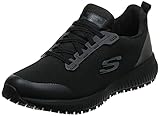
Healthcare workers — particularly early-career nurses and CNAs — often face a real financial constraint when buying footwear. The Skechers Work Sure Track is Dr. Biernacki’s recommendation for nurses who need a clinically appropriate shoe at an accessible price point. At under $80, it carries a genuine ASTM F2913 slip-resistant certification, provides adequate arch support through its memory foam insole, and holds up to standard hospital disinfection on its smooth-leather upper.
The memory foam insole is this shoe’s primary clinical limitation: it’s soft enough to provide immediate comfort but firm enough to compress noticeably over a 12-hour shift. Nurses who use the Sure Track often report it feeling significantly less supportive in hours 10–12 than in the first two hours of the shift. The practical solution is to replace the stock memory foam insole with an aftermarket orthotic — a quality over-the-counter insole with a firm arch lifts the performance of the Sure Track to near-premium levels for the additional $25–40 investment.
Best for: Early-career nurses and nursing students managing tight budgets, CNAs and LPNs who rotate between part-time roles and need a versatile work shoe, and healthcare workers in lower-acuity settings where infection control requirements for footwear are less strict. Pair with a quality aftermarket insole for best long-term outcomes.
4. Dansko XP 2.0 — Best Lightweight Modern Clog for Wide Feet
The Dansko XP 2.0 takes the clinical credibility of the Professional clog platform and rebuilds it in a lighter, more modern construction. The XP (Extra Professional) 2.0 sheds approximately 20% of the Professional’s weight through a redesigned polyurethane outsole and a flexible-yet-structured upper, while maintaining the rocker sole geometry and arch support that make the Dansko line the industry standard for nursing footwear. For nurses who find the classic Professional clog too rigid or heavy — particularly those doing high-mobility floor work with frequent direction changes — the XP 2.0 is the upgrade.
The XP 2.0 runs slightly wider than the Professional throughout the toe box, making it the better choice for nurses with bunions, wider forefoot anatomy, or any condition where toe box compression is a concern. The upper material in the standard XP 2.0 is a slip-resistant synthetic that wipes clean easily — a practical advantage over the Professional’s leather in higher-acuity settings where frequent cleaning is required. The built-in slip-resistant outsole meets ASTM and SRC standards, carrying the same safety certification as the Professional.
The arch support in the XP 2.0 is anatomically similar to the Professional but delivered through a slightly more flexible platform, which some nurses find more comfortable during high-step-count shifts. The trade-off is marginally less lateral stability for nurses with significant ankle instability or posterior tibial tendon issues — those patients are better served by the Professional’s stiffer construction. For the average nurse with normal to mild flat-foot anatomy and no significant ankle pathology, the XP 2.0’s combination of lighter weight, roomy toe box, and full Dansko arch support makes it arguably the best all-around choice in the 2026 lineup.
- ALL-DAY COMFORT: Our lighter weight XP 2.0 clogs are ergonomically designed with padded instep collar, roomy toe box, and TPU heel counter for women who are on their feet all-day.
- LONG-STANDING SUPPORT: An EVA midsole provides stability and shock absorption, while the dual-density PU footbed includes Dansko Natural Arch technology and memory foam for cushioning.
- QUALITY & STYLE: With a classic clog shape, this practical footwear features high quality leather uppers. The removable footbed accommodates standard and custom orthotics.
- SLIP-RESISTANT OUTSOLE: The lightweight clogs are finished with a 1.75" heel and a slip-resistant rubber outsole, which is suitable for dry, wet, and oily/wet surfaces.
- DANSKO HIGH PERFORMANCE CLOGS: Providing quality footwear with legendary comfort, Dansko shoes are chosen by nurses, veterinarians, surgeons, chefs, dentists, food servers and healthcare professionals.
5. Crocs Bistro Clog — Best Slip-Resistant Clog for Easy Cleaning
Crocs are polarizing in podiatric medicine. The standard Classic Clog — beloved as casual footwear — is a poor nursing shoe: insufficient arch support, excessive heel slip, and no meaningful slip resistance. But the Crocs Bistro, designed specifically for foodservice and healthcare workers, is a genuinely different product. The Bistro’s Crocs Lock slip-resistant tread is one of the highest-rated slip-resistant outsoles available at its price point, meeting ASTM F2913 standards on both dry and wet hospital-grade vinyl flooring.
The Bistro’s fully enclosed toe and reinforced structure address two major clinical concerns with the standard clog: the closed toe protects against dropped instruments and fluid exposure at the forefoot, and the tighter heel strap option (in the Work variant) reduces the rearfoot instability that makes open-back clogs biomechanically problematic for high-mobility nursing. The Croslite foam — Crocs’ proprietary closed-cell resin — is fully waterproof, wipeable with bleach and quaternary ammonium compounds, and can be autoclaved in some models. This makes the Bistro the best infection control choice among all the options in this guide.
The primary clinical limitation: the Bistro’s arch support is minimal compared to Dansko alternatives. For nurses without significant arch support needs — those with a neutral-to-high arch who experience little discomfort in unsupported footwear — the Bistro is an excellent choice. For nurses with flat feet, plantar fasciitis, or posterior tibial tendon dysfunction, a custom or high-quality OTC orthotic insert is strongly recommended inside the Bistro to compensate for the limited factory arch.
No products found.
6. Skechers Work Evaa SR — Best Versatile Work Clog for Long Shifts
The Skechers Work Evaa SR bridges the gap between a traditional clog and a modern athletic work shoe — a category that increasingly suits nurses who want the cleanability and quick-on/off of a clog with the cushioning profile of a contemporary sneaker. The Evaa SR uses Skechers’ Air-Cooled Memory Foam insole in a slip-resistant clog platform, delivering a step-in comfort that most hard-soled clogs simply cannot match, while maintaining the ASTM F2913 slip-resistant certification required for healthcare environments.
The synthetic leather upper on the Evaa SR is wipeable with standard hospital disinfectants and resists the kind of fluid penetration that makes fabric-upper shoes problematic in clinical settings. The midsole cushioning is intermediate between the firmer Dansko and the ultra-plush HOKA — appropriate for nurses with moderate comfort needs who don’t have active plantar fasciitis or other conditions requiring either extreme. The clog silhouette means no laces to re-tie, no tongue to manage, and fast donning and doffing between cases or room-to-room rounding.
Best for: Nurses who prefer a modern aesthetic over the classic Dansko clog look, floor staff doing high-step-count rounding who need clog convenience with better-than-average cushioning, and healthcare workers in outpatient or clinic settings where full clinical infection control footwear requirements are less stringent. Also an excellent backup shoe for nurses whose primary clinical shoes need cleaning or drying between shifts.
Nursing Shoes Comparison Table 2026
| Shoe | Style | Slip Rating | Best For | Dr. Rating |
|---|---|---|---|---|
| Dansko Professional | Classic clog | ASTM certified | Overall best, structural support, leather cleanability | ⭐⭐⭐⭐⭐ Best Overall |
| HOKA Bondi 8 | Athletic sneaker | Standard rubber | Plantar fasciitis, heel pain, maximum cushion | ⭐⭐⭐⭐⭐ Best Cushion |
| Skechers Work Sure Track | Work sneaker | ASTM certified | Budget-conscious, pair with aftermarket insole | ⭐⭐⭐⭐ Best Budget |
| Dansko XP 2.0 | Modern clog | ASTM/SRC certified | Wide feet, lighter weight, modern aesthetic | ⭐⭐⭐⭐⭐ Best for Wide Feet |
| Crocs Bistro | Work clog | ASTM certified | Infection control, easy disinfection, waterproof | ⭐⭐⭐⭐½ Best Cleanability |
| Skechers Evaa SR | Athletic clog | ASTM certified | Modern look, mid-range cushion, versatile | ⭐⭐⭐⭐ Best Versatile Clog |
More Podiatrist-Recommended Shoes Essentials
Podiatrist-Recommended Walking Shoe
- ENGINEERED MESH
- Lining Textile
Balance of cushioning, stability, and wide-toe-box — the best all-around choice.
Stability Running Shoe
- FuelCell foam delivers a propulsive feel to help drive you forward
- ENCAP midsole cushioning combines lightweight foam with a durable polyurethane rim to deliver all-day support
- Reflective accents designed to catch the light
- TPU back tab
- New Balance MADE contains a domestic value of 70% or more. MADE makes up a limited portion of New Balance’s US sales.
Medial post controls overpronation during running and fast walking.
Wide-Toe-Box Walking Shoe
No products found.
Roomy forefoot reduces bunion, neuroma, and hammertoe pressure.
As an Amazon Associate, Balance Foot & Ankle earns from qualifying purchases. Product recommendations are based on clinical experience; prices and availability shown above update live from Amazon.


When to See a Podiatrist
The right shoe shape, last, and stability category is more important than brand. Balance Foot & Ankle evaluates your foot type (neutral, pronator, supinator, high-arched) and recommends specific shoe models that match. Bringing in your current pair lets us spot wear patterns that reveal gait issues — a free 5-minute assessment that can prevent years of foot pain.
Call Balance Foot & Ankle: (810) 206-1402 · Book online · Offices in Howell & Bloomfield Hills
Frequently Asked Questions: Shoes for Nurses
How often should nurses replace their work shoes?
Dr. Biernacki’s clinical recommendation is every 6–8 months for nurses working three 12-hour shifts per week, or whenever the midsole shows visible compression, the outsole tread is worn smooth, or the upper has begun to deform. The standard consumer guidance of “replace every 500 miles” translates to approximately 6–7 months for a full-time nurse walking 4–5 miles per shift. Most nurses wear their shoes significantly longer than this — often 12–18 months — and the compressive failure of the midsole during that extended period is a direct contributor to the plantar fasciitis, metatarsalgia, and Achilles tendinopathy Dr. Biernacki treats. Consider purchasing two pairs on alternating use: rotating pairs extends the life of each pair by allowing the midsole foam to fully decompress overnight, and ensures you always have a dry, clean pair available for each shift.
Should nurses wear compression socks with their work shoes?
Yes — for most nurses, compression socks provide a meaningful clinical benefit and Dr. Biernacki routinely recommends them alongside appropriate footwear. Standing and walking for 12 hours drives venous pooling in the lower legs, contributing to edema, varicose vein development, and by end-of-shift fatigue. Graduated compression socks (20–30 mmHg) counteract venous pooling, reduce lower leg swelling, and decrease the achiness that most nurses attribute simply to “tired feet” but is partly venous in origin. The compression sock and the shoe function as a system: the shoe addresses loading mechanics, the compression sock addresses venous return. Both are needed for comprehensive foot and lower leg health over a nursing career.
Do nurses need custom orthotics or are OTC insoles enough?
It depends on the individual’s foot structure and history. Nurses with a neutral arch, no significant pathology, and a good shoe like the Dansko Professional often do well without additional orthotic intervention — the shoe’s factory arch support is sufficient. Nurses with flat feet (pes planus), high arches (pes cavus), a history of plantar fasciitis, significant overpronation, or any diagnosed foot pathology benefit from either a high-quality OTC orthotic (like PowerStep Pinnacle or Powerstep Pinnacle) or a custom orthotic from a podiatrist. The investment in custom orthotics — typically $300–600, often partially covered by insurance — is usually recovered in reduced foot care costs and missed shifts over a 5–10 year period. Dr. Biernacki performs foot scans and custom orthotic fabrication at both Balance Foot & Ankle locations in Howell and Brighton.
Are clogs or sneakers better for nurses?
Neither category is universally superior — the right choice depends on the nurse’s specific work environment, foot anatomy, and any existing pathology. Clogs (particularly Dansko) offer superior arch support, infection control compliance, and ease of donning/doffing. Athletic sneakers (particularly HOKA) offer superior cushioning, more natural gait mechanics, and better fit for nurses with bunions or wide forefoot anatomy. For nurses without specific pathology, Dr. Biernacki generally recommends starting with the Dansko Professional and evaluating at 3 months. For nurses with active plantar fasciitis or heel pain, starting with HOKA Bondi 8 and adding a quality insole produces faster symptom resolution before transitioning to a more structured shoe for long-term wear.
What shoe features most protect against bunion progression in nurses?
Bunion progression (hallux valgus advancement) is driven primarily by compressive forces on the first metatarsophalangeal joint during the push-off phase of gait, combined with a shoe upper that forces the great toe toward the second toe. The three shoe features that most effectively slow bunion progression are: (1) a wide, rounded toe box that does not contact the medial bunion prominence; (2) a rocker sole that reduces push-off force at the first MTP joint; and (3) a firm medial arch that prevents the foot from pronating excessively during midstance, which in turn reduces the valgus loading on the first MTP. The Dansko Professional hits all three criteria — which is why nurses who wear it from early in their career consistently present with less bunion progression than those who wore pointed or narrow-toe shoes. Once a bunion has advanced to a painful or functional stage, surgical consultation is warranted; shoe selection alone cannot reverse deformity.
⚠️ Signs You Need to See a Podiatrist, Not Just Get New Shoes
Better shoes help — but they’re not a substitute for professional evaluation when specific pathology is present. See a podiatrist if you experience any of the following:
- First-step morning heel pain that has persisted for more than 4 weeks — likely plantar fasciitis requiring treatment, not just shoe modification
- Numbness or tingling in the toes or forefoot — may indicate tarsal tunnel syndrome, Morton’s neuroma, or peripheral neuropathy
- Swelling in one foot only — asymmetric edema has a different cause than bilateral shift edema and warrants evaluation
- Arch or midfoot pain that worsens with walking — possible stress fracture, posterior tibial tendon dysfunction, or Lisfranc instability
- Visible deformity progression — bunion enlargement, hammer toe development, or arch collapse that appears to be changing month to month
- Heel or ankle pain in a diabetic nurse — any foot pain in a person with diabetes warrants professional evaluation, as healing capacity is reduced
Call Balance Foot & Ankle: (517) 315-6810
Related Podiatrist Guides
- Best Insoles for Work Boots & Standing All Day 2026
- Best Podiatrist-Recommended Orthotics 2026
- Best Walking Shoes for Heel Pain 2026
- Best Compression Socks for Plantar Fasciitis 2026
- Best Running Shoes for Plantar Fasciitis 2026
- Best Arch Support Sandals 2026
- Best Plantar Fasciitis Night Splints 2026
- Best Metatarsal Pads 2026
🏥 Michigan Nurses: Get a Podiatrist Foot Evaluation
If you’re a healthcare worker dealing with persistent foot pain, arch discomfort, or toe deformity, Balance Foot & Ankle offers dedicated same-week appointments at our Howell and Brighton clinics. Dr. Biernacki performs digital gait analysis, 3D foot scanning for custom orthotics, and comprehensive foot health evaluations tailored to the demands of clinical careers. Many insurance plans — including those offered by major hospital systems — cover these visits.
Book an Appointment → (517) 315-6810Watch: Dr. Tom explains
Podiatrist-recommended products
As an Amazon Associate, Dr. Tom earns from qualifying purchases.
12-hour shift recovery footwear.
View on Amazon →Arch support for long shifts.
View on Amazon →Nurse leg fatigue relief.
View on Amazon →Healthcare floor safety.
View on Amazon →Related resources
Ready to solve this? Book today.
Same-week appointments · Howell & Bloomfield Hills · 4.9★ (1,123+ reviews)
☎ (810) 206-1402Book Online →When Shoes Aren’t Enough — Dr. Tom’s Top 9 Orthotics
About 30% of patients I see for foot pain need MORE than a great shoe — they need a structured insole. Below: my complete 2026 orthotic ranking with pros, cons, and the specific patient I’d give each one to.
★ DR. TOM’S COMPLETE 2026 ORTHOTIC RANKING
9 Best Prefab Orthotics by Use Case
PowerStep, Currex, Spenco, Vionic, and PowerStep Pinnacle — every orthotic I’ve fitted to thousands of patients across both Michigan offices. Each card includes pros, cons, and the specific patient I’d give it to. Real Amazon ratings, review counts, and prices below.
Best All-Purpose Orthotic for Most Patients
Semi-rigid arch shell + dual-layer cushion + deep heel cup. The orthotic I’ve fitted to more patients than any other for 15 years. APMA-accepted. Trim-to-fit design works in athletic shoes, casual shoes, and most work boots.
- The Pinnacle Full length insoles for men & women provide maximum cushioning, from high activity to moderate support. The PowerStep arch support shape provides stability to the foot and ankle, helping to relieve foot pain.
- When you spend all day on your feet, every step counts. PowerStep insoles are a podiatrist-recommended orthotic to help relieve & prevent foot pain related to athletes, runners, Plantar Fasciitis, heel spurs & other common foot, ankle & knee injuries
- The Pinnacle plantar fasciitis insoles offer superior heel cushioning and arch support. The dual-layer cushioning is designed to reduce stress and fatigue, while PowerStep premium arch support is designed for plantar fasciitis relief.
- The PowerStep Pinnacle arch support inserts for men & women can be worn in a variety of shoe types such as; athletic, walking, running, work & some casual shoes. Orthotic Inserts are ordered by shoe size, no trimming required.
- Made in the USA & backed by a 30-day money-back guarantee. PowerStep orthotic inserts for men & women are designed for shoes where the factory insole can be removed. HSA & FSA Eligible
✓ Pros
- Semi-rigid arch shell provides true biomechanical correction
- Deep heel cup centers the heel and reduces lateral instability
- Dual-layer cushion (top + bottom) lasts 9-12 months daily wear
- Available in 8 sizes for precise fit
- APMA-accepted and clinically validated
- Lower price than PowerStep Pinnacle for equivalent function
✗ Cons
- Too thick for most dress shoes (use ProTech Slim instead)
- Some break-in period required (3-7 days for arch tolerance)
- Not enough correction for severe pes planus or rigid pes cavus
Dr. Tom’s Recommendation: If a patient has run-of-the-mill plantar fasciitis, mild flat feet, or arch fatigue, this is the first orthotic I try. Better value than PowerStep Pinnacle for 90% of patients, which is why I swapped it into our clinic kits three years ago. Sub-$50 typically.
Maximum Motion Control · Flat Feet & Severe Over-Pronation
PowerStep’s most aggressive stability orthotic. Adds a 2°-7° medial heel post on top of the standard PowerStep platform — designed specifically for flat-footed patients and severe pronators who need real corrective force.
- Full Length Support - Our ProTech orthotic insoles support pronation, arch pain, heel pain, plantar fasciitis, and heel spurs.
- Your Go To Inserts - These orthotics for plantar fasciitis provide full length, total contact support for a number of common foot issues
- Easily Fix Your Arches - Standard, semi-rigid arch support that fits most shoes including, work boots, dress shoes and sneakers.
- Enhanced Comfort - Our ProTech orthotic inserts have maximum cushioning featuring ShockAbsorb Premium Foam heel support cushion to increased protection.
- Support + Comfort - PowerStep ProTech orthotic insoles are designed with built-in arch support, heel cradle, and a perfect balance of support and comfort. Legitimate PowerStep product packaging is marked with a unique US quality control code. If you are concerned that a PowerStep item is not legitimate, please contact PowerStep customer service.
✓ Pros
- 2°-7° medial heel post adds aggressive pronation control
- Same trusted PowerStep arch shell, more correction
- Built specifically for flat-foot biomechanics
- Excellent for posterior tibial tendon dysfunction (PTTD)
- Removable top cover for cleaning
✗ Cons
- Too aggressive for neutral-arch patients
- Needs longer break-in (10-14 days) due to stronger correction
- Adds 2-3 mm of stack height — won’t fit slim dress shoes
Dr. Tom’s Recommendation: When a patient comes in with significant flat feet AND symptoms (heel pain, arch pain, knee pain), the Original PowerStep isn’t aggressive enough. The Maxx is what gets prescribed. About 25% of my flat-footed patients end up here.
Low-Profile · Fits Dress Shoes & Narrow Casuals
3 mm slim profile with podiatrist-designed tri-planar arch technology. Engineered specifically to fit inside dress shoes, oxfords, loafers, and women’s flats without crowding the toe box. Vionic was founded by an Australian podiatrist.
No products found.
✓ Pros
- 3 mm slim profile (vs 7-10 mm for standard orthotics)
- Tri-planar arch technology adds support without bulk
- Built-in deep heel cup despite slim design
- Fits dress shoes WITHOUT having to remove the factory insole
- Trim-to-fit · APMA-accepted
✗ Cons
- Less arch support than full-volume orthotics
- Top cover wears faster than thicker alternatives
- Not enough correction for severe foot deformities
Dr. Tom’s Recommendation: My default when a patient says ‘I need orthotics but I have to wear dress shoes for work.’ Slim enough to fit in oxfords and pumps without the heel sliding out. The single highest-impact change you can make for office workers with foot pain.
Built-In Metatarsal Pad · Morton’s Neuroma · Ball-of-Foot Pain
Standard Pinnacle orthotic with a built-in metatarsal pad positioned proximal to the metatarsal heads — the exact location that offloads neuromas and metatarsalgia. No need for separate met pads or pad placement guesswork.
- PODIATRIST DESIGNED! An effective alternative to expensive custom-made orthotics. Innovative biomechanical THREE-ZONE COMFORT technology delivers deep heel cup stability, forefoot cushioning, and ultimate arch support to prevent excessive pronation caused by flat feet. These essential contact points help to realign positioning of feet, aiding to re-establish your body's natural alignment, from the ground up.
- VIONIC ORTHOTIC INSOLES! These women's and men's shoe inserts offer a convenient, pain-free natural healing solution for many of the common aches and pains associated with poor lower-limb alignment, plantar fasciitis, and arch pain. EVA orthotic with re-enforced, hardened plastic (PE) shell for added motion control and stability. Cushioned shock dot in the heel for added shock absorption. Can be trimmed in forefoot if necessary.
- DESIGNED FOR EVERYDAY USE! Designed to provide greater control in faster paced activities such as running and fast walking. 4 degree rear foot wedge to provide support and control which helps prevent excess pronation. Odor absorbing cover. Contoured around the heel and arch areas to achieve 100% foot contact. Podiatrist Designed, APMA Seal of Acceptance.
- COMFORTABLE TO WEAR! Shoe inserts for women and men contoured around the heel and arch areas to achieve perfect foot contact.
- SIZES AVAILABLE: XS: Women's 4.5 – 6 / Men's 3.5 – 5 S: Women's 6.5 – 8 / Men's 5.5 – 7 M: Women's 8.5 – 10 / Men's 7.5 – 9 L: Women's 10.5 – 12 / Men's 9.5 – 11 XL: Men's 11.5 – 13
✓ Pros
- Built-in met pad eliminates DIY pad placement errors
- Specifically designed for Morton’s neuroma + metatarsalgia
- Same trusted PowerStep arch + heel cup platform
- Top cover protects sensitive forefoot skin
- Faster relief than orthotics + add-on met pads
✗ Cons
- Met pad position is fixed (can’t fine-tune individual placement)
- Some patients with very small or very large feet need custom
- Slightly thicker than the standard Pinnacle
Dr. Tom’s Recommendation: If a patient has Morton’s neuroma, sesamoiditis, or generalized ball-of-foot pain (metatarsalgia), this saves a clinic visit and a prescription. The built-in pad placement is anatomically correct for 80% of feet. Way better than DIY met pads.
Adaptive Dynamic Arch · Athletic & Daily Wear
Currex’s flagship adaptive arch technology — the orthotic flexes with your gait instead of fighting it. Different stiffness zones along the length give you targeted support at the heel, midfoot, and forefoot. Available in three arch heights (low/medium/high).
- Signature waffle-inspired rubber outsole for traction and flexibility
✓ Pros
- Dynamic flex zones adapt to natural gait cycle
- Three arch heights ensure precise fit
- Lighter than rigid orthotics (no ‘heavy foot’ feel)
- Excellent for runners and athletic walkers
- European podiatric design (German engineering)
✗ Cons
- More expensive than PowerStep Original ($55-65 typically)
- Less aggressive correction than Pinnacle Maxx for severe cases
- Three arch heights means you must self-select correctly
Dr. Tom’s Recommendation: I started recommending Currex three years ago for runners who said PowerStep felt ‘too rigid.’ The dynamic flex zones respect natural gait. Best for active patients who walk 8K+ steps daily and don’t need maximum motion control.
Running-Specific · Heel Strike + Forefoot Strike Compatible
Currex’s purpose-built running orthotic. The midfoot flex zone is positioned for runner’s gait mechanics, with a flared heel cushion for heel strikers and a forefoot rocker for midfoot/forefoot strikers. Tested on 1000+ runners during product development.
- Provides continuous support of the Plantar Fascia by gently stretching the fascia tissue.
- Compression zones promote circulation, reduce impact vibration, boost recovery and strengthen feet.
- Lightweight, seamless design with extra cushioning provides support while still being comfortable.
- Supports the heel/arch and overall foot structure while stabilizing the tendon for better performance
- Made from high quality materials, the socks are moisture wicking and breathable.
✓ Pros
- Designed by German biomechanics lab specifically for runners
- Dynamic arch flexes with running gait (not static like PowerStep)
- Three arch heights (low/medium/high)
- Reduces overuse injury risk in mid-distance runners
- Lightweight (no impact on cadence)
✗ Cons
- Premium price ($60-75)
- Not aggressive enough for severe over-pronators (use Pinnacle Maxx)
- Runner-specific design = less ideal for daily walking shoes
Dr. Tom’s Recommendation: If a patient runs 20+ miles per week and has plantar fasciitis or shin splints, this is the orthotic I prescribe. The dynamic flex zones respect running biomechanics in a way that no rigid PowerStep can match. Pricier but worth it for serious runners.
Cavus Foot & High-Arch Patients
Polyurethane base with a deeper heel cup and higher arch profile than PowerStep — built for cavus (high-arched) feet that need maximum cushion and support. The 5-zone cushioning system addresses the unique pressure points of high-arch feet.
- The first generation of Protalus's M-100 Insole
- Patented Alignment Technology: The M-100 features a deep heel cup and contoured arch to correct overpronation and promote better posture, stability, and joint health throughout your body.
- Comfortable Insoles: The patented stress relief replacement shoe insoles increase comfort and relieve plantar fasciitis and anti-fatigue.
- Improves Alignment: The shoe insoles help improve alignment and reduce pain in the feet, ideal for low and high arches.
✓ Pros
- Deeper heel cup centers the heel for cavus foot stability
- Higher arch profile fills the void under high arches
- 5-zone cushioning addresses cavus foot pressure points
- Polyurethane base lasts 12+ months
- Available in Wide width
✗ Cons
- Too tall/aggressive for normal or low arches
- Won’t fit slim dress shoes
- Pricier than PowerStep Original
- Some patients find the arch height uncomfortable initially
Dr. Tom’s Recommendation: Cavus foot patients are often misdiagnosed and given low-arch orthotics — that makes everything worse. Spenco’s Total Support has the arch profile that high-arch feet actually need. About 15% of my patients have cavus feet; this is what they wear.
Cushion Layer · Standing All Day · Gel Pressure Relief
NOT a true biomechanical orthotic — this is a cushion insole. But for patients who want gel pressure relief instead of arch correction (or to add ON TOP of factory insoles in work boots), this is the best gel option on Amazon.
- ✶ALLEVIATES HEEL PAIN – Tuli’s Heavy Duty Heel Cups provide heel pain relief caused by plantar fasciitis, Sever’s disease, excessive pronation, Achilles tendonitis, etc. Ideal for those on their feet for most of the day or those looking for added comfort.
- ✶PODIATRIST PREFERRED – In an independent study conducted by M3 Global Research, podiatrists chose Tuli’s as the clear winner of recommended heel cup brands.
- ✶SHOCK-ABSORBING DESIGN – The multi-cell, multi-layer design absorbs shock and impact energy, mimicking the natural shock-absorbing system of your feet. As you walk or run, the design reduces the stress on your feet.
- ✶DOCTOR RECOMMENDED & APMA ACCEPTED – Tuli’s Heel Cups were designed by a leading podiatrist and have the honor of being accepted by the American Podiatric Medical Association.
- ✶FITS MOST LACE-UP SHOES – Best used in spacious lace-up shoes like athletic shoes / sneakers.
✓ Pros
- Genuine gel cushioning (not foam pretending to be gel)
- Targeted gel waves under heel and ball of foot
- Trim-to-fit · works in most shoe types
- Sub-$15 price (most affordable option in this list)
- Massaging texture is genuinely soothing
✗ Cons
- ZERO arch support — this is cushion only
- Won’t fix plantar fasciitis or flat-foot issues
- Compresses faster than PowerStep (4-6 months)
- Top cover wears through in high-mileage applications
Dr. Tom’s Recommendation: I recommend these to patients who tell me ‘I just want my feet to stop hurting at the end of my shift’ and who don’t have a biomechanical issue. Construction workers, factory workers, retail. Pure cushion does the job for them.
Tight-Fitting Shoes · Cycling Shoes · Hockey Skates
PowerStep Pinnacle’s slim version of their famous Green insole. The trademark stabilizer cap is preserved but the overall thickness is reduced — works in cycling shoes, hockey skates, ski boots, and other tight-fitting footwear that the standard PowerStep Pinnacle can’t fit into.
- Plantar Fasciitis Relief, Every Step – Firm arch support helps relieve heel and arch pain from plantar fasciitis and supports flat feet and overpronation for better alignment and all-day comfort.
- Clinical-Grade Biomechanics – Tread Labs 26-33 ARCHitecture delivers orthotic-level stability—custom-orthotic feel without the prescription.
- Dialed Fit for Any Shoe – Four arch heights (low, medium, high, extra-high) and an easy 3-step sizing guide make selection simple for work boots, sneakers, and everyday shoes—great for standing all day.
- Built to Last a Million Miles – Durable, recyclable arch supports with our Million-Mile Guarantee; replaceable top covers keep insoles fresh and cost-effective. Unlike foam that flattens, Pace is engineered to last.
- Trusted Expertise – Designed by Mark Paigen (founder of Chaco). Premium arch support inserts for men and women backed by decades of footwear innovation.
✓ Pros
- Stabilizer cap centers the heel (PowerStep Pinnacle’s signature feature)
- Slim profile fits tight athletic footwear
- Lasts 12+ months daily wear
- Excellent for cycling shoes specifically
- Built-in odor-control treatment
✗ Cons
- Premium price ($45-55)
- Less cushion than PowerStep equivalents
- Not as aggressive correction as Pinnacle Maxx for flat feet
- The signature ‘heel cup feel’ takes 1-2 weeks to adapt to
Dr. Tom’s Recommendation: If you’re a cyclist with foot numbness, hot spots, or knee pain — this is the orthotic. The stabilizer cap solves cycling-specific biomechanical issues that no other orthotic addresses. Worth the premium for athletes.
None of these solving your foot pain?
Some patients (about 30%) need custom-molded prescription orthotics. We make 3D-scanned custom orthotics in our Howell and Bloomfield Hills offices — specifically built for your foot mechanics.
Schedule a Custom Orthotic Fitting →FSA/HSA eligible · Most insurance accepted · (810) 206-1402
Dr. Tom Biernacki, DPM is a double board-certified podiatrist and foot & ankle surgeon at Balance Foot & Ankle Specialists in Southeast Michigan. With over a decade of clinical experience, he specializes in heel pain, bunions, diabetic foot care, sports injuries, and minimally invasive surgery. Dr. Biernacki is a member of the APMA and ACFAS, and his patient education content on MichiganFootDoctors.com and YouTube has reached over one million views.
- Plantar Fasciitis: Diagnosis and Conservative Management (PubMed)
- Plantar Fasciitis (APMA)
- Diagnosis and Treatment of Plantar Fasciitis (PubMed / AAFP)
- Heel Pain (APMA)