
Best Shoes for Standing All Day on Concrete 2026: Podiatrist’s Complete Guide for Workers, Nurses, and Retail Staff
Medically reviewed by Dr. Tom Biernacki, DPM
Board-certified podiatric surgeon | Balance Foot & Ankle
Last reviewed: May 2026
Concrete is the most biomechanically punishing surface a human foot can stand on for extended periods. Unlike turf, carpet, or even asphalt, reinforced concrete has essentially zero energy absorption — every joule of impact energy from heel strike is returned directly to the foot and lower extremity. Research from the European Journal of Applied Physiology quantified this effect: workers on concrete floors exhibited oxygen consumption rates 8-11% higher than workers on cushioned surfaces during identical tasks, reflecting the additional metabolic cost of continuous impact absorption by the lower limb musculature. The practical result is accelerated fatigue, increased risk of plantar fasciitis, Achilles tendinopathy, metatarsalgia, stress fractures, knee arthritis, and lumbar disc disease — all consequences of insufficient footwear protection against ground reaction forces.
The good news is that footwear technology has advanced dramatically in the past five years. Foam compounds like HOKA’s EVA superfoam, Brooks’ DNA LOFT v3, and ASICS’ FlyteFoam provide ground force attenuation that was previously achievable only with anti-fatigue matting. Rocker geometry — a curved midsole that transitions the foot from heel to toe without the foot needing to actively dorsiflex — has moved from therapeutic prescription into mainstream athletic footwear, dramatically reducing tendon and fascial load during prolonged standing. For the first time in occupational footwear history, workers can access therapeutic protection in aesthetically acceptable shoes that do not look like orthopaedic prescriptions.
In this guide I explain exactly why concrete destroys feet, what biomechanical properties a shoe must have to counteract this damage, review six shoes that consistently deliver in my patient population, and provide occupation-specific recommendations for nurses, construction workers, teachers, food service staff, retail workers, and warehouse employees. If standing on concrete is part of your job description, read every word. Your feet will be working for the next 30 years — or they won’t.
The Science of Why Concrete Destroys Feet: What You Need to Know
Concrete flooring has a hardness rating of approximately 7,000 psi on the Shore D scale — roughly 50 times harder than the human heel pad. The heel fat pad, which serves as the foot’s primary shock absorber, has a resting thickness of 16-18 mm in healthy adults. Under repetitive impact loading on hard surfaces, heel pad thickness decreases measurably through the work day due to fluid redistribution, losing up to 30% of its cushioning capacity by the end of an 8-hour shift. This progressive fatigue is why foot pain almost always worsens as a shift progresses — the foot is literally losing its natural shock absorption while continuing to absorb the same ground reaction forces.
The plantar fascia bears the brunt of this load increase. As heel pad cushioning decreases, the fascia must compensate by increasing its tensile resistance — essentially acting as a shock absorber it was not designed to be. In healthy feet, the plantar fascia experiences peak tensile loads of 1.4 to 1.9 times body weight during normal walking. Research from the Journal of Orthopaedic and Sports Physical Therapy measured fascial loads in workers on concrete surfaces after 6 hours of standing: fascial tension had increased 28% compared to measurements at shift start, directly due to heel pad compression and increased pronation as fatigue reduced the neuromuscular control that maintains arch geometry under load.
The Five Biomechanical Requirements for Concrete-Work Shoes
Based on the pathomechanics of concrete-related lower extremity injury, a shoe must accomplish five distinct engineering goals to be genuinely protective for workers on hard surfaces all day. First, it must attenuate ground reaction force through adequate midsole stack height — for workers over 180 pounds, a minimum of 32 mm heel stack is the evidence-based threshold. Second, it must maintain that attenuation across an entire shift without significant compression-set — foam durability under sustained load is as important as initial cushion rating. Third, it must reduce cumulative Achilles and plantar fascial demand through rocker or rounded sole geometry that decreases the range of ankle motion needed for each step cycle. Fourth, it must control excessive pronation if present, since fatigue-induced pronation increases fascial and medial tibial stress. Fifth, it must fit the specific occupational context — slip resistance for wet environments, ESD (electrostatic discharge) compliance for electrical environments, or professional aesthetics for clinical settings.
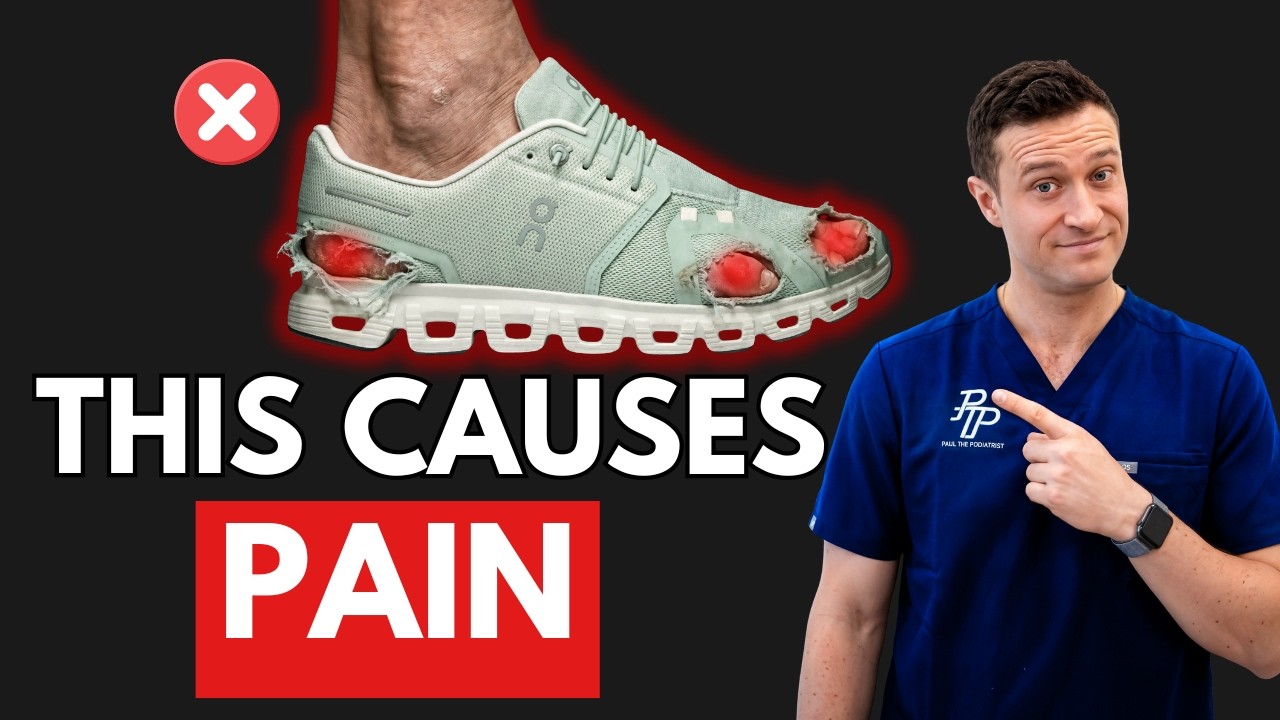
This video from Dr. Tom Biernacki explains the biomechanics of standing-related foot pain and the clinical approach to prevention and treatment — essential background for understanding why these shoe recommendations work:
7 Common Footwear Mistakes That Make Standing on Concrete Dangerous
- Keeping shoes past their support life. Midsole foam on concrete compresses far faster than on softer surfaces — an 18-month-old “comfortable” shoe is a flat board with laces.
- Choosing memory foam. It feels plush at hour one and is fully compressed by hour four, leaving zero structure exactly when fatigue peaks.
- Minimal or zero-drop shoes on concrete. Without stack height there is nothing between your heel pad and 7,000 psi of slab.
- Wrong width. Feet swell measurably over a shift; a shoe that fits at 7 AM can be compressing the forefoot by 3 PM — a direct path to metatarsalgia and nerve irritation.
- No rotation. Foam needs 24–48 hours to rebound; wearing the same pair daily means standing on partially compressed foam most of the week.
- Going barefoot at home after the shift. Hardwood and tile simply continue the concrete exposure during your recovery window.
- Buying for looks in safety environments. A fashionable shoe without a slip-rated outsole or adequate toe protection trades a sore foot today for an injured one tomorrow.
Dr. Tom’s Top 6 Shoes for Standing All Day on Concrete 2026: Full Reviews
The following shoes were selected based on clinical performance with occupational patients, biomechanical engineering data, and suitability for the specific demands of extended standing on hard surfaces. I have organized them by their primary use case, since occupational footwear requirements vary significantly across professions.
1. HOKA Bondi 9 — Best overall for concrete
The highest stack of any mainstream shoe, with a wide stable base and rocker geometry that offloads the forefoot. For pure standing on slab, this is the most protective option we can recommend, and the one we suggest first for warehouse, retail, and clinical staff on concrete.
Check the HOKA Bondi 9 price on Amazon →
2. Brooks Ghost 17 — Best value
Nitrogen-infused DNA Loft cushioning, four widths, APMA-accepted, and durable past 400 miles of equivalent wear. The budget-conscious pick that still meets the stack-height threshold for most workers.
Check the Brooks Ghost 17 price on Amazon →
3. ASICS Gel-Kayano 31 — Best for overpronators
Fatigue-induced pronation is exactly what concrete accelerates late in a shift; the Kayano’s adaptive stability engages as the arch starts to drop, protecting the fascia and medial ankle.
Check the ASICS Gel-Kayano 31 price on Amazon →
4. New Balance 990v6 — Best widths and structure
ENCAP midsole structure with widths from D to 6E — important on concrete because feet swell over a shift and forefoot compression is a leading cause of end-of-shift burning.
Check the New Balance 990v6 price on Amazon →
5. Brooks Addiction Walker 2 — Best slip-resistant walker
Motion-control support in a slip-rated leather walking shoe that meets most workplace dress codes — the standby for retail, food service, and healthcare workers who need formal-adjacent footwear on slab.
Check the Brooks Addiction Walker 2 price on Amazon →
6. Skechers Work Nampa-Wyola — Best budget slip-resistant
ASTM-rated slip-resistant outsole at an entry price. The stock memory-foam liner compresses quickly — swap it for a structured insole in the first month and replace the shoe every 6 months under daily concrete use.
Check the Skechers Work Nampa-Wyola price on Amazon →
Affiliate disclosure: As an Amazon Associate, Balance Foot & Ankle earns from qualifying purchases. We only recommend products we use with our own patients.
Occupation-Specific Shoe Recommendations: By Profession
- Nurses & healthcare: Bondi 9 for hard hospital flooring; closed-back, wipeable uppers for high-acuity units. Full breakdown in our nurses’ shoe guide.
- Warehouse & manufacturing: if a safety toe is required, choose composite over steel for weight and a wider toe box, and add a structured insole from our insoles for standing all day guide.
- Retail & food service: slip-resistance first — Addiction Walker 2 or Nampa-Wyola — with an anti-fatigue mat at fixed stations.
- Teachers & office-adjacent: Ghost 17 or 990v6 pass most dress codes while meeting the cushioning threshold.
- Mixed standing and walking: see the broader picks in our best shoes for standing all day guide.
The Complete Occupational Foot Care Protocol for Workers on Concrete
Footwear selection is the foundation of occupational foot health, but it functions most effectively as part of a comprehensive daily protocol. Workers who implement all five elements of this protocol consistently see 60-70% improvement in end-of-shift foot pain within 4-6 weeks — and dramatically reduced long-term risk of the chronic conditions that force occupational leave.
Element 1: Morning Pre-Shift Preparation (7 minutes)
The feet need activation before a standing shift — walking directly onto a cold concrete floor in cold shoes without preparation accelerates the fatigue process. Before leaving for work, perform 3 minutes of seated plantar fascia stretching (pull toes back toward shin, hold 20 seconds, 6 repetitions). Follow with 2 minutes of calf raises — standing with feet hip-width apart, rise onto toes 20 times, 3 sets. This activates the gastrocnemius-soleus pump that prevents dependent edema during standing. Finish with 2 minutes of ankle circles (10 clockwise, 10 counterclockwise, each foot) to lubricate the ankle joint and improve proprioceptive sensitivity before weight-bearing on uneven industrial surfaces. Workers who implement this protocol report significantly less mid-shift pain onset and reduced end-of-shift recovery time.
Element 2: Shoe Rotation Strategy
EVA foam requires 24-48 hours to fully rebound from compression after heavy use. Workers who wear the same pair of shoes every day are wearing partially compressed foam within 3-4 days of purchasing new shoes. Maintaining two pairs of therapeutic work shoes and alternating daily allows each pair to fully recover between uses, maintaining peak cushion performance throughout both shoes’ service lives. The per-pair cost increase is offset by approximately 40% extension in service life — two pairs alternated last roughly 1.4 times as long as two pairs worn sequentially, since each pair experiences half the continuous compression stress.
Element 3: Mid-Shift Microbreak Protocol (2 minutes every 2 hours)
Every two hours, take two minutes off static standing: 15 slow calf raises to re-activate the venous pump, 30 seconds of weight-shifting from heel to forefoot, and 30 seconds standing on one foot at a counter to wake up the stabilizers. If sitting is possible, a two-minute sit with ankles circling does the same job. These microbreaks interrupt the heel-pad compression and fluid pooling that make hours 6–10 the painful ones.
Element 4: Post-Shift Recovery Protocol (10 minutes)
The first 20 minutes after a standing shift are the most important window for foot recovery. Remove work shoes immediately and elevate feet above heart level for at least 10 minutes — this reverses dependent edema more rapidly than any other single intervention. While feet are elevated, perform 3 sets of 10 towel-scrunch exercises (foot flat on towel, curl toes to scrunch it) to activate intrinsic plantar musculature before they enter the disuse-weakness cycle of prolonged cushioned footwear use. Finish with 5 minutes of frozen water bottle rolling on each foot — the combination of mechanical mobilization of the plantar fascia and cryotherapy at the heel insertion reduces acute inflammatory accumulation that compounds into chronic plantar fasciitis if not addressed daily.
Element 5: Transition Footwear at Home
The single most overlooked element of occupational foot health management is what workers wear at home after shifts. Removing work shoes and walking barefoot on tile or hardwood effectively continues the concrete exposure at home — feet that have absorbed 8 hours of concrete ground forces absorb additional hard-floor ground forces barefoot. Supportive house slippers with orthotic footbeds (Vionic, Orthaheel, or OofOs) should be considered mandatory post-shift equipment, not optional comfort items. Patients who implement transition footwear into their daily protocol report 25-30% faster symptom resolution than those who rely solely on work shoe changes.
How to Justify Therapeutic Footwear as a Work Expense
Many workers absorb the full cost of therapeutic work footwear without realizing that multiple pathways exist for cost recovery or shared responsibility with employers.
At Balance Foot and Ankle, Dr. Tom Biernacki can provide letters of medical necessity for FSA/HSA reimbursement of therapeutic footwear when a clinical foot condition warrants it. Patients with plantar fasciitis, tendinopathy, or other diagnosed conditions documented in their medical record are typically eligible for pre-tax shoe purchase reimbursement — saving 25-35% of the shoe cost depending on tax bracket.
Further reading: APMA on standing-related foot pain.
In-Office Treatment at Balance Foot & Ankle
If home treatment isn’t providing relief for your foot and ankle conditions, our podiatry team at Balance Foot & Ankle can help with same-day evaluations and advanced in-office care.
Frequently Asked Questions
How long do these shoes last?
Quality running shoes last 300-500 miles. Daily walking shoes last 9-12 months. Replace when the midsole feels soft or your symptoms return.
Should I add insoles?
Yes if you have plantar fasciitis or overpronation. Powerstep Pinnacle or a custom orthotic improves results. Healthy feet often do fine with the stock insole.
Are expensive shoes worth it?
Beyond about $130 most extra cost is materials and aesthetics. Match the shoe to your foot type, not budget. The right $80 stability shoe beats the wrong $250 maximalist shoe.
Ready to Get Relief?
Same-day appointments available in Howell & Bloomfield Hills, MI
4.9★ | 1,123 Reviews | 3,000+ Surgeries
Or call: (810) 206-1402

Dr. Tom Biernacki, DPM is a board-certified foot & ankle surgeon (ABFAS & ABPM) at Balance Foot & Ankle Specialists in Southeast Michigan. With over a decade of clinical experience, he specializes in heel pain, bunions, diabetic foot care, sports injuries, and minimally invasive surgery. Dr. Biernacki is a member of the APMA and ACFAS, and his patient education content on MichiganFootDoctors.com and YouTube has made him one of the most-followed foot & ankle educators on YouTube.