Quick answer: For nurses, podiatrists recommend shoes with structured arch support, deep heel cup, and forefoot rocker. Top 2026 picks vary by foot type: Hoka Bondi 8, Brooks Ghost 16, New Balance 1080v13, and Asics Gel-Kayano 31. Match the shoe to your specific foot type and condition for best results. Call (810) 206-1402 or book a foot pain evaluation online.
Medically reviewed by Dr. Tom Biernacki, DPM · Board-Certified Podiatric Surgeon · Last reviewed: April 2026 · Editorial Policy
✅ Medically reviewed by Dr. Tom Biernacki, DPM — Board-Certified Podiatrist · Last updated April 6, 2026
Best Shoes for Nurses 2026: Podiatrist-Recommended & 12-Hour Shift Tested
By Dr. Tom Biernacki, DPM | Double Board-Certified Podiatrist | Updated March 2026


Nurses are the ultimate test of a shoe. Twelve-hour shifts, hard hospital floors, unpredictable spills, and miles of walking between patient rooms — if a shoe can survive nursing, it can survive anything. At Balance Foot & Ankle, we regularly treat nurses dealing with plantar fasciitis, metatarsalgia, and chronic fatigue from inadequate footwear.
This guide combines our podiatric expertise with real-world feedback from nursing professionals. Every shoe below has been evaluated for cushioning, slip resistance, support, durability, and cleanability — because nurses need all five.
🔬 Our 4 Non-Negotiables: What We Look For in Every Shoe
Every shoe recommended on this page meets ALL FOUR of these clinical criteria that Dr. Biernacki uses when evaluating footwear for patients:
Keeps the rearfoot stable and prevents wobbling that strains tendons and ligaments.
The midfoot shouldn’t twist easily. Rigidity prevents arch collapse during gait.
The shoe should flex at the metatarsal heads — not the midfoot — for natural toe-off.
Deep insole cavity accommodates custom orthotics or allows room for swelling.
Understanding Why Nurses Need Specialized Footwear
📧 Get Dr. Tom’s Free Lab Test Guide
Discover the 5 lab tests every person over 35 should ask their doctor about — explained in plain English by a board-certified physician.
🎬 Video coming soon! Subscribe to Balance Foot & Ankle on YouTube for the latest shoe guides.
Our Top Recommended Shoes
Brooks Ghost Max 2

- THIS WOMEN’S SHOE IS FOR: Runners and walkers who want maximized cushion, and a maximized protective ride with effortless, smooth heel-toe transitions and secure, stable landings. The Ghost Max 2 is a certified PDAC A5500 Diabetic shoe and has been granted the APMA Seal of Acceptance. The Ghost Max 2 is a certified carbon neutral product. Predecessor: Ghost Max.
- PROTECTIVE CUSHIONING: A high stack of nitrogen-infused DNA Loft v3 midsole foam cushioning delivers soft, smooth comfort for a protective feel with easy landings.
- STABLE RIDE: A broad base offers inherent stability for a secure feel that doesn’t interfere with your stride. Raised sidewalls offer optimal bending stiffness for a comfortably secure fit. Unique linear last construction adds more volume to the shoe for a comfortable fit inclusive of foot shapes and orthotics.
- ASSISTED TRANSITIONS: GlideRoll Rocker transition technology actively promotes smooth heel-toe transitions for an effortless feeling as you move that won’t interfere with a neutral stride.
- VERSATILITY: An ideal choice for runners which aids by keeping people moving in their habitual motion path thereby reducing the odds for running related injuries. Additionally, the Ghost Max 2 is also an ideal choice for walking as it actively reduces energy absorption in foot soft tissues.
As an Amazon Associate, Balance Foot and Ankle earns from qualifying purchases. Product links are affiliate links and we may earn a commission at no extra cost to you. This does not influence our clinical recommendations. Last update on 2026-09-07 / Images from Amazon Product Advertising API
Why We Recommend It: The Ghost Max 2 takes the beloved Ghost platform and supercharges the cushioning. DNA LOFT v2 midsole with nitrogen infusion provides all-shift shock absorption that doesn’t compress flat after 6 hours. The rocker geometry reduces fatigue by promoting efficient gait. APMA Seal of Acceptance.
12-hour shifts, nurses on hard floors, general medical/surgical units, all-day standing and walking
Nurses who need slip-on convenience (it’s lace-up), operating room use (choose clogs)
👟 Sizing Note: True to size. The mesh upper is breathable but NOT fluid-resistant — pair with waterproof socks if needed.
HOKA Bondi SR
No products found.
Why We Recommend It: The SR (Slip Resistant) version of HOKA’s flagship takes the Bondi’s legendary cushioning and adds a rubber outsole specifically designed for wet, polished hospital floors. RunRepeat measured it at 73.1 HC outsole hardness — 3.7% softer than average, meaning it grips smooth surfaces like few other shoes. The closed upper is easier to clean than mesh alternatives.
Hospital environments with wet floors, ER/trauma nurses, any nurse who prioritizes slip safety
Hot/sweaty feet (less breathable than mesh), nurses who prefer lightweight shoes
👟 Sizing Note: True to size. The leather upper is less forgiving than mesh — break in before a full shift.
Dansko Professional Clog
- Protective heel counter allows the heel to move up and down freely while providing lateral stability.
- Padded instep collar for extra comfort.
- Roomy reinforced toe box allows toes to move comfortably with plenty of "wiggle room."
- The leather-lined, single-density open-cell PU foam sockliner provides breathability and contoured PU midsole provides arch support.
- Anti-fatigue rocker bottom sets feet in a forward motion for shock absorption and energy return.
As an Amazon Associate, Balance Foot and Ankle earns from qualifying purchases. Product links are affiliate links and we may earn a commission at no extra cost to you. This does not influence our clinical recommendations. Last update on 2026-09-07 / Images from Amazon Product Advertising API
Why We Recommend It: The iconic nursing clog for a reason. APMA Seal of Acceptance. The rocker bottom promotes natural gait, the wide toe box accommodates expanding feet during long shifts, and the hard shell is impervious to bodily fluids. Surgeons love these because they slip on/off easily between cases.
Surgeons, OR nurses, any nurse who needs slip-on/off convenience, those who prefer clogs
Nurses who run frequently (open back), nurses who need ankle support, those with balance concerns
👟 Sizing Note: European sizing. Refer to Dansko’s size chart carefully. Most nurses find going one EU size up is ideal.
Brooks Ghost 17
No products found.
Why We Recommend It: If the Ghost Max 2 is above your budget, the standard Ghost 17 is still an outstanding nursing shoe. APMA Accepted, excellent cushioning, available in 4E wide, and significantly less expensive. Multiple nurse surveys rate the Ghost line as the most popular nursing shoe brand.
Budget-conscious nurses, nurses who also run/exercise in their work shoes, wide feet
Nurses needing max cushion for 12+ hour shifts (upgrade to Ghost Max), slip-resistant requirements
👟 Sizing Note: True to size. Extensive width options. The mesh upper is breathable but stains easily — choose dark colors.
Skechers Work Squad SR
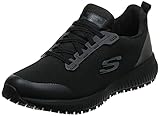
- Light Weight
- Flexible sole
- Electrics Hazard
- Memory Foam foot bed
- Slip Resistant
As an Amazon Associate, Balance Foot and Ankle earns from qualifying purchases. Product links are affiliate links and we may earn a commission at no extra cost to you. This does not influence our clinical recommendations. Last update on 2026-09-07 / Images from Amazon Product Advertising API
Why We Recommend It: For nurses on a tight budget, the Squad SR delivers surprising value. Slip-resistant outsole, memory foam insole, and slip-on convenience at under $75. The memory foam compresses faster than premium foams, so consider swapping the insole for an aftermarket orthotic for longer-lasting support.
Budget nurses, CNA/PCT staff, short shifts under 8 hours, those who want slip-on convenience
12-hour shifts (cushion compresses too quickly), nurses with significant foot conditions
👟 Sizing Note: Runs slightly wide. Those with narrow feet may need to size down. Memory foam insole is removable.
🦶 The Best Shoe Is Only Half the Equation
Even the best shoe can be dramatically improved with the right orthotic inside it. At Balance Foot & Ankle, we help patients match shoes with the perfect orthotic — from over-the-counter picks to precision custom-molded devices.
Related Treatment Guides
📚 Complete Podiatrist Shoe Guide Library
Every guide is written by Dr. Tom Biernacki, DPM — Double Board-Certified Podiatrist with 950,000+ YouTube subscribers and 5,000+ patients treated annually.
The master guide to all podiatrist-recommended shoes 🦶 Best Shoes for Plantar Fasciitis
Top picks for heel pain and plantar fascia relief ⚡ Best Shoes for Neuropathy & Diabetes
Protective footwear for diabetic and neuropathic feet
You are here
Clinical running shoe recommendations for all foot types 👟 Women’s Running Shoes
Women-specific running shoe recommendations 👠 Women’s Shoes for Plantar Fasciitis
Women’s shoes for heel pain relief 🦶 Best Shoes for Bunions
Wide toe box shoes that accommodate bunions 📐 Best Shoes for Flat Feet
Stability and motion control for overpronation 🚶 Best Walking Shoes
Daily walking shoes for comfort and support 🧍 Best Shoes for Standing All Day
Fatigue-fighting shoes for long days on your feet 💥 Best Shoes for Heel Pain
Comprehensive heel pain footwear solutions 🩴 Best Sandals with Arch Support
Supportive sandals for summer foot health ⬆️ Best Shoes for High Arches
Cushioned neutral shoes for supinators 👞 Best Dress Shoes for Foot Pain
Professional footwear that doesn’t sacrifice support 🏛️ Diabetic Shoes & Medicare Coverage
A5500 shoes and insurance information 🔧 Best Shoes for Achilles Tendonitis
Heel drop and cushion for Achilles recovery 🧩 Best Orthotic-Friendly Shoes
Shoes with removable insoles for custom orthotics 🏠 Best Slippers with Arch Support
Indoor footwear for plantar fasciitis and foot pain 🔴 Best Shoes for Morton’s Neuroma
Wide toe box shoes for nerve pain relief 🥾 Best Work Boots for Foot Support
Safety boots with podiatrist-approved support 🧩 Podiatrist Recommended Orthotics
OTC and custom orthotics to supercharge any shoe
Still Unsure Which Shoe Is Right for You?
Our podiatrists can evaluate your foot type, gait, and specific condition to recommend the perfect shoe — plus custom orthotics if needed.
Book Your Appointment →(810) 206-1402 | Howell & Bloomfield Township, MI

Dr. Tom Biernacki, DPM
Double Board-Certified Podiatrist | Balance Foot & Ankle
950,000+ YouTube Subscribers | 5,000+ Patients Treated Annually
Serving Howell & Bloomfield Township, Michigan
More Podiatrist-Recommended Shoes Essentials
Podiatrist-Recommended Walking Shoe
Balance of cushioning, stability, and wide-toe-box — the best all-around choice.
Stability Running Shoe
Medial post controls overpronation during running and fast walking.
Wide-Toe-Box Walking Shoe
Roomy forefoot reduces bunion, neuroma, and hammertoe pressure.
As an Amazon Associate, Balance Foot & Ankle earns from qualifying purchases. Product recommendations are based on clinical experience; prices and availability shown above update live from Amazon.


When to See a Podiatrist
The right shoe shape, last, and stability category is more important than brand. Balance Foot & Ankle evaluates your foot type (neutral, pronator, supinator, high-arched) and recommends specific shoe models that match. Bringing in your current pair lets us spot wear patterns that reveal gait issues — a free 5-minute assessment that can prevent years of foot pain.
Call Balance Foot & Ankle: (810) 206-1402 · Book online · Offices in Howell & Bloomfield Township
Frequently Asked Questions
Medical References & Sources
- American Podiatric Medical Association — Patient Education
- American Orthopaedic Foot & Ankle Society — Foot Conditions
Dr. Tom Recommends: Foundation Wellness DASS Socks
📍 Located in Michigan?
Our board-certified podiatrists treat this condition at two convenient locations. Same-day appointments often available.
Diabetic, Arthritic & Sport socks designed for sensitive feet — non-binding top, smooth toe, moisture-wicking yarn. I recommend these to every patient with swelling, neuropathy, or diabetes-related foot concerns.
- Foundation Wellness DASS Socks (6-Pack) — Non-binding, smooth, moisture-wicking. Safe for diabetic and neuropathic feet.
- Not ideal for: Patients who need Class II medical-grade compression (20–30 mmHg) for venous insufficiency — those require a prescription compression sock.
Affiliate disclosure: Balance Foot & Ankle earns a commission on qualifying purchases. We only recommend products we use clinically.
On Your Feet All Day?
Nurses and healthcare workers deserve pain-free feet. Our podiatrists provide custom orthotics and footwear guidance designed for long shifts on hard floors.
Clinical References
- Reed LF, et al. “Foot function and foot pain in nurses: a cross-sectional study.” International Journal of Nursing Studies. 2014;51(5):677-687.
- Chiu MC, Wang MJ. “Professional footwear evaluation for clinical nurses.” Applied Ergonomics. 2007;38(2):133-141.
- Anderson J, et al. “Musculoskeletal lower limb injury risk in Army populations.” Sports Medicine. 2016;46(5):693-704.
👟 Dr. Tom’s Complete Footwear Library
Podiatrist-Approved Guides for Every Foot Type & Condition
Clinically reviewed by Dr. Tom Biernacki, DPM — Board-Certified Podiatrist
All guides are written and reviewed by licensed podiatrists. Schedule an appointment →
Pros & Cons of Conservative Care for footwear
Advantages
- ✓ Right shoe = pain reduction
- ✓ Multiple price points
- ✓ Fast adjustment
Considerations
- ✗ Trial-and-error
- ✗ Replace every 400 miles
- ✗ Custom orthotics often needed
Dr. Tom’s Recommended Products for footwear
Affiliate disclosure: As an Amazon Associate, Balance Foot & Ankle earns from qualifying purchases. We only recommend products we use with patients.
Brooks Ghost 17 Dr. Tom’s Pick
Best for: Neutral runner
Check Price on Amazon
Brooks Adrenaline GTS 23 Dr. Tom’s Pick
Best for: Stability for flat feet
Check Price on Amazon
Altra Torin 8 Dr. Tom’s Pick
Best for: Zero-drop wide toe box
Check Price on Amazon
Ready to Get Back on Your Feet?
Same-day appointments in Howell + Bloomfield Township. Most insurance accepted. Dr. Tom Biernacki, DPM & team.
Book Today — Same-Day Appointments Available
Call Now: (810) 206-1402
About Your Care Team at Balance Foot & Ankle
Dr. Tom Biernacki, DPM · Board-Certified Foot & Ankle Surgeon. Specializes in conservative-first care, minimally invasive bunion surgery, and complex reconstruction.
Dr. Carl Jay, DPM · Accepting new patients. Specializes in sports medicine, athletic injuries, and routine podiatric care.
Dr. Daria Gutkin, DPM, AACFAS · Accepting new patients. Specializes in surgical reconstruction and pediatric podiatry.
Locations: 4330 E Grand River Ave, Howell, MI 48843 · 43494 Woodward Ave Suite 208, Bloomfield Township, MI 48302
Hours: Mon–Fri 8:00 AM – 5:00 PM · (810) 206-1402
In-Office Treatment at Balance Foot & Ankle
If home treatment isn’t providing relief for your foot and ankle conditions, our podiatry team at Balance Foot & Ankle can help with same-day evaluations and advanced in-office care.
Same-day appointments available. (810) 206-1402
Doctor Hoy’s Natural Pain Relief Gel
Natural topical pain relief I use in our clinic. Arnica + camphor formula — apply directly to the area 3–4x daily. ($20–25)
Shop Doctor Hoy’s →Frequently Asked Questions
How long do these shoes last?
Quality running shoes last 300-500 miles. Daily walking shoes last 9-12 months. Replace when the midsole feels soft or your symptoms return.
Should I add insoles?
Yes if you have plantar fasciitis or overpronation. Powerstep Pinnacle or a custom orthotic improves results. Healthy feet often do fine with the stock insole.
Are expensive shoes worth it?
Beyond about $130 most extra cost is materials and aesthetics. Match the shoe to your foot type, not budget. The right $80 stability shoe beats the wrong $250 maximalist shoe.
Teachers spend just as many hours on hard classroom floors as nurses do on hospital ones — if you work in a school, see our companion guide to the podiatrist recommended shoes for teachers for the same all-day support.

Dr. Tom Biernacki, DPM is a board-certified foot & ankle surgeon (ABFAS & ABPM) at Balance Foot & Ankle Specialists in Southeast Michigan. With over a decade of clinical experience, he specializes in heel pain, bunions, diabetic foot care, sports injuries, and minimally invasive surgery. Dr. Biernacki is a member of the APMA and ACFAS, and his patient education content on MichiganFootDoctors.com and YouTube has made him one of the most-followed foot & ankle educators on YouTube.
More questions patients ask
What are the best shoes for nurses who stand all day?
The best shoes for nurses combine maximum cushioning, excellent arch support, slip resistance, and durability. Top choices include Dansko clogs (excellent arch support and rocker sole), Hoka One One (maximum cushioning), Brooks Addiction Walker, and Alegria. At Balance Foot & Ankle, we recommend nurses prioritize shoes with a cushioned midsole, firm heel counter, and good arch support to prevent plantar fasciitis and foot fatigue during long shifts.
Can standing all day as a nurse cause foot problems?
Yes, prolonged standing during nursing shifts commonly causes plantar fasciitis, Achilles tendinitis, metatarsalgia, varicose veins, and chronic foot and leg fatigue. Wearing supportive footwear and compression socks, alternating weight distribution when possible, and regular stretching can reduce these problems. Balance Foot & Ankle treats many healthcare workers for occupational foot pain and provides custom orthotics for long-shift workers.
Are custom orthotics worth it for nurses?
Custom orthotics are highly valuable for nurses and healthcare workers who stand for 8-12 hours per shift. They provide precisely targeted support and cushioning that reduces fatigue, prevents plantar fasciitis, and alleviates existing foot pain far better than over-the-counter insoles. Balance Foot & Ankle creates custom orthotics for nurses at our Howell (4330 E Grand River) and Bloomfield Township (43494 Woodward Ave #208) offices. Call (810) 206-1402.
Do compression socks help nurses with foot and leg pain?
Yes, graduated compression socks (15-20 mmHg or 20-30 mmHg for more significant symptoms) help nurses by improving venous return, reducing leg swelling and fatigue, and preventing varicose veins. Compression socks are most effective when put on before starting a long shift. Balance Foot & Ankle can recommend appropriate compression levels based on your specific circulatory needs.
What stretches help foot pain in nurses?
Helpful stretches for nurses include plantar fascia stretches (pulling toes back before getting out of bed and throughout the shift), calf stretches against a wall, towel toe curls, and ankle circles. Taking short breaks to sit and stretch during long shifts is important. Balance Foot & Ankle can provide a comprehensive stretching and strengthening program tailored for healthcare workers.
Still have a question about coverage or cost? Book online and we will check your benefits before your visit: Book in Howell · Book in Bloomfield Township. Prefer to talk it through first? Call (810) 206-1402.