
Quick answer: The most effective over-the-counter toenail-fungus treatments use clinically studied antifungals — topical solutions with terbinafine or tolnaftate. They work best on early, surface-level infections; thick, discolored, or painful nails usually need a podiatrist, since fungus under the nail is hard to reach topically.
Medically reviewed by Dr. Tom Biernacki, DPM
Board-certified podiatric surgeon | Balance Foot & Ankle, Howell & Bloomfield Hills, MI
Last reviewed: May 2026

Most over-the-counter toenail fungus treatments fail for advanced infections — but for early-stage cases, a few products with the right active ingredients have decent clearance rates.
You’re in the right place. Dr. Tom Biernacki, DPM, FACFAS — board-certified foot & ankle surgeon with 3,000+ surgeries — explains exactly what the best over-the-counter toenail fungus treatment means and what works. Call (810) 206-1402 for same-day appointment at Howell or Bloomfield Hills.
Quick Answer: Best OTC Toenail Fungus Treatment
The most effective over-the-counter toenail fungus options are: (1) Terbinafine 1% (generic Lamisil AT) — the gold standard allylamide antifungal for mild surface fungus; (2) Undecylenic acid products (Fungi-Nail) — plant-derived, gentler option; (3) Doctor Hoy’s Natural Gel — for associated nail pain and inflammation relief. Honest caveat: OTC treatments only penetrate the nail surface. For subungual (under the nail) or thick nails, prescription oral terbinafine cures 70–80% vs. ~10–30% for topical OTC. If nails are thickened, yellowed more than 50%, or you’ve tried OTC for 3+ months without improvement, see a podiatrist.
Every year, millions of Americans spend hundreds of dollars on over-the-counter toenail fungus treatments and see little to no improvement. As a podiatric surgeon who has treated thousands of toenail fungus cases — ranging from mild discoloration to complete nail destruction requiring removal — I want to give you the honest, clinical breakdown of what OTC products can and cannot do, which ones are worth your money, and exactly when you need to stop trying OTC and get prescription treatment.
Do OTC Toenail Fungus Treatments Actually Work?
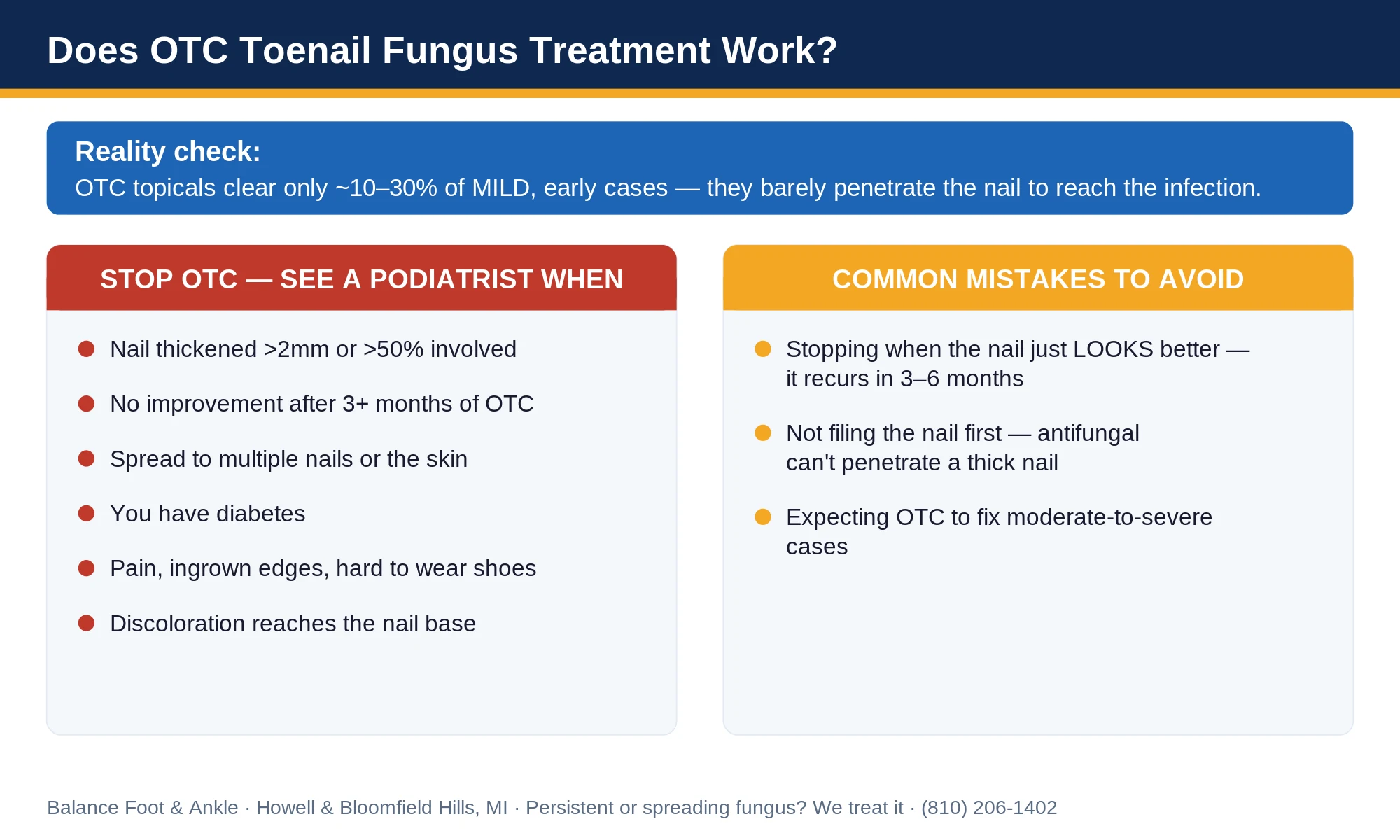
The short answer: sometimes, for mild cases. Here is the clinical reality. Toenail fungus (onychomycosis) is caused by dermatophytes — primarily Trichophyton rubrum — that live beneath the nail plate in the nail bed. OTC topical treatments face a fundamental challenge: they must penetrate a hard, dense keratin structure to reach the active infection. Most OTC formulas penetrate only the top layer of the nail. This means:
- OTC topicals work in roughly 10–30% of mild, early-stage cases (superficial white onychomycosis or distal involvement of <25% of nail)
- Prescription oral terbinafine cures 70–80% of cases by reaching the nail bed through the bloodstream
- Prescription topicals (Jublia, Kerydin) achieve 15–18% cure rates but require 48+ weeks of daily application
The cases where OTC treatment is a reasonable first step: mild surface involvement, very early-stage infection (caught within the first month), superficial white onychomycosis (white streaks on the nail surface rather than deep yellowing under the nail). In our clinic, we generally recommend trying OTC for a maximum of 3 months before escalating to prescription treatment.
Why these recommendations: I personally use the products on this page in my Howell and Bloomfield Hills clinics. When you buy through the links here, Balance Foot & Ankle earns a small commission at no cost to you — and it helps fund the free educational content I make on YouTube. I will never recommend a product I wouldn’t use on my own family.
Top OTC Toenail Fungus Products — Ranked by a Podiatrist
#1: Terbinafine 1% Cream (Generic Lamisil AT) — Best OTC Antifungal
Terbinafine is an allylamide antifungal that works by inhibiting squalene epoxidase, an enzyme critical to fungal cell membrane synthesis. It’s fungicidal (kills the fungus) rather than just fungistatic (slows growth). Generic terbinafine 1% cream is available OTC and is the same active ingredient as prescription-strength formulas. Apply to cleaned, dried nail and surrounding skin twice daily. For best results, file the nail surface gently before application to improve penetration. Expect 3–6 months for visible improvement.
Important note: Terbinafine cream treats surface-level and soft-tissue athlete’s foot very effectively (cures in 1–2 weeks). For nail fungus specifically, it is less effective topically but remains the best available OTC antifungal active ingredient.
#2: Undecylenic Acid (Fungi-Nail) — Best Natural-Derived OTC
Undecylenic acid is derived from castor oil and has genuine antifungal activity documented since the 1940s. Fungi-Nail combines undecylenic acid with zinc undecylenate — the zinc helps harden and protect damaged nail tissue. It’s gentler than terbinafine and suitable for patients with sensitive skin or those who prefer plant-derived treatments. Efficacy for nail fungus is similar or slightly lower than terbinafine in head-to-head comparisons. Apply twice daily to affected nail and surrounding skin. (Note: Fungi-Nail’s current liquid and pen formulas use tolnaftate 1% as the active antifungal; their classic ointment line uses undecylenic acid — both are legitimate, well-established OTC antifungals.)
#3: Doctor Hoy’s Natural Relief Gel — Best for Associated Nail Pain
Doctor Hoy’s Natural Pain Relief Gel is not an antifungal — it contains arnica montana, camphor, and menthol for topical pain relief and anti-inflammatory action. We include it here because toenail fungus frequently causes significant nail pain, pressure sensitivity, and surrounding tissue inflammation — especially when nails thicken and press against footwear. Doctor Hoy’s is excellent as a complementary pain-relief product alongside your antifungal treatment, particularly for the inflammatory discomfort while you wait for the antifungal to take effect (which can take months).

Available from our practice through the Foundation Wellness shop — natural, clean-label formula with no harsh chemicals.
#4: Tea Tree Oil (Melaleuca alternifolia)
Tea tree oil has demonstrated antifungal activity in multiple studies against T. rubrum and C. albicans. A 2013 randomized controlled trial found 100% tea tree oil comparable to 1% clotrimazole for clearing athlete’s foot. For toenail fungus specifically, evidence is more limited. Apply 100% tea tree oil (not diluted) to the nail twice daily using a cotton ball. Some patients report excellent results; clinical cure rates are lower than terbinafine. Best used in combination with a proven antifungal.
Watch: Tea Tree Oil Toenail Fungus Home Treatment [Doctor Cure!] — MichiganFootDoctors YouTube
How to Use OTC Toenail Fungus Treatments Correctly
Correct application protocol dramatically improves OTC outcomes. In our clinic, we see patients who have been applying antifungal products incorrectly for months with zero benefit — typically because they’re applying to an unprepared nail surface. Follow this protocol:
- Clip the nail short — as short as safely possible, cutting straight across
- File the nail surface — use a disposable nail file to thin the nail plate before each application (improves penetration by 40–60% in studies)
- Clean with alcohol — 70% isopropyl alcohol on a cotton ball, let dry fully
- Apply antifungal — cover entire nail surface, under the free edge, and 3mm of surrounding skin
- Let dry completely before putting on socks
- Treat daily without breaks — missing even a week can allow fungal regrowth
- Continue for 6–12 months — even after the nail looks clear (fungus persists in the nail bed)
Natural vs. Pharmaceutical OTC Options
In our clinic, I take a practical approach: if a patient wants to start with natural options, I fully support a 6–8 week trial of tea tree oil or undecylenic acid while monitoring for progress. If there’s no visible improvement at 8 weeks, we move to terbinafine OTC or discuss prescription options. Natural treatments have genuine mechanisms of action — they’re not placebo — but pharmaceutical antifungals (terbinafine) have a higher ceiling effect, especially for more established nail infections. The most important factor, regardless of which product you choose, is consistent daily application without gaps for months.
⚠ Most Common Mistake with OTC Fungus Treatment
The most common mistake we see: stopping treatment when the nail looks better. Toenail fungus is notoriously persistent. The nail can look significantly improved — clearer, less thickened — while the infection remains active in the nail bed. Stopping at this point almost guarantees recurrence within 3–6 months. The second most common mistake: applying treatment without filing the nail first. An unprepared thick nail surface acts as a barrier — the antifungal barely penetrates. File first, every time.
When OTC Treatment Won’t Work — Signs You Need Prescription Care
Stop trying OTC and schedule a podiatry appointment when:
- Nail is thickened to more than 2mm or involves more than 50% of the nail plate
- You’ve used OTC consistently for 3+ months without visible improvement
- The infection has spread to multiple nails or to the skin
- You have diabetes (immune impairment makes OTC inadequate)
- The nail is causing pain, ingrown edges, or making it difficult to wear shoes
- Yellow-brown discoloration extends to the base of the nail (proximal subungual involvement)
In these cases, we typically recommend oral terbinafine (12 weeks for toenails) with liver function monitoring, or prescription topical Jublia for patients who can’t take oral antifungals. Cure rates with prescription oral terbinafine reach 70–80% — far superior to any topical option.
OTC Not Working? Get Prescription Treatment
Same-day and next-day appointments. Howell & Bloomfield Hills, MI.
Book an Appointment →Frequently Asked Questions
What is the fastest OTC treatment for toenail fungus?
No OTC treatment is “fast” — toenail fungus requires months because nails grow slowly (1mm/month). The fastest visible results come from terbinafine 1% cream applied correctly to a properly filed nail surface, combined with antifungal powder in shoes. Expect 3–6 months for early improvement, 6–12 months for full nail clearance. The key word is “consistently” — daily application without gaps gives the best outcome.
Does Vicks VapoRub cure toenail fungus?
Vicks contains camphor, eucalyptus oil, and menthol — all of which have documented antifungal activity. A small 2011 study found Vicks improved 56% of cases vs. 28% cure. I wouldn’t call it a “cure,” but it has genuine antifungal mechanism and is inexpensive. It’s worth trying as a first step for very early-stage infections, but terbinafine cream has stronger antifungal evidence for established nail fungus.
How do I know if toenail fungus is getting better?
Signs of improvement: new nail growth from the base (proximal end) appearing clear and healthy; reduction in nail thickness; less yellow or white discoloration. The key sign is new clear nail growth — not the existing nail clearing (old infected nail tissue doesn’t reverse; it grows out). Progress is visible at 3–4 months for nails with moderate infection.
Does insurance cover toenail fungus treatment?
OTC treatments are not covered by insurance. Prescription topicals (Jublia, Kerydin) are often partially covered but have high copays. Oral terbinafine is generic and inexpensive ($15–40 for a 3-month course) and usually covered by standard prescription plans. Call our office to discuss coverage: (810) 206-1402.
When should I see a podiatrist for toenail fungus?
See a podiatrist if: OTC has been used consistently for 3+ months without improvement; if multiple nails are affected; if you have diabetes; if the nail is thickened, painful, or causing ingrown edges; or if you want a definitive cure rather than management. We can culture the nail to confirm fungal species, prescribe the most effective treatment, and perform nail debridement in-office at Balance Foot & Ankle.
More Toenail Fungus Guides from Dr. Tom
- Toenail Fungus Complete Treatment Guide — oral, topical, laser and home remedy evidence reviewed
- Best Socks for Toenail Fungus — the sock + shoe hygiene protocol that protects your treatment
- Laser Treatment for Toenail Fungus: How It Works
- Does Vicks VapoRub Kill Toenail Fungus? Podiatrist’s Tests
The Bottom Line
OTC toenail fungus treatments can work for mild, early-stage infections — but require consistent daily application for 6–12 months and proper nail preparation before every application. Terbinafine 1% is the strongest OTC antifungal ingredient. For associated nail pain, Doctor Hoy’s natural gel provides excellent relief alongside your antifungal regimen. If you’ve been using OTC treatments for 3+ months without improvement, prescription oral terbinafine is significantly more effective and available at Balance Foot & Ankle in Howell and Bloomfield Hills.
Sources
- Gupta AK et al. “Onychomycosis: a review.” Journal of the European Academy of Dermatology and Venereology, 2017.
- Kreijkamp-Kaspers S et al. “Oral antifungal medication for toenail onychomycosis.” Cochrane Database of Systematic Reviews, 2017.
- Derby R et al. “Novel treatment of onychomycosis using over-the-counter mentholated ointment.” Journal of the American Board of Family Medicine, 2011.
- Hammer KA et al. “Antifungal activity of the components of Melaleuca alternifolia (tea tree) oil.” Journal of Applied Microbiology, 2003.
- American Academy of Dermatology. “Nail Fungus: Diagnosis and Treatment,” 2024.
American Academy of Dermatology: Nail Fungus
Ready to Get Relief?
Same-day appointments available in Howell & Bloomfield Hills, MI
4.9★ | 1,123+ Reviews | 3,000+ Surgeries
Or call: (810) 206-1402

Dr. Tom Biernacki, DPM is a board-certified foot & ankle surgeon (ABFAS & ABPM) at Balance Foot & Ankle Specialists in Southeast Michigan. With over a decade of clinical experience, he specializes in heel pain, bunions, diabetic foot care, sports injuries, and minimally invasive surgery. Dr. Biernacki is a member of the APMA and ACFAS, and his patient education content on MichiganFootDoctors.com and YouTube has made him one of the most-followed foot & ankle educators on YouTube.