

Quick answer: Bunionette Surgery Tailors Bunion Correction is a common foot/ankle topic that affects many patients. The 2026 evidence-based approach combines proper diagnosis, conservative-first treatment, and escalation only when needed. We treat this regularly at our Howell and Bloomfield Township practices. Call (810) 206-1402.
Medically reviewed by Dr. Tom Biernacki, DPM | Board-certified podiatrist | 3,000+ surgeries performed
Last updated: April 2, 2026
Quick Answer
A bunionette (tailor’s bunion) is a painful bony prominence on the outside of the foot at the base of the fifth toe. When conservative treatments fail, surgical correction realigns the metatarsal and eliminates the painful bump. Dr. Tom Biernacki performs bunionette correction using techniques matched to each patient’s deformity pattern.
What Is a Bunionette and How Does It Differ From a Bunion?
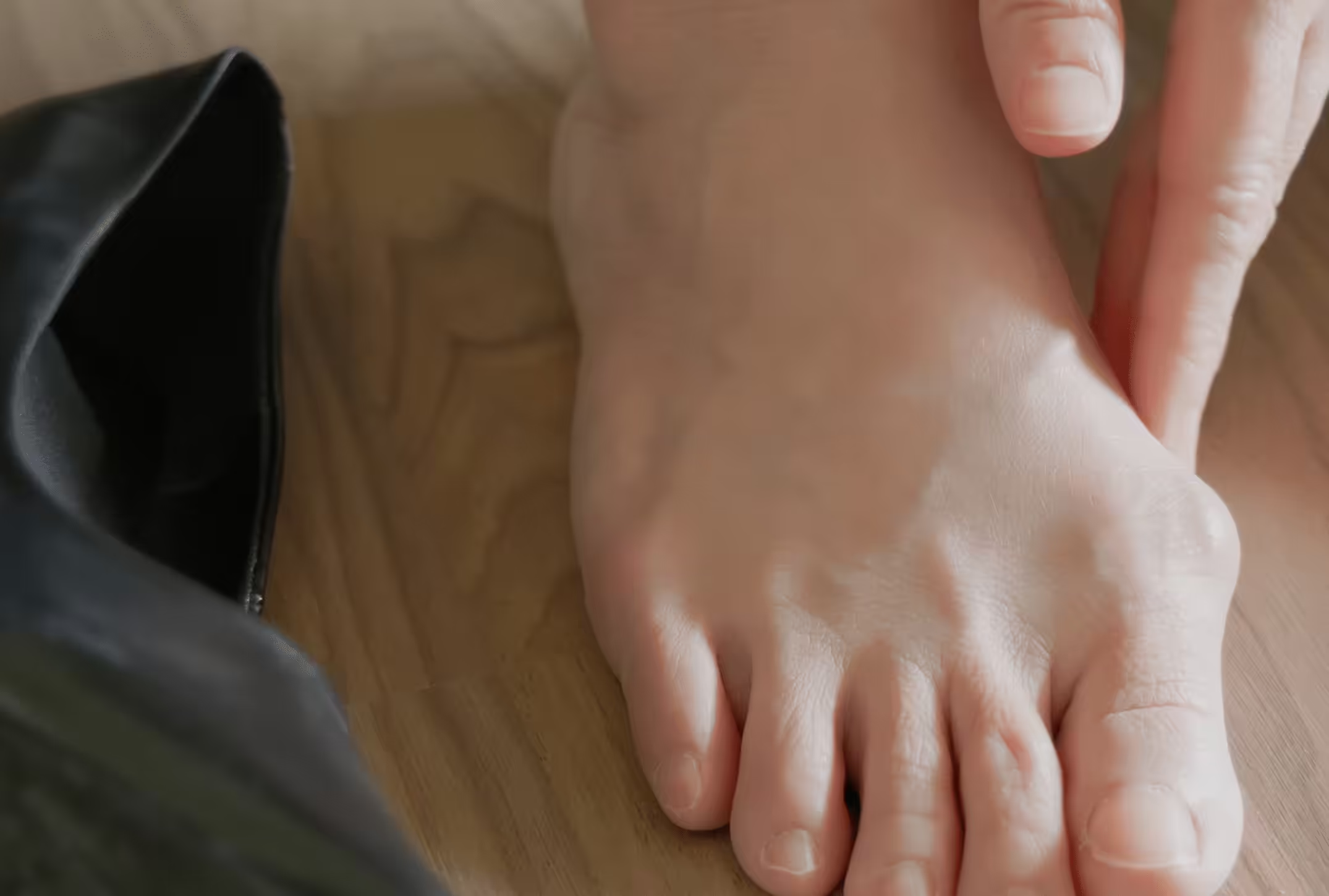
A bunionette is the mirror image of a bunion, occurring at the fifth metatarsophalangeal (MTP) joint on the lateral side of the foot rather than the first MTP joint medially. The fifth metatarsal head becomes prominent laterally — creating a visible bump — due to angular deviation of the metatarsal, bony hypertrophy at the metatarsal head, or a combination of both mechanisms.
▶ Watch

The name ‘tailor’s bunion’ comes from the historical association with tailors who sat cross-legged on hard surfaces, creating chronic pressure on the lateral forefoot. Today, bunionettes most commonly develop from inherited foot structure, shoe pressure, and biomechanical factors that increase loading on the lateral forefoot during gait.
While bunionettes share the same basic pathology as bunions (bony prominence at a metatarsal head), they typically cause symptoms earlier because the fifth metatarsal head has less soft tissue coverage and is more exposed to shoe pressure. Even modest-sized bunionettes can produce significant pain from direct shoe friction against the thin skin over the lateral bump.
Types of Bunionette Deformity and Classification
Type 1 bunionettes involve an enlarged or prominent fifth metatarsal head without significant angular deviation. The metatarsal shaft alignment is normal, but the lateral condyle is unusually prominent, creating the bump that contacts the shoe. This type responds best to simple condylectomy (bump removal) without the need for osteotomy.
Type 2 bunionettes show lateral bowing of the fifth metatarsal shaft, creating an increased fourth-fifth intermetatarsal angle. The curved metatarsal positions the head more laterally than normal, producing the bunionette deformity. Correction requires a metatarsal osteotomy that realigns the distal metatarsal segment medially.
Type 3 bunionettes involve an increased fourth-fifth intermetatarsal angle from a straight but abnormally divergent fifth metatarsal. This is the most common type and responds well to distal metatarsal osteotomy (such as the chevron or oblique sliding osteotomy) that shifts the metatarsal head toward the fourth metatarsal, narrowing the forefoot.
When Surgery Becomes the Right Choice
Conservative treatment for bunionettes includes wider shoes that eliminate lateral pressure, protective padding over the bump, custom orthotics with lateral forefoot accommodation, and anti-inflammatory measures. When 3-6 months of these interventions fail to adequately control symptoms, and the bunionette limits footwear options and activity levels, surgical correction becomes appropriate.
Ideal surgical candidates have persistent pain despite conservative measures, difficulty finding comfortable footwear, limitation of walking or recreational activities, and realistic expectations about the recovery process. The decision is based on pain and functional limitation rather than cosmetic appearance — operating solely for appearance in the absence of symptoms is not recommended.
Pre-operative imaging includes weight-bearing X-rays that measure the fourth-fifth intermetatarsal angle, the lateral deviation angle of the fifth metatarsal head, and assess the joint surface integrity. These measurements determine which surgical procedure will most effectively correct the specific deformity pattern.
Surgical Techniques for Bunionette Correction
Lateral condylectomy — simply removing the prominent bone on the lateral metatarsal head — is the least invasive option, appropriate for Type 1 bunionettes where the metatarsal alignment is normal. The procedure takes 20-30 minutes, allows immediate weight-bearing in a surgical shoe, and has the fastest recovery. However, it does not correct angular deformity and has higher recurrence rates for Types 2 and 3.
Distal chevron osteotomy is the most commonly performed bunionette correction for Types 2 and 3. A V-shaped bone cut in the metatarsal neck allows the head to be shifted medially (toward the center of the foot), narrowing the forefoot and eliminating the lateral prominence. The osteotomy is stabilized with a small screw, and weight-bearing is permitted in a surgical shoe within days.
Oblique diaphyseal osteotomy provides greater correction for severe deformities with large intermetatarsal angles. The longer osteotomy cut allows more medial translation of the metatarsal head while maintaining bone contact for healing. This technique requires slightly longer healing than the distal chevron but achieves excellent correction for the most severe bunionettes.
Recovery Timeline and What to Expect
Bunionette surgery is performed as a 30-45 minute outpatient procedure under ankle block anesthesia with sedation. Patients go home the same day wearing a surgical shoe that allows heel weight-bearing immediately. The bandage stays in place until the first post-operative visit at 5-7 days, when it is changed and the incision is inspected.
Weeks 1-2 focus on elevation, icing, and minimal walking in the surgical shoe. Sutures are removed at 10-14 days. Weeks 3-4 allow progressive walking in the surgical shoe with decreasing reliance on swelling management. Transition to a wide, supportive athletic shoe occurs at 4-6 weeks depending on radiographic healing confirmation.
Full recovery allowing return to all footwear and activities typically takes 6-8 weeks for condylectomy and 8-12 weeks for osteotomy procedures. Residual swelling at the surgical site may persist for 3-4 months but progressively decreases. Most patients can wear wider shoes comfortably by 6 weeks and fashionable shoes by 3-4 months.
Preventing Recurrence After Surgery
Footwear modification after bunionette surgery is essential for long-term success. Shoes with adequate toe box width that do not compress the fifth metatarsal head prevent recurrence of lateral pressure that contributed to the original deformity. Many patients find that after experiencing pain-free walking in properly fitted shoes, they naturally gravitate toward wider footwear.
Custom orthotics that redistribute forefoot pressure and control biomechanical factors like lateral forefoot overloading protect the surgical correction during daily activities. Orthotic use is particularly important in patients with biomechanical contributors to their bunionette such as a rigid cavus foot type or lateral column overload pattern.
Annual monitoring with X-rays for the first 2-3 years after surgery detects any early recurrence while it can be managed conservatively. Catching a slight increase in the intermetatarsal angle early and addressing it with orthotic modification is far preferable to waiting until the bunionette has fully recurred and requires repeat surgery.
Warning Signs Requiring Urgent Evaluation
- function bold() { [native code] } — undefined
- function bold() { [native code] } — undefined
- function bold() { [native code] } — undefined
- function bold() { [native code] } — undefined
The Most Common Mistake We See
The most common mistake is assuming a bunionette can be ‘shaved off’ without addressing the underlying bone misalignment. Simple bump removal (condylectomy) works for Type 1 bunionettes but has a high recurrence rate for Types 2 and 3 where the metatarsal angle is abnormal. Matching the surgical procedure to the deformity type is the key to lasting correction.
Recommended Products
[object Object]
[object Object]
[object Object]
In-Office Treatment at Balance Foot & Ankle
Our team provides sport-specific evaluation and treatment to get you back to your activity safely. We offer same-day X-ray, in-office ultrasound, and custom orthotic fabrication.
Same-day appointments available. Call (810) 206-1402 or book online.
More Podiatrist-Recommended Bunion Essentials
Bunion-Friendly Stability Shoe
Brooks Adrenaline GTS 25 — wide toe box reduces bunion pressure.
Wide-Toe-Box Walking Shoe
New Balance 990v6 — roomy forefoot accommodates bunions and reduces rubbing.
Orthotic Insole

PowerStep arch support — realigns foot mechanics that drive bunion progression.
As an Amazon Associate, Balance Foot & Ankle earns from qualifying purchases. Product recommendations are based on clinical experience; prices and availability shown above update live from Amazon.
When to See a Podiatrist
A bunion is a progressive joint deformity — padding and splints reduce pain but don’t reverse the bone shift. If the big toe angle is worsening, shoes no longer fit, or pain is disrupting sleep or activity, schedule a consult at Balance Foot & Ankle. Our surgeons perform minimally-invasive bunion correction with faster recovery than traditional osteotomy. We’ll review X-rays with you and explain exactly what the joint needs.
Call Balance Foot & Ankle: (810) 206-1402 · Book online · Offices in Howell & Bloomfield Hills
Frequently Asked Questions
How long does bunionette surgery take?
The procedure takes 30-45 minutes as an outpatient surgery under ankle block anesthesia. Patients go home the same day. The surgery can often be performed simultaneously with other forefoot corrections such as hammertoe repair if multiple deformities are present.
Can I walk after bunionette surgery?
Yes. Heel weight-bearing in a surgical shoe is allowed immediately after surgery. You will walk with a modified gait for 4-6 weeks while the bone heals, then transition to regular supportive shoes. Most patients walk comfortably in normal shoes by 6-8 weeks.
Will my bunionette come back after surgery?
Recurrence rates depend on the procedure performed and post-operative management. Osteotomy corrections with proper screw fixation have recurrence rates of approximately 5-10%. Wearing wider shoes and using custom orthotics after surgery significantly reduces recurrence risk.
Can both a bunion and bunionette be fixed at the same time?
Yes. Combined bunion and bunionette surgery is commonly performed when both deformities are symptomatic. Addressing both in a single procedure avoids two separate recovery periods. The overall recovery timeline extends modestly (approximately 2-3 additional weeks) compared to either procedure alone.
The Bottom Line
Bunionette surgery provides reliable, lasting correction of the painful lateral forefoot bump when conservative treatments have been exhausted. Matching the surgical technique to your specific deformity pattern ensures the most durable result with efficient recovery. If a bunionette is limiting your footwear choices and activities, schedule an evaluation to discuss your correction options.
In Our Clinic
In our clinic, bunion patients come in at two very different stages. The first group is women in their 30s and 40s noticing a small bump and seeking nonsurgical slowing tactics — wide toe box shoes, bunion splints at night, custom orthotics to redistribute load away from the first MTP. The second group is patients in their 50s+ who can no longer find shoes that fit and are asking, honestly, about surgery. Our standard workup includes weight-bearing X-rays to measure the intermetatarsal angle and the HVA. Patients with an IMA under 13° usually do well conservatively; 13°+ often benefits from a surgical plan.
Sources
- Fallat LM, et al. A retrospective comparison of tailor’s bunion surgery. J Foot Ankle Surg. 2004;43(1):48-54.
- Coughlin MJ. Treatment of bunionette deformity with longitudinal diaphyseal osteotomy with distal soft tissue repair. Foot Ankle. 1991;11(4):195-203.
- Legenstein R, et al. Chevron osteotomy for correction of bunionette deformity. Foot Ankle Int. 2007;28(2):190-195.
- Kitaoka HB, Holiday AD. Lateral condylar resection for bunionette. Clin Orthop Relat Res. 1992;(278):183-189.
End Lateral Forefoot Pain With Expert Bunionette Surgery
Dr. Tom Biernacki has performed over 3,000 foot and ankle surgeries with a 4.9-star rating from 1,123 patient reviews.
Or call (810) 206-1402 for same-day appointments
Insurance Accepted
BCBS · Medicare · Aetna · Cigna · United Healthcare · HAP · Priority Health · Humana · View All →
Howell Office
3980 E Grand River Ave, Suite 140
Howell, MI 48843
Get Directions →
Bloomfield Hills Office
43700 Woodward Ave, Suite 207
Bloomfield Hills, MI 48302
Get Directions →
Your Board-Certified Podiatrists



Ready to Get Back on Your Feet?
Same-week appointments available at both locations.
Book Your AppointmentWatch: Bunionette Surgery (Tailor’s Bunion)
Dr. Tom on bunionette — 5th metatarsal head prominence, Fallat classification, distal osteotomy + bump resection, conservative wide-toe-box first, 4-6 week recovery.

Bunionette Kit
Conservative + post-op. Dr. Tom’s kit:
As an Amazon Associate, Balance Foot & Ankle earns from qualifying purchases. This supports our free patient education content.
Lateral offload.
Weeks 1-4 protection.
Conservative + return-to-shoe.
Topical lateral forefoot relief.
Related: Bunion Hub · Surgery Services · Book Bunionette Consult
Frequently Asked Questions
When should I see a podiatrist?
If symptoms persist past 2 weeks, affect your normal activity, or are accompanied by red-flag symptoms (warmth, redness, swelling, inability to bear weight).
What does treatment cost?
Most diagnostic visits and conservative treatments are covered by Medicare and major insurers. Out-of-pocket costs vary by your specific plan.
How quickly can I get an appointment?
Most non-urgent cases see us within 5 business days. Urgent cases (sudden pain, possible fracture) typically same or next business day.

Dr. Tom Biernacki, DPM is a double board-certified podiatrist and foot & ankle surgeon at Balance Foot & Ankle Specialists in Southeast Michigan. With over a decade of clinical experience, he specializes in heel pain, bunions, diabetic foot care, sports injuries, and minimally invasive surgery. Dr. Biernacki is a member of the APMA and ACFAS, and his patient education content on MichiganFootDoctors.com and YouTube has reached over one million views.
- Diagnosis and Treatment of Plantar Fasciitis (PubMed / AAFP)
- Heel Pain (APMA)
- Hallux Valgus (Bunions): Evaluation and Management (PubMed)
- Bunions (Mayo Clinic)
Related Treatments at Balance Foot & Ankle
Our board-certified podiatrists offer advanced treatments at our Bloomfield Hills and Howell locations.
Recommended Products from Dr. Tom