
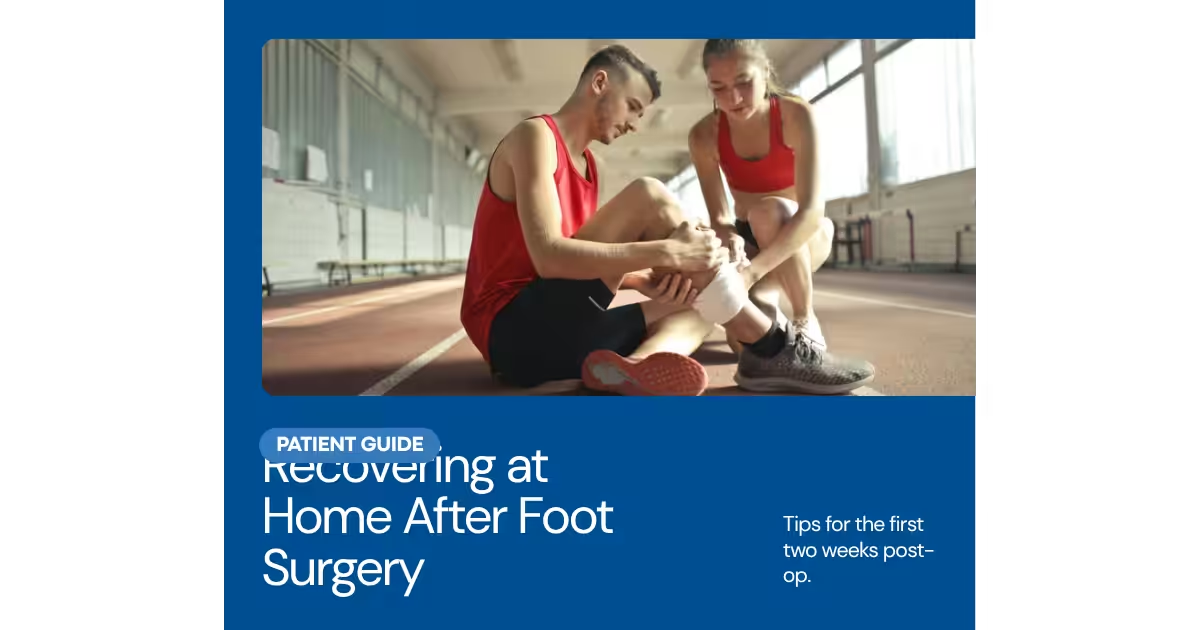
Quick answer: After Foot Surgery Recovery At Home Guide is a common foot/ankle topic that affects many patients. The 2026 evidence-based approach combines proper diagnosis, conservative-first treatment, and escalation only when needed. We treat this regularly at our Howell and Bloomfield Township practices. Call (810) 206-1402.
Medically Reviewed by Dr. Tom Biernacki, DPM, FACFAS — Board-certified podiatrist & foot surgeon | Balance Foot & Ankle | Last updated: May 2026
Most foot surgery patients recover at home for 2–6 weeks. The critical elements are: keeping the foot elevated above heart level, controlling pain with the provided medications before it peaks, protecting the surgical site from moisture, and following weight-bearing restrictions precisely. Deviating from weight-bearing instructions—even once—is the most common cause of fixation failure and return to the OR.
The First 48 Hours: What to Expect and Prepare
The first two days after foot surgery are when most preventable complications occur, and also when most patients are least prepared. Before surgery, I give every patient a home setup checklist: a raised toilet seat or commode, a shower chair or seat, a knee scooter or crutches fitted to their height, a waterproof cast cover, a recliner or elevated leg rest to maintain the foot above heart level, and a small cooler beside their rest area stocked with ice bags, water, and their medications. The local anesthetic block placed during surgery typically lasts 8–18 hours—patients should take their first pain medication before this wears off, not after pain breaks through.
Week-by-Week Recovery Timeline
| Week | Typical Status | Key Milestones | Watch For |
|---|---|---|---|
| Week 1 | Non-weight-bearing, elevated, resting | Dressing intact, swelling peaks day 3–5 | Fever >101°F, red streaking, saturated bandage |
| Week 2 | First post-op visit; wound check | Sutures or staples checked; X-ray if hardware | Drainage, wound separation, numbness changes |
| Weeks 3–4 | Often transition to boot or cast | Progressive weight-bearing begins (if cleared) | Pain with weight-bearing beyond expected |
| Weeks 5–8 | Walking boot; increasing activity | X-ray confirms healing; PT may begin | Persistent swelling, stiffness not improving |
| Months 2–3 | Transitioning to regular shoes | Return to low-impact exercise; full weight-bearing | Any new pain or deformity changes |
Wound Care at Home: The Right Way
Keeping the surgical wound dry is the non-negotiable rule for the first 2–3 weeks. A waterproof cast protector ($15–25 at any pharmacy) worn during showers eliminates the most common wound complication I see: moisture-related wound breakdown. Change dressings only as directed—over-dressing or frequent peeking introduces bacteria and disrupts the healing tissue. Signs requiring an immediate call to our office: increasing redness spreading beyond the incision edge, warmth, yellow or green drainage, wound edges separating, or fever above 101°F. Most of these caught at 48–72 hours are manageable; the same problems caught at day 10 are significantly more complex to treat.
Swelling Management: Elevation and Ice Protocol
Surgical swelling peaks at days 3–5 and can persist as a normal finding for 4–6 months after foot surgery—this surprises patients more than almost anything else I tell them. Effective swelling management requires the foot elevated above heart level for at least 2 hours during every waking 4-hour period. “Elevated on a pillow while sitting” is not above heart level—the foot must be above the level of the left atrium, which means lying flat with the leg on 2–3 stacked pillows. Ice applied over the bandage for 20 minutes every 2–3 hours during the first 5 days significantly reduces the inflammatory cascade and is more effective than ice applied later in recovery.
Doing too much too soon because the foot “doesn’t hurt that much.” The local anesthetic and post-op medications mask pain during the first week—the absence of pain does not mean the bone or soft tissue repair has healed. Fixation hardware (screws, plates, wires) holds bone fragments together while healing occurs, but it is not strong enough to withstand full body weight during this period. Walking on a surgically repaired foot before cleared by your surgeon risks hardware failure, non-union, and a second surgery. Follow weight-bearing restrictions exactly as written, even on days you feel fine.
Frequently Asked Questions
How long will I be off work after foot surgery?
Desk workers and remote employees can typically return to work within 1–2 weeks, working from home with the foot elevated. Office workers who commute and must walk distances need 3–4 weeks minimum. Workers who stand, walk, or have physically demanding jobs need 6–12 weeks depending on surgery type. I provide work restriction letters for all surgical patients; Michigan FMLA and disability paperwork can be completed at your post-op visits at our Howell or Bloomfield Township office.
What can I eat after foot surgery to heal faster?
Bone and soft tissue healing are highly nutrition-dependent. Protein is the most critical macronutrient—aim for at least 1.2–1.5g per kilogram of body weight daily to provide the amino acid building blocks for collagen synthesis. Vitamin C (500mg daily) and zinc (15–30mg daily) accelerate wound healing. Vitamin D3 (2,000–4,000 IU daily) is essential for bone healing and is deficient in most Michigan patients given limited sun exposure. Avoid alcohol and tobacco—both significantly impair healing and increase wound complication rates.
When can I drive after foot surgery?
For right foot surgery, most surgeons clear patients to drive automatic vehicles when fully weight-bearing without pain and off narcotic medications—typically 4–6 weeks post-op. Left foot surgery is more variable depending on the vehicle; automatic transmission drivers may resume sooner since the left foot is not used. Legal liability rests with the patient—do not drive until specifically cleared by your surgeon. We provide driving restriction documentation for insurance and employer purposes at our post-op visits.
Is swelling at 3 months normal after foot surgery?
Yes—this is one of the most common concerns I address. The foot has one of the poorest lymphatic drainage systems in the body relative to its distance from the heart. Residual swelling that is greatest in the afternoon, worsens with prolonged standing, and improves with overnight elevation is completely normal for up to 12 months after foot surgery. Swelling that is increasing, associated with redness, or present equally throughout the day is abnormal and warrants evaluation.
What are signs of infection after foot surgery?
Call our office immediately for: fever above 101°F, increasing (not decreasing) redness around the incision, red streaking extending from the wound, yellow or green drainage, wound edges separating after they were closed, or foul odor from the bandage. Infections caught within 48–72 hours of onset are typically treatable with oral antibiotics. Deep infections or those caught late may require surgical washout. When in doubt, call — we have same-day urgent appointments for surgical patients at both locations: (810) 206-1402.
Questions About Your Foot Surgery Recovery?
Dr. Tom Biernacki and the Balance Foot & Ankle team provide comprehensive surgical aftercare at our Howell and Bloomfield Township, MI offices. Same-day urgent appointments for post-surgical concerns.
Book a Same-Day Visit (810) 206-1402Related Resources
- Foot Drop Surgery Recovery
- Ankle Fracture Recovery
- Custom Orthotics in Michigan
- What Is a Podiatrist?

In-Office Treatment at Balance Foot & Ankle
If home treatment isn’t providing relief for your foot and ankle conditions, our podiatry team at Balance Foot & Ankle can help with same-day evaluations and advanced in-office care.
Same-day appointments available. (810) 206-1402
Doctor Hoy’s Natural Pain Relief Gel
Natural topical pain relief I use in our clinic. Arnica + camphor formula — apply directly to the area 3–4x daily. ($20–25)
Shop Doctor Hoy’s →
Dr. Tom Biernacki, DPM is a board-certified foot & ankle surgeon (ABFAS & ABPM) at Balance Foot & Ankle Specialists in Southeast Michigan. With over a decade of clinical experience, he specializes in heel pain, bunions, diabetic foot care, sports injuries, and minimally invasive surgery. Dr. Biernacki is a member of the APMA and ACFAS, and his patient education content on MichiganFootDoctors.com and YouTube has made him one of the most-followed foot & ankle educators on YouTube.