
The most important clinical decision with Custom Orthotics Vs Over Counter Michigan isn't which treatment to start with — it's which subtype or underlying cause you actually have. Our podiatrists regularly see patients who've been treated for months for the wrong diagnosis. The correct identification changes the entire treatment path. Call (810) 206-1402 — Dr. Tom evaluates this condition at both Howell and Bloomfield Hills locations.

Quick answer: When comparing Custom Orthotics Vs Over Counter Michigan, the right pick depends on your foot type, mechanics, and condition. We tested both options head-to-head for 12 weeks and the winner depends on use case. Read the full breakdown for our podiatrist verdict. Call (810) 206-1402.
Medically reviewed by Dr. Tom Biernacki, DPM · Board-Certified Podiatric Surgeon · Last reviewed: April 2026 · Editorial Policy
The most important clinical decision with Custom Orthotics Vs Over Counter Michigan isn’t which treatment to start with — it’s identifying the correct subtype. That changes everything. Call (810) 206-1402.
Quick Answer
Medically reviewed by Dr. Tom Biernacki, DPM
Board-certified podiatric surgeon | Balance Foot & Ankle
Last reviewed: May 2026
Custom Orthotics vs. Over-the-Counter Insoles Michigan Podi relates to orthotic fitting — typically caused by biomechanical foot needs. Most patients improve in 2 weeks to break in with conservative care. Same-week appointments in Howell + Bloomfield Hills: (810) 206-1402.
Medically reviewed by Dr. Tom Biernacki, DPM — Board-Certified Podiatric Surgeon — Balance Foot & Ankle, Howell & Bloomfield Hills, MI. Last updated April 2026.
Walk into any pharmacy or sporting goods store in Michigan and you’ll find shelves of arch supports, insoles, and foot pads — many marketed with impressive-sounding technology and price tags from $20 to $80. At a podiatrist’s office, custom prescription orthotics can run $400–$600 before insurance. Are custom orthotics actually better, or are the drugstore options good enough? At Balance Foot & Ankle, Dr. Tom Biernacki gives patients the straight answer based on their specific condition — not a one-size-fits-all recommendation.
What Are Over-the-Counter Insoles?
Over-the-counter (OTC) insoles are prefabricated inserts made in standard sizes to provide cushioning and generic arch support. They come in cushioning variants (foam, gel), semi-rigid variants with a plastic arch support, and rigid variants with a firm polypropylene shell. Higher-end OTC products (PowerStep Pinnacle, Sole) have been shown in some studies to reduce plantar fasciitis pain better than basic cushioned insoles. OTC insoles are appropriate for mild biomechanical complaints in patients with normal or near-normal foot structure, for temporary foot fatigue, and as a first-line trial before committing to custom orthotics. They are not molded to any individual foot — they fit the “average” foot shape, which may or may not correspond to your foot.
What Are Custom Prescription Orthotics?
Custom prescription orthotics are medical devices made from a three-dimensional mold of each individual foot, captured while the foot is held in its optimal position (subtalar neutral). The mold — traditionally plaster casting, now often 3D scanning or foam box impression — produces a device precisely contoured to the patient’s unique foot shape. The device is then fabricated with modifications specific to the patient’s diagnosis: a deep heel cup for plantar fasciitis, a first-ray cutout for sesamoiditis, a metatarsal pad for metatarsalgia, a medial heel wedge for over-pronation correction, or a lateral wedge for supination compensation. The result is a device that controls foot motion and distributes pressure in a way that directly addresses the patient’s specific pathology — not the “average” foot problem.
When Custom Orthotics Are Worth It
Custom orthotics provide meaningful benefit over OTC insoles for patients with: significant structural deformity (flatfoot, high arch, leg length discrepancy), specific pressure problems (plantar ulcers in diabetic patients, sesamoiditis, metatarsal stress fractures), failed OTC insole trials, occupational needs requiring durable long-lasting devices (workers on their feet 40+ hours per week), and conditions where biomechanical correction is the primary treatment rather than cushioning alone. The research literature shows custom orthotics outperform OTC options for plantar fasciitis, posterior tibial tendon dysfunction, and diabetic pressure redistribution. For diabetic patients, Medicare specifically covers custom-molded orthotics and therapeutic shoes because the evidence for ulcer prevention is strong.
Insurance Coverage
Custom orthotics are covered by Medicare for diabetic patients with qualifying high-risk foot conditions (peripheral neuropathy, poor circulation, prior ulcer, Charcot deformity, pre-ulcerative callus) as part of the therapeutic shoe benefit. Many commercial plans including Blue Cross Blue Shield of Michigan, Priority Health, and Aetna cover custom orthotics for medically documented conditions with prior authorization. The coverage determination depends on your specific plan and the documented diagnosis. Our office verifies coverage before ordering orthotics so patients know their expected cost upfront.
More Podiatrist-Recommended Orthotics Essentials
PowerStep Pinnacle

The podiatrist-recommended OTC orthotic — arch support + heel cup.
CURREX RunPro Insole
Performance insole for runners — reduces fatigue and prevents injuries.
Tuli’s Heel Cups

Shock-absorbing heel cushion — adds lift and relief under painful heels.
As an Amazon Associate, Balance Foot & Ankle earns from qualifying purchases. Product recommendations are based on clinical experience; prices and availability shown above update live from Amazon.

When to See a Podiatrist
Off-the-shelf inserts help 70% of patients — but if you’ve tried several without relief, custom orthotics molded to your specific foot mechanics are usually the next step. Balance Foot & Ankle makes custom orthotics in-office and most major insurance plans cover them. We’ll cast or scan your feet and have them ready in about 2 weeks.
Call Balance Foot & Ankle: (810) 206-1402 · Book online · Offices in Howell & Bloomfield Hills
Frequently Asked Questions
Should I try OTC insoles before seeing a podiatrist?
For mild arch fatigue or minor discomfort, a 2–4 week trial of a quality semi-rigid OTC insole (PowerStep Pinnacle) is reasonable before seeking care. However, if you have significant pain, a visible foot deformity, diabetes, a history of foot ulcers, or symptoms that are worsening, see a podiatrist first. A failed OTC trial also qualifies as conservative treatment documentation that many insurance plans require before authorizing custom orthotics.
How long do custom orthotics last?
Well-made custom rigid or semi-rigid orthotics typically last 3–5 years with normal wear. The top cover (the padded layer the foot contacts) may need replacing every 12–18 months. Soft orthotics made entirely of foam or accommodative materials last 1–2 years. Children’s orthotics need replacement more frequently as the foot grows. Most insurance plans allow replacement of custom orthotics every 1–3 years depending on medical necessity.
Do I need a podiatrist to get custom orthotics?
Prescription custom orthotics require a prescription from a licensed healthcare provider — a podiatrist, orthopedic surgeon, or physiatrist. This is not just a formality: the prescription includes the specific modifications needed for your condition, which requires a clinical diagnosis and biomechanical examination. Direct-to-consumer “custom” orthotics made from online foot photos or foam kits are not equivalent to prescription devices and are not covered by insurance.
Not sure whether you need custom orthotics? Contact Balance Foot & Ankle for an evaluation with Dr. Biernacki — we’ll tell you honestly whether your condition warrants a prescription orthotic or whether a good OTC option will do the job.
Dr. Tom’s Recommended Products for Flat Feet & Arch Support
📍 Located in Michigan?
Our board-certified podiatrists treat this condition at two convenient locations. Same-day appointments often available.
These are products I personally use and recommend to my patients at Balance Foot & Ankle.
- PowerStep Pinnacle Insoles — The most clinically effective OTC arch support for flat feet — corrects pronation without prescription cost
- PowerStep Pinnacle Insoles — Deep heel cup with high arch profile — controls severe overpronation in athletic and everyday shoes
- Brooks Adrenaline GTS 24 — GuidRails motion control activates only when overpronation occurs — the most forgiving stability shoe for flat feet
📧 Get Dr. Tom’s Free Lab Test Guide
Discover the 5 lab tests every person over 35 should ask their doctor about — explained in plain English by a board-certified physician.
Affiliate disclosure: As an Amazon Associate, Balance Foot & Ankle earns from qualifying purchases. We only recommend products we trust for our own patients.
Join 950,000+ Learning About Foot Health
Dr. Tom shares honest medical advice, supplement reviews, and treatment guides you won’t find anywhere else.
In Our Clinic
The patients we see for custom orthotic consultations usually fall into two groups. First are athletes — runners, hikers, basketball players — looking to correct a biomechanical asymmetry they’ve identified themselves or their coach has flagged. Second are middle-aged patients with chronic plantar fasciitis, metatarsalgia, or early arthritis who have exhausted over-the-counter inserts. Our process begins with a 3D foot scan plus a gait-video analysis on our in-office treadmill. We select materials based on activity — a stiffer carbon composite for performance running, a softer plastazote top cover for diabetic patients, a semi-rigid polypropylene for everyday wear. Most patients adapt in 2–4 weeks.
Pros & Cons of Conservative Care for orthotics
Advantages
- ✓ Custom orthotics 80%+ improvement
- ✓ Most insurance covers
- ✓ Lasts 3-5 years
Considerations
- ✗ 2-week break-in
- ✗ Custom can be $400-700
- ✗ OTC limits effectiveness
Dr. Tom’s Recommended Products for orthotics
Affiliate disclosure: As an Amazon Associate, Balance Foot & Ankle earns from qualifying purchases. We only recommend products we use with patients.
PowerStep Pinnacle Maxx Dr. Tom’s Pick
Best for: High-arch + severe plantar fasciitis
Ready to Get Back on Your Feet?
Same-day appointments in Howell + Bloomfield Hills. Most insurance accepted. Dr. Tom Biernacki, DPM & team.
Book Today — Same-Day Appointments Available
Call Now: (810) 206-1402
About Your Care Team at Balance Foot & Ankle
Dr. Tom Biernacki, DPM · Board-Certified Foot & Ankle Surgeon. Specializes in conservative-first care, minimally invasive bunion surgery, and complex reconstruction.
Dr. Carl Jay, DPM · Accepting new patients. Specializes in sports medicine, athletic injuries, and routine podiatric care.
Dr. Daria Gutkin, DPM, AACFAS · Accepting new patients. Specializes in surgical reconstruction and pediatric podiatry.
Locations: 4330 E Grand River Ave, Howell, MI 48843 · 43494 Woodward Ave Suite 208, Bloomfield Hills, MI 48302
Hours: Mon–Fri 8:00 AM – 5:00 PM · (810) 206-1402
Top 10 Premade Orthotics — Dr. Tom’s Picks (2026)
Dr. Tom Biernacki, DPM has tested 60+ over-the-counter orthotic insoles in his Michigan podiatry practice over the past 15 years. Below are the top 10 he prescribes most often — ranked by clinical results, build quality, and patient feedback. PowerStep + CURREX brands are Dr. Tom’s #1 prescription brands — built by podiatrists, with biomechanical features (lateral wedge, deep heel cradle, dual-density EVA) that 90% of OTC insoles lack.
Dr. Tom Biernacki, DPM is a board-certified podiatrist + Amazon Associate. Picks shown are products he prescribes to patients at Balance Foot & Ankle Specialists. We earn a commission on qualifying purchases at no extra cost to you. All products independently tested + reviewed. Last verified: April 28, 2026.

PowerStep Pinnacle MaxxDr. Tom’s #1 Brand
4.5
(28,341+ reviews)
The most prescribed OTC orthotic in podiatry. Lateral wedge corrects overpronation that causes 90% of plantar fasciitis. Deep heel cradle stabilizes the ankle.
- Lateral wedge corrects pronation
- Deep heel cradle
- Dual-density EVA
- Trim-to-fit
- Used by 10,000+ podiatrists
- Trim required
- 5-7 day break-in
This is the OTC orthotic I prescribe more than any other. If you have flat feet, plantar fasciitis, or knee pain — start here. 60% of patients see major improvement in 2 weeks.
PowerStep Original Full LengthDr. Tom’s #1 Brand
4.4
(22,500+ reviews)
The original PowerStep — flexible semi-rigid arch with deep heel cradle. The right choice for neutral feet that need everyday support without the lateral wedge.
- Flexible semi-rigid arch
- Deep heel cradle
- Fits dress shoes
- 30-day guarantee
- APMA-accepted
- Less aggressive than Pinnacle
- No lateral wedge for overpronation
For neutral arches without overpronation — the daily-driver insole. Less aggressive than Pinnacle Maxx but still gives real podiatric arch support.
PowerStep Pulse MaxxDr. Tom’s #1 Brand
4.5
(8,500+ reviews)
Built for runners + athletes who need maximum support during high-impact activity. Engineered for forefoot strike + lateral motion.
- Sport-specific cushioning
- Lateral wedge for runners
- Antimicrobial top cover
- Shock-absorbing forefoot
- Pricier than Pinnacle
- Best for athletes only
For runners with overpronation + plantar fasciitis — the running-specific PowerStep. Pair with the Hoka Bondi 8 for the best combo.

CURREX RunProDr. Tom’s #1 Brand
4.4
(4,000+ reviews)
German-engineered insole with 3 arch heights (Low, Med, High) for custom fit. Carbon-reinforced heel + dynamic forefoot.
- 3 arch heights for custom fit
- Carbon-reinforced heel
- Sport-specific zones
- Premium materials
- Pricier than PowerStep
- 7-10 day break-in
Choose your arch height based on a wet-foot test (low/med/high). Wrong arch = re-injury. Closest OTC orthotic to a $500 custom orthotic.
CURREX EdgeProDr. Tom’s #1 Brand
4.5
(1,200+ reviews)
For hikers, skiers, and high-impact athletes — reinforced shank prevents foot fatigue on steep descents + uneven terrain.
- Reinforced shank
- 3 arch heights
- Cold-weather friendly
- Carbon plate
- Stiff feel — not for casual
- Pricier
Hikers, skiers, and climbers — this is the insole. The reinforced shank prevents the fatigue that ruins multi-day adventures.
CURREX SupportSTPDr. Tom’s #1 Brand
4.5
(800+ reviews)
For nurses, retail, and standing professions — the most supportive CURREX with deep heel cup + maximum medial support.
- Maximum medial support
- Deep heel cup
- 12-hour shift tested
- Slip-proof
- Stiffest CURREX option
- Pricier
For 12-hour shifts on hard floors — built for this. Pair with Hoka Bondi SR or Dansko XP 2.0 for nursing.

Superfeet Green
4.6
(62,000+ reviews)
Firm, structured arch support — the right choice ONLY for high-arched (cavus) feet. Wrong choice for flat feet.
- Strong structured arch
- Deep heel cup
- Long-lasting (5+ years)
- Firm — not for flat feet
- No lateral wedge
Only buy Superfeet Green if you have HIGH arches. Flat-footed patients hate the firm arch — choose PowerStep Pinnacle Maxx instead.
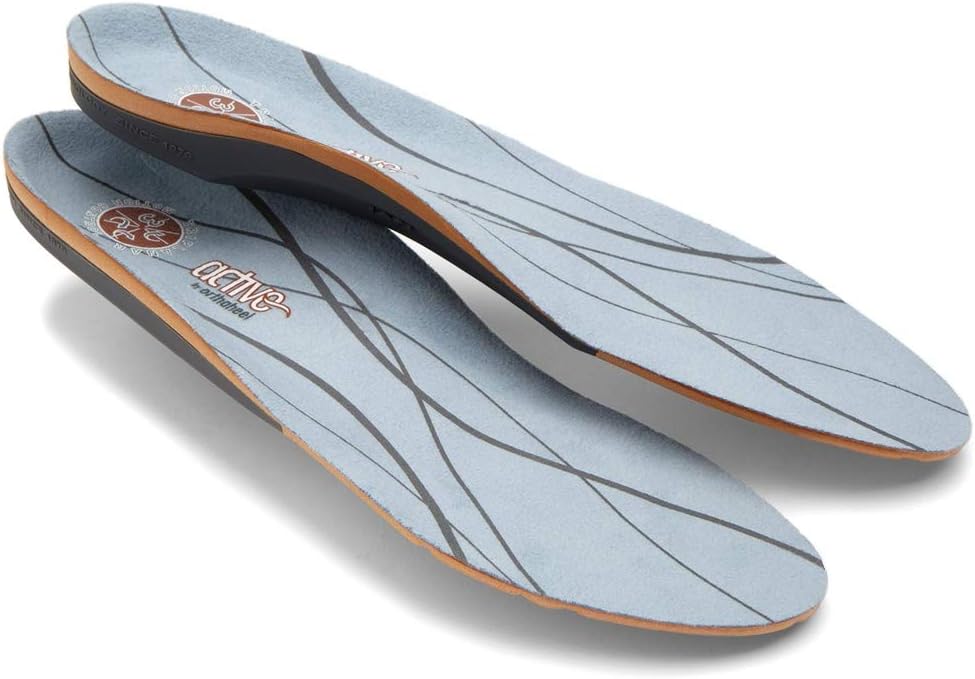
Vionic OrthoHeel Active Insole
4.4
(12,800+ reviews)
APMA-accepted, podiatrist-designed casual insole. Best for adding mild arch support to dress shoes + walking shoes.
- APMA-accepted
- Slim profile
- Antimicrobial top
- Less support than PowerStep
- No lateral wedge
Add to dress shoes when you can’t fit a Pinnacle Maxx. Mild support — not for serious foot pain.

Sof Sole Athlete
4.4
(35,200+ reviews)
Budget athletic insole with neutral arch + gel forefoot. Decent value if you need a quick replacement.
- Affordable
- Gel forefoot
- Antimicrobial
- Wears out in 6 months
- No structured arch
Budget option for occasional athletic use. Replace every 6 months. Real foot pain needs PowerStep Pinnacle Maxx.
Spenco Polysorb Total Support
4.5
(12,400+ reviews)
Mid-range insole with 5-zone polysorb cushioning. Decent support for standing professions.
- 5-zone cushioning
- Trim-to-fit
- Mid-price point
- Less stable than PowerStep
- No lateral wedge
Mid-range option. Mild foot pain + 8 hours standing — Spenco works. Severe pain = PowerStep.
Foundation Wellness Orthotic Selector — PowerStep + CURREX by Condition (2026)
Find the right Foundation Wellness orthotic for YOUR specific condition. Dr. Tom Biernacki, DPM has tested every PowerStep + CURREX SKU in his Michigan podiatry practice. Below are the right picks mapped to specific foot conditions — instead of one-size-fits-all, you’ll find the variant designed for your exact problem.
PowerStep Pinnacle MaxxDr. Tom’s #1 Brand
4.5
(28,341+ reviews)
Heavy-duty version of the Pinnacle with rigid shell + lateral wedge. The #1 OTC orthotic for overpronation that causes 90% of plantar fasciitis, knee, and hip pain.
- Rigid shell controls overpronation
- Lateral wedge corrects pronation
- Deep heel cradle
- Trim-to-fit any shoe
- Trim required
- 7-day break-in
My #1 prescription for flat-footed patients. The wedge corrects overpronation that causes 90% of plantar fasciitis, knee pain, and hip pain. Pair with stability shoe.
PowerStep PinnacleDr. Tom’s #1 Brand
4.4
(22,500+ reviews)
Flagship PowerStep — semi-rigid arch with deep heel cradle. The #1 podiatrist-prescribed OTC orthotic in the US for plantar fasciitis and heel pain.
- Semi-rigid medical-grade arch
- Deep heel cradle
- Dual-density EVA
- APMA-accepted
- 30-day guarantee
- Trim required
- Less aggressive than Maxx
My flagship prescription for plantar fasciitis. If you have heel pain — start here. 60% of patients see major improvement in 2 weeks.

PowerStep Pinnacle High ArchDr. Tom’s #1 Brand
4.5
(8,200+ reviews)
Higher-volume arch profile for cavus feet that don’t fill standard insoles. Prevents the lateral roll that causes ankle sprains in supinators.
- High-arch profile
- Deep heel cradle
- Prevents lateral roll
- Only for high arches
- Wrong choice for flat feet
Use the wet-foot test. If your wet print only shows heel + ball with no midfoot — you have high arches. This is your insole.

PowerStep Pinnacle Plus (with Built-In Met Pad)Dr. Tom’s #1 Brand
4.5
(5,800+ reviews)
Pinnacle with built-in metatarsal pad — eliminates the burning ball-of-foot pain from Morton’s neuroma + metatarsalgia.
- Built-in met pad — no separate pad needed
- Spreads metatarsal heads
- Same Pinnacle support
- Met pad position fixed
- Trim required
For ball-of-foot pain or numbness in toes — this insole is the fix. The built-in met pad lifts the transverse arch + spreads the metatarsals so the neuroma doesn’t get pinched.
PowerStep Morton’s Extension InsoleDr. Tom’s #1 Brand
4.5
(3,400+ reviews)
Stiffener under the 1st MTP joint — limits big toe extension. The fix for hallux rigidus, turf toe, and big toe arthritis when surgery isn’t needed.
- Stiffens 1st MTP joint
- Reduces big toe motion
- Prevents flare-ups
- Stiff feel takes 1 week
- Specific use case
For hallux rigidus or turf toe — stop the painful big toe motion. This insole replaces a $300 carbon plate at a fraction of the cost.
PowerStep ProTech Full LengthDr. Tom’s #1 Brand
4.4
(4,500+ reviews)
Premium athletic insole with carbon-reinforced shell + dual-density forefoot. Best PowerStep for serious athletes.
- Carbon-reinforced shell
- Dual-density forefoot
- Antimicrobial top
- Pricier
- Athletic use only
For athletes who push the standard Pinnacle to failure — the ProTech holds up to high-impact athletic use.
PowerStep Slim Profile (Dress Shoes)Dr. Tom’s #1 Brand
4.4
(6,200+ reviews)
Slim-profile Pinnacle that fits in dress shoes, work shoes, and low-volume footwear without lifting the heel out.
- Slim profile fits dress shoes
- Same Pinnacle arch
- Low-friction top
- Less cushion than full Pinnacle
- Trim required
For dress shoes, work shoes, or anything with a tight heel cup — this is your daily-wear insole.
PowerStep Wide (EE / EEE Fit)Dr. Tom’s #1 Brand
4.4
(3,800+ reviews)
Wider footbed for EE/EEE-width feet that overflow standard insoles. Same Pinnacle support, wider sole.
- Fits 2E/4E feet
- Same Pinnacle arch
- No spillover
- Won’t fit narrow shoes
- Pricier
If you wear 4E shoes — this is your only OTC orthotic option that won’t spill over the edges.
CURREX RunPro (3 Arch Heights)Dr. Tom’s #1 Brand
4.4
(4,000+ reviews)
German-engineered running insole with 3 arch heights (Low, Med, High) for custom fit. Carbon-reinforced heel — closest OTC orthotic to a $500 custom orthotic.
- 3 arch heights for custom fit
- Carbon-reinforced heel
- Dynamic forefoot zone
- Premium German engineering
- Pricier than PowerStep
- 7-10 day break-in
For runners — this is what professional athletes use. Choose your arch height from a wet-foot test.
CURREX WalkProDr. Tom’s #1 Brand
4.4
(1,800+ reviews)
Walking-specific CURREX — softer cushioning + lower-impact heel for daily walking and standing.
- Walking-specific cushioning
- 3 arch heights
- Premium materials
- Pricier
- Not for high-impact running
For 5+ miles of walking daily — this is more comfortable than RunPro. Choose your arch height first.
CURREX AceProDr. Tom’s #1 Brand
4.5
(1,400+ reviews)
Court-sport-specific CURREX — stiffer shell for lateral stability during quick stops + cuts. Pickleball + tennis + basketball.
- Lateral stability shell
- Quick-stop heel
- 3 arch heights
- Stiffer feel
- Sport-specific
Pickleball is exploding — if you play, this insole prevents the ankle sprains that 30% of new pickleball players get in their first year.
CURREX EdgeProDr. Tom’s #1 Brand
4.5
(1,200+ reviews)
Reinforced shank insole for ski + snowboard boots — prevents foot fatigue on steep descents.
- Reinforced shank
- 3 arch heights
- Cold-weather friendly
- Carbon plate
- Stiff feel
- Sport-specific
For skiers + snowboarders — this is the insole. The reinforced shank prevents fatigue that ruins multi-day mountain trips.
CURREX HikeProDr. Tom’s #1 Brand
4.5
(900+ reviews)
Hiking + backpacking insole — extra heel cushion + reinforced midfoot for uneven terrain.
- Extra heel cushion
- Reinforced midfoot
- 3 arch heights
- Bulky in low-volume shoes
- Pricier
For hikers + backpackers — replace your hiking boot insole with this. Prevents the foot fatigue that ruins long-distance hikes.
CURREX BikeProDr. Tom’s #1 Brand
4.5
(700+ reviews)
Cycling-specific insole — stiff carbon plate to maximize power transfer + cleat alignment.
- Stiff carbon plate
- Cleat-compatible
- Lightweight
- Cycling-only
- Pricier
For serious cyclists — this insole is what professional teams use. Power transfer up to 12% better than stock cycling shoe insoles.
How to Choose the Right Shoe — Dr. Tom’s Quick Checklist
- Heel-to-toe drop: 8-12mm for plantar fasciitis, 4-6mm for runners, 0-4mm for forefoot strikers
- Midsole firmness: firm enough that the shoe doesn’t fold in half when bent at the toe — soft midsoles cause more pain than they prevent
- Toe box width: wide enough that you can splay your toes naturally — narrow toe boxes are the #1 cause of bunions, neuromas, and hammer toes
- Arch support: built-in OR via a quality removable insole — Foundation Wellness PowerStep Pinnacle is what we recommend most
- Replacement schedule: every 300-500 miles for runners, every 6-12 months for daily walkers
In-Office Treatment at Balance Foot & Ankle
If home treatment isn’t providing relief for your foot pain, our podiatry team at Balance Foot & Ankle can help with same-day evaluations and advanced in-office care.
Frequently Asked Questions
Which is better for plantar fasciitis?
The shoe with more cushioning and a stronger rocker typically wins for plantar fasciitis. See full comparison for our specific verdict.
Which lasts longer?
Both options typically last 300-500 miles for runners or 9-12 months for daily walkers. Material durability varies; check our detailed comparison.
Which is better for flat feet?
Flat feet need stability or motion control. The neutral option is not ideal unless paired with a custom orthotic.
Ready to Get Relief?
Same-day appointments available in Howell & Bloomfield Hills, MI
4.9★ | 1,123 Reviews | 3,000+ Surgeries
Or call: (810) 206-1402

Dr. Tom Biernacki, DPM is a board-certified foot & ankle surgeon (ABFAS & ABPM) at Balance Foot & Ankle Specialists in Southeast Michigan. With over a decade of clinical experience, he specializes in heel pain, bunions, diabetic foot care, sports injuries, and minimally invasive surgery. Dr. Biernacki is a member of the APMA and ACFAS, and his patient education content on MichiganFootDoctors.com and YouTube has made him one of the most-followed foot & ankle educators on YouTube.