
Medically reviewed by Dr. Tom Biernacki, DPM · Board-Certified Podiatric Surgeon · Last reviewed: April 2026 · Editorial Policy
Quick Answer
Fat Pad Atrophy: Heel & Forefoot Cushioning Loss, Cause relates to plantar fasciitis — typically caused by tight calves and arch overload. Most patients improve in 6-12 weeks with conservative care. Same-week appointments in Howell + Bloomfield Twp: (810) 206-1402.

Medically reviewed by Dr. Tom Biernacki, DPM — Board-Certified Podiatric Surgeon — Balance Foot & Ankle, Howell & Bloomfield Hills, MI. Last updated April 2026.
Treatment at Balance Foot & Ankle: Morton's Neuroma Treatment →
▶ Watch

Medically Reviewed by Dr. Tom Biernacki, DPM — Board-Certified Podiatrist, Balance Foot & Ankle Specialists, Michigan. Last updated April 2026.
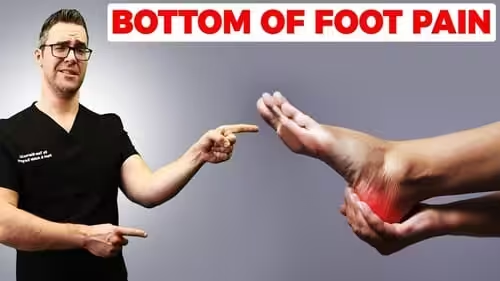
The human foot has two critical natural cushioning structures — the heel fat pad and the plantar forefoot fat pad — that absorb and distribute the enormous forces of walking and running across the load-bearing surfaces. When these fat pads thin or degenerate, patients experience a profoundly unpleasant sensation of walking on bones, with pain that is disproportionate to physical findings and that worsens the longer they stand or walk. Fat pad atrophy is underrecognized, underdiagnosed, and undertreated — but it is highly manageable with the right podiatric approach.
The Heel Fat Pad: Anatomy and Function
The calcaneal fat pad is a specialized adipose tissue compartment beneath the heel bone, organized into fibro-elastic septae that encase fat globules in a honeycomb structure. This architecture allows it to absorb up to 20% of ground reaction force with each heel strike and distribute pressure across the calcaneus. A healthy heel fat pad is approximately 18mm thick; an atrophied pad may measure 10mm or less.
The Plantar Forefoot Fat Pad
A similar, though thinner, fat pad covers the metatarsal heads, protecting the MTP joints and nerves from direct ground contact. When this pad thins, patients develop direct bone-on-ground contact pain at the ball of the foot — often confused with metatarsalgia from structural causes.
Causes of Fat Pad Atrophy
- Age — the most common cause; fat pad thickness decreases by approximately 30% between ages 30 and 80 as septae degenerate and fat lobules flatten
- Corticosteroid injections — repeated cortisone injections into the heel or forefoot fat pad cause fat necrosis and permanent volume reduction; this is a significant risk of overuse of cortisone for plantar fasciitis and metatarsalgia
- High-impact sport history — decades of running and jumping accelerate fat pad degeneration
- Rheumatoid arthritis — inflammatory joint disease causes forefoot fat pad displacement as the toes sublux and the fat pad migrates proximally
- Collagen vascular diseases — scleroderma and lupus affect fat pad architecture
- Diabetes — metabolic changes alter fat pad composition and resilience
- Prolonged steroid use — systemic corticosteroids redistribute and reduce subcutaneous fat
Symptoms
- Deep, aching heel or forefoot pain that is worse with prolonged standing and walking on hard surfaces
- A sensation of walking on the bones of the foot — as if the normal cushioning is gone
- Pain relieved by cushioned footwear or walking on carpeted surfaces
- Tenderness on direct palpation of the heel or metatarsal heads with minimal surrounding findings
- Thin, easily palpable heel bone or metatarsal heads without normal soft tissue thickness
Assessment
Dr. Biernacki assesses fat pad integrity with diagnostic ultrasound — fat pad thickness and architecture are directly measurable in real time. This confirms the clinical diagnosis and quantifies the degree of atrophy to guide treatment intensity.
Treatment
Cushioned Footwear Modifications
The primary treatment goal is replacing the lost intrinsic cushioning with external solutions. Extra-cushioned footwear with viscoelastic midsoles provides the most benefit for daily activity — HOKA, Brooks Glycerin, and New Balance Fresh Foam platforms provide significant cushioning for patients with fat pad atrophy.
Custom Accommodative Orthotics
Custom orthotics with viscoelastic heel cups, deep heel seats, and forefoot metatarsal padding directly replace the lost fat pad cushioning with engineered materials. A properly designed custom orthotic for fat pad atrophy is accommodative (designed for cushioning and pressure redistribution) rather than corrective. Dr. Biernacki fabricates these from a 3D digital foot scan at Balance Foot & Ankle.
Injectable Augmentation
For selected patients with severe heel fat pad atrophy unresponsive to external cushioning, injectable filler augmentation of the fat pad has been explored with biologic fillers. This is a specialized procedure performed in limited centers — Dr. Biernacki provides a referral to appropriate specialists when indicated.
Avoiding Cortisone in Atrophied Pads
Cortisone injections directly into an already-atrophied fat pad are contraindicated — they will cause further permanent fat necrosis and worsen the condition. Alternative anti-inflammatory approaches including ultrasound-guided PRP injection may be used when local anti-inflammatory treatment is needed.
Painful, Thin Soles? Custom Accommodative Orthotics Can Help.
Dr. Biernacki at Balance Foot & Ankle assesses fat pad integrity with ultrasound and designs custom accommodative orthotics for fat pad atrophy. Bloomfield Hills and Howell offices.
📞 (810) 206-1402 |
📧 Get Dr. Tom’s Free Lab Test Guide
Discover the 5 lab tests every person over 35 should ask their doctor about — explained in plain English by a board-certified physician.
📍 Located in Michigan?
Our board-certified podiatrists treat this condition at two convenient locations. Same-day appointments often available.

Insurance Accepted
BCBS · Medicare · Aetna · Cigna · United Healthcare · HAP · Priority Health · Humana · View All →
Howell Office
3980 E Grand River Ave, Suite 140
Howell, MI 48843
Get Directions →
Bloomfield Hills Office
43700 Woodward Ave, Suite 207
Bloomfield Hills, MI 48302
Get Directions →
Your Board-Certified Podiatrists



Ready to Get Back on Your Feet?
Same-week appointments available at both locations.
Book Your AppointmentMore Podiatrist-Recommended Foot Health Essentials
Top-Rated Arch Support Insole
Universal podiatrist-recommended insert for pain relief and prevention.
Foot Massage Ball
Daily 3-minute roll reduces most forms of foot and heel pain.
Moisture-Wicking Sock
Prevents fungus, blisters, and odor — the basics matter.
As an Amazon Associate, Balance Foot & Ankle earns from qualifying purchases. Product recommendations are based on clinical experience; prices and availability shown above update live from Amazon.
When to See a Podiatrist
If foot or ankle pain has been bothering you for more than a few weeks, home care alone may not be enough. Balance Foot & Ankle offers same-week appointments at our Howell and Bloomfield Hills clinics — no referral needed in most cases. Bring your current shoes and a short list of symptoms and we’ll build you a treatment plan in one visit.
Call Balance Foot & Ankle: (810) 206-1402 · Book online · Offices in Howell & Bloomfield Hills
Watch: Dr. Tom explains
Podiatrist-recommended products
As an Amazon Associate, Dr. Tom earns from qualifying purchases.
Heel cushioning for fat pad atrophy.
View on Amazon →Forefoot padding for atrophied metatarsal pads.
View on Amazon →Dynamic cushioning for atrophy.
View on Amazon →Topical comfort for bony prominence pain.
View on Amazon →Related resources
Ready to solve this? Book today.
Same-week appointments · Howell & Bloomfield Hills · 4.9★ (1,123+ reviews)
☎ (810) 206-1402Book Online →Pros & Cons of Conservative Care for foot care
Advantages
- ✓ Conservative care first
- ✓ Same-week appointments
- ✓ Multiple insurance accepted
Considerations
- ✗ Self-treatment can mask issues
- ✗ See a podiatrist if pain >2 weeks
Dr. Tom’s Recommended Products for foot care
Affiliate disclosure: As an Amazon Associate, Balance Foot & Ankle earns from qualifying purchases. We only recommend products we use with patients.


Footnanny Heel Cream Dr. Tom’s Pick
Best for: Daily moisturizer for cracked heels
Ready to Get Back on Your Feet?
Same-day appointments in Howell + Bloomfield Twp. Most insurance accepted. Dr. Tom Biernacki, DPM & team.
Book Today — Same-Day Appointments Available
Call Now: (810) 206-1402
About Your Care Team at Balance Foot & Ankle
Dr. Tom Biernacki, DPM · Board-Certified Foot & Ankle Surgeon. Specializes in conservative-first care, minimally invasive bunion surgery, and complex reconstruction.
Dr. Carl Jay, DPM · Accepting new patients. Specializes in sports medicine, athletic injuries, and routine podiatric care.
Dr. Daria Gutkin, DPM, AACFAS · Accepting new patients. Specializes in surgical reconstruction and pediatric podiatry.
Locations: 4330 E Grand River Ave, Howell, MI 48843 · 43494 Woodward Ave Suite 208, Bloomfield Twp, MI 48302
Hours: Mon–Fri 8:00 AM – 5:00 PM · (810) 206-1402

Dr. Tom Biernacki, DPM is a double board-certified podiatrist and foot & ankle surgeon at Balance Foot & Ankle Specialists in Southeast Michigan. With over a decade of clinical experience, he specializes in heel pain, bunions, diabetic foot care, sports injuries, and minimally invasive surgery. Dr. Biernacki is a member of the APMA and ACFAS, and his patient education content on MichiganFootDoctors.com and YouTube has reached over one million views.
Frequently Asked Questions
Can I see a podiatrist for heel pain without a referral?
How long does plantar fasciitis take to heal?
Should I walk on my heel if it hurts?
What does a podiatrist do for heel pain?
- Plantar Fasciitis: Diagnosis and Conservative Management (PubMed)
- Plantar Fasciitis (APMA)
- Diagnosis and Treatment of Plantar Fasciitis (PubMed / AAFP)
- Heel Pain (APMA)
Related Treatments at Balance Foot & Ankle
Our board-certified podiatrists offer advanced treatments at our Bloomfield Hills and Howell locations.