

▶ Watch
The Figure Skating Foot Environment
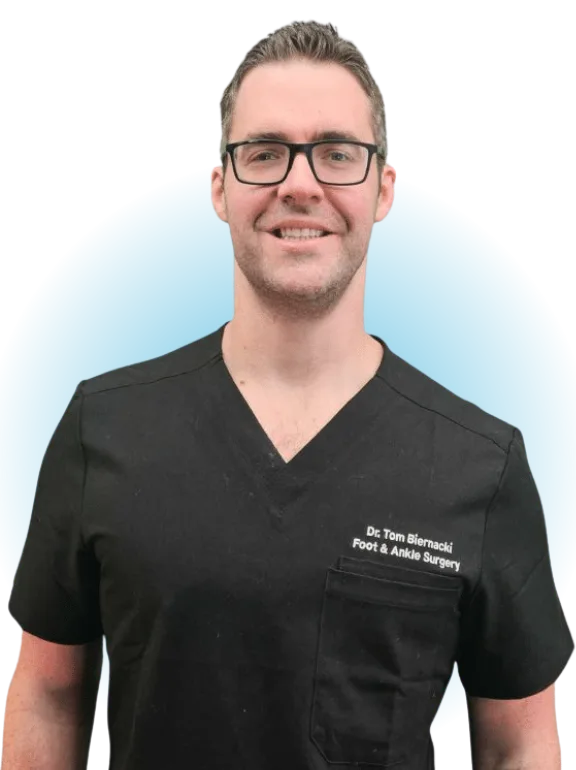
Medically Reviewed by Dr. Tom Biernacki, DPM — Board-Certified Podiatrist, Balance Foot & Ankle Specialists, Michigan. Last updated April 2026.
Figure skating places the foot in a uniquely challenging environment: enclosed in a rigid, form-fitting leather or synthetic boot attached to a steel blade, skating requires powerful edge control, explosive multi-revolution jumps, and artistically precise footwork — all on a rigid surface with essentially no shock absorption beyond the skater’s ankle and knee mechanics.
Competitive figure skaters, particularly those training triple and quadruple jumps, sustain jump landing forces of 3–8 times body weight through the skating boot. The cumulative effect of repeated jump landings across thousands of training repetitions creates a distinct injury profile unlike any other sport.
Lace Bite
“Lace bite” is the informal term for anterior ankle tendinopathy caused by excessive pressure from skate laces over the dorsal ankle. When laces are tied too tightly across the front of the ankle, the underlying tibialis anterior and extensor tendons are chronically compressed, causing inflammation, pain, and eventually tendon degeneration.
Prevention: use a skate tongue pad (foam or gel insert) beneath the tongue to cushion the lace contact area, avoid over-tightening laces in the ankle region (the lower laces near the boot should be snug but not compressive), and ensure proper boot fit so excessive lacing is not needed to achieve heel lock. Once lace bite develops, anti-inflammatory treatment, tongue padding, and temporary boot lacing modification allow recovery while continuing to skate.
Jump Landing Stress Injuries
The repeated impact of jump landings — always on the right foot (free leg landing) in standard skating technique — creates asymmetric lower extremity stress. Stress fractures of the second and third metatarsals, calcaneal stress fractures, and tibial stress reactions occur in high-volume jump training programs.
Young skaters whose skeletal development is still in progress are at heightened risk. Female figure skaters, particularly those with the female athlete triad / relative energy deficiency in sport (RED-S), have significantly elevated stress fracture rates from the combination of impact loading and nutritional deficiency that impairs bone density.
Subungual Hematoma and Toe Nail Problems
The rigid boot toe box creates repetitive pressure on the toenails, particularly the hallux. Subungual hematomas — blood beneath the nail from impact — are common after intense jump training. Nail loss and ingrown toenails from boot pressure are occupational hazards of skating. Proper boot fitting with appropriate toe room (not excessive — too much space creates instability) reduces nail trauma.
Bunions in Skaters
The rigidity of the skating boot can accelerate bunion formation or create painful pressure over existing hallux valgus deformity. Custom boot modifications — including leather stretching over the bunion prominence and padding — can accommodate mild to moderate bunion deformity. Severe bunions may ultimately require surgical correction, which must be timed carefully relative to competitive skating seasons.
Boot Fitting: The Foundation of Skating Foot Health
Properly fitted skating boots are the most important element of figure skating foot health. Boots should be fitted by an experienced skate fitter — not sized like street shoes. Heat molding, custom footbeds, and professional blade mounting alignment are all important for both performance and injury prevention. A boot that fits well should require minimal pain to break in; severe break-in pain suggests a fundamental fit problem that should be corrected rather than endured.
Foot or Ankle Pain? We Can Help.
Balance Foot & Ankle — Howell & Bloomfield Township, MI
📅 Book Online
📞 (810) 206-1402
Insurance Accepted
BCBS · Medicare · Aetna · Cigna · United Healthcare · HAP · Priority Health · Humana · View All →
Howell Office
4330 E Grand River Ave
Howell, MI 48843
Get Directions →
Bloomfield Township Office
43494 Woodward Ave, Suite 208
Bloomfield Township, MI 48302
Get Directions →
Ready to Get Back on Your Feet?
Book online 24/7 at either office.
Watch: Dr. Tom explains
Podiatrist-recommended products
As an Amazon Associate, Dr. Tom earns from qualifying purchases.
Stabilizes skater’s ankle during rehab.
Arch support inside skating boots.
Post-training icing protocol.
Related resources
Ready to solve this? Book today.
Book online 24/7 · Howell & Bloomfield Township · 4.9★ (1,200+ reviews)
More Podiatrist-Recommended Sports Essentials
Hoka Clifton 10

Max-cushion everyday shoe — podiatrist favorite for walking and running.

OOFOS Recovery Slide

Impact-absorbing recovery sandal — wear after long days on your feet.
As an Amazon Associate, Balance Foot & Ankle earns from qualifying purchases. Product recommendations are based on clinical experience; prices and availability shown above update live from Amazon.

When to See a Podiatrist
Athletic injuries heal faster with sport-specific rehab protocols — not generic rest and ice. Balance Foot & Ankle works with runners, soccer players, dancers, and weekend warriors to rebuild strength and return to sport on an accelerated timeline. Don’t let a foot injury keep you sidelined longer than necessary.
Call Balance Foot & Ankle: (810) 206-1402 · Book online · Offices in Howell & Bloomfield Township
In-Office Treatment at Balance Foot & Ankle
If home treatment isn’t providing relief for your foot and ankle conditions, our podiatry team at Balance Foot & Ankle can help with expert evaluations and advanced in-office care.
Book online 24/7. (810) 206-1402
Get Expert Care at Balance Foot & Ankle
Appointments at our Howell and Bloomfield Township offices. Board-certified podiatric surgeons. Most insurance accepted.

Dr. Tom Biernacki, DPM is a board-certified foot & ankle surgeon (ABFAS & ABPM) at Balance Foot & Ankle Specialists in Southeast Michigan. With over a decade of clinical experience, he specializes in heel pain, bunions, diabetic foot care, sports injuries, and minimally invasive surgery. Dr. Biernacki is a member of the APMA and ACFAS, and his patient education content on MichiganFootDoctors.com and YouTube has made him one of the most-followed foot & ankle educators on YouTube.