

You are in the right place. Dr. Tom Biernacki, DPM, FACFAS — board-certified foot & ankle surgeon with 3,000+ surgeries — explains exactly what flexible hammer toe surgery means and what works. Call (810) 206-1402 for same-day appointment at Howell or Bloomfield Township.
Quick answer: Flexible Hammertoe Surgery Pip Joint Arthroplasty is a common foot/ankle topic that affects many patients. The 2026 evidence-based approach combines proper diagnosis, conservative-first treatment, and escalation only when needed. We treat this regularly at our Howell and Bloomfield Township practices. Call (810) 206-1402.

What Is Flexible Hammertoe Surgery?
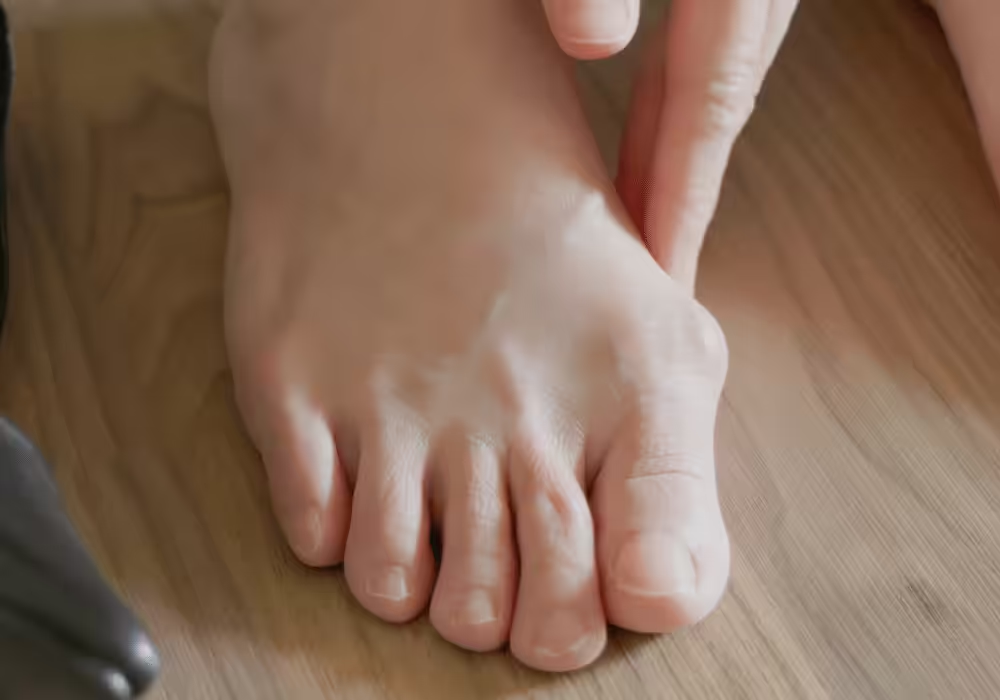
A flexible hammertoe is a toe deformity where the middle joint (proximal interphalangeal or PIP joint) bends downward but can still be manually straightened. Unlike rigid hammertoes — where the joint is fixed — flexible hammertoes have preserved passive range of motion. Surgery for flexible hammertoes is highly effective and involves a procedure called proximal interphalangeal joint arthroplasty.
At Balance Foot & Ankle, our surgical team performs hammertoe corrections as outpatient procedures with high patient satisfaction rates. Most patients are walking the same day of surgery and return to regular footwear within four to six weeks.
Who Needs Flexible Hammertoe Surgery?
Conservative treatment — wider shoes, padding, splinting, and metatarsal supports — is always attempted first. Surgery becomes appropriate when the deformity causes persistent pain, creates skin breakdown or ulceration from shoe pressure, interferes with wearing footwear, causes adjacent toe problems, or significantly affects quality of life despite conservative measures.
The best surgical candidates are non-smokers with good peripheral circulation and realistic expectations about recovery. We evaluate circulation using ankle-brachial index measurements and clinical examination before scheduling surgery.
Surgical Technique: PIP Joint Arthroplasty
Proximal interphalangeal joint arthroplasty is the most common procedure for flexible hammertoe correction. The surgery is performed under local anesthesia with sedation in an outpatient surgical facility.
Step-by-Step Surgical Process
A small longitudinal or elliptical incision is made over the top of the PIP joint. The extensor tendon is identified and either released or lengthened to reduce the deforming force pulling the toe upward. The joint is then exposed by releasing the collateral ligaments on each side. A small amount of bone is removed from the head of the proximal phalanx — this creates a space that allows the toe to be repositioned in a straight alignment.
The toe is held in the corrected position temporarily with a smooth Kirschner wire (K-wire) or an internal implant. K-wires protrude from the tip of the toe and are removed in the office at four to six weeks without anesthesia. Newer absorbable or permanent internal implants are available as alternatives for patients who prefer not to have protruding wires.
The incision is closed with absorbable sutures, and the toe is dressed in a corrective position with gauze and medical tape. A surgical shoe that protects the forefoot while allowing heel weight bearing is provided before the patient leaves the facility.
Additional Procedures Performed at the Same Time
Hammertoe correction is often combined with additional procedures addressing the underlying cause of the deformity. A flexor tendon tenotomy releases the flexor tendon on the bottom of the toe, preventing recurrence from the flexor overpowering the extensor. A metatarsal osteotomy may be performed if the long metatarsal is contributing to forefoot overload and hammertoe formation. Bunion correction (bunionectomy) is frequently performed at the same session when a medially deviated first ray is displacing the second toe.

Recovery After Flexible Hammertoe Surgery
First Two Weeks
Patients are weight bearing immediately in the surgical shoe, though elevation and ice are recommended for the first 72 hours to minimize swelling. Driving is restricted on the operative foot until the surgical shoe is discontinued. Dressing changes are performed by the patient every two to three days using materials provided at discharge.
Weeks Two to Six
Swelling gradually decreases but the toe will remain noticeably swollen for two to four months. If a K-wire is present, it is removed at the four to six week visit. Transition to a wide athletic shoe or surgical sandal typically begins at three to four weeks. Light activity such as walking for exercise can resume once the incision is fully healed.
Three to Six Months
Most patients return to all regular footwear by two to three months. Final surgical results — including full swelling resolution and scar maturation — are assessed at the six-month follow-up. Return to athletic activity including running and court sports typically occurs at three months.
Outcomes and Expectations
Patient satisfaction after flexible hammertoe surgery is high, with most studies reporting good to excellent outcomes in over 85 percent of cases. The toe is permanently straightened and footwear fitting improves significantly. Some residual stiffness at the PIP joint is expected and normal — the joint is intentionally made less mobile as part of the procedure.
Recurrence can occur, particularly if the underlying cause (such as an uncorrected bunion or long metatarsal) is not addressed simultaneously. Our surgeons perform comprehensive preoperative planning to identify all contributing factors and correct them in a single operative session when possible.
Risks and Complications
As with all surgery, risks include infection, wound healing complications, deep vein thrombosis, nerve injury, and anesthetic reactions. Hammertoe-specific risks include recurrence of deformity, transfer lesion (pain shifting to an adjacent metatarsal), floating toe (a toe that does not contact the ground), and vascular compromise. These complications are uncommon when surgery is performed by an experienced foot and ankle surgeon with appropriate patient selection.
Ready to Relieve Your Foot Pain?
Board-certified podiatrists serving Southeast Michigan. Same-week appointments available.
Book Your AppointmentPainful Hammertoe Deformity?
Our foot surgeons perform minimally invasive PIP joint arthroplasty to straighten hammertoes with excellent outcomes.
Book an AppointmentMore Podiatrist-Recommended Hammertoe Essentials
Extra-Depth Orthopedic Shoe
Orthofeet Sprint — tall toe box prevents hammertoe rubbing and friction.
Wide-Toe-Box Walking Shoe
New Balance 990v6 — accommodates curled toes without pressure.
Supportive Insole


![How to Fix Hammer Toes at Home [Overlapping & Crossover Toes]!](https://www.michiganfootdoctors.com/wp-content/cache/flying-press/7ea0260b79509af610220599744e2c56.jpg)
Watch: How to Fix Hammer Toes at Home [Overlapping & Crossover Toes]! — MichiganFootDoctors YouTube
PowerStep Pinnacle — reduces forefoot pressure that drives hammertoe.
As an Amazon Associate, Balance Foot & Ankle earns from qualifying purchases. Product recommendations are based on clinical experience; prices and availability shown above update live from Amazon.
When to See a Podiatrist
Rigid hammertoes don’t reduce with splinting alone — the tendon and capsule have contracted. If the toe no longer straightens passively, surgical correction restores alignment in one short outpatient visit. Call Balance Foot & Ankle to see whether your deformity is still flexible (and responsive to the conservative tools above) or if it’s time for a 20-minute in-office correction.
Call Balance Foot & Ankle: (810) 206-1402 · Book online · Offices in Howell & Bloomfield Township
Frequently Asked Questions
How long does recovery take after flexible hammertoe surgery?
Patients wear a post-op surgical shoe for 4-6 weeks with protected weight-bearing. Return to regular shoes occurs around 6-8 weeks, with full recovery by 3 months.
Is hammertoe surgery painful?
Most patients experience mild to moderate pain controlled with oral medication for 3-5 days. Ankle or regional blocks during surgery provide 12-24 hours of initial pain relief.
What is the difference between flexible and rigid hammertoe surgery?
Flexible hammertoes are corrected with tendon releases and PIP arthroplasty. Rigid deformities require more extensive bone work, PIP fusion, and longer recovery periods.
Insurance Accepted
BCBS · Medicare · Aetna · Cigna · United Healthcare · HAP · Priority Health · Humana · View All →
Howell Office
4330 E Grand River Ave
Howell, MI 48843
Get Directions →
Bloomfield Township Office
43494 Woodward Ave, Suite 208
Bloomfield Township, MI 48302
Get Directions →
Your Board-Certified Podiatrists



Ready to Get Back on Your Feet?
Same-week appointments available at both locations.
Book Your AppointmentIn Our Clinic
Hammertoes come to our clinic in two flavors: flexible (the toe still passively straightens) and rigid (it doesn’t). For flexible hammertoes we use gel toe crests, roomier toe boxes, custom orthotics to address the underlying instability, and sometimes night splints. Rigid hammertoes with a corn on top of the PIP joint, or a callus under the metatarsal head, usually need a minor outpatient procedure (PIP arthroplasty or fusion) to straighten the toe. The patients who wait too long develop fixed deformities and skin breakdown — we would much rather address a flexible hammertoe early.
In-Office Treatment at Balance Foot & Ankle
When conservative care isn’t enough, Dr. Tom Biernacki and the team at Balance Foot & Ankle offer advanced, same-day options — including Hammertoe Treatment Michigan at our Howell and Bloomfield Township clinics.
Same-day appointments available. Call (810) 206-1402 or book online.
In-Office Treatment at Balance Foot & Ankle
If home treatment isn’t providing relief for your hammertoes, our podiatry team at Balance Foot & Ankle can help with same-day evaluations and advanced in-office care.
Same-day appointments available. (810) 206-1402
Doctor Hoy’s Natural Pain Relief Gel
Natural topical pain relief I use in our clinic. Arnica + camphor formula — apply directly to the area 3–4x daily. ($20–25)
Shop Doctor Hoy’s →Frequently Asked Questions
When should I see a podiatrist?
If symptoms persist past 2 weeks, affect your normal activity, or are accompanied by red-flag symptoms (warmth, redness, swelling, inability to bear weight).
What does treatment cost?
Most diagnostic visits and conservative treatments are covered by Medicare and major insurers. Out-of-pocket costs vary by your specific plan.
How quickly can I get an appointment?
Most non-urgent cases see us within 5 business days. Urgent cases (sudden pain, possible fracture) typically same or next business day.
Ready to fix this for good?
Reading goes so far. The fastest path is a 30-minute office visit. Same-day Howell or Bloomfield Township. Call (810) 206-1402.
Get Expert Care at Balance Foot & Ankle
Same-week appointments at our Howell and Bloomfield Township offices. Board-certified podiatric surgeons. Most insurance accepted.

Dr. Tom Biernacki, DPM is a board-certified foot & ankle surgeon (ABFAS & ABPM) at Balance Foot & Ankle Specialists in Southeast Michigan. With over a decade of clinical experience, he specializes in heel pain, bunions, diabetic foot care, sports injuries, and minimally invasive surgery. Dr. Biernacki is a member of the APMA and ACFAS, and his patient education content on MichiganFootDoctors.com and YouTube has made him one of the most-followed foot & ankle educators on YouTube.
More questions patients ask
What is a hammertoe?
A hammertoe is a deformity where the toe bends abnormally at the middle joint, creating a hammer-like appearance. It typically affects the second through fifth toes and results from muscle imbalance, tight shoes, genetics, or underlying conditions like arthritis. Without treatment, flexible hammertoes become rigid and may require surgical correction. Dr. Biernacki offers both conservative and surgical treatment options.
Can hammertoes be fixed without surgery?
Flexible hammertoes (those that can still be straightened manually) often respond to conservative treatment including toe splints, padding, shoe modifications, custom orthotics, and stretching exercises. Once a hammertoe becomes rigid, surgery may be necessary. Early intervention provides the best outcomes for non-surgical management.
What does hammertoe surgery involve?
Modern hammertoe correction typically involves a minimally invasive approach where Dr. Biernacki releases the contracted tendon and removes a small bone segment through a tiny incision. Recovery involves wearing a surgical shoe for 3-4 weeks with most patients returning to regular shoes within 6 weeks. Success rates exceed 90% with low recurrence rates.
Still have a question about coverage or cost? Book online and we will check your benefits before your visit: Book in Howell · Book in Bloomfield Township. Prefer to talk it through first? Call (810) 206-1402.