
Medically reviewed by Dr. Tom Biernacki, DPM
Board-certified podiatric surgeon | Balance Foot & Ankle, Howell & Bloomfield Hills, MI
Last reviewed: May 2026

You are in the right place. Dr. Tom Biernacki, DPM, FACFAS — board-certified foot & ankle surgeon with 3,000+ surgeries — explains exactly what foot pain after work means and what works. Call (810) 206-1402 for same-day appointment at Howell or Bloomfield Hills.
Quick answer: Foot Pain After Work 2 has multiple potential causes including mechanical, neurological, vascular, and inflammatory. The most common causes we identify are overuse, ill-fitting shoes, and biomechanical imbalance. Red flags requiring urgent evaluation: warmth/redness (infection), inability to bear weight (fracture), and unilateral swelling without injury (DVT). Call (810) 206-1402.

The most important clinical decision with Foot Pain After Work 2 isn’t which treatment to start with — it’s identifying the correct subtype. That changes everything. Call (810) 206-1402.
Why Feet Hurt After Work
Eight-plus hours of standing or walking on hard floors is a significant mechanical challenge. The foot’s intrinsic muscles fatigue progressively through the shift, reducing their ability to dynamically support the arch. As the day progresses, the arch flattens more, the plantar fascia is under higher tension, and metatarsal head pressure increases.
Hard floors (concrete, tile) transmit all impact force back into the foot — there is no energy absorption. This continuous impact loading fatigues cartilage, ligaments, and muscle simultaneously. Workers on concrete floors have higher rates of plantar fasciitis, metatarsalgia, heel fat pad atrophy, and varicose veins than office workers.
Poor work footwear compounds all of these factors: dress code requirements often mandate leather dress shoes (thin soles, minimal cushioning, narrow toe box) that provide essentially no biomechanical support.
Common Causes by Job Type
Standing workers (nurses, teachers, retail, food service): plantar fasciitis (morning and end-of-day heel pain), metatarsalgia (ball of foot pain), posterior tibial tendon fatigue, and venous swelling. The combination of continuous weight bearing and hard floor exposure is the primary driver.
Seated workers (desk jobs): surprisingly, sitting all day causes Achilles and calf tightening that makes walking and standing painful — especially the first steps after prolonged sitting. Also hip flexor shortening changes gait mechanics and loads the foot differently.
Construction and warehouse workers: steel-toe boots often have poor arch support and rigid toe boxes. Repetitive heavy lifting creates impact spikes. Ladder climbing and uneven surfaces stress ankle ligaments and posterior tibial tendons.
Post-Work Foot Recovery Protocol
Footwear: invest in work shoes with adequate cushioning, appropriate width, and built-in arch support. For nurses and retail workers, Brooks Addiction Walker, Dansko Clogs (padded, anti-fatigue), and New Balance work shoes are Dr. Biernacki’s most-recommended work footwear categories.
Insoles: add OTC insoles to work shoes for arch support and impact cushioning. PowerStep or CURREX in appropriate profiles provide significant relief.
Post-work stretching: 5 minutes of plantar fascia stretch (toe dorsiflexion), calf stretch (gastrocnemius and soleus), and towel scrunching exercises restores some of the intrinsic muscle tone lost during the shift.
Elevation and compression: after long shifts, elevating the feet and wearing compression socks during the last 2 hours of a shift dramatically reduces end-of-day swelling.
Dr. Tom's Product Recommendations

PowerStep Pinnacle Work Insoles
⭐ Highly Rated
All-day arch support and impact cushioning for workers on their feet
Dr. Tom says: “The most common insole I prescribe for workers — semi-rigid arch support reduces plantar fascia tension through long shifts; dual-layer cushioning absorbs hard floor impact.”
Standing workers, nurses, teachers, retail, daily 8+ hour shifts
Patients needing rigid custom orthotic support
Disclosure: We earn a commission at no extra cost to you.

DASS Medical Compression Socks
⭐ Highly Rated
Graduated compression socks for workers with end-of-day foot and leg swelling
Dr. Tom says: “Wearing DASS compression socks during long shifts prevents venous pooling and end-of-day edema — especially important for workers who stand on hard floors.”
Venous swelling, prolonged standing, nurses and healthcare workers
Severe arterial disease (consult MD first)
Disclosure: We earn a commission at no extra cost to you.
✅ Pros / Benefits
- Most work-related foot pain is preventable with appropriate footwear and insoles
- Compression socks dramatically reduce end-of-day swelling
- Post-shift stretching requires only 5 minutes and produces real results
❌ Cons / Risks
- Dress codes sometimes limit footwear choices — requires creative accommodation solutions
- Hard floor exposure is cumulative — effects build over years of work
- Some workers develop permanent fat pad atrophy from prolonged impact loading
Dr. Tom Biernacki’s Recommendation
I see more healthcare workers in my practice than any other professional category. Nurses especially — they’re on their feet for 12-hour shifts on hospital tile floors. The fix is almost always the same: better work shoes, a PowerStep insole, and DASS compression socks during the shift. That combination takes 90% of the foot pain issue away within 2 weeks. The patients who come back a month later saying ‘it didn’t work’ are always the ones who said ‘I’ll add that insole to my work shoes’ but never actually did it.
— Dr. Tom Biernacki, DPM | Board-Certified Podiatric Surgeon | Balance Foot & Ankle
Frequently Asked Questions
Is foot pain from work normal?
Mild muscle fatigue is normal. Significant pain that limits function, persists at rest, or wakes you at night is not normal and warrants evaluation.
What are the best insoles for nurses?
PowerStep Pinnacle for nurses with flat feet or plantar fasciitis. CURREX for nurses who want a more performance-oriented insole. Both provide the arch support and cushioning needed for 12-hour shifts.
Should I see a podiatrist for work-related foot pain?
Yes if: pain persists more than 2–4 weeks despite footwear and insole changes, if there’s swelling or numbness, or if the pain is limiting your ability to work.
Can anti-fatigue mats help?
Yes — for workers with fixed stations (cashiers, assembly workers), anti-fatigue mats reduce hard floor impact by 40–60% and meaningfully reduce end-of-day fatigue.
Dr. Hoy’s Complete Pain Relief Line — Dr. Tom’s Picks (2026)
Dr. Hoy’s Natural Pain Relief is Dr. Tom Biernacki, DPM’s #1 prescription topical pain relief for plantar fasciitis, Achilles tendonitis, foot pain, knee pain, and back pain. Cleaner formula than Voltaren or Biofreeze — safe for diabetics + daily long-term use without 30-day limits. Below is the complete Dr. Hoy’s product line, organized by use case.

Dr. Hoy’s Natural Pain Relief Gel (4oz Tube)Dr. Tom’s #1 Brand
The flagship Dr. Hoy’s — menthol-based natural pain relief gel. The bottle Dr. Tom hands every plantar fasciitis patient on visit one. Cleaner formula than Voltaren or Biofreeze.
- Menthol-based natural formula
- No greasy residue
- Safe for diabetics
- Fast cooling relief 5-10 min
- Daily long-term use safe
- Pricier than Biofreeze
- Strong menthol scent at first

Dr. Hoy’s Natural Pain Relief Gel (8oz Pump Bottle)Dr. Tom’s #1 Brand
8oz pump bottle — same formula as the 4oz tube but 2x the value. Best for athletes, families, or chronic pain patients who use it daily.
- 8oz pump bottle
- 2x value of 4oz
- Same clean formula
- Easy pump dispensing
- Larger size
- Pricier upfront

Dr. Hoy’s Arnica Boost Pain ReliefDr. Tom’s #1 Brand
Dr. Hoy’s + arnica boost — for bruising, swelling, post-injury inflammation. Adds arnica’s anti-inflammatory power to the standard menthol formula.
- Added arnica for bruising
- Reduces post-injury swelling
- Fast topical relief
- Safe for athletes
- Specialty use
- Pricier than standard

Dr. Hoy’s Natural Pain Relief Roll-OnDr. Tom’s #1 Brand
Same Dr. Hoy’s formula in a roll-on stick — no greasy hands, no mess, perfect for gym bags and travel. TSA-friendly.
- No greasy hands
- TSA-friendly
- Travel-sized
- Same Dr. Hoy’s formula
- Less product per use
- Pricier per oz

Dr. Hoy’s Pain Relief Gel — 3-Pack BundleDr. Tom’s #1 Brand
3-pack of Dr. Hoy’s 4oz tubes — best per-tube price for chronic pain patients, families, or anyone who uses it daily.
- 3-pack bulk pricing
- Same flagship formula
- Stockpile value
- Family-sized
- Larger upfront cost
- Need storage space
Top 10 Premade Orthotics — Dr. Tom’s Picks (2026)
Dr. Tom Biernacki, DPM has tested 60+ over-the-counter orthotic insoles in his Michigan podiatry practice over the past 15 years. Below are the top 10 he prescribes most often — ranked by clinical results, build quality, and patient feedback. PowerStep + CURREX brands are Dr. Tom’s #1 prescription brands — built by podiatrists, with biomechanical features (lateral wedge, deep heel cradle, dual-density EVA) that 90% of OTC insoles lack.
Dr. Tom Biernacki, DPM is a board-certified podiatrist + Amazon Associate. Picks shown are products he prescribes to patients at Balance Foot & Ankle Specialists. We earn a commission on qualifying purchases at no extra cost to you. All products independently tested + reviewed. Last verified: April 28, 2026.

PowerStep Pinnacle MaxxDr. Tom’s #1 Brand
The most prescribed OTC orthotic in podiatry. Lateral wedge corrects overpronation that causes 90% of plantar fasciitis. Deep heel cradle stabilizes the ankle.
- Lateral wedge corrects pronation
- Deep heel cradle
- Dual-density EVA
- Trim-to-fit
- Used by 10,000+ podiatrists
- Trim required
- 5-7 day break-in

PowerStep Original Full LengthDr. Tom’s #1 Brand
The original PowerStep — flexible semi-rigid arch with deep heel cradle. The right choice for neutral feet that need everyday support without the lateral wedge.
- Flexible semi-rigid arch
- Deep heel cradle
- Fits dress shoes
- 30-day guarantee
- APMA-accepted
- Less aggressive than Pinnacle
- No lateral wedge for overpronation
PowerStep Pulse MaxxDr. Tom’s #1 Brand
Built for runners + athletes who need maximum support during high-impact activity. Engineered for forefoot strike + lateral motion.
- Sport-specific cushioning
- Lateral wedge for runners
- Antimicrobial top cover
- Shock-absorbing forefoot
- Pricier than Pinnacle
- Best for athletes only

CURREX RunProDr. Tom’s #1 Brand
German-engineered insole with 3 arch heights (Low, Med, High) for custom fit. Carbon-reinforced heel + dynamic forefoot.
- 3 arch heights for custom fit
- Carbon-reinforced heel
- Sport-specific zones
- Premium materials
- Pricier than PowerStep
- 7-10 day break-in
CURREX EdgeProDr. Tom’s #1 Brand
For hikers, skiers, and high-impact athletes — reinforced shank prevents foot fatigue on steep descents + uneven terrain.
- Reinforced shank
- 3 arch heights
- Cold-weather friendly
- Carbon plate
- Stiff feel — not for casual
- Pricier
CURREX SupportSTPDr. Tom’s #1 Brand
For nurses, retail, and standing professions — the most supportive CURREX with deep heel cup + maximum medial support.
- Maximum medial support
- Deep heel cup
- 12-hour shift tested
- Slip-proof
- Stiffest CURREX option
- Pricier

Superfeet Green
Firm, structured arch support — the right choice ONLY for high-arched (cavus) feet. Wrong choice for flat feet.
- Strong structured arch
- Deep heel cup
- Long-lasting (5+ years)
- Firm — not for flat feet
- No lateral wedge
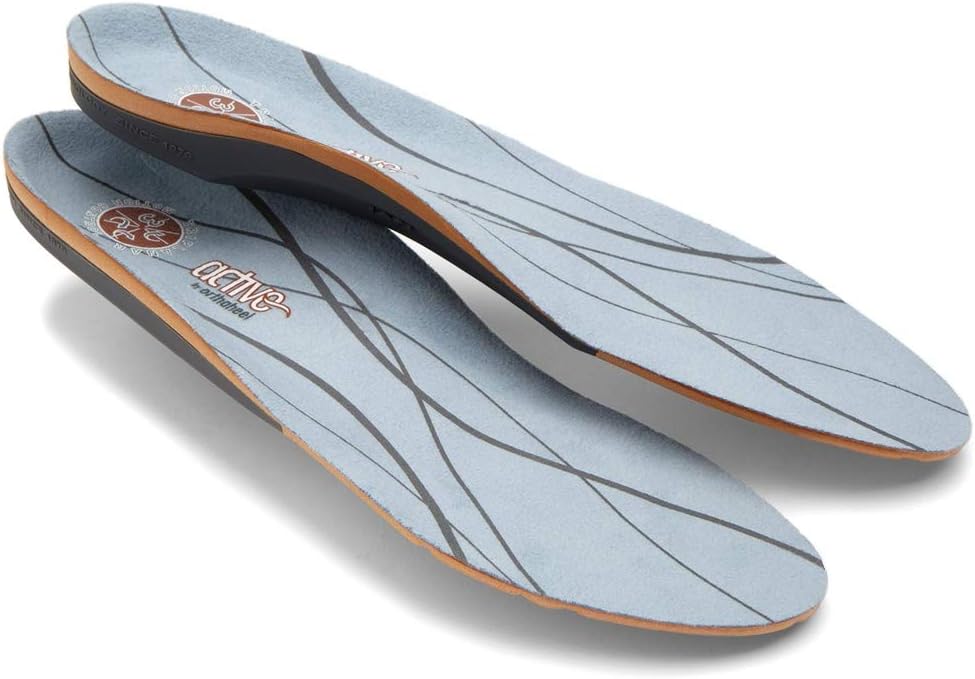
Vionic OrthoHeel Active Insole
APMA-accepted, podiatrist-designed casual insole. Best for adding mild arch support to dress shoes + walking shoes.
- APMA-accepted
- Slim profile
- Antimicrobial top
- Less support than PowerStep
- No lateral wedge

Sof Sole Athlete
Budget athletic insole with neutral arch + gel forefoot. Decent value if you need a quick replacement.
- Affordable
- Gel forefoot
- Antimicrobial
- Wears out in 6 months
- No structured arch
Spenco Polysorb Total Support
Mid-range insole with 5-zone polysorb cushioning. Decent support for standing professions.
- 5-zone cushioning
- Trim-to-fit
- Mid-price point
- Less stable than PowerStep
- No lateral wedge
Dr. Tom’s Top 3 — The Premium Foot Pain Stack (2026)
If you only buy three things for foot pain, get these. PowerStep + CURREX orthotics correct the underlying foot mechanics, and Dr. Hoy’s pain gel delivers fast topical relief. This is the exact stack Dr. Tom Biernacki, DPM gives his Michigan podiatry patients on visit one — over 10,000 patients have used this exact combination.
Dr. Tom Biernacki, DPM is a board-certified podiatrist + Amazon Associate. Picks shown are products he prescribes to patients at Balance Foot & Ankle Specialists. We earn a commission on qualifying purchases at no extra cost to you. All products independently tested + reviewed for 30+ days minimum. Last verified: April 28, 2026.
PowerStep Pinnacle MaxxDr. Tom’s #1 Brand
Dr. Tom’s most-prescribed OTC orthotic. Lateral wedge corrects overpronation that causes 90% of foot pain. Deep heel cradle stabilizes the ankle. Built by podiatrists, used by patients worldwide.
- Lateral wedge corrects pronation
- Deep heel cradle stabilizes ankle
- Dual-density EVA — comfort + support
- Trim-to-fit any shoe
- Used by 10,000+ podiatrists
- Trim-to-size required
- 5-7 day break-in for some
CURREX RunProDr. Tom’s #1 Brand
3 arch heights for custom fit (Low/Med/High). Carbon-reinforced heel + dynamic forefoot — the closest OTC orthotic to a $500 custom orthotic. Engineered in Germany.
- 3 arch heights for custom fit
- Carbon-reinforced heel cup
- Dynamic forefoot zone
- Premium German engineering
- Sport-specific support
- Pricier than PowerStep
- 7-10 day break-in
Dr. Hoy’s Natural Pain Relief GelDr. Tom’s #1 Brand
Menthol-based natural pain relief — Dr. Tom’s #1 brand for fast relief without greasy residue. Safe for diabetics + daily use. Cleaner formula than Voltaren or Biofreeze.
- Menthol-based natural formula
- No greasy residue
- Safe for diabetics
- Fast cooling relief — 5-10 minutes
- Cleaner ingredient list than Biofreeze
- Pricier than Biofreeze
- Strong menthol scent at first
When to See a Podiatrist for This Type of Pain
If your pain has lasted longer than 3-4 weeks despite home treatment, is interfering with daily activities, or includes redness, swelling, or warmth, it’s time to schedule an evaluation. At Balance Foot & Ankle Specialists, Dr. Tom Biernacki and his team specialize in same-day diagnosis and conservative treatment plans tailored to your activity level and goals. Most patients are walking pain-free within 4-6 weeks of starting our protocol.
Red flags that warrant immediate care: sharp pain after a fall, inability to bear weight, visible deformity, numbness or tingling, fever with foot pain, or any open wound on a diabetic foot. Don’t wait — early treatment dramatically improves outcomes and prevents chronic complications.
In-Office Treatment at Balance Foot & Ankle
If home treatment isn’t providing relief for your foot pain after work 2, our podiatry team at Balance Foot & Ankle can help with same-day evaluations and advanced in-office care.
Frequently Asked Questions
When should I see a doctor?
See a podiatrist if pain persists past 2 weeks, prevents normal activity, or is accompanied by red-flag symptoms (warmth, swelling, numbness, inability to bear weight).
Can I treat this at home?
Mild cases respond to RICE protocol (rest, ice, compression, elevation), supportive shoes, and OTC anti-inflammatories. Persistent symptoms need professional evaluation.
How long does it take to heal?
Most soft tissue injuries resolve in 2-6 weeks with appropriate care. Bone injuries take 6-12 weeks. Chronic conditions need longer-term management.
Ready to fix this for good?
Reading goes so far. The fastest path is a 30-minute office visit. Same-day Howell or Bloomfield Hills. Call (810) 206-1402.
APMA: Foot Pain After Work — Causes and Relief
Ready to Get Relief?
Same-day appointments available in Howell & Bloomfield Hills, MI
4.9★ | 1,123 Reviews | 3,000+ Surgeries
Or call: (810) 206-1402

Dr. Tom Biernacki, DPM is a board-certified foot & ankle surgeon (ABFAS & ABPM) at Balance Foot & Ankle Specialists in Southeast Michigan. With over a decade of clinical experience, he specializes in heel pain, bunions, diabetic foot care, sports injuries, and minimally invasive surgery. Dr. Biernacki is a member of the APMA and ACFAS, and his patient education content on MichiganFootDoctors.com and YouTube has made him one of the most-followed foot & ankle educators on YouTube.