
Medically reviewed by Dr. Tom Biernacki, DPM
Board-certified podiatric surgeon | Balance Foot & Ankle
Last reviewed: May 2026

Quick answer: Fusion of the great-toe joint trades a worn, painful joint for a stable, pain-free one, and it is considered mainly for advanced arthritis or a failed prior procedure. The key first step is confirming the cartilage damage is severe enough that joint-preserving options would not last. We review your X-rays and choices at our Howell and Bloomfield Township offices. Call (810) 206-1402.
✅ Medically reviewed by Dr. Tom Biernacki, DPM — Board-Certified Podiatrist · Last updated April 7, 2026
>
Great Toe Joint Fusion Surgery [Faster Recovery Time Tips!]
Great Toe Joint Fusion Surgery: 90%+ patient happiness in the right criteria, reviews are unbeatable and most people say they would do it again!
Great Toe Joint Fusion Overview:

- Great Toe Joint Fusion Surgery: Once you get over losing some motion, the long term reviews are unbeatable and almost everyone is happy with the results!
- This procedure involves fusing the big toe joint at the base and is considered the ultimate big toe surgery in terms of happiness and expected results.
- Everyone is shocked when they are told that they are going to lose there big toe joint, but many long term follows find that patients are most happy with this procedure.
- Big Toe Joint Fusion
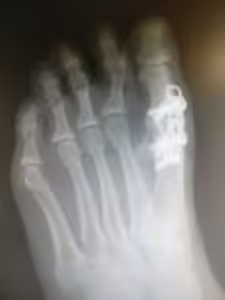
Indications for Great Toe Joint Fusion Surgery:
- Hallux limitus.
- Hallux Rigidus
- Bunion.
- Osteoarthritis of the Great Toe.
- Severe gout of the big toe.

Great Toe Joint Fusion Surgery Procedure:
- Fusion of the big toe joint guarantees that if the fusion surgery is successful, there will never be another deformity that takes place in that area.
- A bunion will never reform and joint osteoarthritis will never have the chance to re-develop.
- The only people who should avoid this type of surgery are people who plan on regularly wearing high heeled shoes over 1-inch, or people like carpet layers or professional bowlers who must regularly pivot off of their big toe joint.
For more see this link: Big Toe Joint Fusion
Great Toe Joint Fusion Recovery Time:
Recovery Timeline:
- Recovery time is usually a couple months total (2 months), but you will only be non-weight bearing in a cast for the first couple of weeks, then the rest of the time will be spent in a surgical shoe that you can walk around in.
- There are certain things you can do to make the healing time faster and slower, they are detailed in this big toe joint fusion recovery time guide:
Week 1:
- Most patients will be fairly sore and protected in a boot, bulky dressing or even a cast.
Week 2:
- We generally tend to transition patients to a nice bulky dressing in a surgical shoe.
- We use a plate, thus some weight bearing is very safe.
Week 3:
- Sutures are usually removed at this point, unless we us absorbable sutures.
- We generally tend to use absorbable sutures.
- At this point we re-apply one final dressing.
Weeks 4-5:
- Most patients are able to transition back to a nice supportive shoe with a band-aid over the incision site at this point.
- Some patients are protected even longer in some cases if there is decreased wound healing.
Weeks 6-8:
- Most patients usually start to feel better than prior to the surgery.
- It is normal to still have a decent amount of pain.
3 Months:
- At this point most patients are at about 70-75% of the final product and are starting to feel better.
6 Months:
- Most patients reach about 90-95% of the final outcome at this point.
- It is still not 100%.
1 Year:
- At this point you should reach the final product.
- This means 100% of the what the surgical result will likely be.

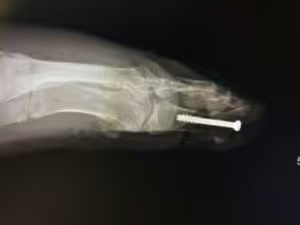
Big Toe Joint Fusion Recovery Time
For more on Great Toe Joint Fusion Surgery:
Related Treatment Guides
- Plantar Fasciitis & Heel Pain Treatment
- Custom 3D Orthotics
- Sports Foot & Ankle Injury Treatment
- Bunion Treatment
📍 Located in Michigan?
Our board-certified podiatrists treat this condition at two convenient locations. Book online 24/7 at either office.
Considering Great Toe Joint Fusion?
First metatarsophalangeal joint fusion (arthrodesis) is the gold standard for severe hallux rigidus. Our podiatric surgeons perform this procedure with excellent outcomes and high patient satisfaction.
📞 Or call us directly: (810) 206-1402
Clinical References
- Coughlin MJ, Shurnas PS. Hallux rigidus: grading and long-term results of operative treatment. Journal of Bone and Joint Surgery. 2003;85(11):2072-2088.
- Raikin SM, Ahmad J, Pour AE, Abidi N. Comparison of arthrodesis and metallic hemiarthroplasty of the hallux metatarsophalangeal joint. Journal of Bone and Joint Surgery. 2007;89(9):1979-1985.
- Brodsky JW, Passmore RN, Pollo FE, Shabat S. Functional outcome of arthrodesis of the first metatarsophalangeal joint using parallel screw fixation. Foot and Ankle International. 2005;26(2):140-146.
In-Office Treatment at Balance Foot & Ankle
If home treatment isn’t providing relief for your foot pain in the big toe joint, our podiatry team at Balance Foot & Ankle can help with expert evaluations and advanced in-office care.
Ready to Get Relief?
Book online 24/7 in Howell & Bloomfield Township, MI
4.9★ | 1,200+ Reviews | 3,000+ Surgeries
Or call: (810) 206-1402

Dr. Tom Biernacki, DPM is a board-certified foot & ankle surgeon (ABFAS & ABPM) at Balance Foot & Ankle Specialists in Southeast Michigan. With over a decade of clinical experience, he specializes in heel pain, bunions, diabetic foot care, sports injuries, and minimally invasive surgery. Dr. Biernacki is a member of the APMA and ACFAS, and his patient education content on MichiganFootDoctors.com and YouTube has made him one of the most-followed foot & ankle educators on YouTube.
More questions patients ask
What is great toe arthritis?
Great toe arthritis (hallux rigidus) is degenerative joint disease of the 1st metatarsophalangeal joint. It causes pain, stiffness, and bone spur formation at the base of the big toe. It's the most common arthritic condition in the foot, affecting adults over 30.
What are the stages of great toe arthritis?
Stage 1: mild stiffness with pain at end-range motion. Stage 2: moderate bone spurs with decreased motion. Stage 3: significant joint space narrowing with constant pain. Stage 4: complete cartilage loss with bone-on-bone contact. Treatment depends on the stage.
How is great toe arthritis treated?
Early stages: stiff-soled shoes, custom orthotics with Morton's extension, anti-inflammatory medication, and corticosteroid injections. Advanced stages: cheilectomy (bone spur removal) or joint fusion surgery. Doctor Hoy's Natural Pain Relief helps manage daily discomfort.
What is great toe joint fusion and when is it needed?
Great toe joint fusion — medically termed first metatarsophalangeal (MTP) arthrodesis — is the surgical fusion of the joint at the base of the big toe where the metatarsal meets the proximal phalanx. It permanently eliminates joint motion and is indicated when: hallux rigidus (big toe joint osteoarthritis) has reached end-stage with severe pain, near-complete loss of joint space, and failure of conservative and joint-preserving surgical treatments; hallux valgus (bunion) is accompanied by significant joint arthritis; the joint is severely deformed from rheumatoid arthritis, avascular necrosis, or post-traumatic arthrosis; or a previous bunion surgery has failed with secondary joint damage. The procedure provides reliable, long-lasting pain relief and is the benchmark against which all other first MTP joint procedures are compared.
How is great toe joint fusion different from bunion surgery?
Great toe joint fusion and bunion surgery both address first MTP joint pathology but are fundamentally different procedures for different disease stages. Bunion surgery (hallux valgus correction) realigns a deformed but still-cartilaginous joint — the metatarsal is cut and repositioned (osteotomy) to straighten the big toe angle, and the joint is preserved with its cartilage intact. The joint retains full or near-full motion after recovery. First MTP fusion eliminates the joint entirely — it is performed when the cartilage has been destroyed by arthritis or when joint alignment is too severely compromised to be corrected while preserving joint function. The key discriminating factor is the quality of the remaining joint cartilage: adequate cartilage favors osteotomy and joint preservation; destroyed cartilage (hallux rigidus, post-traumatic arthrosis) requires fusion. The recovery from fusion is longer (12–14 weeks to shoe) versus bunion correction (6–8 weeks).
What position is the toe fused in, and does it matter?
The fusion position is critically important to functional outcomes — the hardware is set during surgery and the toe heals permanently in the angle chosen. The correct position is: 10–15 degrees of dorsiflexion (the toe angled upward relative to the floor when the foot is flat) — this allows the toe to clear the ground during the swing phase of walking and to contribute to push-off without catching. 10–15 degrees of valgus (the toe angled slightly toward the 2nd toe) — this is the natural resting alignment and prevents the fused toe from deviating medially or laterally in a way that creates shoe pressure problems. Neutral rotation (the toe should not be twisted). Fluoroscopic (real-time X-ray) guidance during surgery confirms the fusion position before locking the hardware. Malunion in excessive dorsiflexion produces nail pressure against the shoe; in plantarflexion the toe impacts the floor with each step.
What footwear can I wear after great toe joint fusion?
Footwear choices after first MTP fusion are more functional than many patients anticipate. Athletic shoes and sneakers are excellent — most have a stiff enough sole and sufficient toe box depth to accommodate the fused toe comfortably. Walking shoes, hiking boots, and work boots are generally well-tolerated. A rocker-bottom sole profile is ideal long-term as it replaces the push-off motion that the fused joint can no longer provide. Stiff-soled dress shoes and oxfords are tolerated by most patients for shorter periods. High heels (above 1 inch) are generally not compatible with first MTP fusion — the fixed dorsiflexion position of the fused toe conflicts with the elevated forefoot position required by heel height. Patients who wear heels professionally should discuss this preoperatively, as it affects surgical decision-making (joint preservation vs. fusion) in appropriate cases. Custom orthotics with a Morton's extension further protect the fusion site during high-mileage activities.
Still have a question about coverage or cost? Book online and we will check your benefits before your visit: Book in Howell · Book in Bloomfield Township. Prefer to talk it through first? Call (810) 206-1402.