

Quick answer: Hallux Rigidus Surgery Cheilectomy Fusion Replacement is a common foot/ankle topic that affects many patients. The 2026 evidence-based approach combines proper diagnosis, conservative-first treatment, and escalation only when needed. We treat this regularly at our Howell and Bloomfield Hills practices. Call (810) 206-1402.
![Stiff Big Toe Joint Pain(Hallux Rigidus) TREATMENT [Exercises, Taping]](https://www.michiganfootdoctors.com/wp-content/cache/flying-press/c5176884df3f62ec55c9a49e0ec09089.jpg)
Watch: Stiff Big Toe Joint Pain(Hallux Rigidus) TREATMENT [Exercises, Taping] — MichiganFootDoctors YouTube
Medically Reviewed by Dr. Tom Biernacki, DPM, FACFAS — Board-certified podiatrist & foot surgeon | Balance Foot & Ankle | Last updated: May 2026
⚡ Quick Answer: Hallux Rigidus Surgery
Hallux rigidus is arthritis of the big toe MTP joint causing progressive stiffness and pain with walking. Mild-to-moderate cases respond well to orthotics, stiff-soled shoes, and injections. When conservative care fails, cheilectomy (bone spur removal) is effective for Grade I–II disease. For Grade III–IV (severe arthritis), first MTP fusion (arthrodesis) provides durable, predictable pain relief and is the gold standard surgical option.
Hallux rigidus — Latin for “stiff big toe” — is the most common arthritic condition of the foot, affecting approximately 1 in 40 adults over age 50. Unlike bunions, which cause the toe to deviate sideways, hallux rigidus restricts the up-and-down motion of the big toe joint through arthritic degeneration and dorsal bone spur formation.
At Balance Foot & Ankle in Howell and Bloomfield Hills, I treat the full spectrum of hallux rigidus — from conservative management in the early grades to complex surgical reconstruction in end-stage disease.
Hallux Rigidus Grading System
| Grade | Findings | Typical Treatment |
|---|---|---|
| Grade 0 | No X-ray changes; stiffness and pain only | Stiff-soled shoes, orthotics, stretching |
| Grade I | Mild joint space narrowing; small dorsal spur | Conservative; cheilectomy if refractory |
| Grade II | Moderate narrowing; larger spurs; 50–75% dorsiflexion lost | Cheilectomy; possible Moberg osteotomy |
| Grade III | Severe narrowing; bone-on-bone; <10° dorsiflexion | First MTP fusion (arthrodesis) or joint replacement |
| Grade IV | Same as III + plantar joint involvement | First MTP fusion — preferred over replacement at this stage |
Cheilectomy — Bone Spur Removal
Cheilectomy is a joint-sparing procedure that removes the dorsal bone spur and approximately 30% of the metatarsal head, restoring dorsiflexion range of motion. It is highly effective for Grade I–II hallux rigidus and preserves the native joint for years to decades. The procedure is performed as outpatient surgery under local anesthesia with sedation. Recovery: surgical shoe with immediate weight-bearing for 2–3 weeks, return to regular shoes at 4–6 weeks, full return to activity by 8–12 weeks.
First MTP Fusion (Arthrodesis)
For Grade III–IV hallux rigidus, first metatarsophalangeal joint fusion provides the most reliable long-term pain relief. The joint surfaces are resected, the toe is positioned in slight dorsiflexion and valgus (the optimal functional position), and fixation with a dorsal plate and crossing screws holds the position while bone heals. The fused toe can no longer bend at the MTP joint, but most patients adapt naturally and walk with minimal gait alteration. Running and vigorous sport are usually possible after complete fusion.
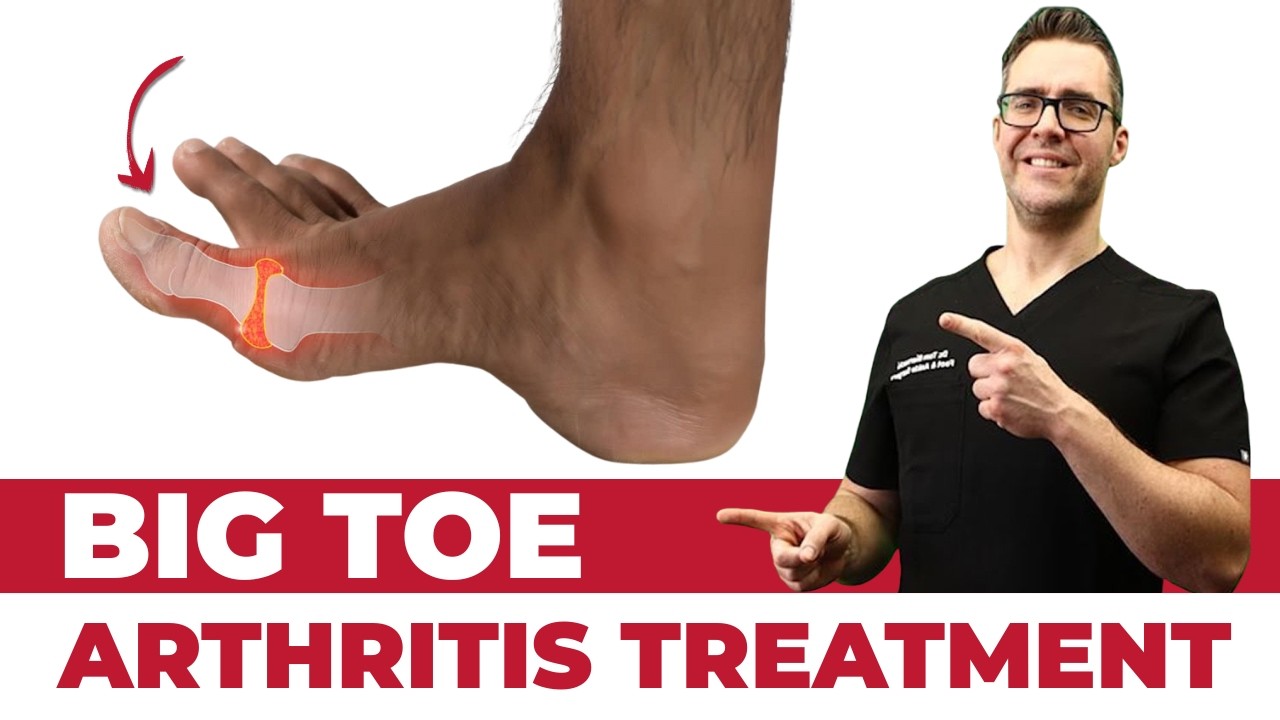
Watch: Stiff Big Toe Joint — Hallux Rigidus Treatment
Dr. Tom explains the causes of hallux rigidus, what exercises help, and when surgery is necessary:
Joint Replacement for Hallux Rigidus
Total or partial first MTP joint replacement is an option for selected Grade III patients who want to preserve some joint motion and are willing to accept lower implant longevity compared to fusion. Modern implant designs (Cartiva synthetic cartilage implant; total joint replacement systems) show promising mid-term results, but long-term data remains less reliable than for fusion. Joint replacement is most appropriate for lower-demand patients over age 60 who want motion preservation and understand the possibility of revision.
Frequently Asked Questions
Can hallux rigidus be treated without surgery?
Yes — for Grade 0–II hallux rigidus, conservative treatment is effective in the majority of patients. A stiff-soled carbon-fiber shoe insert or rocker-bottom shoe reduces MTP joint bending stress with every step. Custom orthotics with a Morton’s extension (rigid forefoot extension under the big toe) reduce dorsiflexion demand. Corticosteroid injections provide temporary relief during acute flares. Physical therapy focusing on calf stretching and intrinsic muscle strengthening is a useful adjunct.
How painful is hallux rigidus surgery recovery?
Cheilectomy recovery is relatively comfortable — most patients manage with OTC pain medication after the first 2–3 days. First MTP fusion is more involved, with moderate pain for the first 1–2 weeks that responds well to the prescribed medication protocol. Both procedures are performed as outpatient surgery; you go home the same day. The key to a comfortable recovery is strict elevation for the first 5–7 days and following the weight-bearing protocol.
Will I walk normally after first MTP fusion?
Yes — the vast majority of patients walk normally after first MTP fusion. The toe is fused in an optimized functional position (10–15° dorsiflexion, 15–20° valgus) so the push-off phase of gait is preserved. Many patients notice minimal gait difference at 6–9 months post-fusion. High heels are not possible after fusion, but athletic shoes and most casual footwear work well.
How long does hallux rigidus surgery last?
Cheilectomy provides lasting relief in approximately 70–80% of patients at 5 years; some patients require repeat cheilectomy or eventual fusion as arthritis progresses. First MTP fusion is highly durable — once fused, the joint does not develop further arthritis and the result is typically permanent. Implant-based joint replacement has a longer-term revision rate of approximately 10–20% at 10 years.
Is hallux rigidus the same as a bunion?
No. Hallux rigidus and bunions (hallux valgus) are distinct conditions. Bunions cause lateral deviation of the big toe with a prominent medial bump; hallux rigidus causes dorsal bone spur formation and restricted joint motion without lateral deviation. Both affect the first MTP joint but through different mechanisms, require different treatment, and often coexist in the same foot.
Hallux Rigidus Evaluation — Howell & Bloomfield Hills
Dr. Tom Biernacki evaluates and treats hallux rigidus at all grades — from conservative management to cheilectomy and first MTP fusion. Same-day appointments often available.
Schedule an Appointment →📞 (810) 206-1402 | Howell & Bloomfield Hills, MI
Related Resources
In-Office Treatment at Balance Foot & Ankle

If home treatment isn’t providing relief for your hallux rigidus, our podiatry team at Balance Foot & Ankle can help with same-day evaluations and advanced in-office care.
Same-day appointments available. (810) 206-1402
Doctor Hoy’s Natural Pain Relief Gel
Natural topical pain relief I use in our clinic. Arnica + camphor formula — apply directly to the area 3–4x daily. ($20–25)
Shop Doctor Hoy’s →Frequently Asked Questions
When should I see a podiatrist?
If symptoms persist past 2 weeks, affect your normal activity, or are accompanied by red-flag symptoms (warmth, redness, swelling, inability to bear weight).
What does treatment cost?
Most diagnostic visits and conservative treatments are covered by Medicare and major insurers. Out-of-pocket costs vary by your specific plan.
How quickly can I get an appointment?
Most non-urgent cases see us within 5 business days. Urgent cases (sudden pain, possible fracture) typically same or next business day.

Dr. Tom Biernacki, DPM is a board-certified foot & ankle surgeon (ABFAS & ABPM) at Balance Foot & Ankle Specialists in Southeast Michigan. With over a decade of clinical experience, he specializes in heel pain, bunions, diabetic foot care, sports injuries, and minimally invasive surgery. Dr. Biernacki is a member of the APMA and ACFAS, and his patient education content on MichiganFootDoctors.com and YouTube has made him one of the most-followed foot & ankle educators on YouTube.