
How to Tell If You Have Wide Feet (Self-Test)
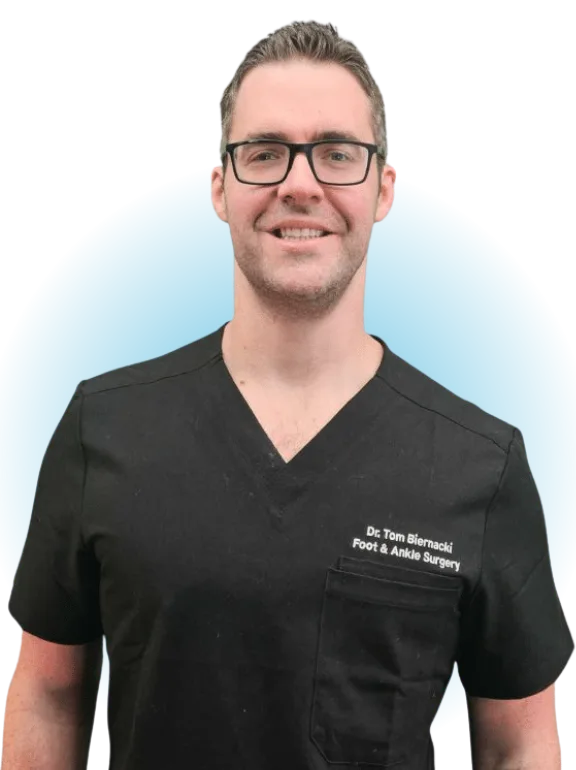
Quick answer: Dr. Tom Biernacki, DPM helps you find the right fit for wide foot test.
Why Fit Matters
Improperly fitting shoes cause bunions, hammer toes, neuromas, ingrown toenails, and chronic foot pain. Right fit is foundational.
Top Brand Recommendations
New Balance, Brooks, Hoka, ASICS, and Saucony all make multiple width options. Dr. Tom can recommend specific models.
Schedule a Fit Consult
Call (810) 206-1402.
In-Office Treatment at Balance Foot & Ankle
If home treatment
No products found.
isn’t providing relief for your foot and ankle conditions, our podiatry team at Balance Foot & Ankle can help with same-week evaluations and advanced in-office care.Same-week appointments available. (810) 206-1402
VitaMedica Arnica Gel
Arnica gel plus 15 plant compounds for sore feet, plantar fasciitis flares and post-activity soreness. Apply a thin layer to the sore area.
Shop VitaMedica Arnica Gel →
Dr. Tom Biernacki, DPM is a board-certified foot & ankle surgeon (ABFAS & ABPM) at Balance Foot & Ankle Specialists in Southeast Michigan. With over a decade of clinical experience, he specializes in heel pain, bunions, diabetic foot care, sports injuries, and minimally invasive surgery. Dr. Biernacki is a member of the APMA and ACFAS, and his patient education content on MichiganFootDoctors.com and YouTube has made him one of the most-followed foot & ankle educators on YouTube.
More questions patients ask
How do I know if I have wide feet?
The simplest test: wet your foot and step on a paper bag or brown paper. Trace around the wet footprint. Measure the widest part across the ball of the foot (the widest point of the forefoot). Compare to standard width charts: for women, if the ball-of-foot width exceeds the standard for your length by more than 1/4 inch, you have wide feet; for men, by more than 3/8 inch. Alternatively, if shoes consistently create pressure marks, redness, or blisters on the pinky toe side or ball of the foot after wearing, your shoes are likely too narrow — a reliable practical indicator of wide feet.
What width letters mean for shoe sizing?
Standard shoe width designations from narrow to wide: Men's: 2A (narrow), B (standard narrow), D (standard/medium), 2E (wide), 4E (extra wide), 6E (ultra wide); Women's: 2A (narrow), B (standard), D (wide), 2E (extra wide). Most mass-market shoes come only in standard width (D for men, B for women) and don't offer alternatives. Brands with the best width range: New Balance (offers 2A through 6E in many models), Brooks (up to 2E), ASICS (up to 2E in select models), and Hoka (limited but improving). Always measure both feet — width can differ between feet.
What foot conditions are caused by wearing shoes that are too narrow?
Wearing narrow shoes is a primary driver of multiple foot conditions: bunions (hallux valgus) — lateral force on the big toe from a narrow toe box progressively deforms the MTP joint; Morton's neuroma — nerve compression between the metatarsal heads from forefoot squeezing; hammertoes — toes buckle to fit within a tight toe box, eventually becoming fixed in the buckled position; tailor's bunion — pressure on the 5th metatarsal head; corns and calluses — chronic friction pressure on bony prominences; and black toenails — nail trauma from the toe box compressing the longest toe. Many of these conditions could be prevented with properly fitted wide-width footwear.
How should a properly fitted shoe feel on a wide foot?
A properly fitted shoe for wide feet: the ball of the foot should sit at the widest part of the shoe (not squeezed in or spilling over the sides); toes should have a thumb's width of space in front of the longest toe and should be able to splay naturally — not pressed together or curled; the heel should be snug without slipping; the arch should align with the shoe's arch support location; no pressure hotspots along the medial or lateral borders. If the shoe creates any red marks, pinching, or numbness after 10 minutes of wearing, it is too narrow. Always fit standing up and at the end of the day when feet are slightly larger.
Still have a question about coverage or cost? Book online and we will check your benefits before your visit: Book in Howell · Book in Bloomfield Township. Prefer to talk it through first? Call (810) 206-1402.