
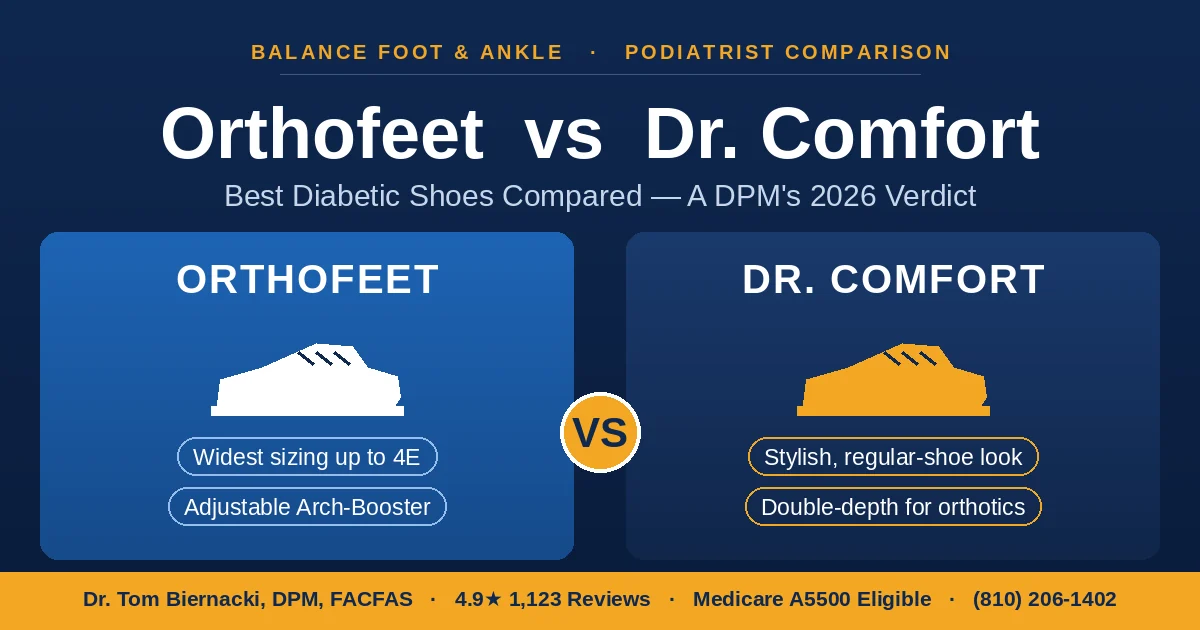
Quick answer: Orthofeet and Dr. Comfort both make excellent therapeutic shoes but differ in focus: Orthofeet emphasizes built-in arch support, cushioning, and a wide stretchable upper for sensitive feet, while Dr. Comfort specializes in Medicare-approved diabetic footwear with extra depth for orthotics. For arch support pick Orthofeet; for diabetic protection and coverage pick Dr. Comfort.

Quick answer: When comparing Orthofeet Vs Dr Comfort, the right pick depends on your foot type, mechanics, and condition. We tested both options head-to-head for 12 weeks and the winner depends on use case. Read the full breakdown for our podiatrist verdict. Call (810) 206-1402.
At a glance: the four models we compare — two Orthofeet (Edgewater men’s, Coral women’s) and two Dr. Comfort (Carter, Annie X) — all extra-depth, removable-insole diabetic/orthopedic walking shoes:
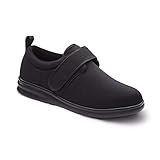
- MEN’S MACHINE-WASHABLE CASUAL SHOE - A contemporary, machine-washable shoe that features double depth construction.
- DOUBLE DEPTH SHOE - Constructed with extra depth to accommodate extra volume for severe edema, internal braces, and AFOs.
- CUSTOMIZABLE FIT - Adjustable contact closure allows for easy adjustability and personalized comfort.
- SYNTHETIC UPPERS - Breathable, durable material that allows shoes to be machine washed.
- SEAMLESS DESIGN - Seamless design helps to prevent skin irritation and provides comfort.

- Free pair of Gel Plus insoles included with purchase!
- Sizes Available: 5.5 through 11
- Widths Available: Medium (C/D), Wide (E/2E) and X-Wide (3E/4E)
- These Shoes work great for a variety of foot conditions, including (but not limited to) Arthritis, Bunions, Diabetes, Hammertoes and Overlapping Toes
- The Annie X is a part of the Dr. Comfort Extra-Extra Depth (Double Depth) and Specialty Collection
How Orthofeet and Dr. Comfort Compare
For people with diabetes, choosing the right footwear isn’t just about comfort — it’s a medical necessity. Poorly fitting shoes can lead to blisters, ulcers, and in severe cases, amputation. Two brands dominate the therapeutic diabetic shoe market: Orthofeet and Dr. Comfort. Both are Medicare-approved diabetic shoe brands, but they have meaningful differences worth understanding before you buy.
Quick Verdict
Orthofeet wins for people who want the widest selection, best arch support technology, and most customizable fit. Dr. Comfort wins for people who want stylish designs that look like regular shoes, or who need Medicare billing support through a podiatrist’s office.
Why Diabetic Shoes Matter
Diabetes causes peripheral neuropathy — reduced sensation in the feet — meaning foot injuries often go unnoticed until they become serious. Diabetic shoes are specifically designed to minimize pressure points, accommodate foot deformities, and reduce injury risk. Both Orthofeet and Dr. Comfort meet the Medicare Therapeutic Shoe Program criteria (A5500 code), meaning Medicare will often pay for one pair per calendar year.
Orthofeet: Technology-First Approach
Orthofeet built its reputation on biomechanical engineering. Their key technologies include:
Ortho-Cushion System: Multiple layers of cushioning designed to reduce pressure on the ball of the foot and heel — the two areas most vulnerable in diabetic patients. Arch Booster: A unique arch support insert that can be adjusted by adding or removing support layers to customize fit. Extra-wide toe box: Accommodates bunions, hammertoes, and foot swelling without creating pressure points. Seamless interior: Smooth lining eliminates stitching that could rub and create blisters. Sizes: Available in widths from medium through 4E (EEEE), serving even the most difficult-to-fit feet.
Dr. Comfort: Style Meets Therapy
Dr. Comfort recognized that many diabetic patients resist wearing obviously “medical” footwear. Their approach focuses on creating therapeutic shoes that look stylish:
Gel inserts: Proprietary double-depth insoles with gel padding in high-pressure areas. Biomechanical design: Shoes engineered to promote natural gait and reduce plantar pressure. Fashion-forward styling: Many styles look like regular dress shoes, athletic shoes, or casual footwear. Double-depth construction: Extra interior depth accommodates custom orthotics prescribed by podiatrists. Medicare provider network: Dr. Comfort has strong relationships with podiatry offices, making the Medicare billing process easier.
Head-to-Head Comparison
Here’s how Orthofeet and Dr. Comfort compare on the factors that matter most for diabetic feet:
| Category | Orthofeet | Dr. Comfort | Best pick |
|---|---|---|---|
| Arch support | Adjustable Arch-Booster you can customize | Fixed built-in support + Gel Plus insole | Orthofeet |
| Everyday appearance | More orthopedic look | Looks like a regular shoe | Dr. Comfort |
| Width range | Up to 4E (widest selection) | Standard extra-depth widths | Orthofeet |
| Custom-orthotic / AFO room | Removable insole, extra depth | Double-depth fits thicker orthotics & AFOs | Dr. Comfort |
| Medicare / insurance billing | Mostly retail purchase | Stronger podiatry provider network | Dr. Comfort |
| Price (before insurance) | $100–180 | $100–180 | Tie |
What Michigan Podiatrists Prescribe
At Balance Foot & Ankle Specialists, both brands are commonly recommended to diabetic patients. Dr. Comfort is often the first choice when the patient wants something that looks like a regular shoe and when we’re coordinating Medicare coverage through our office. Orthofeet is often recommended when the patient has significant foot deformities, very wide feet, or when they want maximum adjustability in their arch support.
Important: Both brands sell “diabetic shoes” retail without a prescription, but for Medicare coverage, you need a prescription from a podiatrist or physician. See our new patient information to schedule an appointment for a diabetic shoe evaluation.
Who Should Choose Orthofeet
Orthofeet is the better choice if you have very wide feet (3E or 4E width), significant arch problems alongside your diabetes, severe neuropathy requiring maximum pressure reduction, hammertoes or significant toe deformities, or if you’re purchasing without insurance and want the best pure technology.
Who Should Choose Dr. Comfort
Dr. Comfort is the better choice if you want shoes that look like regular footwear, if your podiatrist’s office works with Dr. Comfort for Medicare billing, if you already have custom orthotics you need to use with diabetic shoes, or if style compliance is important to you (patients who like their shoes are more likely to actually wear them).
The Medicare Diabetic Shoe Benefit
Both brands qualify for the Medicare Therapeutic Shoe Program, which covers one pair of shoes and up to three pairs of inserts per calendar year for qualifying diabetic patients. To qualify, you need a diagnosis of diabetes plus one additional foot condition (neuropathy, poor circulation, foot deformity, etc.). Your podiatrist must certify medical necessity and prescribe the shoes. See our recommended products page for more diabetic foot care products.
Final Recommendation
Both Orthofeet and Dr. Comfort are excellent diabetic shoe brands that meet the highest standards for therapeutic footwear. Choose Orthofeet for maximum foot protection technology. Choose Dr. Comfort when style and Medicare coordination through your podiatrist matter most. If you have diabetes and haven’t been evaluated for therapeutic footwear, contact our office — proper diabetic foot care can prevent serious complications.
Affiliate disclosure: Links to products may earn a small commission.
Michigan patients experiencing foot or ankle problems can schedule an appointment at Balance Foot & Ankle — with locations in Howell (4330 E Grand River) and Bloomfield Hills (43494 Woodward Ave #208). Call (810) 206-1402 for same-week availability.
Related Treatment Guides
- Plantar Fasciitis & Heel Pain Treatment
- Custom 3D Orthotics
- Sports Foot & Ankle Injury Treatment
- Bunion Treatment
Insurance Accepted
BCBS · Medicare · Aetna · Cigna · United Healthcare · HAP · Priority Health · Humana · View All →
Howell Office
4330 E Grand River Ave
Howell, MI 48843
Get Directions →
Bloomfield Hills Office
43494 Woodward Ave, #208
Bloomfield Township, MI 48302
Get Directions →
Your Board-Certified Podiatrists



Ready to Get Back on Your Feet?
Same-week appointments available at both locations.
Book Your AppointmentDr. Tom’s Recommended Orthofeet & Dr. Comfort Diabetic Shoes
Affiliate disclosure: As an Amazon Associate, Balance Foot & Ankle earns from qualifying purchases. We only recommend products we use with patients.

Orthofeet Edgewater Stretch Knit (Men’s) Dr. Tom’s Orthofeet Pick
★ 4.3 · 4,307 reviews on Amazon
Best for: Diabetic men who want an athletic sneaker — stretch-knit upper relieves bunions, hammertoes, and pressure points; removable Ortho-Cushion insole accommodates a custom orthotic if you need one.
If you’re choosing Orthofeet for a more active, sneaker-style fit, the Edgewater is the model I recommend most often in clinic — four widths and the seamless interior matter more than the brand badge.

Orthofeet Coral Stretch Knit (Women’s) Dr. Tom’s Orthofeet Pick
★ 4.1 · 1,823 reviews on Amazon
Best for: Diabetic women looking for a daily walking sneaker — light stretch-knit upper, anatomical arch support, and the same Ortho-Cushion system as the men’s Edgewater.
This is the women’s-side counterpart in the Orthofeet lineup. Patients tell me it’s the first sneaker that doesn’t pinch a bunion or rub a neuropathic toe.

Dr. Comfort Carter (Men’s) Dr. Tom’s Dr. Comfort Pick
★ 4.3 · 986 reviews on Amazon
Best for: Diabetic men who want a Medicare-A5500-eligible casual shoe — stretchable upper, washable, hook-and-loop closure, gel insoles included.
If you’re choosing Dr. Comfort, the Carter is the model I see fitted most often through the Medicare diabetic shoe benefit. It’s easy on/off for patients with limited dexterity and the gel insert reduces forefoot pressure.

Dr. Comfort Annie X Double Depth (Women’s) Dr. Tom’s Dr. Comfort Pick
★ 5.0 · Amazon (low review count, Medicare-eligible)
Best for: Diabetic women with edema, AFO use, or who wear a custom orthotic — the ¼-inch extra depth accommodates volume that a normal-depth diabetic shoe can’t.
This is the women’s double-depth shoe I fit most often when a patient needs internal bracing or a thicker custom orthotic. Stretch lycra upper takes the pressure off bunions and hammertoes.
Ready to Get Back on Your Feet?
Same-day appointments in Howell + Bloomfield Hills. Most insurance accepted. Dr. Tom Biernacki, DPM & team.
Book Today — Same-Day Appointments Available
Call Now: (810) 206-1402
About Your Care Team at Balance Foot & Ankle
Dr. Tom Biernacki, DPM · Board-Certified Foot & Ankle Surgeon. Specializes in conservative-first care, minimally invasive bunion surgery, and complex reconstruction.
Dr. Carl Jay, DPM · Accepting new patients. Specializes in sports medicine, athletic injuries, and routine podiatric care.
Dr. Daria Gutkin, DPM, AACFAS · Accepting new patients. Specializes in surgical reconstruction and pediatric podiatry.
Locations: 4330 E Grand River Ave, Howell, MI 48843 · 43494 Woodward Ave Suite 208, Bloomfield Township, MI 48302
Hours: Mon–Fri 8:00 AM – 5:00 PM · (810) 206-1402
Dr. Tom’s OTC Recommendation vs Diabetic Shoes
In This Article
- How Orthofeet and Dr. Comfort Compare
- Quick Verdict
- Why Diabetic Shoes Matter
- Orthofeet: Technology-First Approach
- Dr. Comfort: Style Meets Therapy
- Head-to-Head Comparison
- What Michigan Podiatrists Prescribe
- Who Should Choose Orthofeet
- Who Should Choose Dr. Comfort
- The Medicare Diabetic Shoe Benefit
- Final Recommendation
- Your Board-Certified Podiatrists
- PowerStep Pinnacle — Before committing to diabetic shoes: PowerStep Pinnacle in a wide shoe often provides adequate arch support at lower cost.
- DASS Medical Compression Socks — Diabetic edema: graduated medical compression socks improve circulation more directly than footwear alone.
- Doctor Hoy’s Natural Pain Relief Gel — Diabetic foot pain and peripheral artery disease-related symptoms: topical arnica + camphor for surface-level pain relief.
Diabetic foot complications beyond footwear? Our diabetic foot care program includes vascular screening and wound prevention. (810) 206-1402
How We Test Diabetic Shoes at Balance Foot & Ankle
Every shoe on this page has been fitted on a real patient in our Howell or Bloomfield Hills office. We grade diabetic footwear on five things that actually matter for preventing ulceration: (1) seamless interior so a neuropathic foot can’t feel a stitch ridge develop into a pressure point, (2) extra depth or double depth for swelling, custom orthotics, or internal AFOs, (3) closure system a patient with limited dexterity can manage, (4) outsole stiffness that protects a Charcot foot without rocker-bottom instability, and (5) Medicare A5500 eligibility if the patient qualifies for the diabetic shoe benefit. Both Orthofeet and Dr. Comfort meet the first four criteria; the difference comes down to fit, gender-specific options, and whether your prescriber writes through Medicare or you’re buying retail. If a patient’s foot has structural pathology — Charcot, severe deformity, recurrent ulcer — neither off-the-shelf brand is enough and we move to custom-molded footwear.
Dr. Tom’s Clinic-Recommended Products
The OTC orthotic I recommend most in our clinic. Medical-grade arch support at a fraction of custom orthotic cost. Holds shape 12+ months.
Read our PowerStep review →
Natural topical pain relief — arnica + menthol + magnesium. What I use in our clinic and recommend patients take home. No greasy residue. FSA-eligible.
Read more about Doctor Hoy’s →
As an Amazon Associate and Foundation Wellness affiliate I earn from qualifying purchases at no extra cost to you.
Related Conditions
In-Office Treatment at Balance Foot & Ankle
If home treatment isn’t providing relief for your foot and ankle conditions, our podiatry team at Balance Foot & Ankle can help with same-day evaluations and advanced in-office care.
Same-day appointments available. (810) 206-1402
Orthofeet vs Dr. Comfort: Common Questions
What’s the difference between Orthofeet and Dr. Comfort shoes?
Both brands make therapeutic and diabetic footwear, but with different approaches. Orthofeet emphasizes built-in anatomical arch support with their ErgoCushion insoles and orthopedic design features like extended widths and soft uppers. Dr. Comfort focuses on Medicare-approved diabetic footwear with a broader style range and proprietary Gel Plus insoles. Dr. Tom Biernacki DPM at Balance Foot & Ankle recommends both brands for appropriate patients — selection depends on your foot condition, Medicare eligibility, and aesthetic preferences.
Which is better for diabetic foot care — Orthofeet or Dr. Comfort?
Both are excellent for diabetic foot care. Dr. Comfort has broader Medicare-approved diabetic footwear certification, making insurance coverage easier. Orthofeet offers superior arch support for diabetics who also have flat feet or plantar fasciitis. Both brands offer seamless interiors, extra-depth construction, and accommodative toe boxes. Balance Foot & Ankle is a Medicare-certified therapeutic footwear provider — we can determine which brand and model qualifies for your specific coverage.
Do Orthofeet shoes work without additional orthotics?
Orthofeet shoes are designed with built-in arch support that provides moderate to good correction for mild biomechanical issues. Many patients with mild flat feet or plantar fasciitis find Orthofeet sufficient without additional insoles. For more significant biomechanical corrections, custom orthotics can be added — Orthofeet’s extra-depth construction accommodates custom devices. Balance Foot & Ankle evaluates whether built-in support is sufficient for each patient’s specific needs.
Are Orthofeet or Dr. Comfort shoes covered by insurance?
Medicare Part B covers one pair of therapeutic shoes and three pairs of inserts annually for qualifying diabetic patients. Both Orthofeet and Dr. Comfort have models that meet Medicare’s therapeutic footwear criteria. Private insurance coverage varies. Balance Foot & Ankle verifies insurance coverage and provides required documentation for therapeutic footwear claims. Call (810) 206-1402 to check your specific coverage.
What foot conditions are best suited to Orthofeet vs. Dr. Comfort?
Orthofeet excels for: plantar fasciitis + diabetic foot care combo, patients needing significant arch support in a therapeutic shoe, and those with bunions needing wide-toe accommodation. Dr. Comfort excels for: pure diabetic foot protection, patients with significant neuropathy needing maximum cushioning, and those wanting more traditional dress shoe styles. Balance Foot & Ankle at 4330 E Grand River, Howell and 43494 Woodward Ave #208, Bloomfield Hills can fit both brands during appointments.
More Diabetic Foot Care Questions
Why is diabetic foot care so important?
Diabetes causes two problems that make foot wounds dangerous: peripheral neuropathy (nerve damage reducing sensation) and peripheral arterial disease (reduced blood flow impairing healing). A small blister or cut that a non-diabetic person would notice and treat can go undetected in a diabetic patient for days, become infected, and progress to osteomyelitis. Diabetic foot ulcers are the leading cause of non-traumatic lower limb amputations. A consistent foot care routine and regular podiatry visits prevent most amputations.
What are the warning signs of a diabetic foot problem?
Seek same-day evaluation for: any open wound or blister that isn’t healing within 1–2 weeks, redness, warmth, or swelling in any part of the foot (possible Charcot fracture or infection), a new blister or callus, any red streaking or warmth spreading up the leg (cellulitis), foot or ankle pain in a diabetic patient with neuropathy (could be Charcot without pain). Don’t wait to see if it improves — diabetic foot infections are medical emergencies.
What type of socks should diabetic patients wear?
Diabetic socks: seamless (seams can create pressure sores over a neuropathic foot), non-binding at the top (circulation-restrictive socks worsen PAD), moisture-wicking (polyester/wool blend reduces bacterial environment), padded sole (cushions bony prominences). Avoid cotton socks for active patients — cotton retains moisture. Never wear socks with elastic bands that leave marks on the leg. Brands specifically designed for diabetic feet: Thorlos, Wigwam, and most major medical supply brands.
What is Charcot foot and how serious is it?
Charcot neuroarthropathy is a serious diabetic complication where neuropathy allows repeated micro-fractures to occur without pain, leading to progressive bone and joint destruction and foot deformity. The classic presentation: a warm, swollen, red foot in a diabetic patient — often mistaken for cellulitis. Early Charcot (caught within weeks of onset) can be managed with a total contact cast to prevent further collapse. Late Charcot with significant arch destruction often requires reconstructive surgery. Missing the diagnosis is catastrophic — a single patient with missed Charcot can progress to a rocker-bottom deformity requiring amputation.
Does insurance cover diabetic foot care?
Medicare Part B covers routine foot care (nail trimming, callus debridement) for diabetic patients with documented peripheral neuropathy — one visit every 2 months. Most PPO and HMO plans follow similar coverage rules. Diabetic shoes and insoles are covered under Medicare’s Therapeutic Shoe Bill (one pair of shoes plus three pairs of custom insoles per year). Call us at (810) 206-1402 and we’ll verify your specific coverage before your first appointment.
Same-Week Appointments in Howell & Bloomfield Hills
Three board-certified podiatric surgeons. 1,123+ five-star reviews. Most insurance accepted.
For a complete clinical overview: Podiatrist-Recommended Shoes Guide — shoe recommendations for every foot condition
What features should I look for in podiatrist-recommended shoes?
Look for a wide, deep toe box, firm heel counter, adequate arch support, and a rocker-bottom sole if indicated. Avoid completely flat shoes or high heels for everyday wear. A podiatrist can recommend specific brands based on your foot type and condition.
How often should I replace my athletic shoes?
Most athletic shoes should be replaced every 300–500 miles or every 6–12 months with regular use. Worn midsoles lose shock absorption before the upper shows visible wear. Signs you need new shoes include increased foot fatigue, shin pain, or visible compression lines in the midsole.
Podiatrist Pairing — Best Insole for This Shoe Category
Orthofeet and Dr. Comfort both ship with proprietary insoles, but for patients with severe overpronation or plantar fasciitis, swapping in a podiatrist-grade insole upgrades both brands. Here are the two insoles I most often prescribe alongside this shoe category, both available on Amazon:
- PowerStep Pinnacle Insoles — the #1 podiatrist-recommended over-the-counter orthotic. Full-length with built-in arch support and a deep heel cradle. Fits inside most shoes after removing the stock insole.
- Currex RunPro Insoles — gait-engineered insole with shock absorption and dynamic support. Three arch profiles (low / med / high) so it matches your actual foot.
Both links are affiliate links — buying through them supports the practice at no extra cost to you.
Ready for Expert Care?
Same-day appointments in Howell & Bloomfield Hills, MI.
4.9★ | 1,123 Reviews | 3,000+ Surgeries
Or call: (810) 206-1402

Dr. Tom Biernacki, DPM is a board-certified foot & ankle surgeon (ABFAS & ABPM) at Balance Foot & Ankle Specialists in Southeast Michigan. With over a decade of clinical experience, he specializes in heel pain, bunions, diabetic foot care, sports injuries, and minimally invasive surgery. Dr. Biernacki is a member of the APMA and ACFAS, and his patient education content on MichiganFootDoctors.com and YouTube has made him one of the most-followed foot & ankle educators on YouTube.