

You are in the right place. Dr. Tom Biernacki, DPM, FACFAS — board-certified foot & ankle surgeon with 3,000+ surgeries — explains exactly what Brooks Beast vs Adrenaline means and what actually works. Call (810) 206-1402 for a same-day appointment at our Howell or Bloomfield Township office.
The most important clinical decision with Brooks Beast Vs Adrenaline isn’t which treatment to start with — it’s identifying the correct subtype. That changes everything. Call (810) 206-1402.
Dr. Tom’s Top 10 Shoes (2026)
Tested, recommended, and prescribed to my patients. Each pick includes pros, cons, and the specific use case I prescribe it for.
Affiliate disclosure: As an Amazon Associate, Balance Foot & Ankle earns from qualifying purchases.
Need a personalized recommendation? Schedule a fitting at our Howell or Bloomfield Township office. Call (810) 206-1402.
Brooks Beast vs Brooks Adrenaline GTS: Heavy-Duty Stability Compared
Brooks Beast vs Brooks Adrenaline: Heavy-Duty Stability Compared
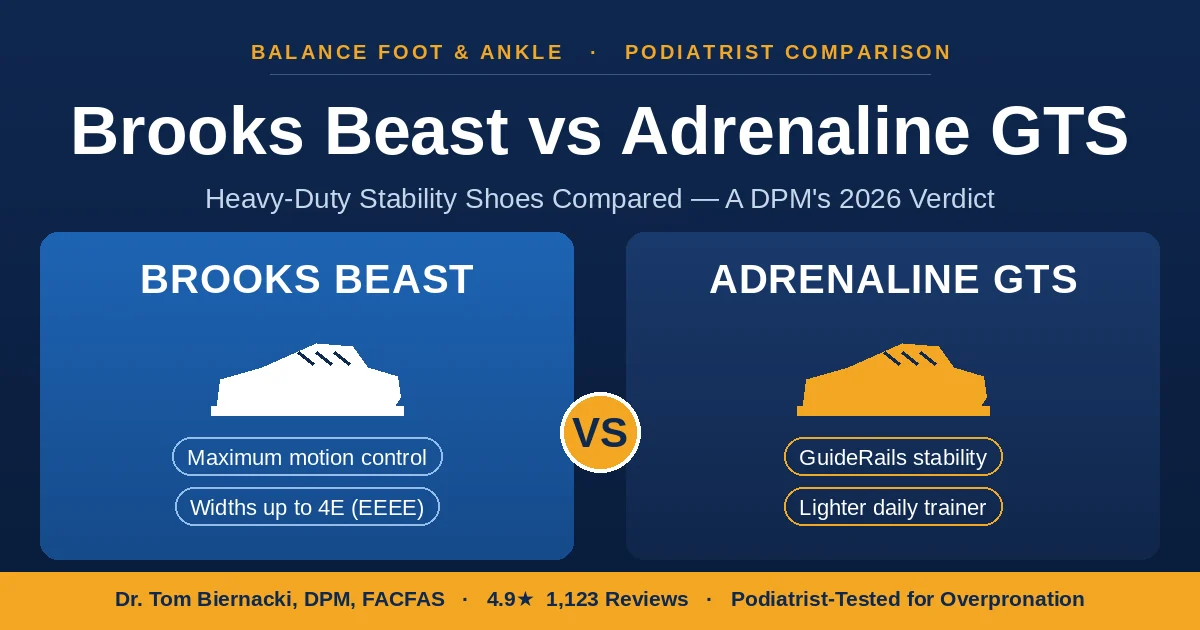
Brooks makes two of the most medically recommended stability running shoes on the market: the Beast (and its women’s version, the Ariel) and the Adrenaline GTS. Both are podiatrist favorites for overpronators, but they serve different levels of need. This comparison will help you choose the right one for your feet.
Quick Verdict
The Brooks Beast is the heavier, more controlling shoe for severe overpronators and people with very flat feet. The Brooks Adrenaline GTS is the lighter, more versatile stability shoe for mild-to-moderate overpronation and everyday use. Most people with overpronation do better in the Adrenaline; the Beast is reserved for the most severe cases.
Understanding Overpronation
Pronation is the natural inward roll of the foot during walking and running. Overpronation — excessive inward roll — puts stress on the ankles, knees, hips, and lower back. It’s associated with flat feet, plantar fasciitis, bunions, and shin splints. Stability shoes like the Beast and Adrenaline use denser foam on the medial (inner) side of the midsole to counteract this roll.
Brooks Beast: Maximum Motion Control
The Beast is one of the last true motion control shoes on the market. Key features:
Extended Progressive Diagonal Rollbar (PDRB): The most aggressive anti-pronation post in any Brooks shoe. BioMoGo DNA midsole: Adaptive cushioning that responds to your weight and gait. Substantial heel counter: Rigid structure that prevents heel from rolling inward. Wide base: Extra-wide platform provides stability for heavy and flat-footed runners. Weight: 12.3 oz (men’s) — among the heaviest running shoes available. Drop: 12mm heel-to-toe drop promotes a heel-strike gait.
The Beast is recommended for: runners over 200 lbs with severe overpronation, people with very flat feet (minimal arch), those who have exhausted lighter stability options, and walkers who need maximum control.
Brooks Adrenaline GTS: Versatile Stability
The Adrenaline GTS (Go-To Shoe) is one of the most popular running shoes of all time for good reason. Key features:
GuideRails support system: Replaced the traditional medial post with holistic support that guides the entire kinetic chain. DNA LOFT v2 midsole: Softer, more responsive cushioning than the Beast. Segmented crash pad: Accommodates any foot strike pattern. Weight: 10.0 oz (men’s) — significantly lighter than the Beast. Drop: 12mm heel-to-toe drop. Wide toe box: Available in widths from 2A to 4E.
The Adrenaline GTS is recommended for: mild-to-moderate overpronators, runners and walkers who want stability without heavy motion control, people who want a shoe that transitions well from running to daily wear, and most people with flat feet who haven’t tried stability shoes before.
Head-to-Head Comparison
Motion Control Level: Beast wins for severe overpronation. Adrenaline is sufficient for most people. Cushioning: Adrenaline wins with softer DNA LOFT foam. Beast has firmer, more supportive cushioning. Weight: Adrenaline wins by over 2 oz — meaningful over miles and hours. Versatility: Adrenaline wins — handles running, walking, and casual wear. Beast is primarily a walking/heavy running shoe. Comfort out of box: Adrenaline wins — breaks in faster and feels immediately comfortable. Durability: Beast wins — the heavier construction lasts longer.
What Podiatrists Recommend
At Balance Foot & Ankle Specialists, we see a lot of overpronators. Our general guidance:
Start with the Adrenaline GTS. The vast majority of overpronators do excellently in it, and it’s lighter and more comfortable for daily wear. Move up to the Beast only if: you’re over 220 lbs with severe flat feet, the Adrenaline isn’t providing enough control, or your podiatrist specifically recommends a motion control shoe after a gait analysis.
For both shoes, consider pairing with custom or semi-custom orthotics for enhanced arch support. See our recommended products page for orthotic options that work well with Brooks stability shoes.
Common Foot Conditions and Which Shoe Helps
Plantar fasciitis: Both help, but Adrenaline’s softer cushioning is often more comfortable initially. Bunions: Adrenaline’s more flexible upper is typically better. Beast’s rigid structure can irritate bunions. Flat feet: Mild-moderate flat feet: Adrenaline. Severe flat feet (fallen arches): Beast. Posterior tibial tendonitis: Beast’s maximum motion control is preferred for this condition. Shin splints from overpronation: Either shoe helps; try Adrenaline first.
Price Comparison
Both shoes are similarly priced. The Brooks Beast typically runs $140-160. The Brooks Adrenaline GTS runs $130-140. Given the Beast’s longer lifespan, cost per mile is often comparable.
Final Recommendation
The Brooks Adrenaline GTS is the right choice for most people with overpronation — it’s lighter, more comfortable, and handles mild-to-moderate cases perfectly. The Brooks Beast is the right choice for severe overpronators, heavy runners, and people with flat feet who haven’t found relief with lighter stability options. When in doubt, get a proper gait analysis. See our comparison of Brooks Ghost vs GTS if you’re not sure whether you need stability at all. If foot pain persists despite proper footwear, schedule an appointment with our podiatry team.
Affiliate disclosure: Links to products may earn a small commission.
Michigan patients experiencing foot or ankle problems can schedule an appointment at Balance Foot & Ankle — with locations in Howell (4330 E Grand River) and Bloomfield Township (43494 Woodward Ave #208). Call (810) 206-1402 for same-week availability.
Related Treatment Guides
- Sports Foot & Ankle Injury Treatment
- Custom Orthotics for Flat Feet
- Plantar Fasciitis & Heel Pain Treatment
- Bunion Treatment
Medical References & Sources
- American Podiatric Medical Association — Patient Education
- American Orthopaedic Foot & Ankle Society — Foot Conditions
📋 Dr. Tom Also Recommends
Podiatrist Recommended Orthotics 2026: Dr. Tom’s Top 10 Insoles & Arch Supports
A podiatrist’s complete clinical guide to the best insoles — custom orthotics, OTC picks, and what actually works for plantar fasciitis, flat feet, neuropathy & more.
Read the Full Guide →Dr. Tom’s Recommended Insoles
📍 Located in Michigan?
Our board-certified podiatrists treat this condition at two convenient locations. Same-day appointments often available.
PowerStep is the brand I prescribe most — medical-grade OTC support without the custom orthotic price tag.
- PowerStep Pinnacle Insoles — The OTC orthotic I recommend most — medical-grade arch support at a fraction of custom orthotic cost. Works in most shoes.
- PowerStep Maxx Insoles — For severe arch pain or flat feet — maximum correction and support when Pinnacle isn’t enough.
📧 Get Dr. Tom’s Free Lab Test Guide
Discover the 5 lab tests every person over 35 should ask their doctor about — explained in plain English by a board-certified physician.
Affiliate disclosure: As an Amazon Associate, Balance Foot & Ankle earns from qualifying purchases. We only recommend products we trust for our own patients.
Join 950,000+ Learning About Foot Health
Dr. Tom shares honest medical advice, supplement reviews, and treatment guides you won’t find anywhere else.
Subscribe on YouTube →Need the Right Stability Shoe?
Choosing between stability and motion control shoes depends on your pronation pattern. Our podiatrists perform gait analysis to match you with the ideal shoe.
Clinical References
- Cheung RT, Ng GY. “Motion control shoes for reducing excessive rearfoot motion.” Physical Therapy in Sport. 2007;8(2):75-81.
- Richards CE, et al. “Is your running shoe prescription evidence-based?” BJSM. 2009;43(3):159-162.
- Nigg BM, et al. “Running shoes and running injuries.” BJSM. 2015;49(20):1290-1294.
Insurance Accepted
BCBS · Medicare · Aetna · Cigna · United Healthcare · HAP · Priority Health · Humana · View All →
Howell Office
4330 E Grand River Ave
Howell, MI 48843
Get Directions →
Bloomfield Township Office
43494 Woodward Ave, #208
Bloomfield Township, MI 48302
Get Directions →
Your Board-Certified Podiatrists



Ready to Get Back on Your Feet?
Same-week appointments available at both locations.
Book Your Appointment👟 Dr. Tom’s Complete Footwear Library
Podiatrist-Approved Guides for Every Foot Type & Condition
Clinically reviewed by Dr. Tom Biernacki, DPM — Board-Certified Podiatrist
All guides are written and reviewed by licensed podiatrists. Schedule an appointment →
Pros & Cons of Conservative Care for footwear
Advantages
- ✓ Right shoe = pain reduction
- ✓ Multiple price points
- ✓ Fast adjustment
Considerations
- ✗ Trial-and-error
- ✗ Replace every 400 miles
- ✗ Custom orthotics often needed
In This Article
- Dr. Tom’s Top 10 Shoes (2026)
- Brooks Beast vs Brooks Adrenaline: Heavy-Duty Stability Compared
- Quick Verdict
- Understanding Overpronation
- Brooks Beast: Maximum Motion Control
- Brooks Adrenaline GTS: Versatile Stability
- Head-to-Head Comparison
- What Podiatrists Recommend
- Common Foot Conditions and Which Shoe Helps
- Price Comparison
- Final Recommendation
- Your Board-Certified Podiatrists
Dr. Tom’s Recommended Products for footwear
Affiliate disclosure: As an Amazon Associate, Balance Foot & Ankle earns from qualifying purchases. We only recommend products we use with patients.
Brooks Ghost 17 Dr. Tom’s Pick
Best for: Neutral runner
Check Price on Amazon
Brooks Adrenaline GTS 23 Dr. Tom’s Pick
Best for: Stability for flat feet
Check Price on Amazon
Altra Torin 8 Dr. Tom’s Pick
Best for: Zero-drop wide toe box
Check Price on Amazon
Ready to Get Back on Your Feet?
Same-day appointments in Howell + Bloomfield Township. Most insurance accepted. Dr. Tom Biernacki, DPM & team.
Book Today — Same-Day Appointments Available
Call Now: (810) 206-1402
About Your Care Team at Balance Foot & Ankle
Dr. Tom Biernacki, DPM · Board-Certified Foot & Ankle Surgeon. Specializes in conservative-first care, minimally invasive bunion surgery, and complex reconstruction.
Dr. Carl Jay, DPM · Accepting new patients. Specializes in sports medicine, athletic injuries, and routine podiatric care.
Dr. Daria Gutkin, DPM, AACFAS · Accepting new patients. Specializes in surgical reconstruction and pediatric podiatry.
Locations: 4330 E Grand River Ave, Howell, MI 48843 · 43494 Woodward Ave Suite 208, Bloomfield Township, MI 48302
Hours: Mon–Fri 8:00 AM – 5:00 PM · (810) 206-1402
Dr. Tom’s OTC Support Stack for Maximum Motion Control
- PowerStep Maxx — Brooks Beast provides motion control; PowerStep Maxx inside adds additional medial arch correction for severe overpronators who need more than Beast alone.
- Doctor Hoy’s Natural Pain Relief Gel — Post-run medial knee, ankle, or tibialis posterior soreness from overpronation: arnica gel applied after activity.
- DASS Medical Compression Socks — Severe overpronation with lower leg swelling: graduated compression socks reduce the venous pooling that worsens with flat foot mechanics.
Severe flat feet still causing pain despite maximum motion control shoes? Custom 3D orthotics at Balance Foot & Ankle → (810) 206-1402
The same two shoes are set against each other on their published numbers at our measurement site: Brooks Beast GTS 26 vs Adrenaline GTS 24 — stack heights, heel-to-toe drop and weight in one table, with an independent laboratory’s figures beside them where a lab has published any.
Related Conditions
Visit Balance Foot & Ankle — Same-Day Appointments Available
Our podiatry team serves patients throughout Michigan including Howell, Brighton, and Bloomfield Township. If you’re dealing with heel pain, ingrown toenails, or a foot injury, we have same-day appointment availability.
Same-day appointments available. (810) 206-1402
Related Care at Balance Foot & Ankle
Clinical foot and ankle services at our Howell and Bloomfield Township offices.
Get Expert Care at Balance Foot & Ankle
Same-week appointments at our Howell and Bloomfield Township offices. Board-certified podiatric surgeons. Most insurance accepted.
Same-Week Appointments in Howell & Bloomfield Township
Three board-certified podiatric surgeons. 1,123+ five-star reviews. Most insurance accepted.
Ready for Expert Care?
Same-day appointments in Howell & Bloomfield Township, MI.
4.9★ | 1,123 Reviews | 3,000+ Surgeries
Or call: (810) 206-1402

Dr. Tom Biernacki, DPM is a board-certified foot & ankle surgeon (ABFAS & ABPM) at Balance Foot & Ankle Specialists in Southeast Michigan. With over a decade of clinical experience, he specializes in heel pain, bunions, diabetic foot care, sports injuries, and minimally invasive surgery. Dr. Biernacki is a member of the APMA and ACFAS, and his patient education content on MichiganFootDoctors.com and YouTube has made him one of the most-followed foot & ankle educators on YouTube.
More questions patients ask
What's the difference between Brooks Beast and Brooks Adrenaline GTS?
The Brooks Beast is Brooks' maximum motion-control shoe — designed for severe overpronators and flat feet. It has an extended Progressive Diagonal Rollbar (PDRB) providing firm medial support, a wider base, and extra-firm midsole. The Adrenaline GTS is Brooks' stability shoe — built for moderate overpronation with GuideRails technology that corrects only excess movement. Dr. Tom Biernacki DPM at Balance Foot & Ankle recommends Beast for severe flat feet and Adrenaline for mild-moderate overpronation.
Who should wear Brooks Beast vs. Adrenaline GTS?
Brooks Beast is for: severe overpronators, patients with rigid flatfoot, heavy individuals (200+ lbs) needing maximum structure, and those whose Adrenaline hasn't provided enough correction. Brooks Adrenaline is for: mild-to-moderate overpronators, most daily runners needing stability, and those transitioning from neutral shoes to stability. Balance Foot & Ankle performs digital gait analysis to determine which model is appropriate for your specific biomechanics.
Is the Brooks Beast too stiff for everyday walking?
The Beast can feel stiff initially but most patients adapt within 2–3 weeks. For severe overpronators, the firmness is appropriate and reduces pain — what feels 'stiff' is actually proper motion control. If the Beast feels uncomfortably stiff after a full break-in period, the Adrenaline may be more appropriate. Balance Foot & Ankle evaluates whether your pronation severity warrants the Beast's level of control.
Can the Brooks Adrenaline GTS accommodate custom orthotics?
Yes — both Adrenaline and Beast have removable footbeds accommodating custom orthotics. The Adrenaline's moderate volume suits most custom orthotics well. The Beast's wider platform is particularly accommodating for bulkier custom devices. Balance Foot & Ankle fabricates custom orthotics and can test fit them in both shoe models during fitting appointments to ensure optimal function.
How often should I replace Brooks Beast or Adrenaline shoes?
Both models should be replaced every 300–500 miles or approximately 6–12 months for daily walkers/runners. The firm medial posts in motion-control shoes can degrade before outsole wear is obvious — if your foot pain returns, the shoe may have lost its corrective properties even if it looks fine. Balance Foot & Ankle can assess midsole compression during footwear evaluation appointments at our Howell and Bloomfield Township offices.
Still have a question about coverage or cost? Book online and we will check your benefits before your visit: Book in Howell · Book in Bloomfield Township. Prefer to talk it through first? Call (810) 206-1402.